
Popliteus Tendinopathy


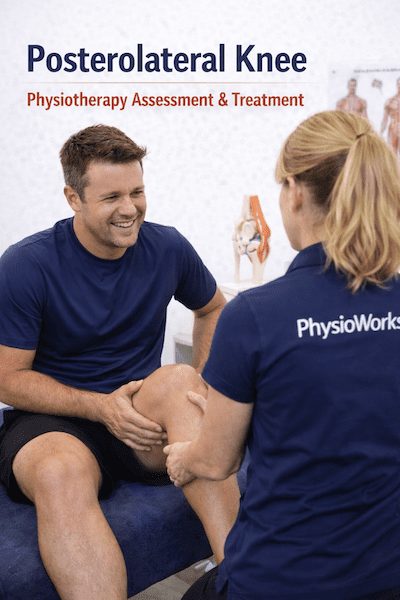
Posterolateral knee assessment for possible popliteus tendon pain.
Managing Popliteus Tendinopathy
Popliteus tendinopathy is an overload-related condition affecting the popliteus tendon at the back and outer side of the knee. Symptoms may become noticeable during running, downhill walking, changing direction or twisting on a planted foot.
A structured knee pain assessment can help determine whether the popliteus tendon is the likely source of pain. Your physiotherapist will also consider other causes of posterior knee pain and use broader tendinopathy management principles where appropriate.
Quick Answer: What Is Popliteus Tendinopathy?
Popliteus tendinopathy affects the tendon of the small popliteus muscle at the posterolateral knee. The muscle helps control rotation between the thigh and shin and assists the knee as it begins to bend from a straight position. Repeated or rapidly increased loading can exceed the tendon’s current capacity and cause pain.
Where Do You Feel Popliteus Pain?
People commonly describe an ache or sharp pain at the outer-back corner of the knee. Symptoms may increase during:
- downhill running or walking
- deceleration and sudden stopping
- turning on a planted leg
- cutting or changing direction
- walking on uneven ground
- repeated knee bending under load
Some people feel pain early during activity. Others notice that symptoms increase as fatigue affects lower-limb control.
What Causes Popliteus Tendinopathy?
Popliteus tendon pain usually develops after repetitive loading or a sudden increase in training demands. Common contributing factors may include:
- increased running distance, speed or frequency
- more downhill running or hill training
- repeated cutting and direction-change activities
- previous knee injury or reduced knee confidence
- reduced hip, calf or lower-limb strength
- fatigue-related changes in movement control
- changes in training surface, footwear or technique
Assessment may include a review of your lower-limb movement, training history and biomechanics. Your physiotherapist may also recommend practical load-management strategies that allow you to remain active without repeatedly aggravating the tendon.
What Are the Symptoms?
- pain at the back or outer side of the knee
- local tenderness near the posterolateral knee
- pain during knee rotation or direction changes
- discomfort during downhill walking or running
- reduced confidence during single-leg activities
- mild local swelling in some cases
- clicking or catching, although these symptoms are not specific to the popliteus
Could the Pain Come From Another Structure?
Several structures can cause pain near the back and outer side of the knee. Your physiotherapist may assess for:
- lateral meniscus injury
- lateral collateral ligament injury
- posterolateral corner injury
- biceps femoris tendon pain
- superior tibiofibular joint pain
- Baker’s cyst
- referred pain from the lower back or nearby nerves
This distinction matters because different conditions require different loading, exercise and activity-management strategies.
How Is Popliteus Tendinopathy Diagnosed?
Diagnosis usually begins with a clinical assessment. Your physiotherapist will ask about your symptoms, training changes and aggravating activities. They may then assess:
- the exact location of tenderness
- knee range of movement
- rotational control of the knee and shin
- single-leg strength and balance
- walking, running or direction-change technique
- signs suggesting another knee structure is involved
Ultrasound or MRI may be helpful when the diagnosis remains unclear, symptoms persist or another injury is suspected. Imaging findings should be considered alongside your symptoms, function and clinical examination.
Physiotherapy for Popliteus Tendinopathy
1. Settle Irritating Loads
Early management commonly involves reducing the activities that cause a marked symptom increase. This may mean temporarily adjusting hills, running speed, cutting drills or training volume rather than stopping all exercise.
2. Restore Strength and Load Tolerance
Exercise rehabilitation aims to improve the tendon’s ability to tolerate load. Your program may include calf strengthening, hip strengthening, controlled knee rotation and progressive single-leg exercises. Relevant knee-strengthening exercises may help distribute load more effectively through the lower limb.
3. Improve Movement Control
Your physiotherapist may use movement coaching, taping or hands-on treatment where appropriate. However, progressive exercise and sensible training changes usually form the main part of longer-term rehabilitation.
4. Return to Running and Sport
Your return plan should progress from predictable, straight-line activities to higher-load tasks. Hills, acceleration, deceleration and direction-change drills can then be reintroduced as strength, control and symptom tolerance improve.
What Can You Do This Week?
- Reduce downhill running and sharp direction changes first.
- Keep moving within a comfortable symptom range.
- Track how your knee responds during the following 24 hours.
- Avoid repeatedly testing the painful movement.
- Maintain pain-free strength and cardiovascular exercise where possible.
- Prioritise sleep and recovery during heavy training periods.
Can You Run With Popliteus Tendinopathy?
You may be able to continue some running if symptoms remain mild, your technique does not change significantly and discomfort settles to its usual level by the next day. Reduce hills, pace, distance or frequency first.
Stop running and arrange an assessment when pain progressively increases, causes limping, produces instability or does not settle after reducing the load.
How Long Does Recovery Take?
Recovery varies according to symptom severity, training demands, how long the condition has been present and whether another knee structure is involved. A mild recent flare may improve over several weeks. More persistent tendon pain may require a longer period of progressive loading before returning to hills, speed and cutting movements.
When Should You Seek Prompt Medical Advice?
Seek prompt assessment if you have:
- marked swelling after an injury
- inability to bear weight
- a knee that locks and will not move normally
- rapidly increasing calf swelling, warmth or redness
- fever or unexplained severe pain
- chest pain or sudden shortness of breath
When Should You Book a Physiotherapy Assessment?
Consider booking an assessment when:
- posterolateral knee pain is worsening
- you cannot walk or run downhill comfortably
- your knee feels unstable
- swelling increases after exercise
- symptoms have not improved after reducing the provoking load
- you are preparing for an event and need a safe training plan
- you are unsure whether the pain involves the tendon or another knee structure
What to Do Next
A physiotherapist can assess the likely pain source, identify contributing loads and build a staged exercise plan. Treatment should match your current symptoms, activity goals and response to progressive loading.
Choose your clinic and appointment pathway
Select a PhysioWorks clinic to continue to live booking, an appointment request or reception assistance.
Knee Support Products
These knee support products are commonly used by our physiotherapists to help reduce strain, improve stability, and support your recovery at home.
-
-
-


- Liniments & Gels, Massage Liniments, Pain Management
Fisiocrem
$16.95 – $39.95Select optionsQuick View -
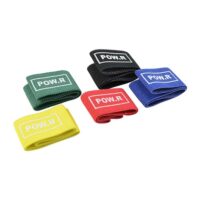 Exercise Equipment, Knee, Resistance Band
POW.R Fabric Mini Loop Bands
$12.00 – $55.00Select optionsQuick View -
- EMS Machines, Pain Management, TENS Machine, TENS Machine & EMS
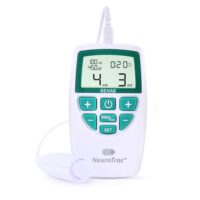
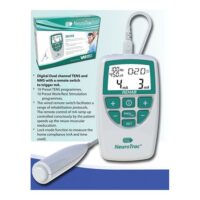
NeuroTrac Rehab (TENS Machine + EMS)
$285.00Add to cartQuick View -
-

 Calf, Elbow, Ice & Heat, Knee, Pain Management
Victor Elastic Cold Sleeve
$44.00 – $60.00Select optionsQuick View -
-
-
 Exercise Balls, Back, Exercise Equipment, Knee, Shoulder
66fit Exercise Balls | Core & Rehab Stability Ball
$32.00 – $57.00Select optionsQuick View -
 Exercise Equipment, Resistance Band
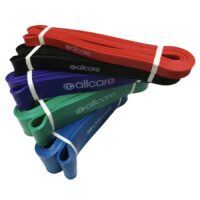
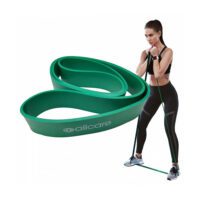
AllCare Powerloop Bands
$24.95 – $79.95Select optionsQuick View -



Related Knee and Running Information
- Knee Pain
- Posterior Knee Pain
- Tendinopathy
- Meniscus Tear
- Posterolateral Corner Injury
- Running Injuries and Advice
References
- Morrissey CD, et al. Prevalence, mechanisms and return to sport after isolated popliteus injuries. 2022.
- Olewnik Ł, et al. Morphological classification of the popliteus tendon. 2021.
- Breda SJ, et al. Progressive tendon-loading exercise versus eccentric exercise for tendinopathy. 2021.
- Escriche-Escuder A, et al. Load progression criteria in lower-limb tendinopathy rehabilitation. 2020.
- Lu R, et al. Lower-limb biomechanics during slope running and knee loading. 2024.
Popliteus Tendinopathy FAQs
What does the popliteus muscle do?
The popliteus helps the knee begin bending from a straight position. It also assists with controlled rotation between the thigh and shin during walking, running and direction changes.
Can popliteus tendinopathy cause pain at the back of the knee?
Yes. Popliteus tendon overload may cause pain at the back and outer side of the knee, particularly during downhill walking, running, deceleration or twisting on a planted foot.
How long does popliteus tendinopathy take to improve?
Recovery time varies. A mild recent flare may improve over several weeks, while persistent symptoms may require a longer period of progressive exercise and gradual return to running or sport.
Is popliteus pain the same as a meniscus injury?
No. Popliteus tendon pain and meniscus injuries affect different structures, although their symptoms can overlap. A clinical assessment can help identify the most likely source.
Should you stop running with popliteus tendinopathy?
Not always. Some people can continue modified running by reducing hills, pace, distance or frequency. Stop and seek assessment if pain worsens, causes limping, produces instability or remains aggravated the following day.
