
AFL Injuries
Common injuries, warning signs, prevention and return-to-football guidance.


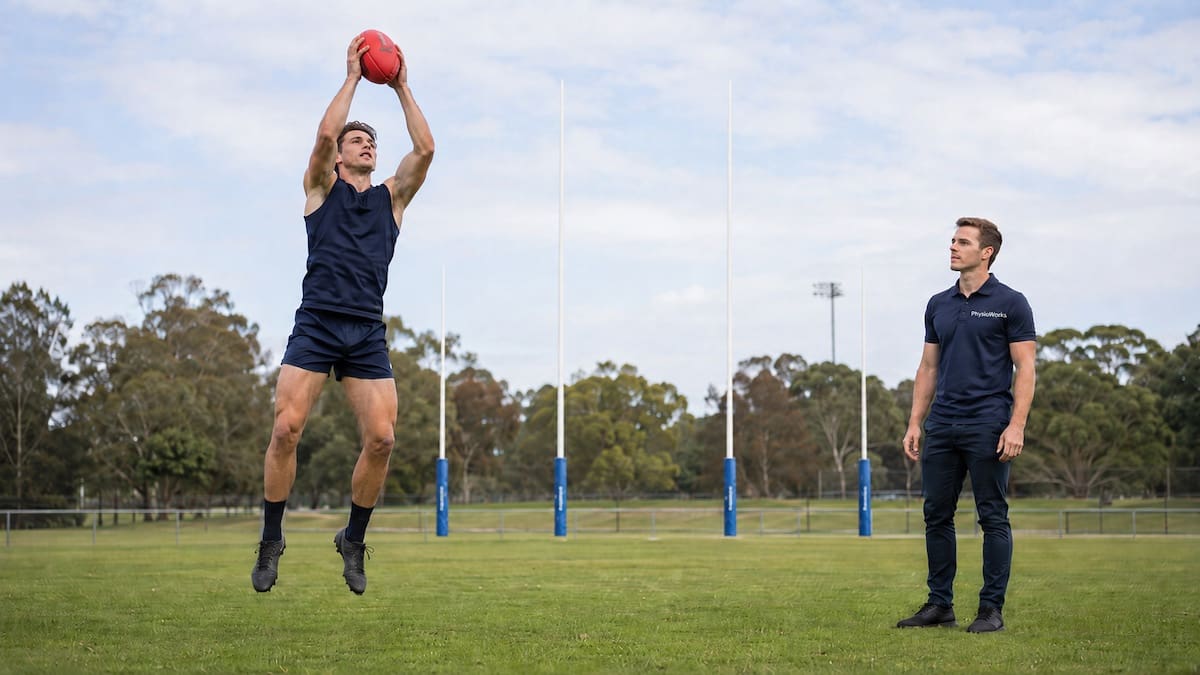
AFL injuries commonly affect the quadriceps, hamstring, calf, groin, ankle, knee, shoulder, neck and head. Australian rules football combines high-speed running, kicking, jumping, landing, tackling and rapid changes of direction. An injury may happen suddenly during a contest or build gradually when training and match loads exceed recovery.
Symptoms often appear during sprinting, kicking, landing from a mark, cutting, tackling or repeated running. The likely injury depends on the body region, mechanism, swelling, strength, movement confidence and ability to continue playing.
Quick Answer: What Are the Most Common AFL Injuries?
Common AFL injuries include quadriceps and hamstring strains, calf strains, groin strains, ankle sprains, ACL injuries, meniscus injuries, shoulder injuries and concussion. Lower-limb injuries are prominent because AFL repeatedly demands sprinting, braking, kicking, landing and cutting.
Explore Related Football Injury Guides
Compare AFL injury patterns with other running and contact football codes.
Which AFL Actions Commonly Trigger Pain?
The activity that triggers pain can help identify the likely body region. However, it does not confirm a diagnosis.
Sprinting or Chasing
High-speed running may provoke quadriceps, hamstring or calf pain, particularly after a rapid change in running exposure.
Kicking
Repeated or forceful kicking may load the quadriceps, hamstring, hip flexor and groin. Pain during the kicking swing or follow-through may indicate a soft-tissue problem.
Cutting or Evading
Rapid direction changes place high braking and rotational loads through the ankle, knee and groin.
Tackling or Falling
Contact may affect the shoulder, ribs, wrist, neck or head. Any suspected concussion requires immediate removal from play.
Repeated Training Load
Tendon pain and recurring soft-tissue symptoms may build when running, gym, kicking or contact loads rise faster than recovery.
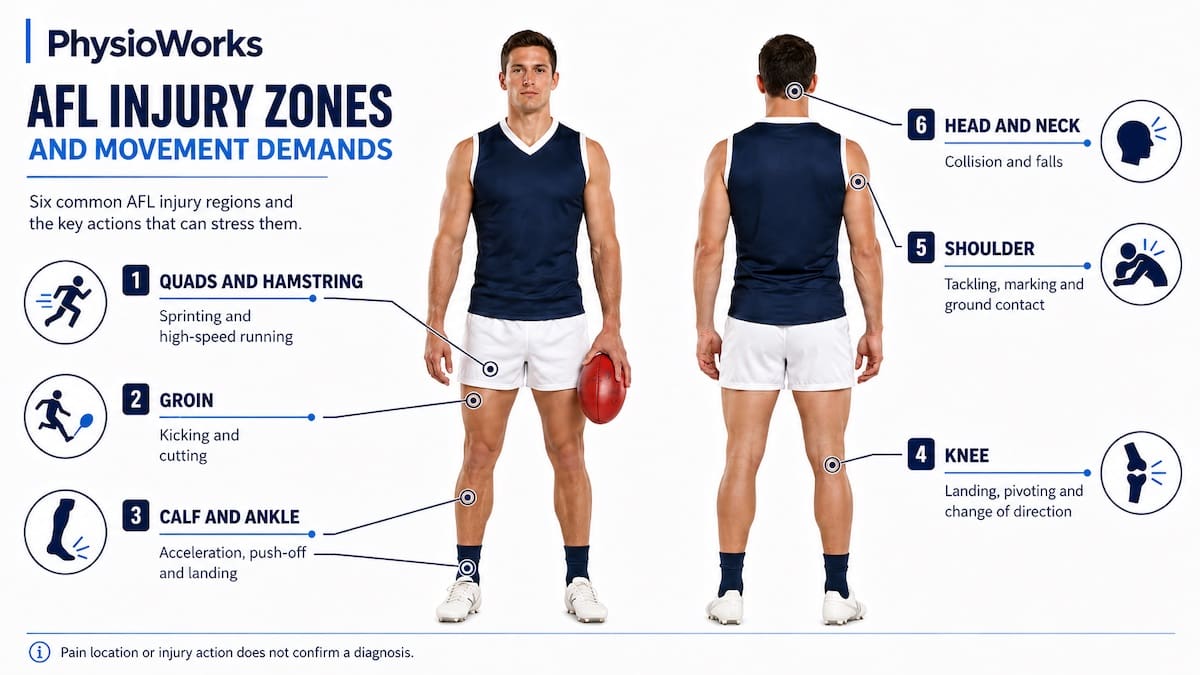
Common AFL Injuries by Body Region
Quadriceps, Hamstring, Calf and Groin
These tissues absorb high loads during sprinting, kicking, acceleration and braking.
- Quadriceps strain
- Hamstring strain
- Calf strain
- Groin strain
Knee
Pivoting, deceleration, landing and contact can place high loads through the knee.
Ankle and Foot
Landing on another player’s foot, tackling and uneven ground may cause an ankle injury.
Shoulder, Neck and Head
Tackles, marking contests and ground contact may affect the upper body or head.
Why Do AFL Injuries Happen?
AFL repeatedly moves players between jogging, sprinting, braking, jumping, turning, kicking and contact. These actions create short peaks in force rather than one steady workload. Fatigue may then reduce timing, control and decision-making late in a quarter or match.
Surface firmness, footwear, weather, congested fixtures and sudden changes in training can also influence injury risk. Previous injury matters because strength, speed exposure or confidence may remain below match demands even after pain settles.
AFL Injury Risk Often Rises When:
- running volume or sprint exposure increases too quickly
- a player returns after illness, travel, holidays or time away
- strength work does not match match-day running and contact demands
- a previous quadriceps, hamstring, calf, groin, ankle or knee injury remains under-rehabilitated
- fatigue changes landing, cutting, sprinting or tackling technique
How Can Physiotherapy Help an AFL Injury?
Physiotherapy usually starts with an assessment of the injury, movement, strength and training load. Depending on the problem, your physiotherapist may assess joint movement, swelling, muscle strength, balance, sprint tolerance, landing control, cutting mechanics and football-task confidence.
Treatment may include pain-management advice, hands-on treatment, taping or bracing guidance, exercise rehabilitation and a planned progression back to running and contact. The goal is not only to reduce symptoms. Rehabilitation should also prepare the player for the speed, kicking, landing, tackling and repeat-effort demands of AFL.
Sports injury physiotherapy can guide this process. Exercise physiology may also help rebuild conditioning and long-term strength when a player needs a broader training program.
When Should You Seek Assessment?
Consider physiotherapy or medical assessment when pain changes how you run, kick, jump, land, tackle or train.
- pain persists, worsens or keeps returning
- swelling, bruising, locking, catching or instability develops
- you cannot walk normally or confidently weight-bear
- speed, jump power or confidence to cut, tackle or mark falls
- symptoms flare after training or remain worse the next day
- you have recurring quadriceps, hamstring, calf, groin, ankle or knee symptoms
- you suspect concussion or notice headache, fogginess, dizziness or balance change
Urgent Warning Signs After an AFL Injury
Seek urgent medical care for severe pain, major swelling, deformity, inability to weight-bear, worsening weakness or numbness, or significant head or neck trauma.
Call 000 or seek emergency care after a head injury if the player develops worsening confusion, repeated vomiting, seizure, increasing drowsiness, weakness, severe or worsening headache, neck pain or loss of consciousness.
How Can AFL Injuries Be Prevented?
No program prevents every injury. However, players can reduce avoidable risk by building capacity progressively and preparing for the movements that AFL demands.
- Warm-up: use progressive running, movement preparation and football-specific drills.
- Strength: train quadriceps, hamstrings, calves, groin, hips, trunk and single-leg control.
- Speed: build sprint exposure progressively rather than adding it suddenly.
- Landing and cutting: practise braking, balance and change-of-direction technique.
- Contact: progress tackling and contested work in planned stages.
- Recovery: account for sleep, soreness, match congestion and next-day response.
How Do You Return Safely to AFL?
A safe return should progress from symptom control to strength, running, football skills, contact and match exposure. The timing depends on the injury, position, fitness, confidence and response after each session.
Settle Symptoms
Restore comfortable walking, joint movement and basic strength. Monitor pain, swelling and next-day response.
Rebuild Capacity
Progress lower-limb strength, balance, calf capacity, quadriceps and hamstring strength, and repeated-effort tolerance.
Restore Running
Build from jogging to tempo running, accelerations and controlled sprint exposure without sudden load spikes.
Add Football Tasks
Progress kicking, cutting, jumping, landing, marking and position-specific drills. Add contact when appropriate.
Return to Training and Matches
Move from controlled training to full training, then staged match minutes when symptoms, capacity and confidence allow.
AFL Injury FAQs
What are the most common AFL injuries?
Common AFL injuries include quadriceps and hamstring strains, concussion, calf strains, ankle sprains, knee ligament injuries, meniscus injuries, groin pain and shoulder injuries. These problems reflect the sport’s sprinting, kicking, tackling, landing and cutting demands.
Why are hamstring strains common in AFL?
Hamstring strains are common because AFL players repeatedly sprint, kick, accelerate and decelerate. Risk may rise when high-speed running load changes quickly, fatigue affects sprint mechanics, or previous strength and running exposure have not been fully restored.
When should I worry about a knee injury after a tackle or landing?
Seek assessment if the knee swells quickly, feels unstable, locks, gives way or prevents normal walking. A planted-foot twist, awkward landing or contact injury may affect the ACL, meniscus, kneecap or another knee structure.
What should I do if I suspect concussion?
Stop playing immediately. Do not return to the same game or training session. Arrange medical assessment and follow a graduated return-to-sport process because symptoms can change over time.
How long does it take to return to AFL after injury?
Recovery time varies with the diagnosis, injury severity, position demands and response to rehabilitation. Return should depend on movement, strength, running, football-task and contact readiness rather than time alone.
Can physiotherapy help reduce recurring AFL injuries?
Physiotherapy may help address strength gaps, limited load tolerance, landing-control problems, sprint deficits and incomplete return-to-play preparation. A prevention plan may include strength work, running-load planning, movement retraining and football-specific progressions.
What To Do Next
If an AFL injury is limiting training, match play or confidence, a physiotherapist can assess the problem, guide load management and plan a staged return to football.
Book an appointment when symptoms keep returning, affect performance or leave you unsure about safe training progression.
Choose your clinic and appointment pathway
Select a PhysioWorks clinic to continue to live booking, an appointment request or reception assistance.


References
- Bennett H, Fuller JT, DeBenedictis TA, et al. Ankle sprain, concussion, and anterior cruciate ligament injuries are common and burdensome in sub-elite female Australian football players. J Sci Med Sport. 2024;27(8):539-544. doi:10.1016/j.jsams.2024.05.008
- Breed R, et al. The Relationship Between Running Load, Strength, Muscle Architecture and Hamstring Strain Injury Across Two Seasons of Elite Male Australian Football: A Prospective Cohort Study. Sports Med Open. 2025;11(1):146. doi:10.1186/s40798-025-00944-4
- Farley JB, Keogh JWL, Woods CT, Milne N. Injury profiles of Australian football players across five women’s and girls’ competition levels. J Sci Med Sport. 2022;25(1):58-63. doi:10.1016/j.jsams.2021.08.016
- Australian Institute of Health and Welfare. Sports injury in Australia: Australian rules football. Published July 30, 2025.
- Australian Football League. AFL and AFLW injury reports. Published September 5, 2024.