POW.R Fabric Mini Loop Bands
$12.00 – $55.00
- Description
- Additional information
Description
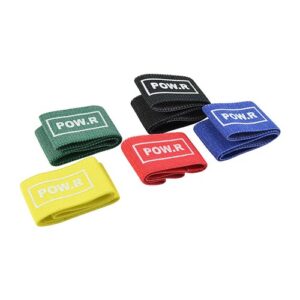
POW.R Fabric Mini Loop Bands are woven fabric resistance bands for progressive strength, muscle activation and lower-limb control exercises. Available in five resistance levels, they can be used during physiotherapy-guided rehabilitation, home exercise, gym training and pre-exercise activation.
The compact fabric loops provide external resistance without the narrow feel of many traditional elastic mini bands. Their woven construction is designed to improve comfort and reduce rolling or slipping during controlled lower-body exercises.
Who May Benefit From These Mini Loop Bands?
POW.R Fabric Mini Loop Bands may suit people who have been advised to include controlled resistance exercises in their rehabilitation or strength program. Common applications include:
- Hip and glute strengthening exercises
- Knee alignment and lower-limb control drills
- Muscle activation before gym training, running or sport
- Progressive home exercise programs
- Balance, stability and coordination exercises
- Pilates, general conditioning and low-impact strength work
The most appropriate resistance depends on your exercise, current strength, movement control and rehabilitation stage. Start with a level that allows steady technique rather than choosing resistance by colour alone.
Key Benefits
- Provides controlled resistance for lower-body strengthening
- Supports progressive hip, glute and knee-control exercises
- Woven fabric construction feels broad and comfortable against the body
- Designed to reduce rolling and slipping during movement
- Five resistance options support gradual exercise progression
- Compact and portable for home, gym or travel use
Product Features
- Fabric mini loop resistance-band design
- Each band measures approximately 29 cm × 5.5 cm
- Five colour-coded resistance options
- Reusable and suitable for repeated exercise sessions
- Compact size for easy storage and transport
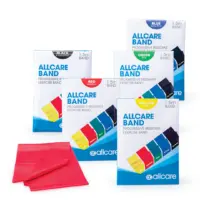
Resistance Colour Guide
| Colour | Resistance level | Typical selection approach |
|---|---|---|
| Yellow | Light | Gentle activation, technique practice or early progression |
| Red | Medium | General activation and moderate strengthening |
| Green | Strong | Progressive strengthening with established control |
| Blue | Extra strong | Higher-resistance exercises for experienced users |
| Black | Special strong | Advanced resistance where technique remains controlled |
These descriptions provide a general comparison rather than a prescribed rehabilitation progression. Resistance can feel different depending on how far the band is stretched and where it is positioned.
Why Use POW.R Fabric Mini Loop Bands?
Reduced strength or movement control around the hips and legs can affect squatting, walking, running, stairs and sporting activities. A mini loop band adds external resistance to an exercise, requiring the working muscles to control both the effort and the return phase of each repetition.
This makes the band useful for exercises that target the gluteal muscles, hips and lower limbs. It can also provide a simple movement cue during exercises where knee position, pelvic stability or controlled alignment matters.
The band should support good movement rather than force the body into position. A lighter resistance is often more useful when learning an exercise or rebuilding control.
How Do Fabric Mini Loop Bands Work?
The closed-loop design stretches as you move your legs apart. This creates resistance that changes with the amount of stretch. Your muscles must work against that resistance while maintaining the intended exercise position.
The fabric construction distributes pressure across a wider surface than a narrow rubber loop. It is also designed to reduce the rolling, twisting or pinching that can interrupt exercises performed around the thighs, knees or lower legs.
For technique examples and general progression principles, see the PhysioWorks resistance band exercise guide.
What Exercises Can They Be Used For?
POW.R Fabric Mini Loop Bands can be incorporated into a wide range of exercises, depending on your goals and current capacity. Examples may include:
- Side steps and band walks
- Bridges with outward knee control
- Standing or side-lying hip abduction
- Controlled squats and sit-to-stand exercises
- Clams and other glute activation exercises
- Lower-limb warm-up exercises before training
Placement around the thighs, knees, ankles or feet changes the difficulty and demands of an exercise. Use the position prescribed in your exercise program rather than moving the band further down the legs simply to make an exercise harder.
How to Select and Use Your Band
- Choose a resistance that allows you to complete the movement slowly and with control.
- Position the band as shown in your exercise instructions.
- Check that the fabric lies flat and is not twisted.
- Move through a comfortable range without allowing the band to pull you out of position.
- Progress resistance only when you can maintain the required technique across the full set.
- Inspect the band regularly and stop using it if the fabric or stitching becomes damaged.
Exercise quality is more important than selecting the strongest band. Reduce the resistance, range, repetitions or exercise difficulty if you cannot maintain smooth movement.
Safety and Progression
- Do not wrap the band so tightly that it causes numbness, tingling, discolouration or marked discomfort.
- Keep the band away from sharp objects and rough surfaces that may damage the fabric.
- Stop the exercise if you develop sharp pain, giving way, increasing swelling or worsening symptoms.
- Seek physiotherapy or other appropriate health advice when you are uncertain about resistance, placement or exercise technique.
- Use after surgery only when the exercise and resistance have been approved for your stage of recovery.
Frequently Asked Questions
Which resistance level should I choose?
Choose the lightest level that produces useful resistance while still allowing steady, controlled technique. Yellow or red may suit activation and introductory exercises, while the stronger levels may suit later progressions. The correct choice depends on the exercise and your current capacity rather than experience alone.
Are fabric bands better than rubber mini bands?
Fabric bands are generally broader and are designed to reduce rolling, twisting and pinching. Rubber bands may suit exercises requiring a different stretch characteristic or a smaller loop. The better option depends on the exercise, resistance required and your comfort preferences.
Can I use these bands for knee exercises?
Yes. Mini loop bands are often used in exercises targeting hip strength, knee alignment and lower-limb control. They do not treat every cause of knee pain, so persistent pain, locking, giving way or swelling should be assessed appropriately. See the PhysioWorks knee exercise guide for general exercise principles.
Where should I position the band?
Position depends on the exercise. Common placements include above the knees, around the lower legs, at the ankles or around the feet. Moving the band further from the hips can substantially increase the exercise demand, so follow the placement shown in your program.
Can beginners use fabric mini loop bands?
Yes. Beginners can start with lighter resistance and simple exercises. The band should add manageable resistance without causing compensations, breath holding or loss of balance.
When should I seek physiotherapy advice?
Arrange advice if exercises increase pain, swelling, numbness or instability, or if you are unsure which exercises and resistance suit your condition. Assessment is also recommended for persistent symptoms, recurrent injuries or rehabilitation following surgery.
Related PhysioWorks Articles
- Resistance Band Exercises – learn how resistance changes with stretch and how to progress common band exercises.
- Knee Exercises – review controlled strengthening and alignment principles for common knee exercise programs.
- What Force Can a Resistance Band Generate? – understand why band load changes as the material stretches.
Related Products
- POW.R Wide Fabric Loop Resistance Band – a wider loop option for hip, glute and lower-body exercises.
- Smooth and Spiky Massage Balls – a portable option for muscle recovery and self-massage after exercise.
- Pilates Balls – add controlled instability to core, balance and rehabilitation exercises.
What to Do Next
Select the resistance that lets you maintain comfortable, controlled movement throughout your exercise. Follow your prescribed program when one has been provided, and seek physiotherapy advice if pain persists, symptoms worsen or you are uncertain about the correct resistance or exercise progression.
Additional information
| Weight | .5 kg |
|---|---|
| Dimensions | 20 × 15 × 10 cm |
| Resistance | Full Set, Heavy Blue, Light Red, Medium Green, X-Heavy Black, X-Light Yellow |