
BPPV – Benign Paroxysmal Positional Vertigo
BPPV: Symptoms, Causes & Treatment
Benign paroxysmal positional vertigo, or BPPV, is a common inner-ear cause of brief spinning triggered by changes in head position.



Guided head positioning can help identify the positional pattern and affected canal in BPPV.
BPPV commonly causes a short burst of spinning when you roll in bed, lie back, look up or bend forward. The spinning is usually brief, although nausea or unsteadiness can last longer.
BPPV stands for benign paroxysmal positional vertigo. It occurs when tiny calcium carbonate crystals, called otoconia, become displaced from their usual location and move into one of the inner ear’s semicircular canals.
When your head changes position, these displaced particles can stimulate the balance sensors incorrectly. Your inner ear then sends a movement signal that does not match what your eyes and body are sensing, which can produce vertigo and characteristic involuntary eye movements called nystagmus.
Common trigger
Rolling in bed, looking up, bending forward or lying back.
Typical episode
The strongest spinning usually lasts less than one minute.
Usual treatment
A canal-specific repositioning manoeuvre based on the assessment findings.
What are the common symptoms of BPPV?
BPPV symptoms usually occur when your head moves into a particular position rather than causing constant spinning throughout the day. This positional pattern can help distinguish BPPV from other causes of dizziness.
- Sudden spinning or whirling
- Dizziness when rolling over in bed
- Vertigo when lying back or getting out of bed
- Spinning when looking up
- Dizziness when bending forward
- Nausea and, occasionally, vomiting
- Brief involuntary eye movements called nystagmus
- Temporary unsteadiness after the spinning settles
Many people describe the main vertigo episode as intense but short. However, repeated attacks can leave you feeling washed out, cautious with movement or mildly off balance for longer.
Why do I feel dizzy when I roll over in bed?
Rolling in bed is one of the most recognisable BPPV triggers. Changing your head position can move displaced particles within the affected semicircular canal. This briefly stimulates the inner-ear balance sensors and can create a sudden spinning sensation.
The same mechanism can cause symptoms when you lie back, sit up, look towards a high shelf, wash your hair or bend down to pick something up.
What causes BPPV?
BPPV develops when otoconia become displaced from the utricle and enter a semicircular canal. In many people, there is no single identifiable reason why this happens.
BPPV may occur after:
- Age-related changes within the inner ear
- A head injury or concussion
- Prolonged periods of reduced head movement or bed rest
- Some inner-ear disorders or inflammation
- A previous episode of BPPV
A head or neck injury can also produce several potential causes of dizziness. For example, symptoms following trauma may require assessment for BPPV as well as other vestibular, neurological or cervical causes. You can read more about whiplash when neck symptoms are also present.
Who is more likely to experience recurrent BPPV?
BPPV can return after successful treatment. Research has identified associations between recurrence and factors such as previous BPPV, migraine, osteoporosis, low vitamin D levels and some inner-ear disorders. However, these associations do not mean that every person with one of these conditions will develop recurrent BPPV.
People with vestibular migraine or Ménière’s disease may also experience dizziness for reasons other than BPPV. Assessment therefore matters when symptoms recur or change.
Is BPPV the same as other causes of dizziness?
No. BPPV is one specific cause of vertigo. Its hallmark is a short episode of spinning associated with a particular change in head position.
Other vestibular conditions can cause longer attacks, persistent imbalance, hearing symptoms, visual sensitivity, headache-associated dizziness or symptoms that are not consistently linked to one position.
BPPV
Usually causes brief spinning with rolling, lying back, looking up or bending forward.
Vestibular migraine
Dizziness may occur with migraine features such as headache, visual sensitivity, motion sensitivity or light sensitivity.
Ménière’s disease
Vertigo may occur with fluctuating hearing changes, tinnitus or a feeling of pressure or fullness in the ear.
For a broader overview, see our vertigo and dizziness guide.
How is BPPV assessed?
A physiotherapist trained in vestibular assessment can review your symptom pattern and perform positional tests to assess for BPPV.
The tests aim to reproduce the positional response safely while the clinician observes the direction, timing and duration of any nystagmus. These findings can help determine whether BPPV is likely and which semicircular canal is involved.
Posterior canal BPPV
The posterior semicircular canal is the most commonly affected canal. The Dix-Hallpike test is commonly used when posterior canal BPPV is suspected.
Horizontal canal BPPV
Horizontal canal BPPV can produce a different pattern of positional vertigo and nystagmus. A supine roll test may be used when the history or eye movements suggest horizontal canal involvement.
Positional testing can help establish:
- Whether the findings are consistent with BPPV
- Which semicircular canal appears to be involved
- Which side is most likely affected
- Whether more than one canal may be involved
- Whether another vestibular or medical cause needs consideration
Imaging is not routinely required for straightforward BPPV when the history and examination are typical. However, atypical findings or additional neurological, hearing or medical symptoms may require further investigation or medical referral.
For an independent medical overview, see the NCBI Bookshelf guide to benign paroxysmal positional vertigo.
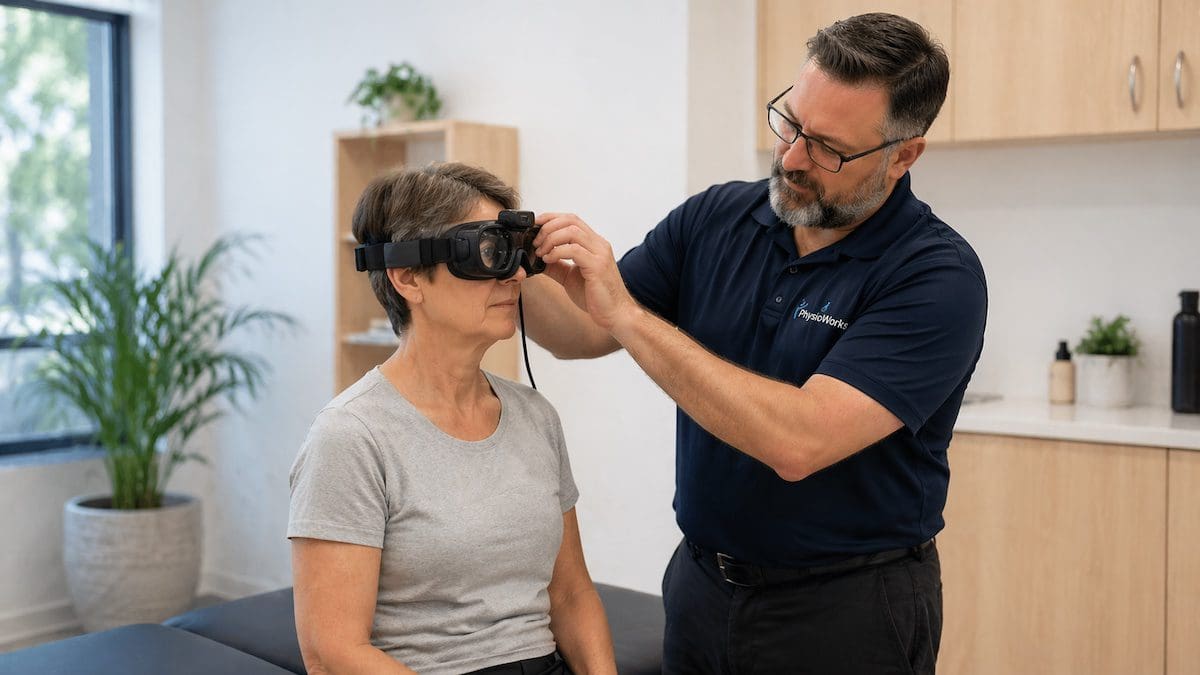
Infrared goggles can improve observation of eye movements during vestibular assessment.
Advanced vestibular assessment at Clayfield
Some dizziness presentations are persistent, recurrent or atypical. In these situations, standard bedside testing may not provide all the information needed.
At our Clayfield clinic, vestibular assessment may include infrared goggles. These allow the physiotherapist to observe eye movements while reducing visual fixation, which can make some forms of nystagmus easier to detect.
Infrared-goggle assessment may be useful when:
- Symptoms keep returning
- The positional pattern is unusual
- More than one canal may be involved
- Symptoms persist despite previous repositioning manoeuvres
- A non-BPPV vestibular problem is also suspected
How is BPPV treated?
BPPV treatment usually involves a canalith repositioning manoeuvre. The appropriate manoeuvre depends on the canal, side and pattern identified during positional testing.
Repositioning manoeuvres
A repositioning manoeuvre uses a controlled sequence of head and body positions to guide the displaced particles out of the affected semicircular canal.
For posterior canal BPPV, the Epley manoeuvre is one commonly used repositioning technique. Other manoeuvres may be more appropriate for horizontal canal BPPV or other positional patterns.
For that reason, the manoeuvre should match the assessment findings rather than using the same sequence for every person with dizziness.
Some people improve after one treatment. Others require repeat treatment, particularly when symptoms have been present for longer, more than one canal is involved or BPPV has recurred.
Vestibular rehabilitation
After the strongest positional vertigo settles, some people continue to feel unsteady, visually sensitive or cautious with head movement.
Vestibular rehabilitation therapy may then include individually selected balance exercises, gaze-stability exercises and graded exposure to movements that remain difficult.
The aim is to improve function and confidence rather than repeatedly performing repositioning manoeuvres when BPPV is no longer present.
Advice for everyday activities
Short-term advice may include strategies for getting in and out of bed, using stairs, showering, working at heights or moving around at night when dizziness increases fall risk.
Your physiotherapist can tailor this advice to your balance, symptoms and usual activities.
Does medication treat BPPV?
Medication may sometimes help control severe nausea or vomiting. However, medication does not reposition the displaced particles that cause BPPV.
Vestibular-suppressant medicines are therefore not routinely used as the primary treatment for straightforward BPPV. Canal-specific repositioning remains the main treatment when positional testing confirms the condition.
How quickly does BPPV improve?
Many people improve soon after an appropriate repositioning manoeuvre. Some respond after one treatment, while others require a small number of sessions.
Recovery may take longer when:
- Symptoms have been present for several weeks
- More than one semicircular canal is involved
- BPPV affects both ears
- The condition has recurred
- Residual imbalance remains after the spinning has stopped
- Another vestibular condition is also contributing to symptoms
If vertigo settles but you remain off balance, further vestibular rehabilitation may help improve steadiness and confidence.
Can BPPV come back after treatment?
Yes. BPPV can recur after successful treatment.
A recurrence does not necessarily mean that the original treatment failed. The crystals may become displaced again later, producing a new episode of positional vertigo.
If familiar symptoms return, reassessment can confirm whether BPPV has recurred, determine which canal is involved and identify the appropriate treatment.
Can I treat BPPV at home?
Some people can use a home repositioning manoeuvre after a clinician has confirmed the diagnosis, side and canal involved.
However, BPPV manoeuvres are not interchangeable. A technique that is appropriate for one canal may be ineffective for another pattern, and dizziness that resembles BPPV may have another cause.
Assessment is therefore a sensible first step, particularly for a first episode, an atypical presentation, significant balance difficulty or symptoms that do not respond as expected.
What to do next
If brief spinning occurs when you roll in bed, lie back, look up or bend forward, BPPV is one condition worth assessing. The first step is to confirm whether your symptoms and eye-movement pattern fit BPPV and identify the affected canal before selecting a repositioning manoeuvre.
If the spinning settles but imbalance remains, your physiotherapist can also determine whether vestibular rehabilitation may help.
Common BPPV questions
What is BPPV?
BPPV stands for benign paroxysmal positional vertigo. It causes brief episodes of spinning when displaced inner-ear particles stimulate a semicircular canal during certain head movements.
Why do I feel dizzy when I turn in bed?
Turning in bed is a common BPPV trigger because changing head position can move displaced particles within an affected semicircular canal and briefly stimulate the inner-ear balance sensors.
How does physiotherapy treat BPPV?
A physiotherapist can assess the positional pattern and identify the likely canal involved. Treatment commonly uses a canal-specific repositioning manoeuvre. Vestibular rehabilitation may also help if imbalance or movement sensitivity remains afterwards.
How quickly should I get BPPV checked?
Consider an assessment when positional vertigo affects walking, sleep, work, exercise or confidence with daily activities. Earlier assessment may also help distinguish BPPV from other causes of dizziness.
Is BPPV dangerous?
BPPV itself is usually not life-threatening. However, sudden spinning can increase fall risk, particularly when getting out of bed, using stairs or moving in poor light.
Will BPPV go away on its own?
BPPV can sometimes settle without treatment. However, an appropriate repositioning manoeuvre can often resolve the positional vertigo sooner once the affected canal has been identified.
Can BPPV come back?
Yes. BPPV can recur after successful treatment. Repeat assessment can confirm whether BPPV has returned and identify the correct manoeuvre for the new episode.
Can I treat BPPV at home?
Sometimes. A home manoeuvre may be suitable after the diagnosis, affected side and canal have been identified. Different BPPV patterns require different manoeuvres, so assessment is usually recommended before starting self-treatment.
When should I seek urgent medical care for dizziness?
Seek urgent medical care if sudden dizziness occurs with new weakness or numbness, facial droop, difficulty speaking, severe new headache, double vision, fainting, chest pain, major loss of coordination or sudden hearing loss.

Graded return to comfortable head movement can help rebuild confidence after positional vertigo settles.
Choose your clinic and appointment pathway
Select a PhysioWorks clinic to continue to live booking, an appointment request or reception assistance.
If BPPV leaves you cautious or unsteady after the spinning has settled, simple balance equipment may support an individually prescribed home program when recommended by your physiotherapist.
Balance Products
These balance products are commonly used by our physiotherapists to improve strength, balance, prevent injuries falls or injuries, plus assist home exercise programs.
-
-
- Gift Ideas, Back, Christmas Gift Ideas, Exercise Balls, Exercise Equipment, Knee, Pelvic Floor, Product Search
66fit Pilates Balls
$14.95 – $16.95Select optionsQuick View -
-







References
- Bhattacharyya N, Gubbels SP, Schwartz SR, et al. Clinical Practice Guideline: Benign Paroxysmal Positional Vertigo (Update). Otolaryngol Head Neck Surg. 2017;156(3 Suppl):S1-S47. doi:10.1177/0194599816689667
- Cox H, Frith J. Best practice assessment and management of benign paroxysmal positional vertigo in older adults. Age Ageing. 2025;54(8):afaf225. doi:10.1093/ageing/afaf225
- Pan Q, Li B, Zou K, Zhang J, Wang Y, Tang X. Risk factors and a nomogram model for recurrence of benign paroxysmal positional vertigo: a multicenter cross-sectional study. Front Neurol. 2025;16:1542090. doi:10.3389/fneur.2025.1542090
- Alolayet H, Murdin L. Benign paroxysmal positional vertigo: a systematic review of the effects of comorbidities. Front Neurol. 2025;16:1595693. doi:10.3389/fneur.2025.1595693
- Rhim G, Kim MJ. Vitamin D supplementation and recurrence of benign paroxysmal positional vertigo. Nutrients. 2024;16(5):689. doi:10.3390/nu16050689
- Chen JJ, Fu YX, Wang M, Liu S, Feng Y. A systematic review and network meta-analysis of efficacy of postmaneuver rehabilitation in benign paroxysmal positional vertigo treatment. J Otorhinolaryngol Hear Balance Med. 2025;6(2):23. doi:10.3390/ohbm6020023
