
Ménière’s Disease Physiotherapy



Ménière’s disease can affect vertigo, hearing and balance.
Ménière’s disease physiotherapy may help when vertigo, imbalance, and reduced movement confidence continue between attacks. Ménière’s disease is an inner ear condition that can cause spinning vertigo, hearing changes, tinnitus, and pressure or fullness in one ear. It sits within the broader group of vestibular conditions that affect balance and spatial awareness.
A GP, ENT specialist, or audiologist usually guides diagnosis and medical care. Physiotherapy can support the functional side of recovery, especially if you feel unsteady, avoid movement, or struggle with walking, turning, work, driving, or busy visual environments between episodes.
What is Ménière’s disease?
Ménière’s disease is a long-term inner ear disorder. It is commonly linked with abnormal fluid pressure or fluid regulation in the labyrinth, which helps control hearing and balance. When this system is disrupted, the brain can receive mixed balance and hearing signals.
The result can be sudden vertigo attacks, fluctuating hearing loss, tinnitus, ear fullness, nausea, and reduced balance confidence. Symptoms often occur in episodes rather than staying constant all day.
Ménière’s disease symptoms
Symptoms vary from person to person. Some people notice warning signs before an attack. Others find the vertigo starts suddenly. Common symptoms include:
- spinning vertigo lasting about 20 minutes to several hours
- fluctuating hearing loss, often in one ear
- tinnitus, ringing, buzzing, or roaring in the ear
- a blocked or full feeling in the ear
- nausea or vomiting during stronger attacks
- unsteadiness, motion sensitivity, or fear of falling between episodes
Common Ménière’s disease pattern
- repeated vertigo episodes
- hearing symptoms that fluctuate
- tinnitus or ear fullness
- imbalance or reduced confidence between attacks
How is Ménière’s disease different from other dizziness problems?
Ménière’s disease is one possible cause of vertigo, but it is not the only one. BPPV usually causes brief spinning with head position changes, such as rolling in bed or looking up. Vestibular migraine can cause dizziness, visual sensitivity, nausea, and imbalance with or without headache. PPPD can cause longer-lasting unsteadiness that is often worse in busy environments.
Because symptoms can overlap, assessment matters. A clear history, hearing tests, eye movement assessment, balance testing, and medical review can help guide the right next step.
What causes Ménière’s disease?
The exact cause is not fully settled. Current thinking links Ménière’s disease to abnormal fluid handling in the inner ear. Researchers also discuss possible links with migraine mechanisms, viral illness, immune factors, vascular changes, and genetics.
In practice, symptoms can change over time. Some people have clusters of attacks followed by quieter periods. Others notice gradual hearing or balance changes.
How is Ménière’s disease diagnosed?
Diagnosis is usually based on your symptom history, hearing changes, examination findings, and exclusion of other causes. Hearing tests are commonly used. Clinical criteria often include at least two spontaneous vertigo episodes, each lasting 20 minutes to 12 hours, plus fluctuating hearing-related symptoms that are not better explained by another vestibular disorder.
If your symptoms include sudden hearing change, new neurological signs, severe headache, fainting, chest pain, or unusual symptoms, seek medical review promptly.
What is the treatment for Ménière’s disease?
Treatment usually combines medical management and rehabilitation. Your doctor or ENT may discuss dietary strategies, medicines for vertigo or nausea, hearing support, or further procedures in more persistent cases. The National Institute on Deafness and Other Communication Disorders notes that vestibular rehabilitation or physical therapy may be recommended when chronic balance problems continue.
Physiotherapy does not change inner ear fluid levels. Instead, it targets the balance and movement problems that may remain between attacks.
Can physiotherapy help Ménière’s disease?
Physiotherapy may help if imbalance, motion sensitivity, dizziness, or reduced confidence continues between attacks. A structured vestibular rehabilitation therapy program may include balance exercises, walking tasks, gaze control exercises, head movement practice, and strategies for busy visual environments.
Physiotherapy often focuses on:
- improving balance and coordination
- reducing movement avoidance between episodes
- building confidence with walking and turning
- supporting safer daily activity
- reducing fall risk where balance has declined
- helping you pace activity after a flare
Some people also benefit from balance improvement exercises once the acute spinning phase has settled.
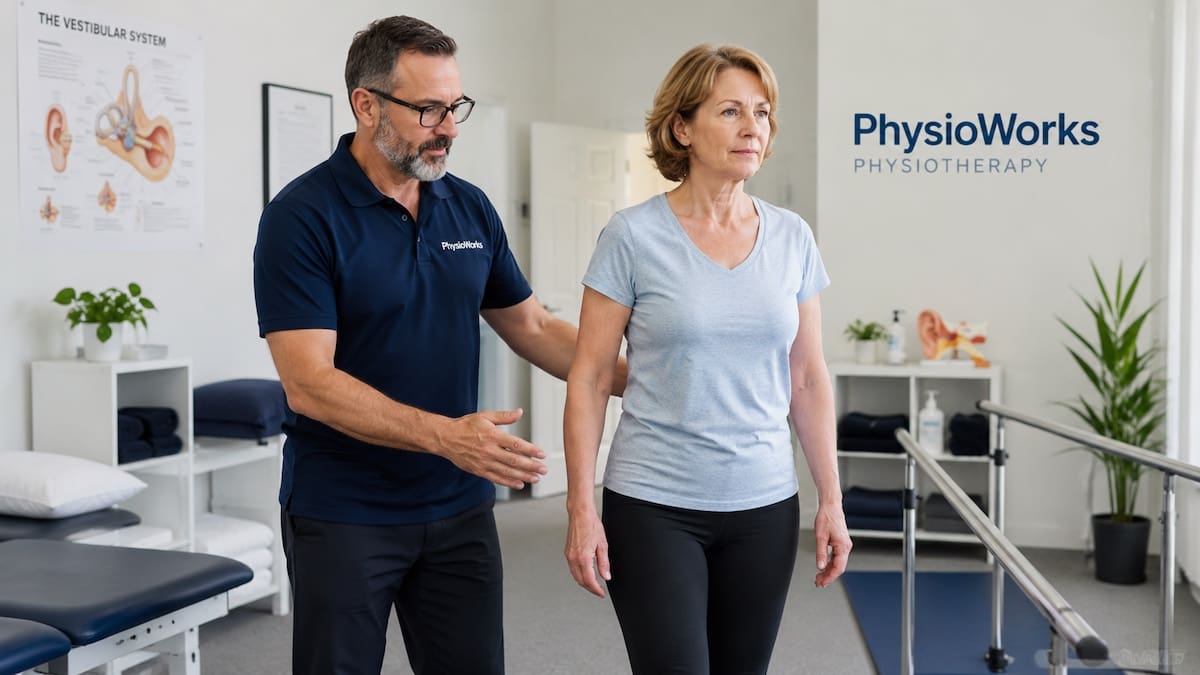
When vestibular rehab may be useful
Vestibular rehabilitation is usually more useful between attacks than during a severe spinning episode. It may suit people who feel unsteady, avoid head movement, or lose confidence with walking after vertigo episodes.
Exercises should match your symptoms, balance level, and medical advice. Overdoing exercises too early can flare symptoms in some people.
Can Ménière’s disease be cured?
Ménière’s disease is usually managed rather than cured. Some people have long stable periods. Others continue to have recurring episodes. The main goals are to reduce the impact of attacks, protect safety, support hearing and balance, and help you function more confidently between episodes.
Does diet help Ménière’s disease?
Dietary advice should be discussed with your doctor because it depends on your health history and symptom pattern. Some people are advised to review salt intake, caffeine, alcohol, and hydration habits. Diet alone is not the full answer, but it may form part of a broader medical plan.
When should dizziness be checked urgently?
Seek urgent medical care if dizziness or vertigo occurs with facial drooping, arm or leg weakness, slurred speech, double vision, fainting, chest pain, severe headache, new confusion, trouble walking, or a sudden major change in hearing or symptoms.
These symptoms are not typical Ménière’s disease patterns and need prompt medical assessment.
Related vestibular information
- Vertigo and dizziness
- Vertigo physiotherapy
- BPPV
- Vestibular migraine
- Persistent Postural-Perceptual Dizziness
- Vestibular FAQs
Frequently asked questions about Ménière’s disease
How long can a Ménière’s disease attack last?
A Ménière’s disease vertigo attack commonly lasts from about 20 minutes to several hours. Some people recover quickly afterwards, while others feel tired, foggy, or unsteady for longer.
Is Ménière’s disease the same as vertigo?
No. Vertigo is a symptom. Ménière’s disease is one possible cause of vertigo. BPPV, vestibular migraine, vestibular neuritis, PPPD, and other health problems can also cause dizziness or spinning sensations.
Can Ménière’s disease affect hearing?
Yes. Ménière’s disease can cause fluctuating hearing loss, often in one ear. Tinnitus and ear fullness can also occur. A GP, ENT specialist, or audiologist may recommend hearing tests to help guide diagnosis and management.
When is physiotherapy useful for Ménière’s disease?
Physiotherapy is usually most useful between attacks when imbalance, motion sensitivity, dizziness, or fear of falling affects walking, work, activity, or confidence. It is not the primary medical treatment for inner ear fluid changes.
Should I exercise during a Ménière’s disease attack?
During a severe vertigo attack, safety and medical advice come first. Sit or lie safely, avoid driving, and follow your medical plan. Once severe spinning settles, guided rehabilitation may help you return to movement more confidently.
When should Ménière’s disease symptoms be checked urgently?
Seek urgent medical care if dizziness occurs with weakness, facial drooping, slurred speech, severe headache, chest pain, fainting, double vision, new confusion, or a sudden major change in symptoms.
What to do next
If Ménière’s disease or recurring vertigo is affecting your balance, walking, work, or confidence, a vestibular physiotherapy assessment may help clarify what is contributing to your symptoms and what rehabilitation steps may suit you.
Book an appointment if symptoms are settled enough for assessment, or seek medical care first if your symptoms are sudden, severe, unusual, or linked with hearing or neurological changes.
What to do now:
- seek medical review for new or worsening vertigo symptoms
- track episode timing, hearing changes, and possible triggers
- consider vestibular physiotherapy if imbalance continues between attacks
Choose your clinic and appointment pathway
Select a PhysioWorks clinic to continue to live booking, an appointment request or reception assistance.
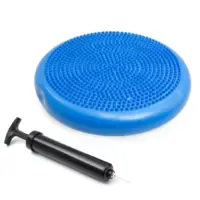
Balance Products
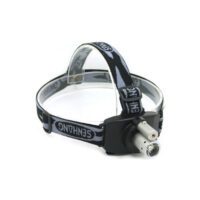
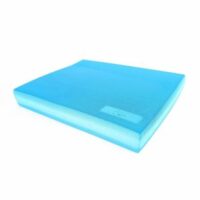
These balance products are commonly used by our physiotherapists to improve strength, balance, prevent injuries falls or injuries, plus assist home exercise programs.
-
-
- Gift Ideas, Back, Christmas Gift Ideas, Exercise Balls, Exercise Equipment, Knee, Pelvic Floor, Product Search
66fit Pilates Balls
$14.95 – $16.95Select optionsQuick View -
-




References
- Basura GJ, Adams ME, Monfared A, et al. Clinical Practice Guideline: Ménière’s Disease. Otolaryngol Head Neck Surg. 2020;162(2_suppl):S1-S55. doi:10.1177/0194599820909438
- Lopez-Escamez JA, Carey J, Chung WH, et al. Diagnostic criteria for Ménière’s disease. J Vestib Res. 2015;25(1):1-7. doi:10.3233/VES-150549
- Rezaeian A, Abtahi H, Moradi M, Farajzadegan Z. The effect of vestibular rehabilitation in Meniere’s disease: a systematic review and meta-analysis of clinical trials. Eur Arch Otorhinolaryngol. 2023;280(9):3967-3975. doi:10.1007/s00405-023-08066-x
- Hall CD, Herdman SJ, Whitney SL, et al. Vestibular Rehabilitation for Peripheral Vestibular Hypofunction: An Updated Clinical Practice Guideline. J Neurol Phys Ther. 2022;46(2):118-177. doi:10.1097/NPT.0000000000000382
- National Institute on Deafness and Other Communication Disorders. What Is Ménière’s Disease? Diagnosis and Treatment. Updated August 15, 2024. Accessed July 6, 2026.
