
Real-Time Ultrasound Physiotherapy
Live visual feedback for deep core, pelvic floor and muscle control retraining.

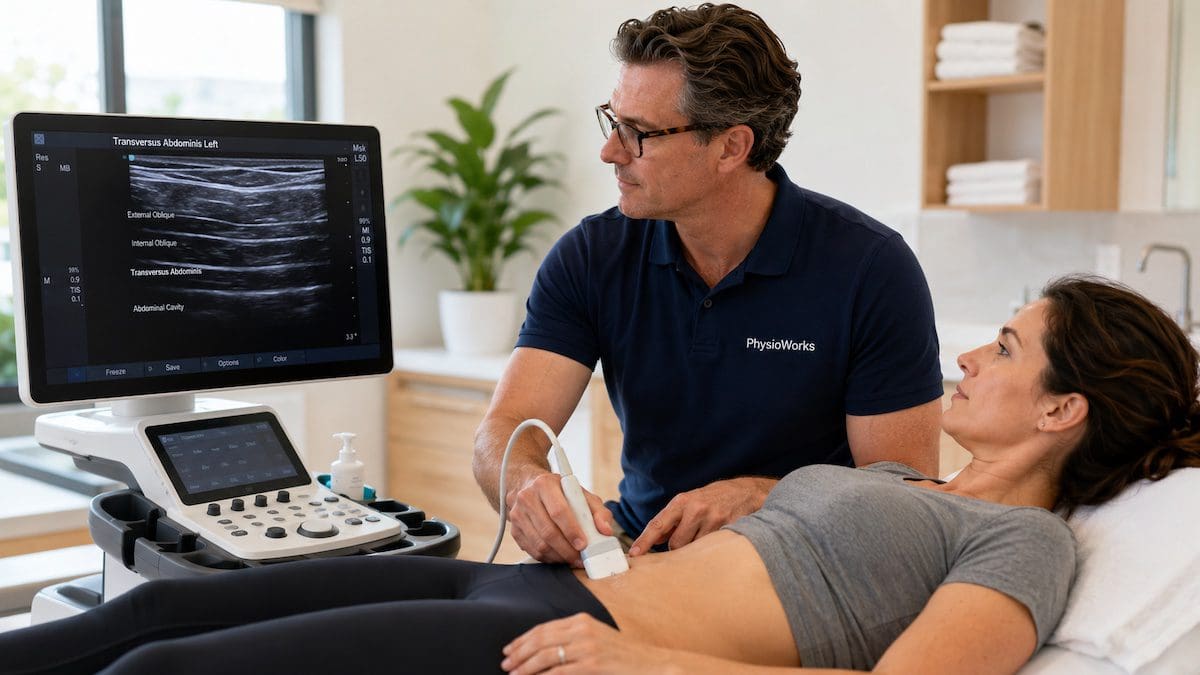
Live ultrasound feedback for deep core retraining.
Real-time ultrasound physiotherapy uses live ultrasound imaging to help you see how specific muscles contract, relax, and coordinate during exercise. At PhysioWorks, this treatment is most often used alongside physiotherapy and rehabilitation for deep trunk, pelvic floor, and stabilising muscle retraining. It is available at our Ashgrove and Sandgate clinics.
Many people find it helpful when they are struggling to feel the right muscle working during exercise. That can happen with lower back pain, sciatica, pelvic floor dysfunction, or after surgery. Instead of guessing, you and your physiotherapist can watch the muscle response on screen and match what you feel with what is actually happening.
Quick summary
- Real-time ultrasound physiotherapy uses live imaging as exercise feedback.
- It can help show whether deep support muscles are switching on correctly.
- It is commonly used for deep core, pelvic floor and muscle control retraining.
- It works best as part of a broader physiotherapy rehabilitation plan.
What is real-time ultrasound physiotherapy?
Real-time ultrasound physiotherapy is a rehabilitation tool that uses live imaging as visual feedback while you perform specific muscle exercises. It does not treat tissue with heat or sound waves. Instead, it helps your physiotherapist assess muscle timing, control, and activation so you can retrain the correct muscles more accurately.
How does real-time ultrasound retraining work?
The ultrasound scanner shows a live image of muscles beneath the skin while you perform guided movements or low-load exercises. This is especially useful for muscles that are difficult to feel, such as the transversus abdominis, multifidus, and pelvic floor. Your physiotherapist can then adjust your position, breathing, and movement strategy so the target muscle works at the right time and with the right pattern.
For some people, that makes exercise clearer and more efficient. It can also reduce compensation from larger outer muscles that often take over when deep stabilising muscles are slow, inhibited, or poorly coordinated.
Why use real-time ultrasound feedback?
- Shows whether the correct deep muscle is switching on
- Helps reduce compensation from larger outer muscles
- Makes exercise coaching more precise and easier to follow at home
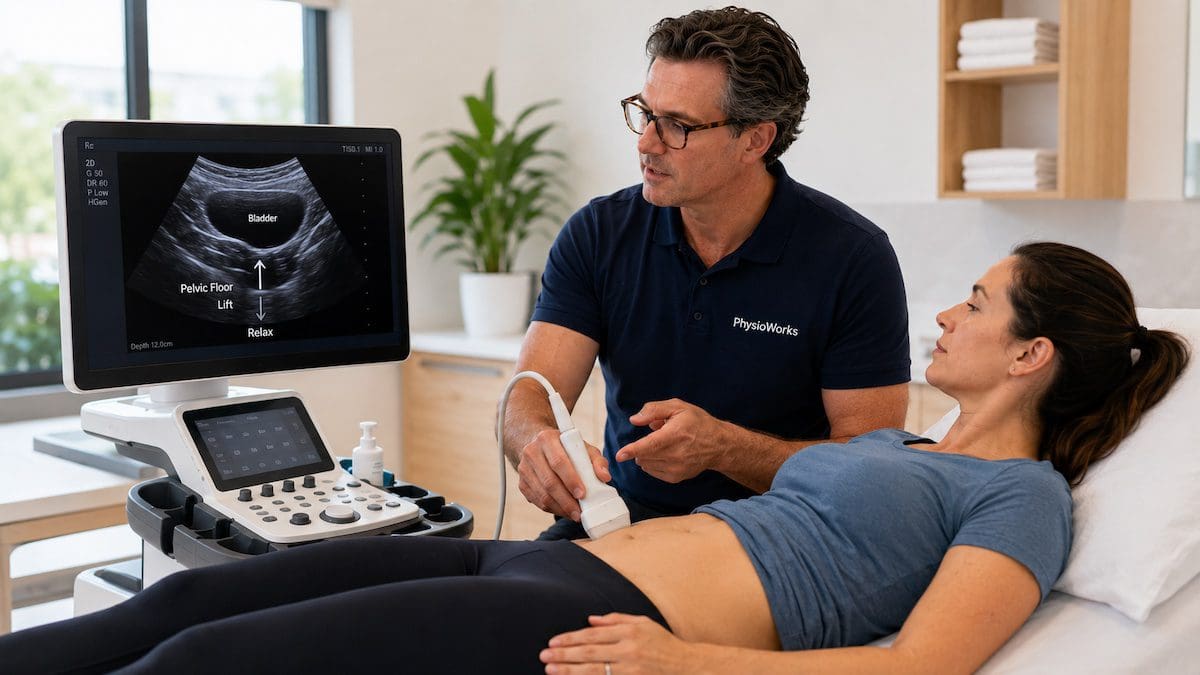
Bladder ultrasound can help guide pelvic floor control.
Can real-time ultrasound help pelvic floor retraining?
Real-time ultrasound may help pelvic floor retraining by showing movement through the lower abdomen and bladder region. During guided breathing and pelvic floor activation, the image can help your physiotherapist explain lift, relaxation, timing, and whether you are using the correct strategy.
This can be useful when people are unsure whether they are contracting or relaxing the pelvic floor correctly. It may also help during postnatal rehabilitation, continence rehabilitation, or pre and post prostatectomy rehab, depending on your assessment findings.
What conditions benefit from real-time ultrasound physiotherapy?
Real-time ultrasound retraining is commonly used when muscle control is part of the problem rather than strength alone. It may assist people with:
- back pain and deep core retraining
- lower back pain involving poor trunk muscle timing
- sciatica where trunk control forms part of rehabilitation
- sacroiliac joint pain
- pregnancy back pain and postnatal rehabilitation
- pelvic floor exercises and continence rehabilitation
- shoulder pain when muscle control retraining is needed
- knee pain where quadriceps timing or control matters
How can real-time ultrasound physiotherapy help deep core retraining?
Deep support muscles often work quietly and can be hard to isolate by feel alone. That is why some people struggle with core stability training even when they are trying hard. Real-time ultrasound gives immediate feedback, so you can see whether the correct muscle is switching on and whether larger surrounding muscles are dominating instead.
This can be particularly useful in early rehabilitation, after pain flare-ups, after pregnancy, or when returning to sport following periods of reduced training. For more detail on the deep trunk muscles often targeted in this process, see our deep core muscles guide.
Who may benefit from real-time ultrasound retraining?
This treatment may suit people who have persistent symptoms, recurrent episodes, or difficulty learning an exercise pattern despite clear verbal instruction. It can also help athletes and active people who need more precise muscle retraining as part of a broader rehabilitation plan.
If your rehabilitation depends on motor control, timing, or coordination, real-time ultrasound may give your physiotherapist another useful way to assess progress and improve exercise quality.
What happens during an ultrasound physiotherapy session?
Your physiotherapist will first assess your symptoms, movement pattern, and rehabilitation goals. The ultrasound probe is then placed over the relevant area so you can watch the muscles on screen during simple movements or exercises. You may be asked to practise breathing, abdominal bracing, pelvic floor contraction, posture changes, or low-load limb movements while the image provides feedback.
Most people then continue with a home or gym-based exercise program. Real-time ultrasound is usually one part of treatment rather than the whole program.
How is progress built into your rehabilitation plan?
Progress usually starts with accurate awareness of the target muscle, then moves into better control during everyday positions and exercise. Your physiotherapist may progress your program from breathing and low-load activation into trunk control, lifting, walking, running, gym work, or sport-specific tasks when appropriate.
This staged approach helps connect the screen feedback to real movement. The goal is not just to switch a muscle on once, but to build a pattern you can use confidently outside the treatment room.
How your plan may progress
| Stage | Focus | Example |
|---|---|---|
| Early | Awareness and timing | Breathing, gentle activation, relaxation control |
| Middle | Control during movement | Trunk control, posture changes, low-load limb movement |
| Later | Functional carryover | Lifting, gym work, walking, running, or sport-specific drills |
When is real-time ultrasound retraining recommended?
Real-time ultrasound retraining is most useful when accurate muscle activation is important and standard coaching has not been enough. Your physiotherapist may recommend it during early-stage core stability training, pelvic floor retraining, post-surgical rehabilitation, or persistent spinal pain management. For general information about how physiotherapy may help, Healthdirect provides a useful overview of physiotherapy.
When may ultrasound physiotherapy not be appropriate?
Real-time ultrasound retraining is not needed for every injury or every exercise program. If your main limitation is load tolerance, strength, joint mobility, or conditioning, other rehabilitation strategies may be more important. It is also not a stand-alone fix. Good results usually depend on combining it with the right diagnosis, exercise progression, and broader rehabilitation plan.
What to do now
- Book a physiotherapy assessment if you cannot feel the right muscles working during rehabilitation
- Ask whether deep core, pelvic floor, or stabilising muscle retraining is relevant to your symptoms
- Use ultrasound feedback as part of a broader exercise and recovery plan
Related PhysioWorks guides
These related guides may help you connect real-time ultrasound feedback with your broader rehabilitation plan:
- Core stability training
- Deep core muscles guide
- Pelvic floor exercises
- Lower back pain
- Pregnancy back pain
Real-Time Ultrasound Physiotherapy FAQs
Is real-time ultrasound physiotherapy the same as therapeutic ultrasound?
No. Real-time ultrasound physiotherapy uses imaging as visual feedback during exercise and assessment. Therapeutic ultrasound is a different modality that has traditionally been used to apply sound energy to tissues. On this page, the focus is on live imaging to improve muscle control, movement quality, and exercise accuracy.
Can real-time ultrasound retraining help back pain?
It may help some people with back pain when poor activation or timing of the deep trunk muscles forms part of the problem. It is most useful when a physiotherapist needs to teach more accurate control of muscles such as the transversus abdominis or multifidus as part of a broader rehabilitation program.
Can ultrasound physiotherapy help pelvic floor problems?
It may. Real-time imaging can be used during pelvic floor exercises to improve awareness of muscle lift, relaxation, and timing. That can be helpful for some people with pelvic floor dysfunction, postnatal recovery, or continence issues, especially when they are unsure whether they are doing the exercise correctly.
What muscles can real-time ultrasound show during rehabilitation?
Real-time ultrasound may show deep muscles such as the transversus abdominis, multifidus, and pelvic floor, depending on the assessment area and clinical goal. Your physiotherapist will choose the target area based on your symptoms, movement findings, and rehabilitation plan.
Do I need a referral for real-time ultrasound physiotherapy?
Most people do not need a referral to see a physiotherapist for assessment and rehabilitation. However, some funding pathways, insurers, or medical programs may have their own requirements. If you are unsure, phone the clinic first and the team can explain the best booking pathway for your situation.
How many sessions of real-time ultrasound retraining will I need?
That depends on your condition, goals, and how quickly you learn the exercise pattern. Some people only need a small number of sessions to improve muscle awareness, while others benefit from repeated review as part of longer rehabilitation. Your physiotherapist will guide this based on your progress.
Is real-time ultrasound physiotherapy safe?
Yes, it is generally considered a low-risk assessment and feedback tool when used by a trained clinician. It is non-invasive and is commonly used to observe muscle movement during exercise. The main issue is not safety, but whether it is the right tool for your presentation and rehabilitation goals.

Retraining can progress into confident movement control.
What to do next
If you have ongoing pain, recurrent symptoms, or difficulty activating the correct muscles during rehabilitation, book a physiotherapy assessment to check whether real-time ultrasound retraining is likely to add value. Your physiotherapist can explain whether your problem is more related to motor control, strength, mobility, or load tolerance.
PhysioWorks offers real-time ultrasound physiotherapy at the following clinics:
If this treatment suits your needs, we can integrate it into a structured rehabilitation program that matches your diagnosis, goals, and stage of recovery.
Choose your clinic and appointment pathway
Select a PhysioWorks clinic to continue to live booking, an appointment request or reception assistance.


References
- Valera-Calero JA, Al-Boloushi Z, Casaña J, et al. Ultrasound Imaging as a Visual Biofeedback Tool in Rehabilitation: An Updated Systematic Review. Int J Environ Res Public Health. 2021;18(14):7554. doi:10.3390/ijerph18147554
- Van K, Hides JA, Richardson CA. The use of real-time ultrasound imaging for biofeedback of lumbar multifidus muscle contraction in healthy subjects. J Orthop Sports Phys Ther. 2006;36(12):920-925. doi:10.2519/jospt.2006.2304
- Kuo YL, Lin KY, Wu MH, Wu CH, Tsai YJ. Transabdominal ultrasonography-guided biofeedback training for pelvic floor muscles integrated with stabilization exercise improved pregnancy-related pelvic girdle pain and disability: a randomized controlled trial. Physiotherapy. 2024;124:106-115. doi:10.1016/j.physio.2024.01.005
