
Active Foot Posture Correction Exercises
Physiotherapy-guided arch control, foot strength and lower limb loading exercises.


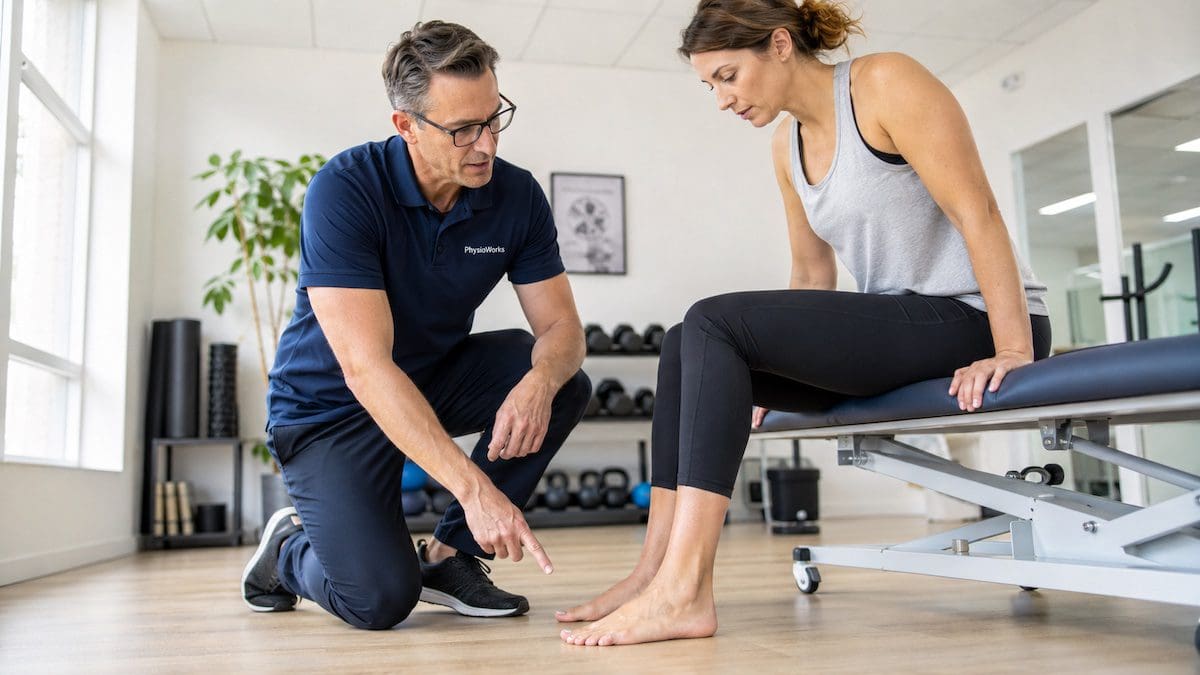
Guided arch control can help improve foot loading during daily movement.
Active foot posture correction exercises train the muscles that help support your arch, control foot posture and manage load through the foot and ankle. At PhysioWorks, this program sits within special interest rehabilitation and may suit people with foot pain, flat feet, plantar fasciitis and related overload problems.
Rather than relying only on passive support, these exercises aim to improve how your foot works during standing, walking, running and sport. A physiotherapist may assess your foot posture, walking pattern, balance, calf flexibility and lower limb control before choosing the right starting level.
Quick Summary
- Best suited to: flexible flat feet, arch collapse, foot fatigue and some overload problems.
- Main goal: improve foot strength, arch control and loading tolerance.
- Often combined with: footwear advice, calf strength, balance work and temporary orthotic support.
- Progression: seated control, standing balance, walking, running and sport-specific loading.
What are active foot posture correction exercises?
Active foot posture correction exercises are progressive strength and control drills for the small muscles inside the foot and the larger muscles that help guide arch support, ankle stability and lower limb alignment. The goal is to improve how your foot manages load, not simply make the arch look higher at rest.
These exercises are often used when poor arch control, calf weakness, balance deficits or footwear stress may be adding load to the heel, arch, forefoot or ankle.
- They may help painful flexible flat feet or collapsing arches.
- They may reduce overload through the heel, arch and forefoot.
- They can work alongside footwear advice and temporary orthotic support.
- They usually progress from simple control drills to weight-bearing function.
How do active foot posture correction exercises work?
Active foot posture correction exercises work by improving muscle activation, endurance and movement quality. This helps the foot manage load with each step during walking, standing, running and sport.
Your foot acts as the base for the rest of your body. If arch control is poor, extra stress may travel through the forefoot, ankle, shin, knee, hip and lower back. Exercise can help improve control, but it needs to match your symptoms and your current strength.
Most programs start with awareness and low-load control. They then move into standing balance, calf strength, walking retraining and sport-specific loading where needed.
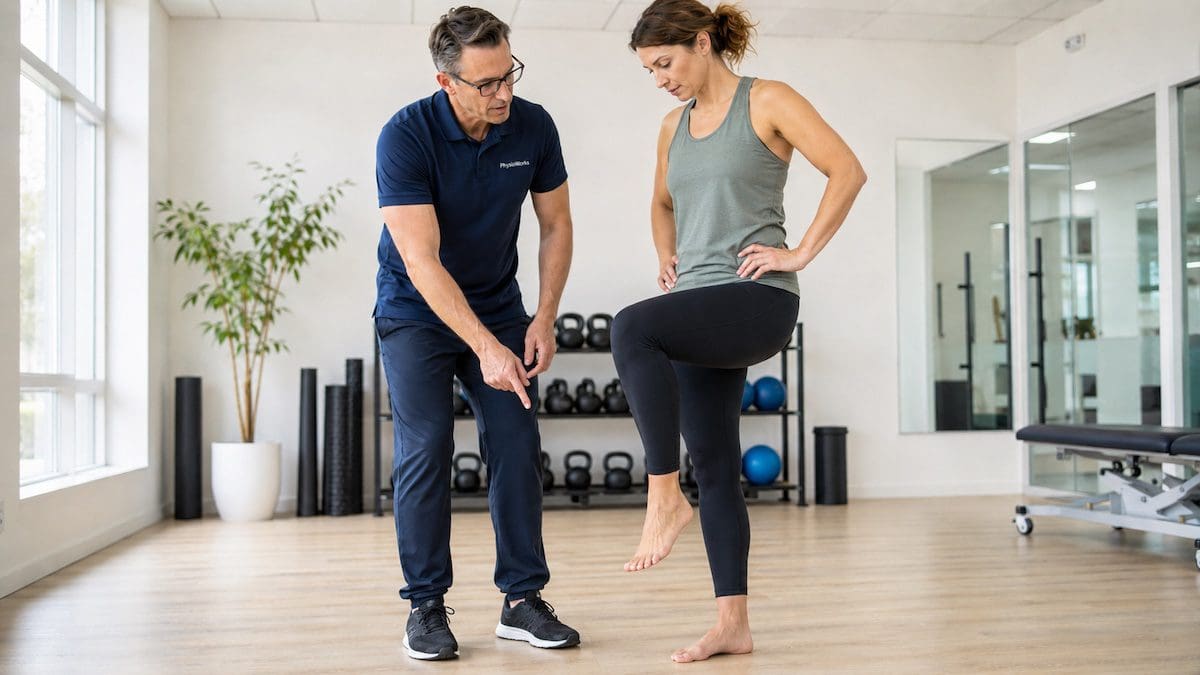
Balance progressions help build foot control for walking, running and sport.
What exercises are commonly used?
Your physiotherapist may begin with low-load control drills such as short-foot activation, toe control, arch doming, calf control, balance tasks and walking retraining. The aim is not simply to “lift the arch”. The aim is to improve how your foot manages load during daily activity.
As control improves, your program may progress to standing balance, heel raises, single-leg control, hopping drills, running drills or sport-specific tasks. Progression should match your symptoms, strength, footwear and activity goals.
Typical Exercise Progression
| Stage | Main focus | Examples |
|---|---|---|
| Early control | Find the arch muscles and reduce over-gripping. | Short-foot drill, toe control, seated arch awareness. |
| Standing strength | Hold better foot posture under body weight. | Heel raises, calf loading, supported single-leg balance. |
| Walking control | Use the foot well during normal movement. | Step control, gait cues, footwear review. |
| Sport or higher load | Build tolerance for faster or repeated loading. | Hopping, running drills, change-of-direction work. |
Who can benefit from active foot posture correction exercises?
Active foot posture correction exercises may suit people whose symptoms are linked to poor foot posture, reduced arch control or overload through the foot and ankle. They are commonly considered for pes planus, plantar fasciitis, heel spurs, metatarsalgia and some cases of recurrent ankle instability.
They may also help runners, field-sport athletes, active workers and people who notice foot fatigue after long periods of walking or standing. If symptoms suggest nerve irritation, inflammatory disease, fracture or a rigid structural problem, your physiotherapist may recommend further assessment first.
Should you stop wearing orthotics?
You should not stop wearing orthotics suddenly if they help you walk, stand or work with less pain. In many cases, active foot posture correction exercises are used alongside orthotics first.
This is often more practical than removing support too early. Some people can gradually reduce orthotic use as strength and endurance improve. Others do better with a mix of exercise, footwear changes and ongoing arch support. The right plan depends on your foot structure, sport, work demands and symptom history.
Keep exercising or reduce load?
Continue gentle exercises if symptoms stay mild, settle quickly and do not change your walking pattern.
Reduce load and seek advice if pain increases during the day, changes your gait, causes swelling or keeps returning after activity.
Stop and arrange medical review if you have sudden severe pain, marked swelling, numbness, unexplained night pain or pain after trauma.
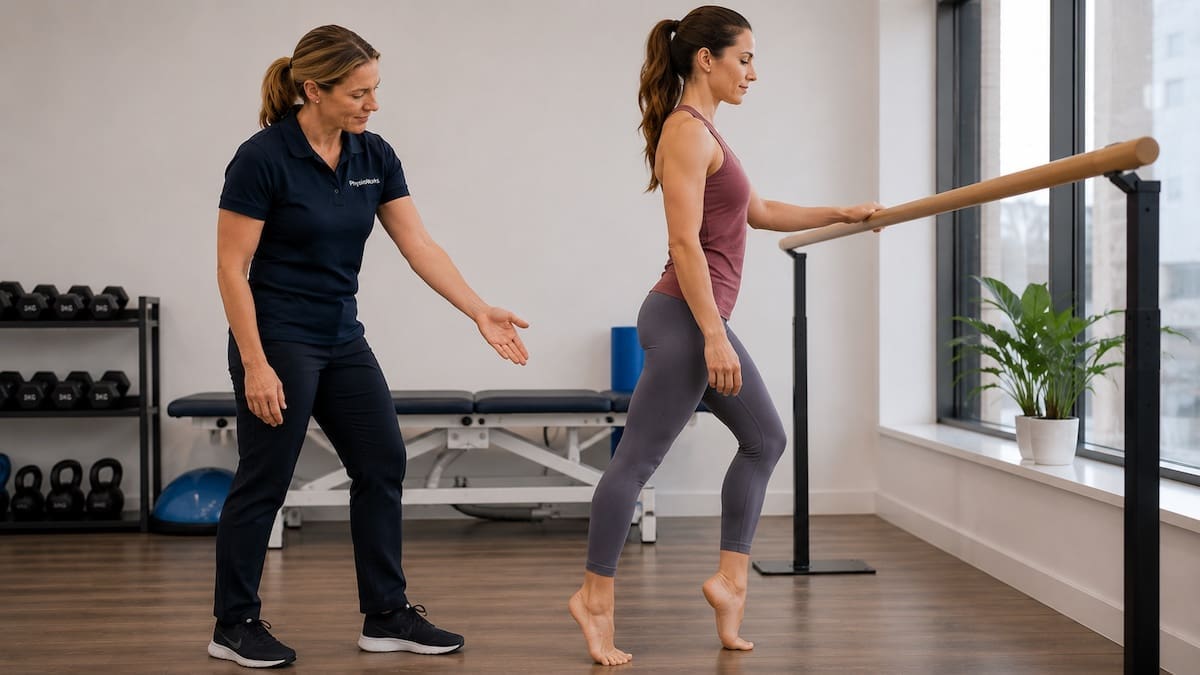
Rebuilding confident forefoot push-off.
How long do active foot posture correction exercises take to work?
The timeline varies. Mild to moderate cases may improve over several weeks. Long-standing weakness, rigid foot posture or more complex lower limb issues usually take longer.
Progress often depends on exercise accuracy, loading tolerance, consistency, footwear and whether calf stiffness, hip control or balance deficits are also being addressed. Research suggests foot and lower limb exercise can improve arch shape and function in adults with flexible flatfoot. Plantar heel pain guidelines also support exercise, stretching, taping and individualised education as part of conservative care. Healthdirect’s flat feet overview notes that supportive shoes, physiotherapy and orthotics may help when symptoms are present.
What happens during an assessment?
Your physiotherapist will usually assess your standing foot posture, walking pattern, single-leg balance, ankle mobility, calf strength, footwear and symptom behaviour. They may also check whether your pain is more likely coming from the plantar fascia, forefoot, tendon structures, joint loading or another source such as tarsal tunnel syndrome.
From there, your physiotherapist may prescribe a graded exercise program that matches your starting point. Early exercises often focus on control and arch awareness. Later stages may include balance, calf loading, hopping, gait retraining and return-to-sport drills where relevant.
Where is this service available?
PhysioWorks provides rehabilitation services across multiple Brisbane clinics. To find a suitable location for active foot posture correction exercises, visit the PhysioWorks clinics page or book with your preferred clinic through Physiotherapy Treatment. Service suitability may vary depending on clinician interests and appointment availability.
FAQs about active foot posture correction exercises
Can active foot posture correction exercises help flat feet?
They may help some people with flexible flat feet by improving muscle control, endurance and foot loading patterns. Results vary depending on age, foot flexibility, symptom severity and whether the foot posture is flexible or more rigid.
Are active foot posture correction exercises good for plantar fasciitis?
They can form part of a broader plantar fasciitis program, especially when poor arch control or foot loading contributes to symptoms. Treatment may also include calf and plantar fascia stretching, taping, footwear advice and load modification.
Do I still need supportive shoes?
Often yes, at least in the short term. Supportive footwear can reduce strain while your foot strength and endurance improve. Your physiotherapist can guide when shoe changes or reduced support are appropriate.
Can these exercises replace orthotics?
Sometimes, but not for everyone. Some people can gradually reduce orthotic use as control improves. Others continue to benefit from a combination of exercise, footwear changes and support.
How often should I do active foot posture correction exercises?
Most programs work well when practised regularly in short, accurate sessions. Your physiotherapist may start with daily low-load control drills, then progress to strength and balance exercises several times per week. Accuracy matters more than doing many poor repetitions.
Can these exercises help runners?
They may help some runners when poor arch control, foot fatigue, calf weakness or lower limb loading issues contribute to symptoms. Running-related programs often need more than foot exercises alone. They may also include calf strength, hip control, gait retraining, footwear advice and load management.
What to do next
If you have painful flat feet, arch collapse, heel pain or forefoot overload, a physiotherapy assessment can help identify whether active foot posture correction exercises are likely to suit you. Your treatment plan may include exercise progressions, footwear advice, temporary support strategies and guidance on safe return to walking, work or sport.
Early assessment is useful when symptoms keep returning, when pain affects your walking or when you are unsure whether your problem is muscular, tendon-related, joint-related or linked to another condition. A tailored program is usually safer and more useful than guessing which foot exercises to do.
Choose your clinic and appointment pathway
Select a PhysioWorks clinic to continue to live booking, an appointment request or reception assistance.
Ankle Products
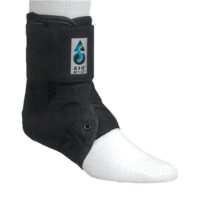
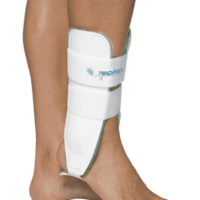
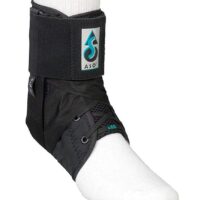
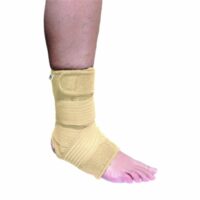
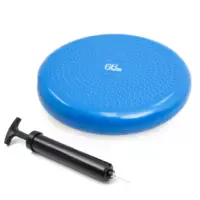
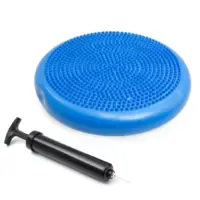
These ankle products are commonly used by our physiotherapists to improve ankle pain, strength, balance, proprioception, endurance and flexibility, plus assist home exercise programs.
-
 Ankle, Braces & Supports, Clearance Sale
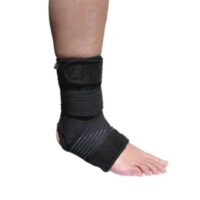
Ankle Support with Strap – OPPO 1003
$42.00Select optionsQuick View -
 Ankle, Braces & Supports, Foot, Walking
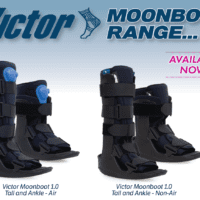
Victor Moonboot 1.0 Air or No Air
$77.00 – $79.00Select optionsQuick View -
-
-
 Ankle, Braces & Supports, Foot
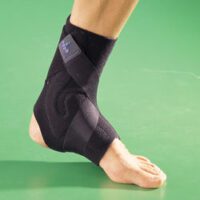
Ankle Support with Plastic Stay – OPPO 1109
$52.00Select optionsQuick View -
-


-
-
-
- EMS Machines, Pain Management, TENS Machine, TENS Machine & EMS
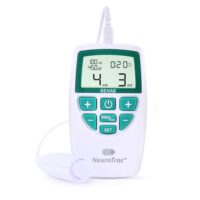
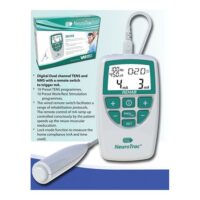
NeuroTrac Rehab (TENS Machine + EMS)
$285.00Add to cartQuick View -

-

- Liniments & Gels, Massage Liniments, Pain Management
Fisiocrem
$16.95 – $39.95Select optionsQuick View -
-


References
- Koc TA Jr, Goulet GC, O’Halloran E, et al. Heel Pain – Plantar Fasciitis: Revision 2023. J Orthop Sports Phys Ther. 2023;53(12):CPG1-CPG39. doi:10.2519/jospt.2023.0303
- Morrissey D, Cotchett M, Said J’Bari A, et al. Management of plantar heel pain: a best practice guide informed by a systematic review, expert clinical reasoning and patient values. Br J Sports Med. 2021;55(19):1106-1118. doi:10.1136/bjsports-2021-104425
- Wei Z, Zeng Z, Liu M, Wang L. Effect of intrinsic foot muscles training on foot function and dynamic postural balance: A systematic review and meta-analysis. PLoS One. 2022;17(4):e0266525. doi:10.1371/journal.pone.0266525
- Jia Y, Sai X, Zhang E. Comparing the efficacy of exercise therapy on adult flexible flatfoot individuals through a network meta-analysis of randomized controlled trials. Sci Rep. 2024;14:21186. doi:10.1038/s41598-024-72149-w
- Flat feet (fallen arches). Healthdirect Australia. Accessed June 24, 2026.
