
Running Assessment
Running Injury Risk & Performance Assessment Brisbane



Assessing single-leg control for running injury risk.
A running assessment checks whether your body has the strength, flexibility, control and load tolerance needed for running. It helps identify deficits that may increase injury risk or limit performance, especially if you are returning from pain, increasing distance, or preparing for an event.
This one-hour runner assessment is available at our Clayfield, Sandgate, and Ashgrove clinics. It goes beyond a basic running analysis by assessing your strength, flexibility, movement control and running-related load capacity.
Available Clinics
Running Injury Risk & Performance Assessments are currently available at:
Please mention your running goals, recent injuries, or upcoming event when booking.
Runner Assessment: Quick Summary
- Session time: approximately 60 minutes.
- Tests: flexibility, strength, balance, control and running-related movement.
- Results: colour-coded chart: normal, minor deficit or major deficit.
- Outcome: a specific exercise plan to target your weak links.
- Best for: injured runners, returning runners, event preparation and injury prevention.
What Is a Running Assessment?
A running assessment is a structured physiotherapy screen for runners. It checks how your hips, knees, ankles, calves, feet and trunk cope with running demands. The aim is to identify modifiable issues before they become bigger problems.
Running loads the body repeatedly. Small deficits in calf strength, hip control, ankle mobility or single-leg stability can matter when repeated thousands of times each run. This assessment connects your test results to your training, injury history and goals.
Who Should Book a Runner Assessment?
You may benefit from a runner assessment if you want to reduce injury risk, return from pain, or improve running performance. It suits recreational runners, half marathon runners, marathon runners, trail runners, triathletes and athletes who use running as part of their sport.
- You keep getting recurring running injuries.
- You are increasing distance, speed work, hills or race training.
- You have had shin splints, Achilles tendinopathy, runner’s knee or plantar fasciitis.
- You want a structured plan before an event.
- You are unsure what strength or mobility work your body needs.
What Does the One-Hour Runner Assessment Include?
Your physiotherapist will assess your running history, current training load, previous injuries, footwear, flexibility, muscle strength and movement control. The session gives you clear actions, not just a list of findings.
1. Running History and Training Load
We review your weekly distance, recent changes, terrain, speed sessions, hills, footwear, recovery and event goals. This helps identify whether training load, tissue capacity, or both may be contributing to your risk profile.
2. Flexibility and Mobility Testing
We assess areas that commonly affect running mechanics, including ankle mobility, calf flexibility, hip flexor length, hamstring flexibility, glute mobility and trunk rotation. Reduced mobility in one area may increase load elsewhere.
3. Runner Muscle Strength Testing
We test key running muscles, including the calves, glutes, hamstrings, quadriceps, hip stabilisers and trunk. Calf capacity and hip control are especially important for many running-related injuries.
4. Single-Leg Control and Movement Tests
Running is mostly a series of single-leg landings. We assess balance, step-down control, hopping tolerance, squat mechanics and landing quality. These tests may highlight deficits linked to knee pain, shin pain, hip pain or ankle overload.
5. Running-Specific Plan
Your results are converted into a clear plan. You receive targeted exercises for your main deficits, along with practical advice on training progression, recovery and when to review.
Colour-Coded Runner Deficit Chart
Your assessment findings are charted into three practical categories:
- Normal: no clear deficit found for that test.
- Minor deficit: an area to improve before it becomes a bigger problem.
- Major deficit: a priority weakness or restriction that needs targeted work.
This makes your program easier to understand and gives you a baseline to retest later.
Why Do Running Injuries Keep Returning?
Running injuries often return when the original weak link has not been corrected. Pain may settle with rest, but the underlying issue can remain. Common contributors include calf weakness, hip control deficits, poor load progression, reduced ankle mobility, low tendon capacity and inadequate recovery.
Research suggests running-related injury risk is influenced by multiple factors rather than one single cause. Recent reviews highlight the importance of training history, previous injury, load, strength, flexibility and individual runner characteristics. A runner assessment helps identify which factors matter most for you.
Can a Running Assessment Reduce Injury Risk?
A running assessment may help reduce injury risk when it leads to practical changes. These may include a targeted strength program, mobility work, graded load progression, running technique advice or referral for further review when needed.
The assessment does not make runners injury proof. Instead, it helps identify modifiable deficits and gives you a clearer plan. This is useful if you have recurring running injuries or you are building toward a race.

Testing calf strength and running load capacity.
Common Running Weaknesses We Assess
| Area Tested | Why It Matters |
|---|---|
| Calf strength and endurance | Supports push-off, Achilles loading and repeated impact tolerance. |
| Hip strength and control | Helps manage pelvis, knee and foot position during single-leg loading. |
| Ankle mobility | Affects stride mechanics, hill running, squatting and landing control. |
| Hamstring and glute capacity | Supports hip extension, speed work and uphill running tolerance. |
| Single-leg balance and hopping | Tests running-specific control, stiffness and impact tolerance. |
How Is This Different From Running Analysis?
Running analysis focuses more on your running mechanics, gait pattern, stride and loading style. A runner assessment looks more broadly at whether your body has the musculoskeletal capacity to handle running.
Many runners benefit from both. However, if you keep getting injured, the strength and flexibility screen is often the missing piece. Changing your running style without improving tissue capacity may not be enough.
What Happens After the Assessment?
You leave with a practical program based on your results. Your plan may include strength exercises, mobility drills, balance work, hopping progressions, calf capacity training, glute strengthening, load-management advice or a graded return-to-running plan.
Your physiotherapist may also recommend review testing. This allows you to compare your later results with your first colour-coded chart and update your program as your strength, flexibility and control improve.
Ideal For Brisbane Runners Preparing For
- Half marathons
- Marathons
- Trail running events
- Hyrox preparation
- Triathlon running training
- Return to running after injury
- Running volume progression
Related Running Injury Pages
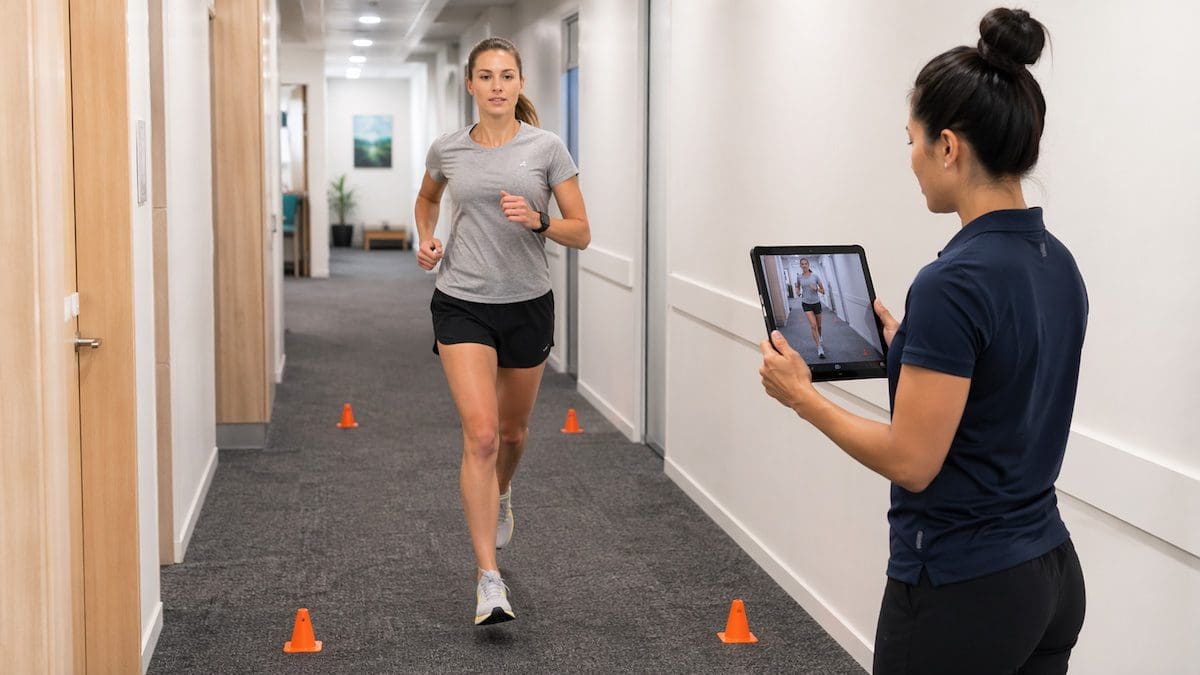
Reviewing running form and confident movement progress.
What To Do Next
If you want to run with more confidence, book a one-hour running assessment at Clayfield, Sandgate or Ashgrove PhysioWorks. Your physiotherapist will assess your flexibility, strength, movement control and running-related capacity, then create a targeted plan based on your colour-coded results.
This assessment is useful before race preparation, after a running injury, or when you want a clearer plan to improve performance and reduce avoidable training setbacks.
Choose your clinic and appointment pathway
Select a PhysioWorks clinic to continue to live booking, an appointment request or reception assistance.


References
- Correia CK, et al. Risk factors for running-related injuries: an umbrella systematic review. J Sport Health Sci. 2024.
- Wu H, et al. Do exercise-based prevention programs reduce injury in endurance runners? Sports Med. 2024.
- Toresdahl BG, et al. Strength and flexibility self-assessment and subsequent training injuries among runners. Sports Health. 2025.
- Linton L, et al. Running-centred injury prevention support: a scoping review. 2025.
Runner Assessment FAQs
Where is the running assessment available?
The running assessment is currently available at Clayfield, Sandgate and Ashgrove PhysioWorks. Please choose one of these clinics when booking this service.
How long does a running assessment take?
A running assessment takes about one hour. This gives enough time to review your running history, assess flexibility, test key running muscles, check single-leg control and explain your colour-coded results.
Do I need to be injured to book a runner assessment?
No. Many runners book before symptoms become a problem. It can help identify strength, flexibility or control deficits before a training increase, race preparation block or return to running.
Is this the same as running analysis?
No. Running analysis focuses more on gait and running mechanics. A runner assessment checks your musculoskeletal ability to tolerate running, including strength, flexibility, control and load capacity.
What do I receive after the session?
You receive a colour-coded summary of your assessment findings and a targeted program. The aim is to address your main deficits and guide safer, more efficient running progress.
Can this assessment improve running performance?
It may help performance when the program improves weak links that limit running efficiency, strength, control or training tolerance. Performance gains depend on your baseline, consistency and training goals.
