
TRL Injuries: Common Injuries, Prevention and Return to Play


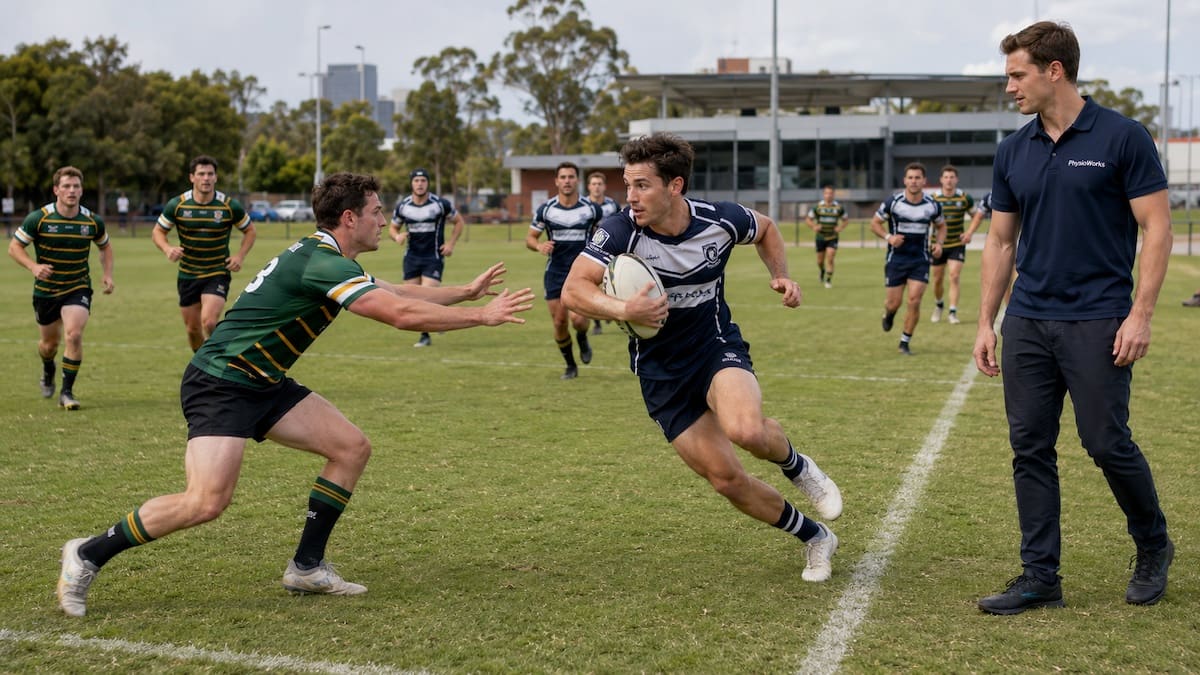
TRL places repeated load through the hamstrings, groin, knees, calves and ankles.
TRL injuries most often affect the hamstring, ankle, knee, calf and groin. Rapid acceleration, sharp sidestepping, sudden braking and repeated games can cause acute strains or sprains. Meanwhile, training-load spikes and limited recovery may contribute to gradual overuse pain.
Some injuries happen in one moment. Others build over several training sessions or tournament games. Symptoms often appear around the knee, ankle or back of the thigh. Gradually increasing soreness may also fit an overuse injury pattern.
Explore Football Injury Guides
Compare TRL with other football codes or open the broader football injury hub.
Why Do TRL Injuries Happen?
TRL involves repeated short bursts of running. Players accelerate, brake, shuffle, bend, sidestep and accelerate again. These movements place repeated load through the knees, ankles, hamstrings, calves and groin muscles.
TRL involves less direct contact than tackle football. However, low contact does not mean low physical demand. A player may still be injured during an awkward foot plant, accidental collision, dive, fall or sudden reach.
Fatigue can affect movement control late in a game or during back-to-back fixtures. Hard playing surfaces, unsuitable footwear grip, limited recovery and sudden increases in playing time may also change how the body manages load.
Evidence note: Direct TRL-specific injury research remains limited. Rugby league and broader field-sport research can help explain likely injury patterns, but tackle-code injury rates should not be interpreted as TRL injury rates.
Where Does Pain Occur During TRL?
The movement that triggers pain can help identify the body region that needs assessment. However, the playing action alone cannot confirm a diagnosis.
Accelerating or Chasing
Pain may occur through the hamstring, calf or Achilles region when sprint force rises quickly.
Sidestepping or Planting
A sharp change of direction may provoke knee pain, a knee ligament injury, an ankle sprain or groin pain.
Braking Rapidly
Sudden deceleration increases demand through the knee, quadriceps, calf and ankle as the body slows down.
Reaching or Diving
Falls and awkward touches may jar the shoulder, wrist, ribs or neck even when heavy contact is absent.
Repeated Tournament Games
Gradually increasing muscle or tendon pain may indicate that playing load has risen faster than recovery.
What Are the Most Common TRL Injuries?
The injury pattern varies with a player’s speed, previous injuries, fitness, playing surface and recovery. Common presentations include the following.
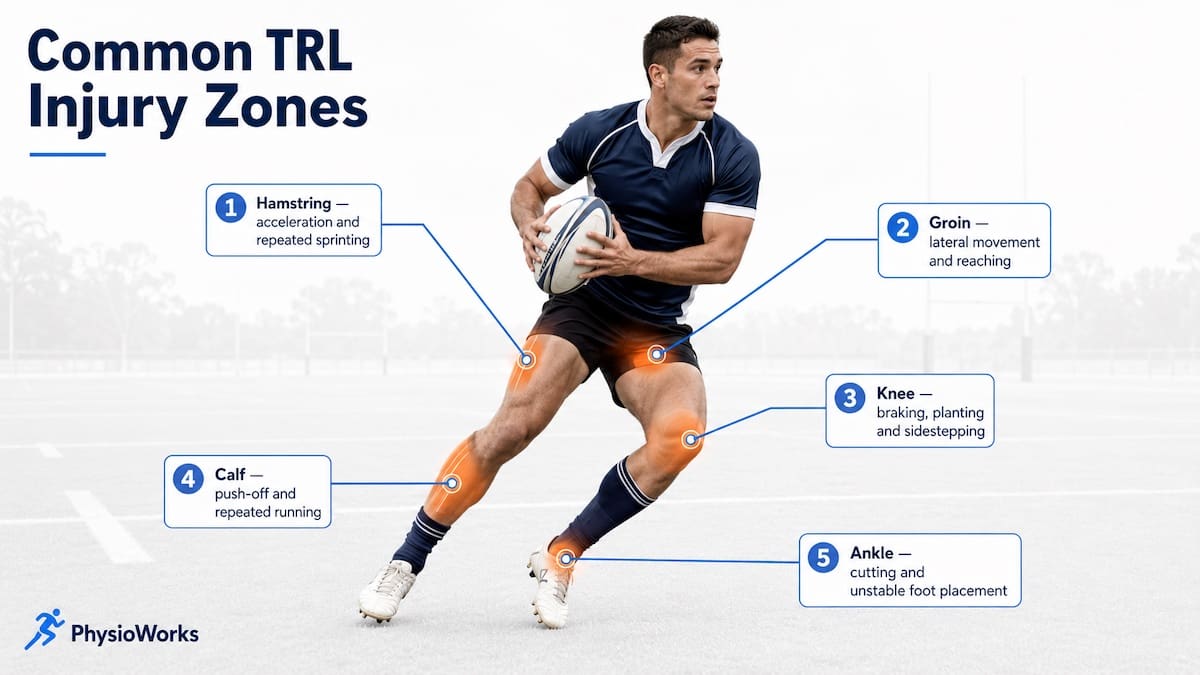
Acceleration, sidestepping, braking and repeated running create different injury demands during TRL.
Hamstring Strain
A hamstring strain may occur during acceleration, chasing or repeated sprint efforts. Risk may increase when sprint exposure rises suddenly or fatigue reduces running control.
Ankle Sprain
The ankle may roll during a quick cut, unstable landing or awkward foot plant. Previous ankle sprains may also affect balance and confidence.
Knee Pain
Knee symptoms may relate to load intolerance, tendon irritation, a joint sprain or difficulty managing repeated braking and turning.
ACL Injury
An ACL injury may occur during an awkward plant, uncontrolled knee movement or sudden direction change. A pop, rapid swelling or giving way needs assessment.
Groin Strain
The groin muscles work during lateral movement, reaching, turning and rapid changes of direction. Symptoms may appear suddenly or build with repeated loading.
Overuse Injuries
Overuse pain may develop when match volume, sprint load or tournament demands rise faster than the body can recover.
Who Has a Higher Risk of Injury?
Both recreational and competitive players can sustain TRL injuries. Recreational players may run into problems after returning from a break, adding sprint work too quickly or entering several games with limited preparation.
Faster and more experienced players still face risk. Higher running speeds, sharper direction changes and repeated efforts create substantial physical demand. Fatigue can also affect control during the later stages of a game.
Previous injury matters. A past ankle sprain, hamstring strain or knee injury may raise the chance of recurring symptoms when strength, balance, sprint tolerance or change-of-direction confidence have not fully returned.
How Can Physiotherapy Help With TRL Injuries?
Physiotherapy for TRL injuries may help identify the likely source of pain and guide a sport-specific rehabilitation plan. Your physiotherapist may assess:
- walking, jogging and running tolerance
- knee, ankle and hip movement
- hamstring, calf, quadriceps and hip strength
- single-leg balance and control
- jumping and landing mechanics
- braking and sidestepping technique
- training load and recovery patterns
- confidence during change-of-direction tasks
Management may include education, symptom modification, progressive strengthening, running preparation and return-to-sport drills. The plan should match the injury, playing level and physical demands of TRL.
An exercise physiologist may assist with longer-term conditioning, strength progression and structured training. Massage may support comfort or recovery for some players. However, passive treatment should not replace active rehabilitation when strength, control or running capacity needs improvement. Learn more about sports injury physiotherapy.
When Should You See a Physiotherapist?
Consider an assessment when you notice:
- pain that continues beyond 7 to 10 days
- swelling, bruising or a pop at the time of injury
- pain when jogging, accelerating or changing direction
- loss of power or difficulty pushing off
- knee buckling, instability or repeated giving way
- locking or catching within a joint
- recurring pain in the same area
- reduced confidence when planting or sidestepping
An assessment can clarify the injury, guide loading and help you plan a safer return to TRL.
Seek Prompt Medical Care
Seek prompt assessment for marked deformity, inability to bear weight, rapidly increasing swelling, severe pain, loss of feeling or worsening weakness.
Stop playing after a possible concussion. Symptoms may include headache, confusion, dizziness, balance problems, memory disturbance or unusual behaviour. Follow current concussion return-to-sport guidance.
How Can You Reduce TRL Injury Risk?
Warm Up
Use progressive running, balance tasks, short accelerations and controlled change-of-direction drills before playing.
Build Strength
Train the calves, hamstrings, quadriceps, hips and trunk to support repeated sprinting, braking and cutting.
Practise Braking
Do not train top speed alone. Include controlled deceleration, re-acceleration and planned sidestepping.
Manage Workload
Increase sprint volume and game time gradually, particularly after illness, injury, holidays or a break from training.
Rehabilitate Ankle Sprains
Restore movement, calf capacity and balance after an ankle injury. Review our ankle sprain prevention advice.
Prioritise Recovery
Plan adequate sleep and recovery around demanding sessions, stacked fixtures and tournament weekends.
How Do You Return Safely to TRL?
Return through graded exposure rather than moving directly from rest into a full game. The exact progression depends on the injury and should reflect your symptoms, strength and playing demands.
1. Daily Function
Progression: Walking, stairs and normal daily activity.
Check: Minimal pain, no increasing swelling and near-full movement.
2. Straight-Line Running
Progression: Jogging, steady running and progressive acceleration.
Check: Good control without limping or loss of power.
3. Planned Direction Change
Progression: Controlled braking, sidestepping and re-acceleration.
Check: Confident planting with stable movement.
4. Reactive Drills
Progression: Unplanned direction changes and game-based movement.
Check: Respond at speed without hesitation or instability.
5. Match Conditioning
Progression: Repeated efforts under fatigue and controlled training games.
Check: No meaningful symptom increase later that day or the next morning.
Common checkpoints may include repeated single-leg calf raises, controlled hopping and landing, full-speed acceleration, planned and reactive sidestepping, and repeated efforts under fatigue. No single checklist is suitable for every injury.
Related Football Injury Guides
- Touch Football Injuries — similar running and sidestepping demands in a touch-based football code.
- Rugby League Injuries — higher-contact football with sprint, tackle and collision demands.
- Rugby Union Injuries — injury guidance for running, tackling, rucking and set-piece demands.
- Soccer Injuries — common problems related to running, kicking, landing and direction changes.
- AFL Injuries — guidance for sprinting, kicking, jumping, landing and contact injuries.
TRL Injuries FAQs
Are TRL injuries common even though the sport is low contact?
Yes. Many TRL injuries result from sprinting, braking, cutting and repeated efforts rather than heavy collisions. Muscle strains, ankle sprains and knee symptoms may occur when fatigue or sudden load increases reduce movement control.
What are the most common TRL injuries?
Common TRL injuries include hamstring strains, ankle sprains, knee pain, groin strains and overuse problems. The pattern varies with running speed, recovery, previous injury and the number of games played.
Should I keep playing after rolling my ankle?
Stop playing when you cannot run normally, feel unstable, develop marked swelling or cannot change direction confidently. Continuing may worsen the injury. An assessment can help determine the severity and guide rehabilitation.
Should I keep playing with hamstring tightness?
Stop when tightness changes your stride, reduces acceleration or develops into sharp pain. Hamstring symptoms during sprinting may worsen if you continue at full speed.
How do I know if my knee injury needs an assessment?
Book an assessment for swelling, locking, buckling, giving way, a pop at the time of injury or pain during cutting and planting. Seek prompt care if you cannot bear weight or the knee appears deformed.
How long does it take to return to TRL?
Recovery time depends on the tissue involved and the severity of the injury. A safe return should rely on movement, strength, running capacity and sport-specific testing rather than time alone.
What Should You Do Next?
If pain is limiting your training or match performance, a physiotherapist can assess the injured area, review your running and sidestepping demands, and guide a graded return to TRL.
Choose your clinic and appointment pathway
Select a PhysioWorks clinic to continue to live booking, an appointment request or reception assistance.
Muscle & Soft Tissue Products
These muscle and soft tissue products are commonly used by our physiotherapists to relax or loosen muscles, improve strength, comfort, flexibility, and home exercise programs.
-
- Exercise Equipment, Resistance Band
POW.R Wide Fabric Loop Resistance Band
$14.95 – $49.95Select optionsQuick View - Liniments & Gels, Massage Liniments, Pain Management
Fisiocrem
$16.95 – $39.95Select optionsQuick View -
 Exercise Equipment, Knee, Resistance Band
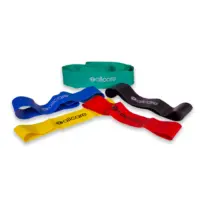
POW.R Fabric Mini Loop Bands
$12.00 – $55.00Select optionsQuick View -
-
-

-

-


-
-
-
 Exercise Equipment, Resistance Band
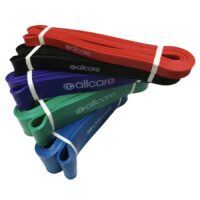
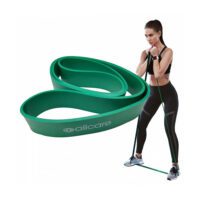
AllCare Powerloop Bands
$22.00 – $65.00Select optionsQuick View - EMS Machines, Pain Management, TENS Machine, TENS Machine & EMS
NeuroTrac Rehab (TENS Machine + EMS)
$285.00Add to cartQuick View -
-

 Exercise Balls, Back, Exercise Equipment, Knee, Shoulder
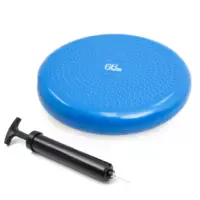
66fit Exercise Balls | Core & Rehab Stability Ball
$32.00 – $57.00Select optionsQuick View











References
- King DA, Hume PA, Hardaker N, Clark TN. Match and training injury incidence in rugby league: a systematic review, pooled analysis, and update on published studies. Sports Med Health Sci. 2022;4(2):75-84.
- Maniar N, Shield AJ, Williams MD, Timmins RG, Opar DA. Incidence and prevalence of hamstring injuries in field-based team sports: a systematic review and meta-analysis. Sports Med. 2023;53(2):229-244.
- Wagemans J, Delbaere K, Smith M, et al. Exercise-based rehabilitation reduces reinjury following acute lateral ankle sprain: a systematic review update with meta-analysis. Br J Sports Med. 2022;56(22):1271-1280.
- Patricios JS, Ardern CL, Hislop MD, et al. Consensus statement on concussion in sport: the 6th International Conference on Concussion in Sport—Amsterdam, October 2022. Br J Sports Med. 2023;57(11):695-711.
- Barden C, Stokes KA, McKay CD, et al. A systematic review using the RE-AIM framework of injury prevention interventions in rugby. BMC Sports Sci Med Rehabil. 2021;13(1):74.
