
Walking Injuries
Walking Injuries: Common Causes, Treatment and Prevention
Walking injuries commonly affect the feet, ankles, shins, knees, hips and lower back. The demands change when you add hills, stairs, trails, a dog leash, a golf bag or a sudden increase in distance.


What Are Walking Injuries?
Walking injuries are aches, pains or physical injuries that begin during or after recreational walking, fitness walking, hill walking, stair walking, dog walking, golf or bushwalking.
Some start suddenly. For example, you may roll an ankle on an uneven trail, trip over a leash or miss a step. Others develop gradually after repeated loading, such as worsening heel, Achilles, shin, knee or hip pain.
Commonly affected areas include the foot, ankle, shin, knee, hip and lower back.
Walking remains one of the most accessible ways to stay active. Therefore, management usually focuses on adjusting the aggravating load rather than avoiding walking indefinitely.
Why Do Walking Injuries Develop?
Your body adapts when walking demands rise at a manageable rate. Symptoms become more likely when the total load increases faster than your current capacity or recovery.
Distance
A sudden increase in walking time, daily steps or consecutive walking days can exceed current tissue capacity.
Speed
Faster walking increases the work required from the calves, hips and cardiovascular system.
Hills and stairs
Climbing increases calf, thigh and hip demand. Descending increases the braking demand on the thighs and knees.
Terrain
Rocks, roots, slopes, sand and wet ground increase balance and ankle-control demands.
Extra load
A backpack, golf bag, shopping or a pulling dog can change posture, balance and total effort.
Recovery
Poor sleep, illness, repeated activity or inadequate rest can reduce your tolerance to a normal walk.
Where Do Walking Injuries Occur?
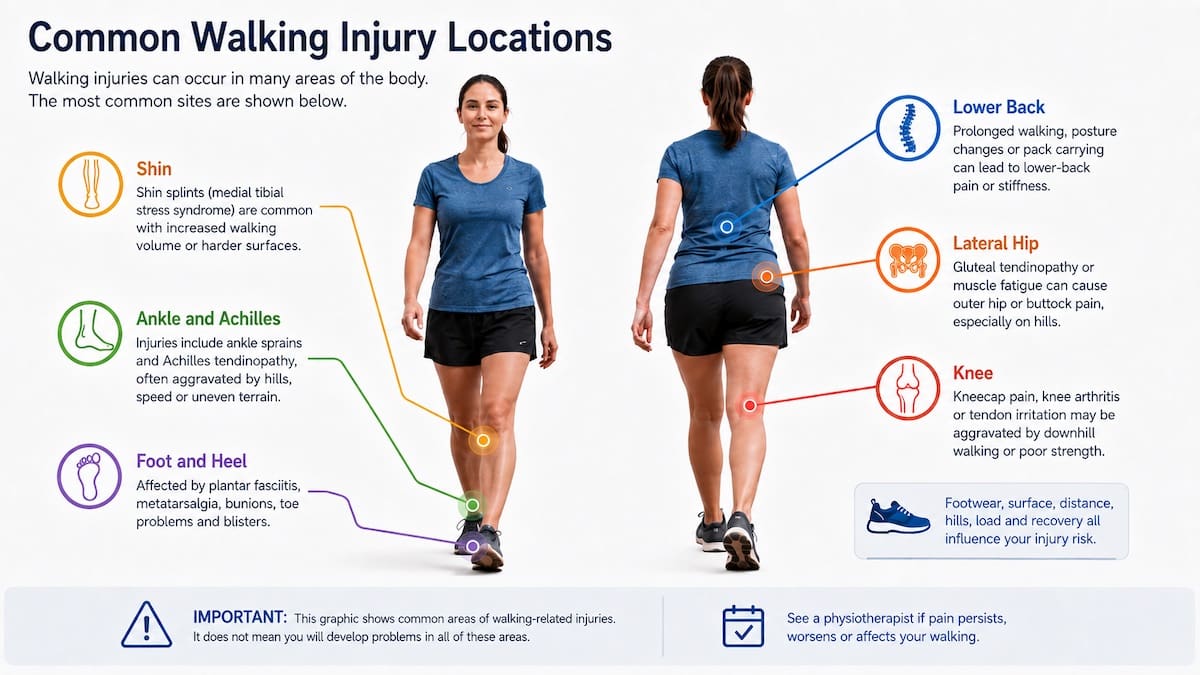
Walking injuries most often affect the lower limbs. However, symptoms can also develop in the hips and lower back when distance, posture, terrain or carrying load changes.
Foot and heel pain
Repeated loading can irritate the heel, arch, forefoot or toes. Morning first-step pain commonly occurs with plantar fasciitis.
Ankle and Achilles pain
Hills and faster walking increase calf demand. Uneven trails can also cause an ankle sprain or aggravate Achilles tendinopathy.
Shin pain
Shin symptoms may build after increased distance, harder surfaces, repeated hills or a sudden change in footwear. One possible presentation is shin splints.
Knee pain
Long walks, stairs and descents can aggravate pain around the kneecap or knee joint, particularly when strength endurance is limited.
Hip pain
Longer strides, side slopes, hills and reduced gluteal endurance may contribute to groin, buttock or outer-hip discomfort.
Back pain
Prolonged walking, carrying equipment, repeated golf swings or altered stride can aggravate lower-back symptoms.
How Do Different Types of Walking Change the Load?
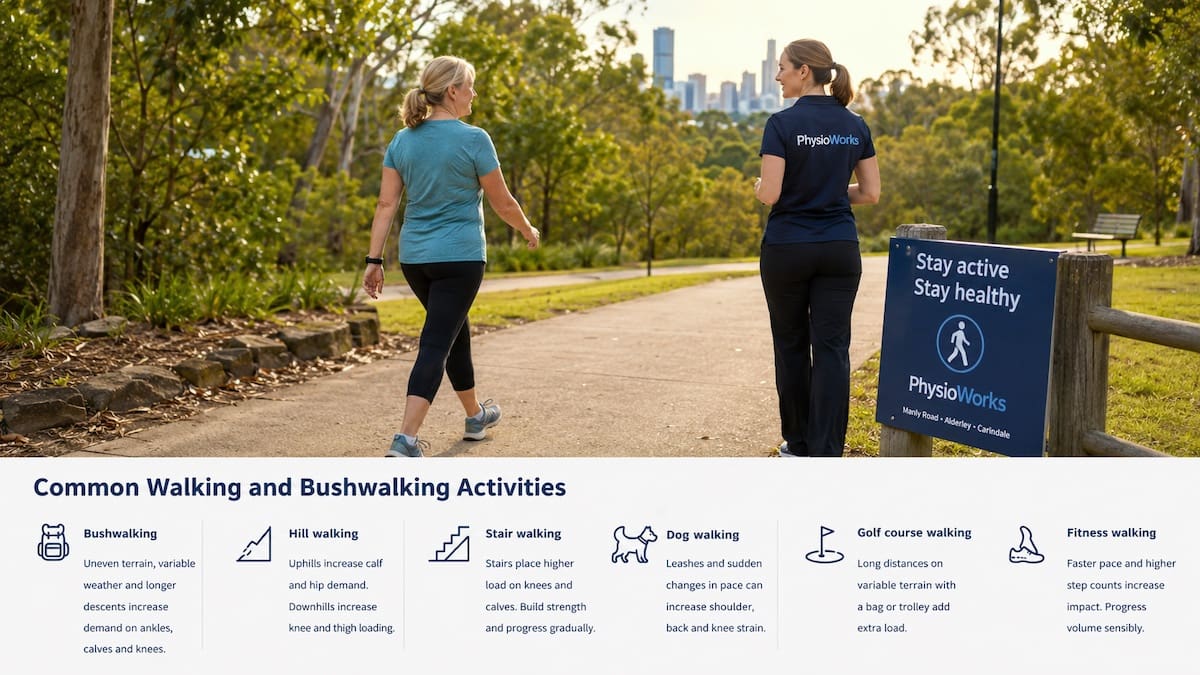
Walking activities share the same basic movement. However, each activity changes the surface, elevation, balance demand, duration or load you must manage.
Bushwalking and hiking
Bushwalking adds uneven ground, roots, rocks, wet surfaces, longer descents and often a backpack. These factors increase the demand on your feet, ankles, calves, knees and balance.
Research into hiking injuries identifies the lower limb as the most commonly affected body region. Blisters and ankle sprains are frequently reported problems.
Useful preparation includes:
- building walking distance before attempting a long trail
- practising hills and uneven surfaces
- wearing shoes that have already been tested
- using suitable socks and managing hot spots early
- keeping pack weight manageable
- allowing extra time for descents and slippery sections
- carrying water and checking weather and trail conditions
Hill walking
Uphill walking requires more work from your calves, thighs, hips, heart and lungs. Symptoms may develop in the Achilles tendon, calf, front of the knee or outer hip when hill volume rises suddenly.
Downhill walking requires the thighs to control your body as it lowers. This braking action can aggravate kneecap pain or cause marked thigh soreness, especially after a long descent.
Start with short, gentle hills. Increase either the number of hills or their steepness before increasing both at once.
Stair walking
Stairs require more knee and hip movement and greater lower-limb force than level walking. Stair descent can be particularly demanding because the thigh muscles must control your body as you lower onto the next step.
Pain may appear during stairs before it appears on flat ground. Common problem areas include the kneecap, quadriceps tendon, calf, Achilles tendon and hip.
Use the handrail when needed. Place the whole foot on the step where possible and slow down if pain or reduced control causes you to drop onto the next step.
Dog walking
Dog walking can support regular activity and routine. However, sudden pulling, leash entanglement and unexpected changes in direction create risks that ordinary walking does not.
Possible dog-walking injuries include falls, hand or wrist injuries, shoulder strains, ankle injuries and fractures. Risk may increase when the dog is large, strong or reactive, the path is crowded, or the walker has reduced balance or bone strength.
- Use a secure lead and suitable harness.
- Avoid wrapping the lead around your hand or fingers.
- Choose quieter routes while training leash behaviour.
- Wear shoes with reliable grip.
- Avoid phone use while controlling the dog.
- Ask for help when the dog’s pulling force exceeds your safe capacity.
Walking a golf course
Walking a golf course combines several hours of walking with slopes, uneven grass, repeated standing and golf swings. Carrying or pushing clubs adds another load.
Walking the course can provide useful physical activity. However, fatigue may contribute to foot, calf, knee, hip or back symptoms late in the round.
- Build walking tolerance before returning to a full round.
- Use comfortable golf shoes with suitable grip.
- Choose a balanced carry bag or well-adjusted buggy.
- Avoid an overloaded bag.
- Eat and drink during longer rounds.
- Use a cart temporarily when injury, heat or course terrain makes walking unsuitable.
Commuting, shopping and workplace walking
Daily walking can become demanding when it includes hard floors, prolonged standing, work boots, public-transport stairs or carrying bags.
The total weekly load matters. You may tolerate a planned weekend walk but flare after adding several busy workdays, shopping trips or a step-count challenge.
What Are the Most Common Walking Injuries?
- Plantar fasciitis and other heel or arch pain
- Blisters, toenail irritation and forefoot pressure
- Achilles tendinopathy
- Shin splints
- Knee pain, including pain around the kneecap
- Outer-hip or gluteal tendon pain
- Ankle sprains
- Calf or thigh muscle strains
- Lower-back pain aggravated by distance, carrying or fatigue
- Falls or upper-limb injuries caused by dog-leash pulling
Should You Keep Walking When It Hurts?
You may be able to continue with a modified walk when discomfort remains mild, does not worsen and settles soon afterwards.
Reduce your walking load when pain:
- builds as the walk continues
- changes your stride or causes a limp
- is clearly worse the following morning
- increases after each walking session
- causes you to avoid stairs, hills or normal daily tasks
- requires repeated pain medication so you can continue
Change the factor most likely to be driving the flare. This may mean reducing distance, removing hills, choosing a smoother path, using fewer stairs, carrying less or walking without the dog temporarily.
How Can Physiotherapy Help?
A physiotherapist can assess the likely source of your symptoms and identify the activity factors limiting your walking capacity.
Your assessment may include:
- recent changes in distance, speed, hills, stairs and terrain
- walking pattern and stride
- foot, ankle, knee, hip and spinal movement
- calf, thigh, hip and trunk strength
- balance and single-leg control
- stair or hill technique
- footwear, pack, golf-bag or dog-leash factors
- your response during the walk and the following day
Management may include activity modification, progressive strengthening, balance exercises, footwear advice, walking retraining and a staged return to your preferred activity.
A gait assessment may be useful when symptoms repeatedly return despite sensible changes.
When Should You Book an Appointment?
Consider a physiotherapy assessment when:
- pain lasts longer than one to two weeks
- symptoms keep returning when you increase walking
- pain limits your usual distance, pace or daily activity
- you have lost strength, balance or confidence
- your walking pattern has changed
- stairs or hills remain difficult despite reducing load
- you are preparing for a major hike or walking holiday with an unresolved injury
- you have fallen or nearly fallen while walking your dog
How Can You Reduce Your Risk of a Walking Injury?
-
Begin with a manageable amount
Choose a distance and terrain that do not cause a meaningful symptom increase during the walk or the next day.
-
Change one demand at a time
Increase distance before adding substantial hills, faster pace, stairs, rough terrain or extra load.
-
Use suitable footwear
Choose comfortable shoes with enough toe room and grip for the intended surface. Replace them when the sole or upper no longer performs its job.
-
Build strength
Calf raises, sit-to-stands, step exercises and suitable single-leg tasks can improve walking capacity.
-
Practise the task
Prepare for trails on uneven ground, for golf by building longer walks, and for stairs through controlled step practice.
-
Manage what you carry or control
Keep backpacks and golf bags manageable. Use dog-walking equipment and routes that allow safe control.
-
Respond to fatigue
Shorten the session when your stride, balance, foot placement or ability to control a dog starts to deteriorate.
How Should You Return to Walking After Pain?
Start with a walking level you can tolerate without a significant flare during the following 24 hours. Then progress one variable at a time.
Stage 1
Rebuild comfortable time or distance on flat, predictable ground.
Stage 2
Add gentle hills, stairs or slightly less predictable surfaces.
Stage 3
Add pace, longer descents, consecutive days, a light pack, golf equipment or controlled dog walking.
Use your symptoms rather than a fixed percentage rule. A small increase is usually reasonable when your stride remains normal and symptoms return to their usual level by the next day.
What Are the Health Benefits of Walking?
Regular walking can support cardiovascular health, metabolic health, mood, physical function and long-term independence. Meaningful health benefits can occur below the traditional target of 10,000 steps per day.
Hill walking, stair walking and walking a golf course may provide a greater fitness challenge than a short level walk. However, more demanding walking is not automatically better. The activity needs to match your current health, capacity and recovery.
Walking does not address every aspect of fitness or falls prevention. Many people benefit from adding suitable strength and balance exercises. See our guide to healthy ageing and exercise over 50.
Related Walking and Injury Information
Common Questions About Walking Injuries
What are the most common walking injuries?
Common problems include heel and arch pain, blisters, Achilles tendinopathy, shin pain, knee pain, hip pain, ankle sprains and lower-back pain. Dog walking may also cause falls or upper-limb injuries after sudden leash pulling.
Why does walking downhill hurt my knees?
Downhill walking requires the thigh muscles to control your body as it lowers. This increases the braking demand around the knee and can aggravate kneecap or joint pain when the hill is steep, long or unfamiliar.
Why are stairs harder than level walking?
Stairs require more knee and hip movement and greater muscle force than flat walking. Stair descent also requires controlled lowering, which can expose pain or weakness that is not obvious on level ground.
How can I reduce dog-walking injury risk?
Use suitable leash equipment, avoid wrapping the lead around your hand, choose routes that match your balance and the dog’s behaviour, and seek training help when the dog pulls more strongly than you can safely control.
Can walking a golf course cause pain?
Yes. A full round combines prolonged walking, slopes, uneven grass, standing, carrying or pushing equipment and repeated swings. Build your walking tolerance and reduce bag load when fatigue contributes to foot, knee, hip or back pain.
Should I keep walking if it hurts?
You may continue with a shorter or easier walk when discomfort remains mild and settles promptly. Reduce or stop when pain worsens, changes your stride or remains clearly aggravated the following day.
How can physiotherapy help with walking injuries?
Physiotherapy may identify contributing factors, guide symptom management and improve the strength, balance and load tolerance needed for your preferred type of walking.
References
- Ding D, et al. Daily steps and health outcomes in adults: a systematic review and dose-response meta-analysis. The Lancet Public Health. 2025. Read the daily steps systematic review.
- Pocovi NC, et al. Effectiveness and cost-effectiveness of an individualised, progressive walking and education intervention for the prevention of low back pain recurrence in Australia: a randomised controlled trial. The Lancet. 2024;404:134–144. Read the WalkBack trial.
- Braybrook PJ, et al. Types and anatomical locations of injuries among mountain bikers and hikers: a systematic review. PLOS ONE. 2023;18:e0285614. Read the hiking injury review.
- Maxson R, et al. Epidemiology of dog walking-related injuries among adults presenting to United States emergency departments, 2001–2020. Medicine and Science in Sports and Exercise. 2023. Read the dog-walking injury study.
- Rosa R, Buckley R. Leash-related injuries associated with dog walking. JBJS Reviews. 2024. Read the leash-related injury review.
- Hall M, et al. Medial knee joint loading during stair ambulation and walking while carrying loads. Gait & Posture. 2013. Read the stair-loading study.
- Sorbie GG, et al. Golf and physical health: a systematic review. Sports Medicine. 2022;52:2943–2963. Read the golf health systematic review.
- Montero-Odasso M, et al. World guidelines for falls prevention and management for older adults. Age and Ageing. 2022;51:afac205. Read the world falls guidelines.
What Should You Do Next?
Identify the walking demand most closely linked to your symptoms. Reduce that factor first, then rebuild from a level you can tolerate.
Arrange an assessment when pain keeps returning, changes how you walk, reduces your confidence or prevents you from reaching your normal walking goals.
Choose your clinic and appointment pathway
Select a PhysioWorks clinic to continue to live booking, an appointment request or reception assistance.


