
Rugby League Injuries


What Injuries Are Common in Rugby League?
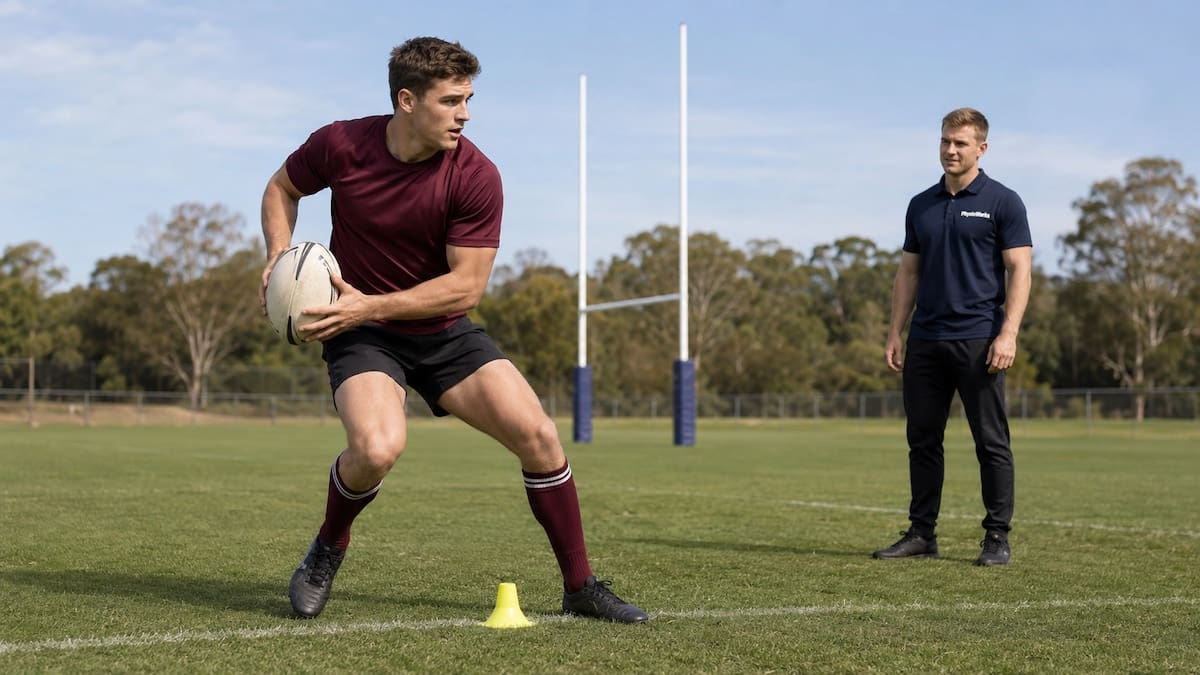
Rugby league injuries commonly affect the knee, ankle, hamstring, shoulder, head and neck. They may occur during tackles, sprinting, sidestepping, braking, landing or repeated contact. Some injuries happen suddenly. Others build as training, gym and match loads exceed a player’s current capacity.
Common examples include ankle sprains, knee ligament injuries, hamstring strains, shoulder injuries and concussion. Players with a suspected concussion should stop play and follow current concussion return-to-sport guidance.
Quick answer: Rugby league combines sprinting, cutting, landing and repeated collision. Lower-limb injuries are common, while tackles also expose the shoulder, head and neck to high forces.
Seek prompt assessment after a head knock, significant swelling, joint instability, marked weakness, inability to bear weight or loss of normal movement.
Injury surveillance and pooled research report high rates of lower-limb, head, neck and contact-related injuries during rugby league match play.1–3
Choose Your Football Code
Compare the movement demands and injury patterns of different football codes.
Where Does Pain Occur During Rugby League?
The action that causes pain can provide useful clues. However, one movement does not prove a diagnosis. A physiotherapist can assess the injured area, movement pattern, strength and load response.
Sprinting and Chasing
High-speed running can load the hamstrings, calf and groin. Sudden acceleration or late-game fatigue may increase symptoms.
Sidestepping and Braking
A planted foot, rapid direction change or poor deceleration control can load the knee and ankle.
Tackling and Contact
Tackles can force the shoulder, ribs, head or neck into unexpected positions.
Landing and Contesting Kicks
Awkward landings may load the ankle, knee, Achilles tendon or calf.
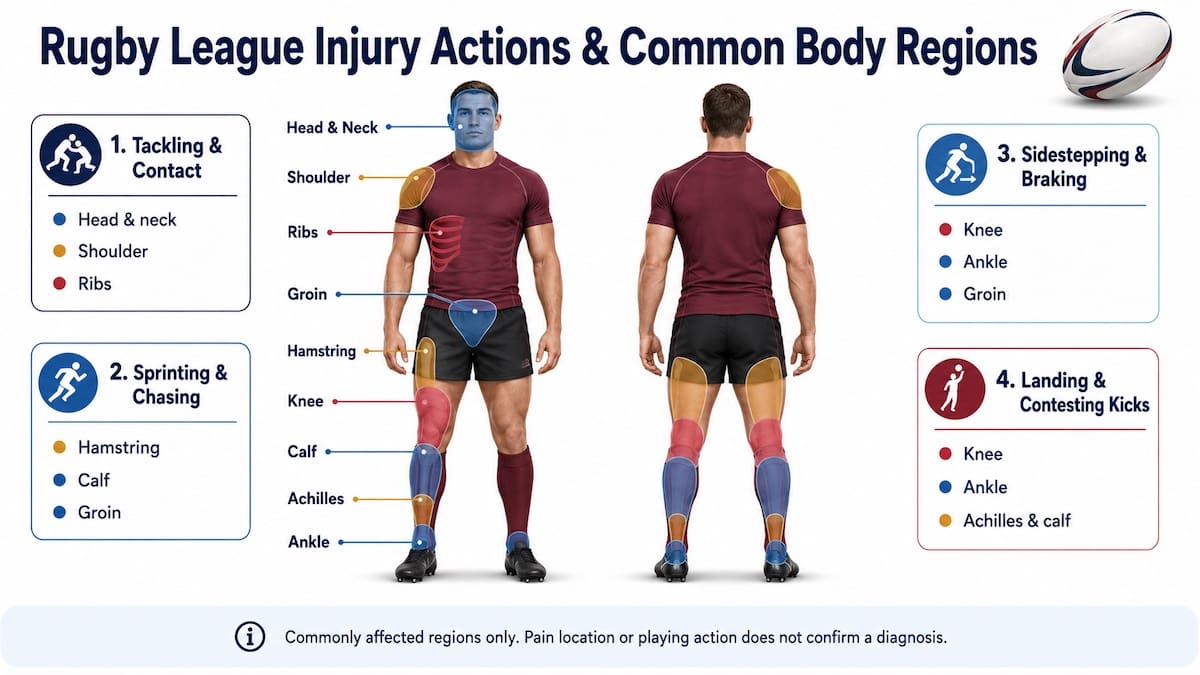
Where Do Rugby League Injuries Occur?
Rugby league can load several body areas during the same match. The main injury pattern depends on the tackle or running action, player position, previous injury, training history, contact exposure and fatigue.
Knee Injuries
Sidestepping, landing or contact to a planted leg can strain the knee.
Ankle Injuries
The foot may roll, become trapped under another player or remain fixed while the body turns.
Hamstring and Thigh Injuries
Sprinting, chasing, kicking and repeated accelerations can overload the thigh muscles.
Shoulder Injuries
Tackles and falls may force the arm into an awkward or unstable position.
Head and Neck Injuries
Direct impact, rapid acceleration and collision forces can cause concussion or neck symptoms.
Back Injuries
Repeated bending, rotation, contact and gym-to-field workload changes can aggravate the back.
Why Do Rugby League Injuries Happen?
Rugby league combines repeated sprint efforts with frequent collisions. Muscles and joints must absorb force, produce speed and recover quickly before the next play. During a tackle, the direction and size of the load can change without warning.
Fatigue can also affect running mechanics, reaction time and joint control. Later in a training session or match, a player may brake less effectively, land with reduced control or enter contact in a poorer position.
Some injuries build rather than occur in one event. A rapid increase in running, tackling, gym work or match minutes may exceed the body’s current capacity. Previous injury, reduced strength and incomplete exposure to full-speed or contact training may also raise recurrence risk.
Do Boots and Playing Surfaces Affect Injury Load?
Boot grip can improve traction and acceleration. However, greater traction may also increase twisting load when the foot remains fixed during a sidestep or tackle. A sudden change in boots, studs or surface can alter how force travels through the ankle and knee.
Rugby League Load Check
- Did your running, contact or gym load increase sharply?
- Did pain, swelling or tightness increase the next morning?
- Can you sprint and brake without guarding?
- Can you change direction at game speed?
- Can you tolerate position-specific contact drills?
- Has your confidence returned when you are tired?
What Are the Most Common Rugby League Injuries?
Ankle Sprain
An ankle sprain may occur when the foot rolls during a cut, landing or tackle. Pain, swelling and reduced weight-bearing tolerance are common.
High Ankle Sprain
A syndesmosis injury affects the ligaments above the ankle. Pain often increases with twisting, pushing off, running or changing direction. Recovery can take longer than for a typical lateral ankle sprain.
Knee Ligament Injury
A tackle, twist or awkward landing can strain the knee ligaments. Symptoms may include swelling, pain, instability or reduced confidence when cutting.
ACL Injury
An ACL injury may occur during a sidestep, landing or contact to a planted leg. Some players notice rapid swelling, a pop or a feeling that the knee gives way.
Hamstring Strain
A hamstring strain often occurs during acceleration or top-speed running. Repeat strains are more likely when strength, sprint exposure or load progression remain incomplete.
Shoulder Dislocation
A shoulder may dislocate during a tackle or fall, particularly when the arm is forced away from the body. A suspected dislocation requires urgent assessment. Do not attempt to force the shoulder back into place.
Concussion
Concussion can follow a direct or indirect impact that transfers force to the head. Symptoms vary and may include headache, dizziness, confusion, balance problems, nausea, vision changes or unusual behaviour. Remove any player with suspected concussion from play and arrange appropriate medical care.4
How Can Physiotherapy Help Rugby League Injuries?
Physiotherapy for rugby league injuries starts with an assessment of the injured area and the movements that matter for the player’s position. This may include strength, balance, running, landing, sidestepping and contact tolerance.
Your rehabilitation plan may include:
- Advice about the likely injury and safe activity levels.
- Pain and swelling management where needed.
- Progressive strength and mobility exercises.
- Running, acceleration and sprint exposure.
- Braking, landing and change-of-direction retraining.
- Position-specific skill and contact progression.
- Objective return-to-training and return-to-play checks.
- Next-day symptom and workload review.
Exercise physiology may support later-stage strength, conditioning and long-term capacity after the acute injury phase. Massage may help short-term muscle comfort during heavy training periods. However, massage does not replace structured rehabilitation for unstable joints, concussion or recurrent injuries.
Read more about sports injury physiotherapy and return-to-sport planning.
When Should You See a Physiotherapist?
Consider an assessment when:
- Pain lasts more than a few days or keeps returning.
- Swelling, bruising or loss of movement is significant.
- A knee, ankle or shoulder feels unstable.
- You cannot jog, sprint, cut or tackle normally.
- Your speed, control or confidence has not returned.
- The same hamstring, ankle, shoulder or knee problem keeps recurring.
- Symptoms increase after each training session.
Early assessment may reduce uncertainty and help you choose an appropriate training level.
How Can Rugby League Players Reduce Injury Risk?
No programme can prevent every injury in a collision sport. However, preparation can improve a player’s ability to tolerate running, landing, cutting and contact.
Warm-Up
Use progressive running, movement preparation and rugby-specific skills before high-speed or contact work.
Strength
Build single-leg strength, calf capacity, hamstring strength, trunk control and shoulder endurance.
Technique
Practise braking, cutting, landing and safe contact positions before adding fatigue or full speed.
Recovery
Balance field, gym and match loads. Allow enough recovery after demanding sprint and contact sessions.
Players who sidestep, jump or change direction at speed may also benefit from an ACL injury prevention programme.
How Do You Return Safely to Rugby League?
A safe return requires more than pain relief. Players usually need graded exposure to running speed, repeated efforts, change-of-direction, rugby skills, contact and match-style fatigue.
1. Rehabilitation
Focus: Settle symptoms and restore movement, strength and basic control.
Progress when: Daily activity and early exercises are well tolerated.
2. Running
Focus: Jogging, acceleration, braking and progressive sprint exposure.
Progress when: Running produces no meaningful immediate or next-day flare.
3. Non-Contact Training
Focus: Change-of-direction, ball skills, repeat efforts and position-specific drills.
Progress when: Game-speed movement is controlled and confident.
4. Contact Training
Focus: Tackle preparation, controlled contact and reactive drills.
Progress when: Contact feels controlled and symptoms remain stable afterwards.
5. Match Return
Focus: Full training, decision-making, repeated efforts and fatigue.
Progress when: Return-to-play markers are met and full training is tolerated.
Return timing varies with the injury, position, age, competition level and medical requirements. Concussion follows a separate staged process and may require medical clearance.
Related Rugby League Injury Guides
Rugby League Injury FAQs
What is the most common injury in rugby league?
Sprains, strains and contact-related joint injuries are common. Lower-limb injuries often include ankle sprains, knee ligament injuries and hamstring strains. Head, neck and shoulder injuries also require careful management because rugby league involves repeated collisions.1–3
How do I know if my ankle sprain is a high ankle sprain?
A high ankle sprain often causes pain above the ankle joint. Symptoms may increase with twisting, pushing off, squeezing the lower leg or running. Assessment can help distinguish a syndesmosis injury from a more typical lateral ankle sprain.
When can I return to play after a concussion?
Return timing depends on symptoms, age, medical advice and the relevant sport policy. Do not return on the same day after suspected concussion. Follow a staged return and seek medical review if symptoms persist, worsen or return during activity.4
Do women and men experience the same rugby league injuries?
Many injury types overlap across women’s and men’s rugby league. These include lower-limb, shoulder, head and neck injuries. Exposure, training history, strength, match demands and previous injury may still influence each player’s risk profile.1
Should I keep playing if my hamstring keeps tightening?
Repeated tightness may reflect fatigue, reduced sprint tolerance, incomplete strength recovery or a rapid workload increase. Continuing through recurring symptoms may increase the chance of a strain. Reduce high-speed load and arrange assessment if the problem persists.
Can physiotherapy prevent rugby league injuries?
Physiotherapy cannot remove all injury risk. However, it may help players improve strength, running tolerance, landing control, change-of-direction ability and contact preparation. Rehabilitation may also reduce recurrence risk after an earlier injury.
What to Do Next
If pain, swelling, weakness or reduced confidence is limiting rugby league training, consider a physiotherapy assessment. Your physiotherapist can assess the likely injury, identify current loading limits and build a staged plan for running, contact and return to play.
Suspected concussion: Stop play immediately. Do not return on the same day. Follow recognised concussion guidance and seek appropriate medical assessment. See the Australian Concussion in Sport guidance.
Choose your clinic and appointment pathway
Select a PhysioWorks clinic to continue to live booking, an appointment request or reception assistance.
Muscle & Soft Tissue Products
These muscle and soft tissue products are commonly used by our physiotherapists to relax or loosen muscles, improve strength, comfort, flexibility, and home exercise programs.
-
-
 Exercise Equipment, Knee, Resistance Band
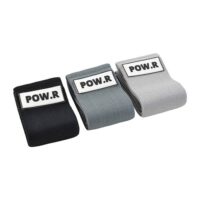
POW.R Fabric Mini Loop Bands
$12.00 – $55.00Select optionsQuick View -
-
-
 Exercise Equipment, Resistance Band
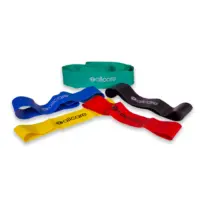
AllCare Powerloop Bands
$22.00 – $65.00Select optionsQuick View -

-
- EMS Machines, Pain Management, TENS Machine, TENS Machine & EMS
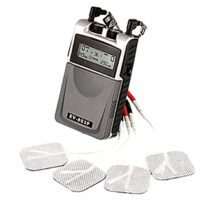
NeuroTrac Rehab (TENS Machine + EMS)
$285.00Add to cartQuick View -
-

-


- Liniments & Gels, Massage Liniments, Pain Management
Fisiocrem
$16.95 – $39.95Select optionsQuick View - Exercise Equipment, Resistance Band
POW.R Wide Fabric Loop Resistance Band
$14.95 – $49.95Select optionsQuick View -
 Exercise Balls, Back, Exercise Equipment, Knee, Shoulder
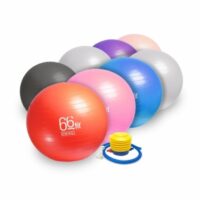
66fit Exercise Balls | Core & Rehab Stability Ball
$32.00 – $57.00Select optionsQuick View -











References
- Scantlebury S, Jones B, Owen C, et al. Time to level the playing field between men and women—given similar injury incidence: a two-season analysis of match injuries in elite men’s and women’s rugby league. J Sci Med Sport. 2024;27(11):742-747. doi:10.1016/j.jsams.2024.07.004
- King DA, Clark TN, Hume PA, et al. Match and training injury incidence in rugby league: a systematic review, pooled analysis, and update on published studies. Sports Med Health Sci. 2022;4(2):75-84. doi:10.1016/j.smhs.2022.03.002
- Burger N, Lambert MI, Viljoen W, et al. Tackle injury epidemiology and performance in rugby league. BMJ Open Sport Exerc Med. 2023;9(1):e001473. doi:10.1136/bmjsem-2022-001473
- Patricios JS, Ardern CL, Hislop MD, et al. Consensus statement on concussion in sport: the 6th International Conference on Concussion in Sport—Amsterdam 2022. Br J Sports Med. 2023;57(11):695-711. doi:10.1136/bjsports-2023-106898
- Australian Institute of Health and Welfare. Sports injury in Australia: rugby. Updated July 30, 2025.
