- Description
- Additional information
Description
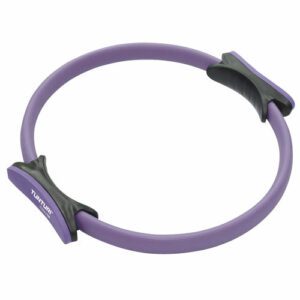
Pilates Ring Strength & Toning
Pilates Ring | Core Strength | Muscle Toning | Rehabilitation Support
At PhysioWorks, we commonly recommend a Pilates ring for patients who need low-load resistance training to improve core stability, posture, and muscular control. Whether you are rebuilding strength after injury or refining technique in Clinical Pilates, this versatile tool delivers controlled resistance without placing excess strain on joints.
Why Use a Pilates Ring?
Many people struggle with poor core activation, weak hip stabilisers, shoulder instability, or postural fatigue. These issues often contribute to back pain, neck tension, and reduced exercise performance. A Pilates ring provides gentle but targeted resistance that activates deep stabilising muscles while maintaining joint alignment.
From a physiotherapy perspective, controlled resistance is essential during early rehabilitation and corrective exercise programs. The ring allows muscle engagement without heavy loading, which makes it suitable for injury recovery, post-natal reconditioning, and general strength development.
How Does a Pilates Ring Work?
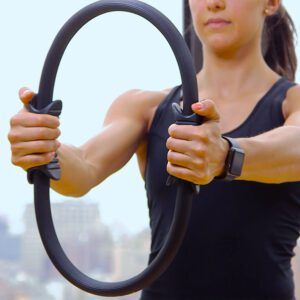
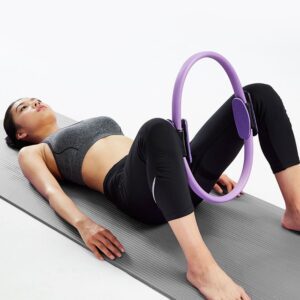
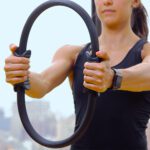
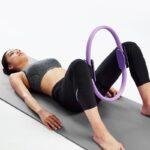
The ring creates resistance through inward compression or outward expansion. When you press the padded handles together or gently resist the ring’s outward pressure, your muscles activate to stabilise and control the movement. This promotes neuromuscular coordination and improves muscle endurance.
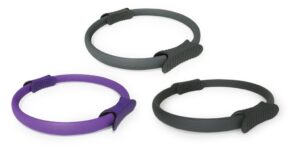
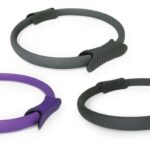
Our Pilates ring includes:
- Comfortable foam outer covering
- Dual padded grips for hands or thighs
- Three resistance levels – light, medium, heavy
- Durable spring steel core for consistent resistance
The varying resistance options allow gradual progression. Beginners may start with light resistance, while experienced users can challenge themselves with heavier tension.
For exercise guidance, read our Pilates guide for technique advice and rehabilitation principles.
What Is a Pilates Ring Used For?
A Pilates ring supports both rehabilitation and performance training. It is commonly used for:
- Core stability and abdominal control
- Hip adductor and glute strengthening
- Shoulder stabilisation exercises
- Postural correction programs
- Low-load rehabilitation after injury
For example, patients recovering from lower back pain often use the ring to retrain deep abdominal muscles. Individuals following rotator cuff irritation may incorporate gentle shoulder stability drills. Post-natal patients benefit from controlled pelvic floor and abdominal engagement.
This compact tool suits home exercise programs, gym routines, and supervised Clinical Pilates sessions.
Who Is It Best For?
The Pilates ring suits:
- Rehabilitation patients
- Post-natal exercise programs
- Office workers improving posture
- Athletes refining core control
- Home users wanting portable resistance training
Its lightweight, portable design makes it ideal for travel or small home spaces.
Key Benefits
- Improves core stability and muscle activation
- Enhances posture and joint control
- Provides progressive resistance levels
- Supports low-impact rehabilitation
- Lightweight and portable for convenient training
Related Articles
- Pilates – Technique & Benefits Explained
- Lower Back Pain Treatment Guide
- Rotator Cuff Injury Rehabilitation
What To Do Next
If you are unsure which resistance level suits your condition, book an assessment with one of our physiotherapists to incorporate the Pilates ring safely into your rehabilitation program.
Additional information
| Weight | 0.4 kg |
|---|---|
| Dimensions | 60 × 38 × 39 cm |
| Resistance | Heavy, Light, Medium |