
Golfer’s Elbow
Golfer’s Elbow: Symptoms, Causes and Treatment
Golfer’s elbow causes pain where the forearm tendons attach to the inside of the elbow. Treatment usually combines activity changes with progressive strengthening that rebuilds the tendon’s ability to tolerate gripping, lifting, work and sport.


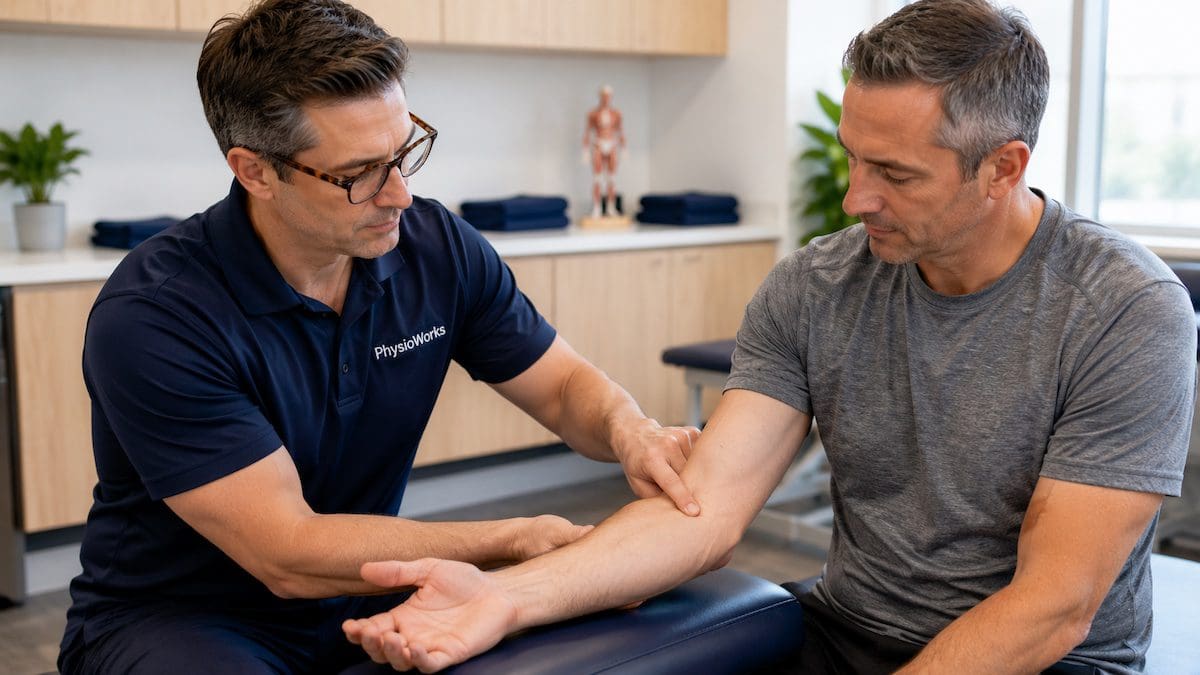
Pain location
Symptoms usually sit around the bony point on the inside of the elbow and may spread into the inner forearm.
Common triggers
Gripping, lifting, golf, racquet sports, gym exercises and repeated tool use may aggravate the tendon.
Recovery focus
Useful rehabilitation builds grip, wrist, elbow and shoulder capacity before progressing work or sporting loads.
What Is Golfer’s Elbow?
Golfer’s elbow is pain and reduced load tolerance where the wrist and finger flexor tendons attach to the medial epicondyle, which is the bony point on the inside of the elbow. Health professionals may also call it medial epicondylalgia or medial elbow tendinopathy.
The condition can affect golfers, but golf is not the only cause. It also occurs in racquet-sport players, throwing athletes, gym users and people whose work involves repeated gripping, lifting or tool use.
Golfer’s elbow commonly develops when the demand placed on the tendon exceeds its current capacity. A sudden increase in activity can trigger symptoms. However, pain may also build gradually through repeated loading with too little recovery.
If your pain is not limited to the inside of the elbow, visit our main elbow pain guide for information about other elbow conditions.
What Are the Symptoms of Golfer’s Elbow?
Symptoms usually develop around the inner elbow and worsen during tasks that load the forearm tendons.
Inner-elbow pain
You may feel an ache or sharper pain around the medial epicondyle. The discomfort can extend into the inner forearm.
Painful gripping
Carrying shopping, lifting a kettle, opening a jar or holding sports equipment may reproduce symptoms.
Reduced strength
Your grip may feel weaker or less dependable, particularly during heavier or repeated tasks.
Forearm fatigue
The muscles along the inner forearm may feel tight, tired or uncomfortable after activity.
Morning stiffness
The elbow may feel stiff after rest and then ease as you begin moving it.
Pain with wrist movement
Resisted wrist or finger flexion may reproduce pain near the inner-elbow tendon attachment.
What Activities Commonly Aggravate It?
Any task that repeatedly loads the wrist and finger flexor muscles may aggravate golfer’s elbow. The relevant load differs between people.
- Golf swings, driving-range sessions and striking repeatedly from firm mats.
- Pull-ups, rows, curls, deadlifts and other gripping exercises.
- Carrying heavy bags, tools, boxes or work equipment.
- Repeated screwdriver, hammer or power-tool use.
- Racquet sports and throwing activities.
- Gardening, pruning and other sustained hand tasks.
- Sudden changes in technique, equipment, workload or training volume.
What Causes Golfer’s Elbow?
The common flexor tendon transfers force from the forearm muscles into the inner elbow. Repeated or unusually high gripping, pulling, lifting and swinging loads may make the tendon sensitive.
Symptoms can begin after one obvious increase in activity. Alternatively, the tendon may gradually become less tolerant when work, training and daily loads repeatedly exceed its ability to recover.
Contributing factors may include:
- a rapid increase in golf, gym, throwing or racquet-sport volume;
- repetitive or forceful gripping at work;
- reduced forearm or grip strength;
- limited shoulder, elbow or wrist capacity;
- changes in sporting technique or equipment;
- returning too quickly after time away from activity; and
- neck or nerve sensitivity that changes arm function.
Golfer’s elbow is one form of tendinopathy. Tendons usually respond best when irritating loads are adjusted and then progressively rebuilt rather than avoided indefinitely.
Could Inner-Elbow Pain Be Something Else?
Not every pain on the inside of the elbow is golfer’s elbow. An assessment may consider several other structures and conditions.
Ulnar nerve irritation
Nerve irritation may cause tingling, numbness or an electric sensation towards the ring and little fingers.
Elbow ligament injury
Throwing, trauma or forceful valgus loading may affect the ligament on the inside of the elbow.
Referred arm pain
The neck, shoulder or nearby nerves may refer pain towards the elbow and forearm.
Joint injury, arthritis, fracture and other less common conditions may also cause medial elbow pain. Your history and examination findings help determine which structure is most likely involved.
How Is Golfer’s Elbow Diagnosed?
A physiotherapist or doctor can often diagnose golfer’s elbow from your history and a clinical examination. The assessment should consider when the pain began, which loads reproduce it and whether you have weakness, neck pain, tingling or a history of trauma.
Your examination may include:
- palpation around the medial epicondyle and inner forearm;
- grip-strength testing;
- resisted wrist and finger movements;
- elbow, wrist and shoulder movement testing;
- assessment of sport, gym or work tasks; and
- neck and nerve screening when symptoms suggest wider involvement.
Imaging is not always required. Ultrasound or MRI may be considered when symptoms persist, the diagnosis remains uncertain or another condition needs to be excluded. An X-ray may be useful following trauma or when a joint or bone problem is suspected.
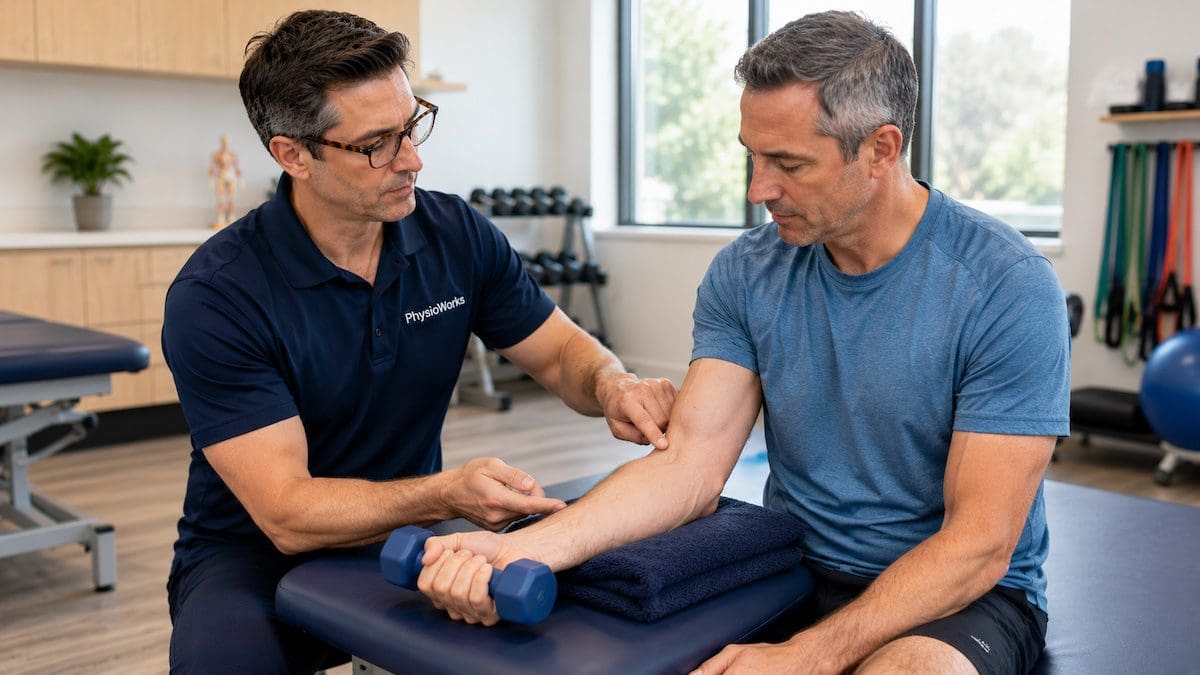
How Is Golfer’s Elbow Treated?
Treatment should match your symptoms, current capacity and goals. Rehabilitation generally moves from reducing aggravation towards progressively heavier and more specific loading.
-
Identify the main load triggers
Review the tasks, exercises or sporting loads that reproduce symptoms. This may include golf volume, grip demands, gym exercises or repetitive work.
-
Adjust rather than automatically stop
Reduce the intensity, frequency, duration or grip demand enough to prevent repeated flare-ups while maintaining comfortable activity where possible.
-
Begin appropriate tendon loading
Early exercises may use controlled wrist, finger or grip contractions at a manageable resistance. The starting level should reflect your irritability and strength.
-
Build forearm and upper-limb strength
Resistance can progress as symptoms and function improve. Your program may include the wrist flexors, grip, elbow, shoulder and supporting muscles.
-
Restore work, gym or sporting capacity
Later rehabilitation should recreate the speed, range, repetition and force required for your normal activities.
Load management and education
Load management does not mean avoiding all activity. Instead, it involves finding a level that the elbow can tolerate and then progressing from that point. Your response during the task, later that day and the next morning can help guide changes.
Progressive exercise
Exercise is usually central to rehabilitation because it helps restore the tendon’s capacity to accept force. Exercises may begin with simple wrist or grip loading before progressing to heavier, faster or more task-specific movements.
Your physiotherapist may also address shoulder and upper-limb strength when these areas affect how you grip, lift, swing or throw. Visit our exercise library for broader rehabilitation information.
Manual therapy
Joint mobilisation, soft-tissue treatment or nerve techniques may provide short-term symptom relief for some people. These treatments should support an active rehabilitation plan rather than replace progressive loading.
Taping and bracing
A brace or tape may temporarily reduce symptoms during gripping, work or sport. However, external support does not restore tendon capacity by itself.
Movement and technique coaching
Technique changes may help when a specific golf, gym, work or racquet-sport task repeatedly overloads the elbow. Changes should be practical and relevant to the person rather than based on one assumed fault.
Can You Keep Playing Golf?
Some people can continue playing with changes to volume and intensity. Others need a short period away from the most aggravating swings before gradually rebuilding their golf load.
Reduce volume first
Fewer holes, a shorter practice session or more recovery between sessions may reduce accumulated tendon load.
Modify aggravating shots
Heavy rough, firm mats and repeated high-force practice shots may be more provocative than controlled swings.
Progress gradually
Start with tolerable clubs and controlled swings before increasing shot number, speed and playing demands.
Avoid repeatedly testing the elbow with high-volume practice when symptoms are worsening. Grip weakness, increasing pain during play or a prolonged post-round flare may indicate that the current load is too high.
How Should Gym Exercises Be Modified?
Pull-ups, heavy rows, curls and deadlifts may aggravate symptoms because they require sustained or forceful gripping. You may not need to remove every upper-body exercise.
Useful temporary changes may include:
- reducing resistance or total sets;
- changing the handle, wrist position or grip width;
- using a slower and more controlled movement;
- reducing repeated training to failure;
- avoiding several high-grip exercises in the same session; and
- using straps selectively when clinically appropriate.
The aim is to retain useful training while creating enough room for the tendon to adapt.
Should You Wear a Golfer’s Elbow Brace?
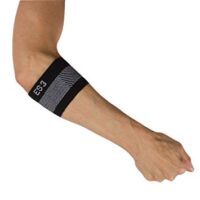
A counterforce elbow strap sits around the upper forearm below the painful tendon attachment. Some people find that it reduces discomfort during lifting, golf, gym training or manual work.
The strap should feel supportive rather than painfully tight. It should not cause numbness, tingling, skin irritation or increased forearm pain.
A brace may be a useful short-term aid, but it should not replace strength rehabilitation and activity progression. For general fitting principles, see our tennis elbow brace guide. Strap placement may differ for inner-elbow symptoms, so ask your physiotherapist if you are unsure about positioning. You can also browse our elbow braces and supports.
How Long Does Golfer’s Elbow Take to Improve?
Recovery varies between people. A recent and mildly irritable problem may improve over several weeks. Longer-standing or repeatedly aggravated tendon pain can take several months to settle and rebuild.
Factors that may affect recovery include:
- how long symptoms have been present;
- the amount of gripping or lifting that cannot be modified;
- tendon irritability and current strength;
- associated nerve, ligament, neck or joint symptoms;
- the demands of your sport or work; and
- how consistently rehabilitation can be progressed.
Progress is not always linear. A temporary symptom increase does not automatically mean the tendon has been damaged again. However, repeated or escalating flare-ups usually indicate that the current load or exercise dose needs review.
When Should You Seek Assessment?
Consider a physiotherapy or medical assessment when inner-elbow pain:
- persists despite reducing the obvious aggravating load;
- limits work, sport, gym training or daily gripping;
- causes noticeable loss of strength;
- returns whenever activity is increased;
- includes tingling or numbness into the hand;
- followed a fall, collision or sudden force; or
- prevents you from fully bending or straightening the elbow.
What Happens During a Physiotherapy Assessment?
Your physiotherapist will first clarify the activities that matter to you and the loads that trigger symptoms. The examination then helps determine whether the tendon is the main pain source and whether other areas require attention.
History
Your clinician reviews symptom behaviour, work, sport, gym activity, previous injuries and recent changes in load.
Testing
The assessment may include movement, palpation, grip strength, resisted tests and task-specific loading.
Rehabilitation plan
You receive guidance about activity changes, suitable exercises, expected progression and signs that require review.
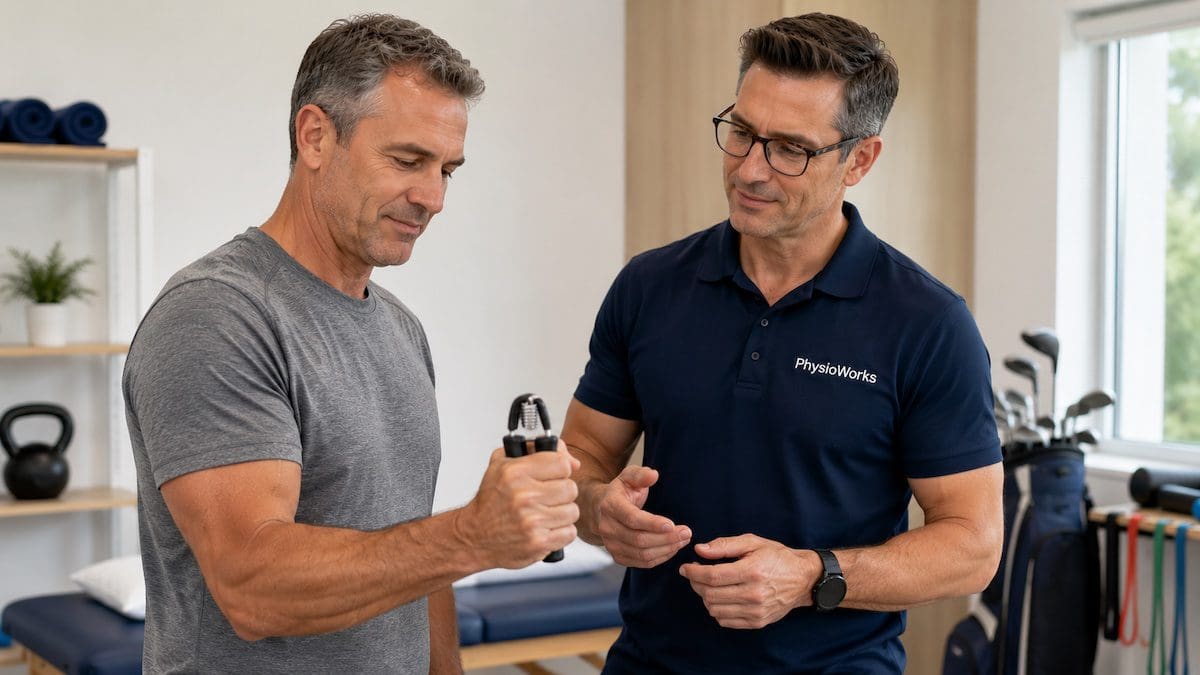
Choose your clinic and appointment pathway
Select a PhysioWorks clinic to continue to live booking, an appointment request or reception assistance.
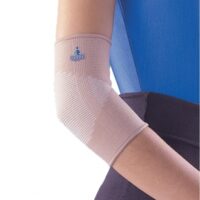
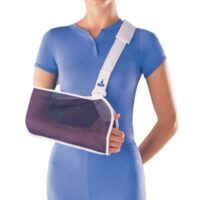
Elbow Products
These elbow support products are commonly used by our physiotherapists to help reduce strain, improve strength, and support your elbow recovery at home.
-
-
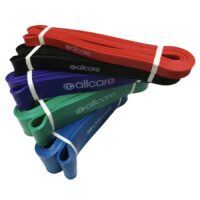
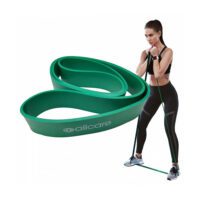 Exercise Equipment, Resistance Band
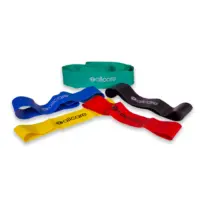
AllCare Powerloop Bands
$24.95 – $79.95Select optionsQuick View -

-
- Liniments & Gels, Massage Liniments, Pain Management
Fisiocrem
$16.95 – $39.95Select optionsQuick View -

 Calf, Elbow, Ice & Heat, Knee, Pain Management
Victor Elastic Cold Sleeve
$44.00 – $60.00Select optionsQuick View -
- EMS Machines, Pain Management, TENS Machine, TENS Machine & EMS
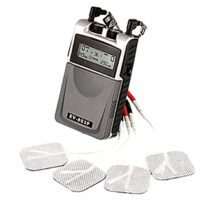
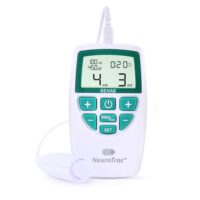
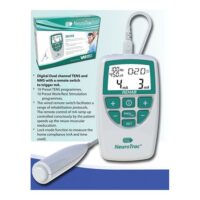
NeuroTrac Rehab (TENS Machine + EMS)
$285.00Add to cartQuick View -
-
-
-
-
-




References
- Konarski W, et al. Current concepts of natural course and management of medial epicondylitis: a clinical overview. Orthopedic Reviews. 2023.
- DeLuca MK, et al. Medial epicondylitis: current diagnosis and treatment options. Journal of Musculoskeletal Surgery and Research. 2023.
- Adani N, et al. Non-traumatic medial-sided elbow pain: a comprehensive review of etiologies, diagnostic strategies, and treatment approaches. Cureus. 2025.
- Meredith TJ, et al. Diagnosis and management of common tendinopathies. American Family Physician. 2025.
- Shim J, et al. Patient ratings in exercise therapy for tendinopathy: a review. Physiotherapy. 2023.
Golfer’s Elbow FAQs
What is golfer’s elbow?
Golfer’s elbow is pain and reduced load tolerance where the wrist and finger flexor tendons attach to the inside of the elbow. It is commonly linked with repeated gripping, lifting, swinging or throwing loads.
What is the fastest way to treat golfer’s elbow?
A useful early approach is to reduce the most aggravating loads without stopping all comfortable activity. Progressive wrist, grip and upper-limb strengthening can then rebuild the tendon’s capacity. Recovery speed varies between people.
Can physiotherapy help golfer’s elbow?
Physiotherapy may help by assessing the likely pain source, identifying aggravating loads and creating a progressive rehabilitation plan. Treatment can include exercise, load guidance, temporary bracing, manual therapy and task-specific coaching.
How long does golfer’s elbow take to improve?
A recent and mildly irritable problem may improve over several weeks. Longer-standing or repeatedly aggravated symptoms can take several months. Recovery depends on tendon irritability, activity demands, strength and whether other conditions are contributing.
Should I wear a golfer’s elbow brace?
A counterforce strap may temporarily reduce discomfort during gripping, work or sport. It should feel supportive rather than painfully tight and should not cause tingling or numbness. A brace does not replace progressive rehabilitation.
Can I keep playing golf with golfer’s elbow?
Some people can continue with fewer holes, shorter practice sessions or reduced swing intensity. Increasing pain, worsening grip weakness or symptoms that remain elevated after play suggest that the current golf load should be reduced and reviewed.
