
Functional Shoulder Instability
Shoulder Instability
Shoulder instability can make your shoulder feel loose, unreliable or as though it may slip or give way. It may follow an injury or dislocation, or develop when the muscles that control the shoulder are not keeping the joint stable during movement.



Assessing shoulder stability and control.
Shoulder instability can range from a subtle loss of control to repeated subluxations or complete shoulder dislocations. Some people notice symptoms only during overhead sport, gym work or demanding arm positions. Others feel that the shoulder is unreliable during ordinary reaching or lifting.
The cause is not always the same. Instability may involve structural changes to the capsule, ligaments or shoulder labrum. In other cases, joint laxity, muscle coordination and movement control play a greater role. Many presentations involve a combination of these factors.
If pain rather than slipping or instability is your main concern, the Shoulder Pain Guide can help you compare other common shoulder problems.
Common feeling
The shoulder may feel loose, vulnerable, unreliable or as though it could slip out of position.
Common triggers
Throwing, serving, swimming, overhead lifting, pressing and reaching behind the body can provoke symptoms.
Rehabilitation focus
Treatment commonly progresses from shoulder control to strength, endurance and activity-specific loading.
What Is Shoulder Instability?
The shoulder joint has a large range of movement. Unlike a deep ball-and-socket joint such as the hip, the shoulder relies heavily on its capsule, ligaments, labrum and surrounding muscles to keep the upper arm bone centred in the socket.
Shoulder instability occurs when that control is insufficient for the movement or load being placed on the joint. The shoulder may move excessively, partially slip from the socket, completely dislocate or simply feel difficult to control.
Clinicians may describe instability in different ways depending on how it developed and the direction of unwanted movement.
- Traumatic instability: follows an injury such as a fall, collision or forced shoulder movement.
- Atraumatic instability: develops without one clear injury and may relate to joint laxity and reduced muscular control.
- Multidirectional instability: excessive movement occurs in more than one direction.
- Functional instability: poor muscle timing, coordination or movement control contributes substantially to the symptoms.
These categories can overlap. For example, a person who previously dislocated their shoulder may later develop poor control, apprehension and weakness even after the initial injury has healed.
What Causes Shoulder Instability?
Shoulder instability may develop after trauma or gradually through a combination of joint laxity, repeated loading and reduced muscular control.
Common contributing factors include:
- A previous shoulder dislocation or subluxation
- Damage to the shoulder capsule, ligaments or labrum
- Generalised joint laxity or naturally flexible joints
- Reduced rotator cuff strength or endurance
- Poor shoulder blade control
- Reduced proprioception or awareness of shoulder position
- Repeated overhead loading
- Rapid increases in throwing, swimming, serving or gym workload
Overhead athletes can be particularly sensitive to small changes in shoulder control because their sport repeatedly takes the arm into demanding positions. Instability may overlap with conditions such as swimmer’s shoulder, labral injury or rotator cuff-related pain.
What Does Shoulder Instability Feel Like?
Not everyone with shoulder instability experiences a complete dislocation. In many cases, the main symptom is a sense that the shoulder cannot be trusted during particular movements.
Possible symptoms include:
- A loose or unstable feeling in the shoulder
- Slipping, shifting or giving way
- Apprehension when the arm moves overhead or behind the body
- Weakness during lifting, throwing or pressing
- Clicking, clunking or catching
- Shoulder pain during or after activity
- A temporary “dead arm” feeling
- Reduced confidence with work, gym or sport
- Repeated subluxations or dislocations
Pain alone does not confirm instability. Conditions such as biceps tendinopathy, rotator cuff injury and labral problems can produce overlapping symptoms.
Is Shoulder Instability Serious?
The significance of shoulder instability depends on how it started, how often the shoulder gives way and whether there has been structural injury. Mild functional symptoms can sometimes respond well to rehabilitation. Repeated traumatic dislocations, substantial weakness or ongoing neurological symptoms need closer assessment.
If your shoulder repeatedly dislocates or feels unstable after trauma, assessment can help determine whether the symptoms relate mainly to movement control or whether associated injuries such as a labral injury or rotator cuff tear need further investigation.
How Is Shoulder Instability Assessed?
A physiotherapist will usually begin by asking how the symptoms started, which positions feel unstable and whether you have previously experienced a subluxation or dislocation.
Your assessment may include:
- Shoulder range of motion
- Rotator cuff strength and endurance
- Shoulder blade movement and control
- Joint laxity and instability tests where appropriate
- Proprioception and dynamic shoulder control
- Functional lifting or reaching tasks
- Sport-specific positions such as throwing or serving
- Review of recent training or workload changes
The clinician may also assess your neck, upper back and surrounding muscles when these could influence your symptoms.
Imaging is not required for every unstable shoulder. X-ray, ultrasound, MRI or other imaging may be useful after significant trauma, recurrent dislocation, suspected structural injury or when symptoms do not fit the expected pattern. Imaging findings should be interpreted alongside your history and physical examination.
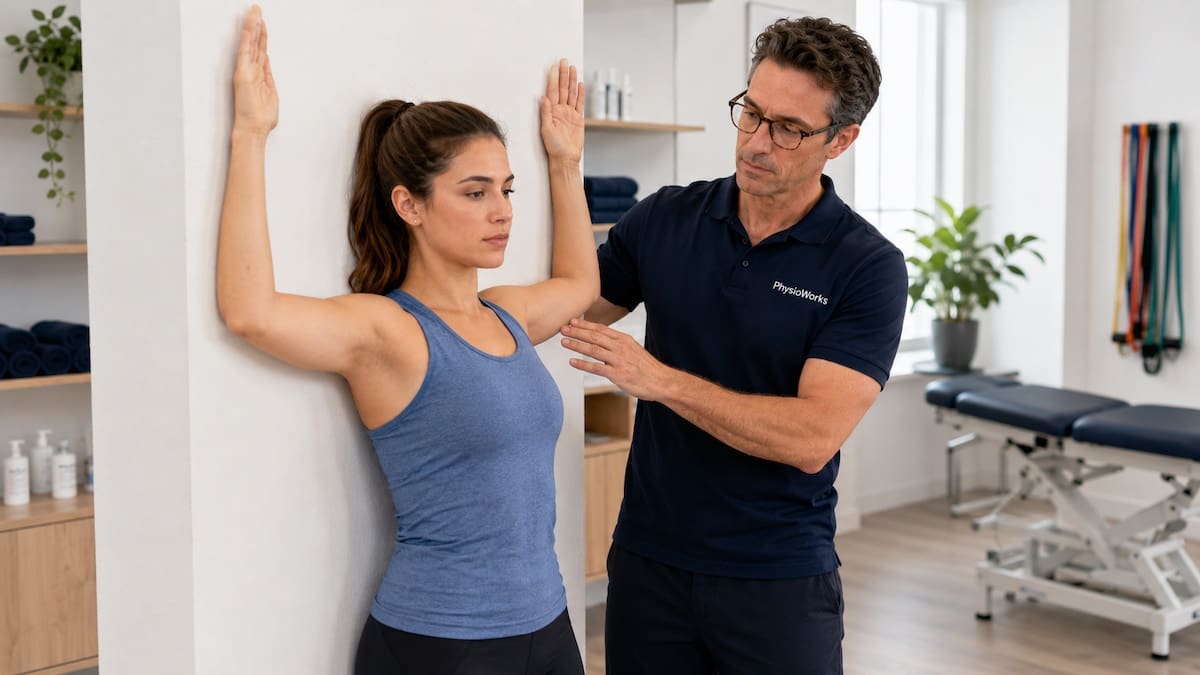
Retraining shoulder blade and rotator cuff control.
Physiotherapy for Shoulder Instability
Physiotherapy for shoulder instability aims to improve how well the muscles control the joint and then build the capacity needed for daily activity, work, gym exercise or sport.
The starting point depends on whether the instability followed trauma, whether the shoulder has dislocated, how irritable it is and the activities you want to return to.
1. Restore shoulder control
Early rehabilitation may focus on comfortable shoulder positions, joint awareness and controlled movement. The aim is to develop repeatable movement without unnecessary guarding or slipping.
2. Strengthen the rotator cuff
The rotator cuff helps keep the ball of the shoulder centred as the arm moves. Strength work usually progresses from controlled low-load exercise towards greater resistance, range and speed.
See our rotator cuff exercise guide for more information about shoulder strengthening principles.
3. Improve shoulder blade control
The shoulder blade provides the base for arm movement. Rehabilitation may include exercises for the serratus anterior, trapezius and other muscles that help position and control the shoulder blade.
Read more about shoulder blade and scapular muscle exercises.
4. Build strength and endurance
As control improves, rehabilitation usually becomes more demanding. Pushing, pulling, carrying and overhead exercises can be introduced progressively according to your symptoms and goals.
5. Retrain work, gym or sport demands
A swimmer, tennis player, thrower or contact-sport athlete needs different end-stage rehabilitation from someone whose goal is comfortable daily lifting. Later rehabilitation should progressively reproduce the speed, load, position and endurance required for your usual activities.
Can Exercise Help Shoulder Instability?
Exercise is an important part of treatment for many people with atraumatic, functional or multidirectional shoulder instability. A structured program can improve muscular control, strength, endurance and confidence with movement.
However, there is no single shoulder instability exercise program that suits everyone. The correct starting level depends on factors such as pain, apprehension, joint laxity, previous injury, strength and activity demands.
If you are unsure where to begin, a shoulder physiotherapy assessment can help match exercise selection and progression to your presentation.
How Long Does Shoulder Instability Rehabilitation Take?
Recovery time varies. A mild control problem may improve over several weeks, while recurrent or multidirectional instability can require several months of progressive rehabilitation.
Instead of relying only on a calendar, progression should reflect what your shoulder can do. Useful markers include improving strength, better movement control, reduced apprehension and the ability to tolerate the loads required for your work or sport.
When Is Surgery Considered?
Surgery is not required for every unstable shoulder. Rehabilitation is commonly considered when symptoms are primarily related to atraumatic or functional instability and the shoulder can be progressively strengthened without repeated traumatic episodes.
An orthopaedic opinion may be appropriate when there are recurrent traumatic dislocations, significant structural injury, persistent instability despite appropriate rehabilitation or high-demand sporting requirements that cannot be met safely.
Even when surgery is recommended, rehabilitation remains important for restoring movement, strength and function afterwards.
Can Shoulder Instability Return?
Shoulder instability can recur, particularly when the joint remains lax, a structural injury persists or strength and sport-specific capacity have not been restored.
Continuing appropriate strength and control exercises after symptoms settle may help maintain the shoulder’s capacity. Athletes should also increase throwing, swimming, serving and overhead training gradually rather than making sudden workload jumps.
What to Do Next
If your shoulder repeatedly slips, gives way or feels unreliable, an assessment can help clarify whether the main problem is joint laxity, muscle control, a previous injury or an associated structural problem.
A physiotherapist can assess your shoulder movement, strength and activity demands, then build a rehabilitation plan around the tasks you want to regain.
Choose your clinic and appointment pathway
Select a PhysioWorks clinic to continue to live booking, an appointment request or reception assistance.
References
- Stokes DJ, McCarthy T, Frank RM, et al. Physical Therapy for the Treatment of Shoulder Instability. Phys Med Rehabil Clin N Am. 2023;34(2):267-281.
- Hippensteel KJ, Brophy RH, Smith MV, Wright RW. Comprehensive Review of Multidirectional Instability of the Shoulder. Curr Rev Musculoskelet Med. 2023;16(4):201-209.
- Spanhove V, Van Daele M, Van den Abeele A, et al. Muscle Activity and Scapular Kinematics in Individuals With Multidirectional Shoulder Instability: A Systematic Review. Ann Phys Rehabil Med. 2021;64(1):101457.
- Warby SA, Ford JJ, Hahne AJ, Watson L, Balster S, Lenssen R, Pizzari T. Comparison of 2 Exercise Rehabilitation Programs for Multidirectional Instability of the Glenohumeral Joint: A Randomized Controlled Trial. Am J Sports Med. 2018;46(1):87-97.
Shoulder Instability FAQs
What is the difference between functional and structural shoulder instability?
Functional shoulder instability is mainly associated with how the muscles coordinate and control the joint. Structural instability involves physical changes or injury to structures such as the capsule, ligaments, labrum or bone. Some people have features of both.
Can shoulder instability cause pain?
Yes. An unstable shoulder can become painful during lifting, reaching, gym exercise or sport. However, pain can also come from nearby tendons, the labrum or other shoulder structures, so pain alone does not confirm instability.
Can shoulder instability improve without surgery?
Many people with atraumatic, functional or multidirectional instability can improve with progressive rehabilitation. Surgery may be considered when recurrent traumatic instability, significant structural injury or persistent symptoms remain despite appropriate rehabilitation.
What exercises are used for shoulder instability?
Exercises commonly target rotator cuff strength, shoulder blade control, proprioception, endurance and progressive overhead loading. The right starting point depends on your symptoms, strength, joint laxity and activity goals.
How long does shoulder instability physiotherapy take?
Timeframes vary. Some milder control problems improve within several weeks, while recurrent or multidirectional instability may require several months of progressive rehabilitation. Progress is usually guided by strength, control, symptoms and activity tolerance rather than time alone.
Can shoulder instability come back?
Yes. Instability can recur when joint laxity or structural problems remain, or when shoulder strength, endurance and activity-specific capacity have not been restored. Ongoing strength work and gradual workload progression may help reduce recurrence.
When should I get an unstable shoulder assessed?
Arrange an assessment if your shoulder repeatedly slips, gives way, feels apprehensive, clicks painfully or limits sleep, work, gym or sport. Seek prompt medical care after major trauma, a visible deformity or new neurological or circulation symptoms in the arm or hand.
