
Hydrotherapy Brisbane
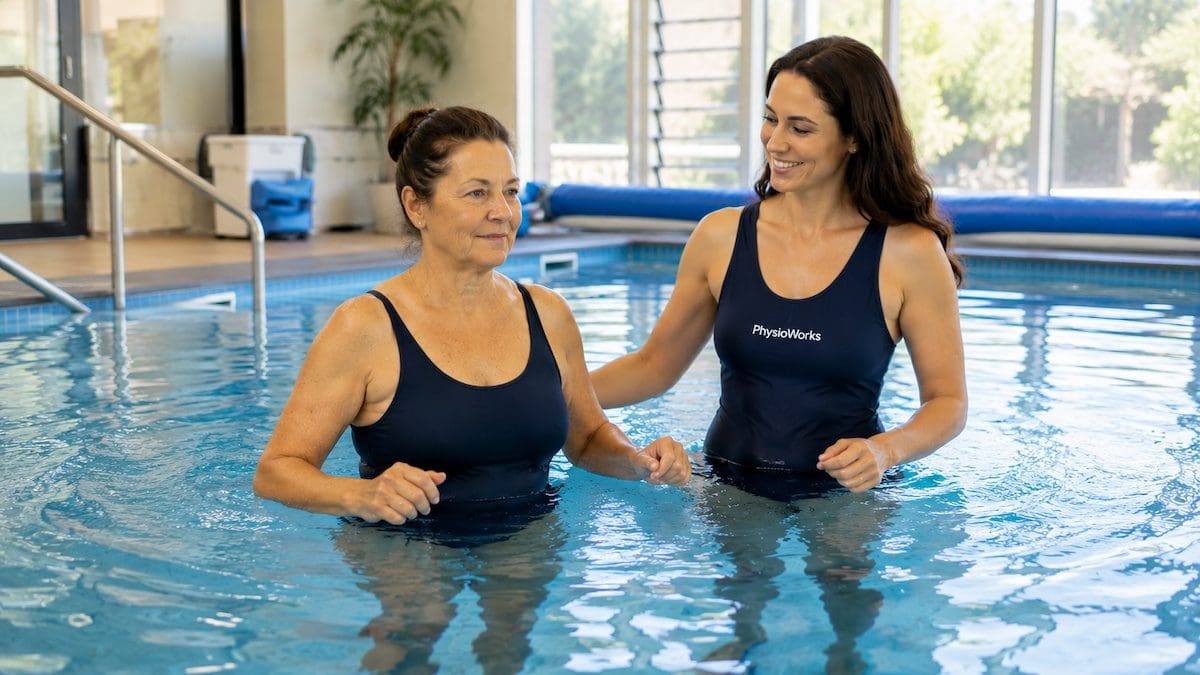
Guided warm-water exercise may help you move with less joint loading while rebuilding strength, balance and confidence.
Location
Hydrotherapy is coordinated through PhysioWorks Sandgate and nearby heated-pool facilities.
First step
Complete an assessment before beginning an individual or group hydrotherapy program.
Swimming
Swimming skills are usually unnecessary because most exercises take place in supported shallow water.
Progression
Your plan may progress from supported pool exercise towards stronger land-based rehabilitation.
How Do You Start Hydrotherapy?
Hydrotherapy at Sandgate uses an assessment-first pathway. A direct online hydrotherapy appointment has not been established, so please call our reception team to arrange the appropriate initial assessment.
Arrange Your Initial Assessment
Call PhysioWorks Sandgate and explain that you are interested in hydrotherapy. Reception can help arrange the appropriate assessment and provide current pool or class information.
Learn About the Sandgate Clinic
Review clinic access, services and contact details before arranging your assessment.
Your assessment helps determine whether individual hydrotherapy, the Sandgate hydrotherapy group class, clinic-based strengthening or a combined plan is the most appropriate starting point.
What Is Hydrotherapy?
Hydrotherapy uses warm water, buoyancy and water resistance to support rehabilitation. It is sometimes called aquatic physiotherapy or aquatic exercise therapy.
Buoyancy reduces the amount of body weight passing through your joints and spine. As a result, walking, squatting and other exercises may feel more manageable in water than they do on land.
Meanwhile, water provides resistance in every direction. Your clinician can use that resistance to develop strength and movement control without immediately relying on heavy weights.
Why Consider Hydrotherapy?
Hydrotherapy may provide a useful entry point when pain, stiffness, weakness or fear of falling limits land-based exercise.
Reduced joint loading
Water supports part of your body weight. This may make movement more comfortable for people with osteoarthritis, knee arthritis or other painful joints.
Warmth and mobility
A heated pool may help stiff joints and muscles feel more comfortable while you begin controlled mobility exercises.
Adjustable resistance
Changing your speed, movement direction, equipment or water depth can increase or reduce exercise difficulty.
Supported balance practice
Water slows movement and may provide a more reassuring environment for early balance training and fall prevention.
Why Is an Assessment Required Before Hydrotherapy?
Before beginning hydrotherapy, your clinician needs to understand your health, mobility and rehabilitation goals. The assessment also checks whether the pool environment is suitable and safe for you.
-
Review your condition and health history
Your clinician discusses your symptoms, diagnosis, medical history, medications and any recent surgery or medical advice.
-
Assess your current function
The assessment may review strength, joint movement, walking, balance and the activities you currently find difficult.
-
Check pool safety and access
Your clinician considers skin integrity, continence, infections, cardiac health, seizures, dizziness and your ability to enter and leave the pool safely.
-
Choose the right pathway
The findings help determine whether individual hydrotherapy, group hydrotherapy or land-based rehabilitation is the better starting point.
-
Plan your progression
Your program should connect pool exercise with meaningful goals such as walking, stairs, work, sport or daily independence.
Which Hydrotherapy Pathway May Suit You?
The most suitable option depends on your health, mobility, water confidence, rehabilitation stage and need for supervision.
Individual hydrotherapy
Individual sessions may suit early rehabilitation, complex medical needs, significant balance concerns or people who require close supervision and a targeted program.
Sandgate hydrotherapy group class
A supervised small-group class may suit people who have completed screening and can exercise safely with less individual assistance.
Land-based rehabilitation
Clinic or gym-based exercise may be more appropriate when you are ready for greater loading, functional strengthening and progression towards normal activities.
Some people use hydrotherapy as a temporary bridge. Others combine pool exercise with physiotherapy treatment, Exercise Physiology Sandgate or a home exercise program.
What Happens During a Hydrotherapy Session?
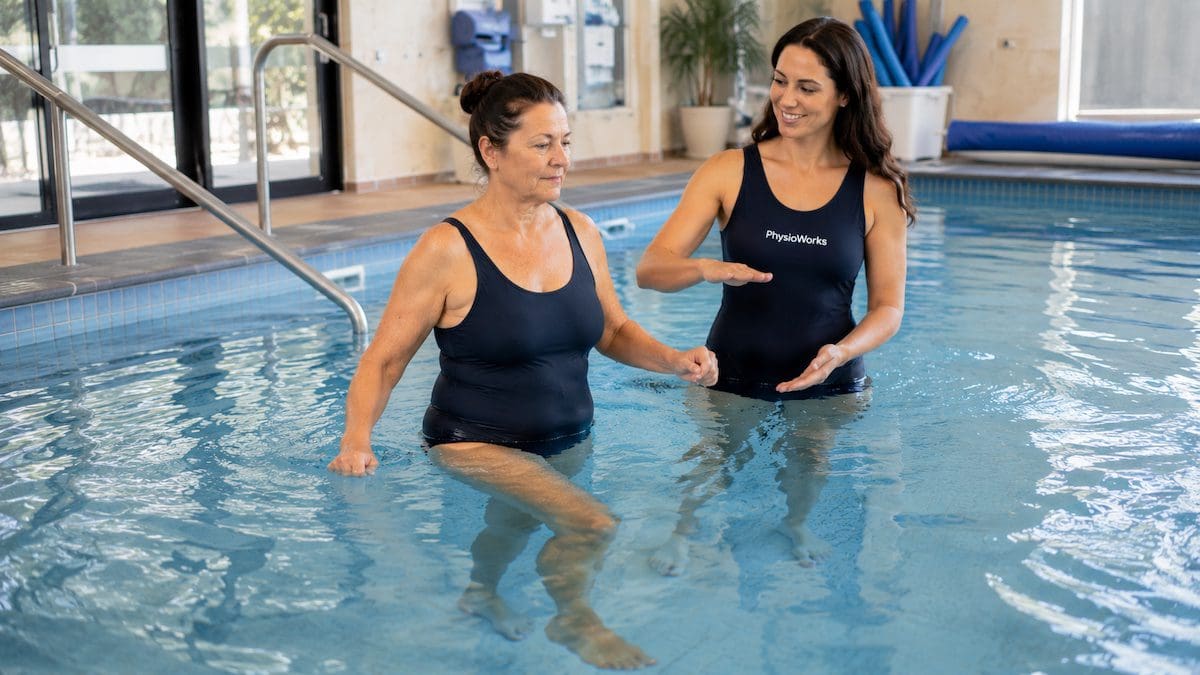
Your clinician selects exercises according to your assessment findings, goals and response on the day. Water depth, exercise speed and equipment can be adjusted to change the amount of support or resistance.
Mobility and movement
You may practise controlled joint movement, reaching, trunk rotation or gentle range-of-motion exercises.
Walking and balance
The program may include forward, backward and sideways walking, stepping tasks and supported balance exercises.
Strengthening
Exercises may target the hips, knees, calves, shoulders and trunk using body weight, water resistance or aquatic equipment.
Fitness and function
When suitable, your clinician may add conditioning intervals and activities related to stairs, transfers, work or daily mobility.
Most sessions take place in shallow or chest-deep water. Rails and pool-edge support may be available, so swimming is usually unnecessary.
Who May Benefit From Hydrotherapy?
Hydrotherapy does not suit every person or condition. However, it may be considered when supported water-based movement offers a practical way to begin or progress rehabilitation.
Arthritis and joint stiffness
People with osteoarthritis, rheumatoid arthritis or stiff painful joints may find warm-water movement easier to tolerate.
Back, hip or knee pain
Hydrotherapy may provide a graded exercise option for some people with lower back pain, hip pain or knee pain.
Post-operative rehabilitation
After medical or surgical clearance, hydrotherapy may support movement during post-operative physiotherapy.
Balance and walking concerns
Supported water exercise may help some people rebuild confidence before progressing to more demanding land-based walking and balance tasks.
Persistent pain
Warm-water exercise may provide an entry point when pain or fear of movement makes ordinary exercise difficult. Learn more about our broader pain management approach.
Reduced strength or fitness
People returning after illness, injury or reduced activity may use aquatic exercise to rebuild exercise tolerance gradually.
What Does Research Say About Hydrotherapy?
Research suggests that aquatic exercise can provide modest improvements in pain, function, strength, balance and fitness for several patient groups. Results vary, and hydrotherapy should form part of a program matched to the individual rather than replace appropriate medical care or progressive land-based rehabilitation.
Hip and knee osteoarthritis
Systematic reviews and clinical trials suggest aquatic exercise may reduce pain and improve function for some people with hip or knee osteoarthritis. The supported environment may be particularly useful when ordinary weight-bearing exercise is initially difficult.
Chronic lower back pain
Reviews of aquatic exercise for chronic lower back pain report improvements in pain and function for some participants. However, treatment programs, supervision and study quality vary.
Chronic disease and reduced conditioning
A systematic review of adults with and without chronic disease reported improvements in strength, balance and cardiorespiratory fitness following water-based exercise. Programs commonly ran for several weeks and included progressive exercise rather than passive time in the pool.
When May Hydrotherapy Be Unsuitable?
Most people can participate safely after appropriate screening. However, hydrotherapy may need to be postponed or modified when a health issue creates an infection, medical or pool-safety risk.
Extra planning may also be required if you have:
- difficulty entering or leaving the pool
- significant dizziness or fainting
- poorly controlled breathing problems
- continence concerns
- an unstable medical condition
- recent surgery without clearance for pool activity
- significant fear of water
Call Sandgate reception before attending if your health changes or you are unsure whether you should enter the pool.
How Should You Prepare?
-
Bring relevant health information
Bring your referral, scans, surgeon instructions or medical clearance when these documents relate to your rehabilitation.
-
Pack suitable pool clothing
Wear swimwear or comfortable clothing designed for pool use. Bring a towel and any personal pool-access items you require.
-
Plan safe pool access
Tell reception if you need help with stairs, rails, changing facilities or transport.
-
Report changes in your health
Advise the team about wounds, infections, illness, dizziness or changes in your medical condition before entering the pool.
How Does Hydrotherapy Progress Back to Land Exercise?
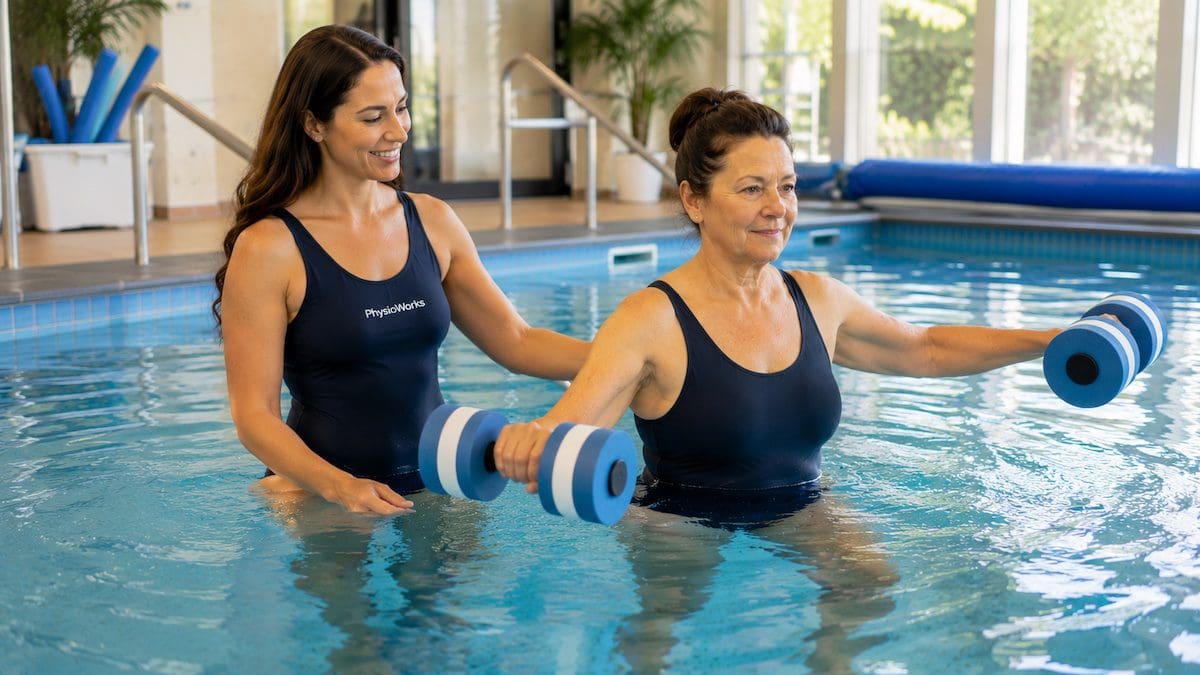
Hydrotherapy is often most useful when it connects with a broader rehabilitation goal. As movement becomes easier, your clinician may gradually increase exercise difficulty or reduce the support provided by the water.
Your progression may include shallower-water exercise, faster movements, greater resistance, more demanding balance tasks and a transition towards strengthening exercises on land.
The aim is not simply to perform pool exercises. The aim is to improve the activities that matter to you, such as walking, stairs, work, recreation or independent daily function.
What Should You Do Next?
Start with an assessment through PhysioWorks Sandgate. The assessment helps determine whether hydrotherapy is suitable and whether individual sessions, group exercise, land-based rehabilitation or a combined approach best matches your needs.
Call Sandgate Reception
Tell reception that you would like to arrange a hydrotherapy assessment. The team can provide current pathway and pool information.
Before Your Assessment
Bring any relevant referral, scan, surgeon advice or medical clearance. Please also advise us about wounds, illness, dizziness or other health concerns.
Hydrotherapy FAQs
What is hydrotherapy?
Hydrotherapy is guided exercise in a heated pool. Water supports part of your body weight and provides gentle resistance. This may help you work on strength, mobility, walking and balance with less joint loading than some land-based exercises.
Do I need to be able to swim?
Usually, no. Most rehabilitation exercises occur in shallow or chest-deep water. Pool rails, the pool edge and clinician supervision can provide additional support.
Do I need an assessment before starting?
Yes. An assessment helps review your health, mobility, goals and pool-safety needs. It also helps determine whether individual hydrotherapy, a group class or land-based rehabilitation is the most appropriate option.
Who may benefit from hydrotherapy?
Hydrotherapy may suit some people with arthritis, joint stiffness, persistent back or lower-limb pain, post-operative weakness, balance concerns or reduced exercise tolerance. Suitability depends on your health and assessment findings.
Can I join the Sandgate hydrotherapy group class?
You may be able to join after completing the required screening assessment. The assessment confirms whether group exercise is safe and useful or whether you need individual hydrotherapy or another rehabilitation pathway first.
Is hydrotherapy helpful for arthritis?
Many people with arthritis find warm-water exercise easier to tolerate than land exercise. Research suggests aquatic exercise may provide modest short-term improvements in pain and function for some people with hip or knee osteoarthritis.
Can hydrotherapy help chronic lower back pain?
Hydrotherapy may help some people with chronic lower back pain improve movement tolerance, pain and function. It is generally most useful when connected to a progressive rehabilitation plan and meaningful daily goals.
When should hydrotherapy be avoided?
Hydrotherapy is commonly delayed when someone has an open wound, active skin infection, vomiting or diarrhoea, fever, uncontrolled seizures or unstable heart symptoms. Extra screening may be needed for dizziness, continence concerns, breathing problems or complex medical conditions.
How do I arrange hydrotherapy at PhysioWorks?
Call PhysioWorks Sandgate on 07 3269 1122 and ask to arrange a hydrotherapy assessment. Reception can advise you about the appropriate assessment pathway and current pool or class arrangements.
References
- Lei C, Chen H, Zheng S, et al. The efficacy and safety of hydrotherapy in patients with knee osteoarthritis: a meta-analysis of randomized controlled trials. Int J Surg. 2024;110(3):1711-1722.
- Chen X, Fan Y, Tu H, Luo Y. Clinical efficacy of different therapeutic options for knee osteoarthritis: a network meta-analysis based on randomized clinical trials. PLoS One. 2025;20(6):e0324864.
- Song JA, Oh YA, Lee K. Effects of aquatic exercises for patients with osteoarthritis: systematic review with meta-analysis. Healthcare (Basel). 2022;10(4):637.
- Ma J, Zhang T, Xu J, et al. Effect of aquatic physical therapy on chronic low back pain: a systematic review and meta-analysis. J Rehabil Med. 2022;54:jrm00368.
- Babiloni-Lopez C, Pleguezuelos E, Perez-Risco J, et al. Water-based exercise in patients with nonspecific chronic low back pain: a systematic review. PM R. 2024;16(5):575-589.
- Rivas Neira S, Marques AP, Fernández Cervantes R, Seoane T, Vivas Costa J. Efficacy of aquatic versus land-based therapy for pain management in women with fibromyalgia: a randomised controlled trial. Physiotherapy. 2024;123:91-101.
- Faíl LB, Marinho DA, Marques EA, et al. Benefits of aquatic exercise in adults with and without chronic disease: a systematic review with meta-analysis. Scand J Med Sci Sports. 2022;32(3):465-486.
- Lee CH, Yoon JY, Lee JY, et al. Aquatic exercise and land exercise treatments after total knee replacement arthroplasty in elderly women: a comparative study. Medicina (Kaunas). 2021;57(7):698.
