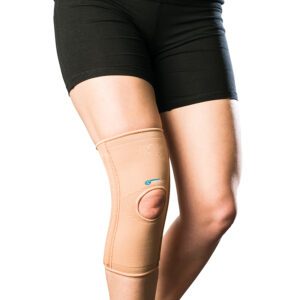
AllCare Ortho Elastic Knee Support With Splints AOK13
$39.95
- Description
- Additional information
Description
AllCare AOK13 Elastic Knee Support with Splints
The AllCare Ortho Elastic Knee Support AOK13 combines flexible compression with spiral side stays and an open-patella design. It may suit people looking for comfortable, light-to-moderate support during everyday activities or selected rehabilitation exercises.
This support is designed for mild knee symptoms. It is not a rigid hinged brace or a substitute for assessment after a significant knee injury.
Is the AOK13 Right for You?
The AOK13 may be suitable when you need flexible compression and some additional side support, rather than firm restriction of knee movement.
- Mild knee discomfort during walking or daily activities.
- Minor swelling where compression is appropriate.
- Selected low-grade knee sprains, following professional advice.
- Additional comfort or support during suitable rehabilitation exercises.
Not every knee condition responds to bracing. If you have substantial instability, repeated giving way, significant swelling or a recent major injury, seek professional advice before choosing this support.
Key Features and Benefits
- Four-way stretch elastic: Provides flexible compression while allowing knee movement.
- Spiral side stays: Add flexible support on the inner and outer sides of the knee.
- Open-patella design: Leaves the kneecap uncovered and may improve comfort for some users.
- Flexible construction: Allows movement during appropriate daily activities.
- Four selectable sizes: S, M, L and XL, subject to stock availability.
How to Choose Your AOK13 Knee Support Size
Measure around the middle of your knee, at kneecap level, using a flexible measuring tape. Keep the tape level and close to the skin without pulling it tightly.
Compare your measurement with the manufacturer’s sizing chart before selecting a size.
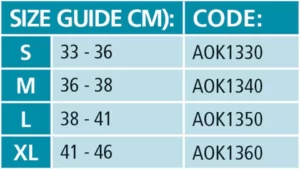
A correctly fitted brace should remain comfortably in place without causing numbness, tingling, marked skin indentation or changes in circulation.
If your measurement falls between two sizes, seek sizing advice rather than automatically choosing the tighter fit.
How to Wear Your Elastic Knee Support
- Check the manufacturer’s sizing information and select the appropriate size.
- Position the support so the kneecap aligns with the open-patella section.
- Check that the side stays sit correctly and the brace does not bunch behind your knee.
- Walk and bend your knee gently to assess comfort and fit.
- Remove the support if you develop numbness, tingling, increasing pain or skin irritation.
Wear duration depends on your symptoms, activity and clinical advice. Use the support during suitable activities when it provides a practical benefit. Do not assume that wearing it continuously will improve recovery.
Follow the manufacturer’s instructions for cleaning, drying and product care.
When Might You Need a Different Knee Brace?
The AOK13 provides flexible support rather than rigid knee stabilisation. A different brace or clinical assessment may be necessary if you have:
- A moderate or severe ligament injury.
- Repeated knee buckling or significant instability.
- A knee injury requiring restricted movement.
- Post-operative bracing requirements.
- A suspected fracture or major structural injury.
If you are unsure about your injury, read our guide to knee pain causes or seek advice from a physiotherapist.
Frequently Asked Questions
Does the AOK13 provide ligament support?
The spiral stays offer flexible side support, but the AOK13 is not a rigid hinged ligament brace. Significant ligament instability needs professional assessment and may require a different support.
Can I use the AOK13 for kneecap pain?
The open-patella design may feel comfortable for some people with mild kneecap symptoms. However, it does not necessarily correct patellar tracking. Learn more about patellofemoral pain syndrome and suitable rehabilitation.
Can I wear the knee support all day?
Wear time should reflect comfort, activity needs and professional advice. Remove the support if it causes skin irritation, numbness, tingling or increasing discomfort. Follow any specific instructions from your treating clinician.
Will the knee brace replace strengthening exercises?
No. A brace may provide temporary support, but it does not replace rehabilitation. Depending on the problem, knee strengthening and movement exercises may help build longer-term capacity.
Helpful Knee Support Information
- Knee Pain and Injury Guide — understand common knee problems and treatment options.
- Knee Exercises — learn about strengthening and activity progression.
- Compare Knee Braces and Supports — browse other support designs.
- PhysioWorks Clinic Product Availability — find out how to check local stock.
For general Australian health information, see Healthdirect’s knee pain guidance.
Choosing Your Next Step
Select your size using the WooCommerce product options to purchase the AOK13 online. If you need local collection, contact your preferred PhysioWorks clinic first to confirm availability.
If your knee locks, repeatedly gives way, develops marked swelling or remains painful despite appropriate changes to activity, arrange a physiotherapy or medical assessment.
Additional information
| Weight | .2 kg |
|---|---|
| Dimensions | 5 × 10 × 30 cm |
| Size | S, M, L, XL |