
Bunion management guide
Understand bunion symptoms, contributing factors and common management choices.
$54.95
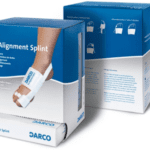
The DARCO TAS Toe Alignment Splint is a universal post-operative support designed to help maintain toe alignment while your foot heals after selected bunion or toe procedures. Use it only when recommended and fitted by your surgeon, podiatrist or treating healthcare professional.
The DARCO TAS is a soft, adjustable splint used to maintain the position of one or more toes during post-operative healing. DARCO identifies it for use following procedures for hallux valgus, commonly called a bunion, hammer toes and tailor’s bunion.
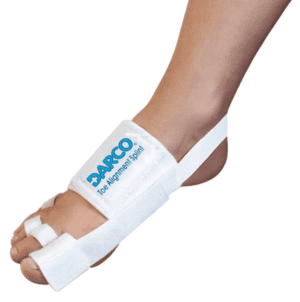
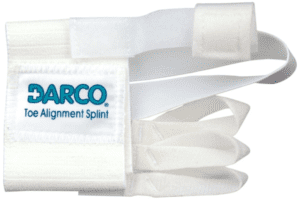
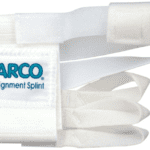
A low-profile elastic band wraps around the forefoot. A heel band helps hold the support in position, while one large-toe loop and three smaller-toe loops provide options for supporting the affected toe or toes.
Primary purpose
Maintaining toe alignment during post-operative healing.
Sizing
Universal size.
Foot
Suitable for either the right or left foot.
Pack quantity
One toe alignment splint.
Materials note
Latex-free.
Use
Single-patient use under healthcare-professional guidance.
A surgeon, podiatrist or other treating healthcare professional may recommend this splint after a procedure involving:
Your operation, dressings and recovery instructions determine whether this product is appropriate. Do not substitute it for another splint prescribed by your treating clinician.
The elastic metatarsal band sits around the forefoot just behind the metatarsal heads. The heel band helps limit slipping, while the selected soft toe loop gently supports the operated toe in the position directed by your clinician.
The design can support one or several toes. However, the appropriate setup depends on the procedure and your clinician’s instructions. More tension does not provide a better result and may create unwanted pressure.
Confirm which toe or toes require support and whether your dressings must remain in place underneath the splint.
Place the metatarsal band around the forefoot, just behind the metatarsal heads. It should feel secure without restricting circulation.
Pass the heel band around the back of the heel and attach it to the medial and lateral sides of the metatarsal band.
Apply the appropriate loop to the toe or toes identified by your treating clinician. Follow the product illustrations or clinician demonstration rather than guessing the direction of pull.
The toes should remain warm and their normal colour. The splint should not cause increasing pain, throbbing, numbness, tingling or excessive pressure.
Wear the splint for the schedule provided by your clinician. The manufacturer does not provide a universal wear time because post-operative needs vary between procedures and patients.
Use extra care when walking. Move more slowly than usual and follow any instructions about footwear, weight bearing, walking aids or activity restrictions. Do not drive while wearing the device.
When the splint becomes lightly soiled, clean it with a damp cloth or soft brush. Allow it to air dry completely. Do not use heat to speed drying.
Inspect the bands and loops regularly. Stop using the product and seek advice if a component becomes damaged, loses its hold or creates unwanted pressure.
This product is designed mainly for maintaining alignment after surgery. People seeking non-operative support for an untreated bunion may need a different product, footwear modification or an individual management plan.
For general information about symptoms, footwear and treatment choices, read our bunion management guide. Our foot pain conditions hub also explains other causes of forefoot discomfort.
No. DARCO primarily identifies the TAS for maintaining toe alignment following hallux valgus, hammer-toe or tailor’s-bunion surgery. Use it only when it matches your clinician’s post-operative instructions.
Yes. The universal design can be fitted to either the right or left foot. Correct loop placement still depends on the operated toe and your clinician’s directions.
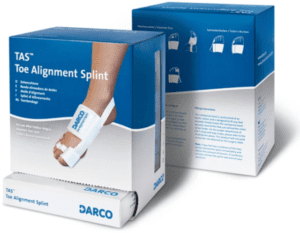
The DARCO TAS comes in a universal size. Check that the WooCommerce product image and model code identify the TAS before adding it to your cart.
The manufacturer describes the metatarsal band as low profile and suitable for many forms of footwear. However, your post-operative footwear, dressings and weight-bearing restrictions take priority.
Fasten it securely enough to hold the prescribed position without causing excess pressure. Loosen it and seek advice if you develop increasing pain, swelling, numbness, tingling or altered toe colour.
Use a damp cloth or soft brush for light cleaning, then allow the splint to air dry. Avoid direct heat.
Confirm that your clinician has recommended the DARCO TAS for your procedure. Review the product image and model, then use the native WooCommerce purchase controls above to add the product to your cart.
Do not purchase this product as a substitute for clinical review if you have an untreated bunion, unexplained forefoot pain or uncertainty about the correct support.
Manufacturer information: Review the current DARCO instructions supplied with the product and follow your treating healthcare professional’s post-operative plan.
| Weight | .1 kg |
|---|---|
| Dimensions | 20 × 10 × 5 cm |