FAQs

Frequently Asked Questions


Warming Up Before Exercise

Dynamic warm-up exercises with physiotherapy coaching before exercise
Dynamic warm-ups prepare your body for activity.

Warming up before exercise helps your body move from rest into harder work. It prepares your muscles, joints, tendons and nerves for sport, gym work or daily tasks.

A good warm-up should be active and gradual. It may include stretching exercises, a clear exercise plan and simple safe sport habits. For sport, it can also form part of sports physio care.

Quick Answer: What Makes a Good Warm-Up?

  • Start with easy movement for 2 to 5 minutes.
  • Add moving stretches for the joints you will use.
  • Turn on the main muscles for the task.
  • Finish with drills that match your sport or workout.
  • Save long static holds for after exercise or a separate stretch session.

Why Is Warming Up Important?

Warming up lifts body heat and blood flow. It also helps muscles switch on and joints move more freely.

This matters because sudden hard effort can overload soft tissue. A warm-up gives your body time to adjust before you sprint, jump, lift or change direction.

Does Warming Up Improve Sport?

It can. The best warm-ups usually match the task ahead. A runner may add marching, leg swings and short run-throughs. A footballer may add balance, landing and change-of-direction drills.

Recent reviews support moving stretches before fast sport. These drills keep you active through range. They appear more useful than long static holds before speed, jump or power work.

Warm-Up Decision Guide

Before running

Walk or jog first. Add leg swings, marching and short build-ups.

Before gym work

Use light cardio, joint range work and easy sets before heavy lifts.

Before sport

Add balance, landing, agility and sport-like drills.

What Type of Warm-Up Helps Most?

An active warm-up usually helps most. Start with easy whole-body movement. Then add moving stretches, light muscle work and practice drills.

For injury risk, a warm-up should do more than make you feel warm. It should also build control. This is why many sport plans include balance, landing and trunk control. These ideas also sit well with safe sport habits and sports injury care.

What Should a Good Warm-Up Include?

Most warm-ups take 5 to 15 minutes. A harder session, cold weather or a return from injury may need more time.

  1. Easy movement: walk, cycle, jog or skip lightly.
  2. Moving stretches: move your hips, knees, ankles, shoulders or spine.
  3. Muscle wake-up: use light work for the muscles you need.
  4. Practice: rehearse the speed, skill or load needed for the session.

Should You Stretch Before Exercise?

Yes, but choose the right type. Moving stretches are often better before exercise because they keep you active. Long static holds may suit a cool down or a separate stretch session.

If you feel stiff after training, read about DOMS muscle soreness, muscle recovery and why a cool down matters.

Can Warming Up Help Prevent Injury?

Warming up may reduce injury risk, especially when it is part of a regular plan. It cannot stop every injury. However, it can reduce the jump from rest to hard effort.

This can help before sprinting, jumping, lifting, cutting or field sport. It is also useful when you return after a break.

When Should You Change Your Warm-Up?

  • Pain appears during the warm-up and does not settle.
  • You feel tight in the same area each session.
  • Your sport needs speed, jumping or sharp turns.
  • You are returning after injury, illness or time away.
  • Your current warm-up feels too short or too easy.

When Should You Seek Help?

Book an assessment if pain, tightness or the same injury keeps returning despite warming up. Ongoing issues may point to strength, range, tendon load or technique problems.

A physio can assess your movement and training load. They may help you keep training safely, modify your plan or rest when needed. This guide on listening to your body during exercise may help if you are unsure.

Related PhysioWorks Articles

Frequently Asked Questions About Warming Up

What type of warm-up is best before exercise?

The best warm-up is active, moving and matched to the task. Start easy. Then add joint range, light muscle work and drills that match your session.

Is dynamic stretching better than static stretching before exercise?

Moving stretches are usually better before fast or powerful exercise. Static stretching can still help, but long holds often fit better after exercise or in a separate stretch session.

How long should a warm-up take?

Most warm-ups take 5 to 15 minutes. Harder sessions, cold weather or return from injury may need a longer build-up.

Can warming up reduce soreness after exercise?

It may help some people feel less stiff. Training load, sleep, recovery and recent activity still play a major role.

Do beginners need to warm up?

Yes. Beginners often benefit from a warm-up because it helps movement feel smoother and gives the body time to adapt.

What to Do Next

Use a warm-up that matches your activity. Keep it simple, active and gradual. If pain, tightness or repeated injury keeps stopping your training, a physio assessment can help guide your next step.

Choose your clinic and appointment pathway

Select a PhysioWorks clinic to continue to live booking, an appointment request or reception assistance.

Follow PhysioWorks

Get physiotherapy tips, exercise videos, recovery advice and blog updates.

References

  1. Li FY, Guo CG, Li HS, Xu HR, Sun P. A systematic review and net meta-analysis of the effects of different warm-up methods on the acute effects of lower limb explosive strength. BMC Sports Sci Med Rehabil. 2023;15(1):106. doi:10.1186/s13102-023-00703-6
  2. Esteban-García P, Sánchez-Infante J, Ramírez-delaCruz M, Rodríguez-Álvarez J, Rubio-Arias JÁ. Does the inclusion of static or dynamic stretching in the warm-up routine improve jump height and ROM in physically active individuals? A systematic review with meta-analysis. Appl Sci. 2024;14(9):3872. doi:10.3390/app14093872
  3. Ding L, Luo J, Smith DM, Mackey M, Fu H, Davis M. Effectiveness of warm-up intervention programs to prevent sports injuries among children and adolescents: a systematic review and meta-analysis. Int J Environ Res Public Health. 2022;19(10):6336. doi:10.3390/ijerph19106336
  4. Zhu C, Lu Y, Tao M, Yin T, Li J, Thompson S, Gu N. Effects of neuromuscular warm-up on athletes’ change-of-direction performance and knee isokinetic muscle strength: a systematic review and meta-analysis. Front Physiol. 2026;17:1750821. doi:10.3389/fphys.2026.1750821

Is Chest Pain Always a Sign of a Heart Attack?

Chest pain anterior chest wall screening discussion with physiotherapist
Chest pain should be screened safely first.

Chest pain can feel scary. It is not always a heart attack. Pain can also come from the chest wall, ribs, upper back, muscles, reflux, stress, or lung problems. Still, treat new, strong, or odd chest pain as heart related until a doctor rules this out.

Call 000 now if chest pain is strong, getting worse, lasts more than 10 minutes, or comes with shortness of breath, sweat, nausea, dizziness, faintness, or pain that spreads to the arm, jaw, neck, back, or shoulder.

If your pain has been checked and the likely cause is chest wall or upper back related, our thoracic pain guide explains common rib, upper back, and posture-related pain patterns.

Call 000 if chest pain may be serious

Call 000 if chest pain is strong, getting worse, lasts more than 10 minutes, or feels heavy, tight, squeezing, or crushing.

Also call 000 if chest pain comes with shortness of breath, sweat, nausea, dizziness, faintness, collapse, or pain spreading to the arm, jaw, neck, back, shoulder, or stomach.

Short answer

No. Chest pain is not always a heart attack. Muscles, ribs, the upper back, posture, and breath control can all cause chest pain. Yet heart pain must be checked first. This matters most when pain is new, strong, or not like your usual pain.

Quick guide

  • Call 000 if chest pain is strong, getting worse, lasts more than 10 minutes, or feels heavy, tight, or crushing.
  • Seek urgent care if pain spreads to the arm, jaw, neck, back, or shoulder.
  • Book a doctor visit if pain is new, odd, or keeps coming back.
  • See a physio only after a doctor has ruled out heart, lung, and other key risks.

How can you tell if chest pain may be urgent?

You cannot safely judge chest pain from symptoms alone. Heart attack signs can vary. Some people feel heavy chest pressure. Others feel short of breath, sweaty, sick, dizzy, faint, or just very unwell.

Chest pain can also come from other serious causes. These include a clot in the lung, chest infection, or a problem with a large blood vessel. So the first step is safety.

Symptoms that need 000

Call 000 at once if chest pain:

  • lasts more than 10 minutes at rest
  • feels heavy, tight, squeezing, or crushing
  • spreads to the arm, jaw, neck, shoulder, back, or stomach
  • comes with shortness of breath, sweat, nausea, dizziness, faintness, or collapse
  • starts with a sudden sense that something is very wrong

Do not drive yourself to hospital if these signs are present. Ask for an ambulance.

How does chest wall pain feel?

Chest wall pain comes from the ribs, muscles, joints, or upper back. It often changes with movement, posture, deep breaths, coughs, sneezes, lifting, or touch over the sore spot.

Common patterns include upper back stiffness, rib joint pain, costochondritis, muscle strain, side strain, or overload from long sitting and desk work. Pain may feel sharp, local, aching, or wrapped around the chest wall.

These signs do not prove the pain is safe. They only make a chest wall cause more likely after serious causes have been checked.
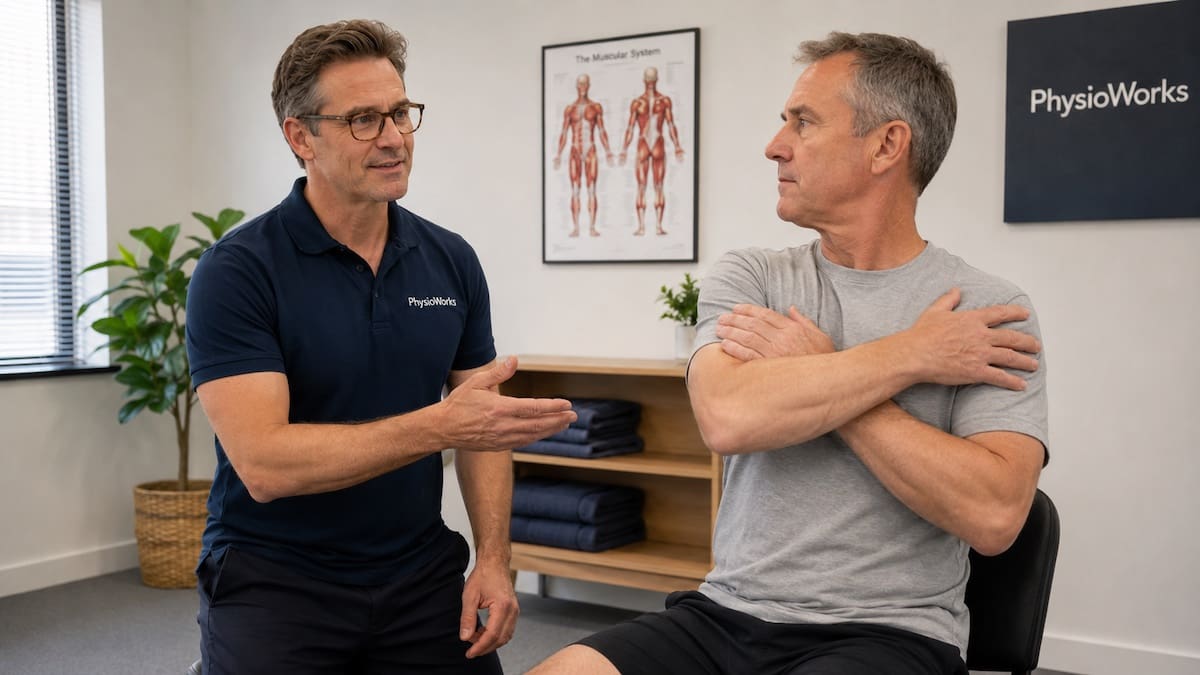
Chest wall pain thoracic spine rotation assessment with physiotherapist
Movement can help identify chest wall pain patterns.

What else can cause chest pain?

Chest pain can come from many body systems. Non-heart causes include reflux, stress, chest infection, asthma, rib stress injury, muscle strain, and upper back stiffness. Some of these still need medical care.

Because symptoms overlap, seek medical review when chest pain is new, worse, repeated, or hard to explain.

Heart pain vs chest wall pain

Pattern More urgent pattern Chest wall pattern
Pain type Heavy, tight, squeezing, or crushing Sharp, local, aching, or tender to touch
Spread Arm, jaw, neck, back, shoulder, or stomach Rib line, chest wall, or between shoulder blades
Other signs Sweat, nausea, breathlessness, faintness, collapse Worse with twisting, deep breaths, coughs, posture, or pressure
Best first step Call 000 or seek urgent medical care Medical review first if new or unclear, then physio if cleared

When can physio help?

Physio may help after heart, lung, and other urgent causes have been ruled out. A physio can check upper back movement, rib motion, posture, breath control, sore muscles, and daily load.

Care may include gentle hands-on work, breath drills, posture advice, mobility work, and strength work. Your plan should match your symptoms, health history, and goals.

Helpful follow-up guides include thoracic facet joint pain, respiratory physiotherapy, posture exercises, and our broader physiotherapy treatment guide.

Related information

What to do next

If your chest pain feels urgent, call 000. If it is new, odd, or keeps coming back, see a doctor first.

If your doctor has ruled out serious causes and your pain seems linked to the ribs, upper back, posture, or movement, a physio check may help guide safe next steps.

Choose your clinic and appointment pathway

Select a PhysioWorks clinic to continue to live booking, an appointment request or reception assistance.

Thoracic and Upper Back Products

These thoracic and upper back products are commonly used by our physiotherapists to improve strength, posture, movement, plus assist home exercise programs.

View all thoracic and upper back products

Follow PhysioWorks

Get physiotherapy tips, exercise videos, recovery advice and blog updates.

References

  1. National Heart Foundation of Australia; Cardiac Society of Australia and New Zealand. Australian clinical guideline for diagnosing and managing acute coronary syndromes 2025. Published 2025.
  2. Rahman A. Chest pain. Aust J Gen Pract. 2024;53(7):437-442. doi:10.31128/AJGP-04-23-6810
  3. Healthdirect Australia. Chest pain. Accessed June 30, 2026.
  4. Winzenberg T, Jones G, Callisaya M. Musculoskeletal chest wall pain. Aust Fam Physician. 2015;44(8):540-544.

Chest Pain FAQs

Can chest pain come from the upper back?

Yes. Upper back stiffness and rib joint pain can cause pain that wraps around the chest wall. This pain often changes with twisting, reaching, deep breaths, or posture. Still, new or odd chest pain needs medical review first.

Can posture cause chest pain?

Posture can add to chest wall pain, mostly with long sitting, rounded shoulders, or poor movement variety. Posture is rarely the only factor. Strength, breath control, rib motion, work habits, and stress can also play a role.

How do I know if chest pain is muscular?

Muscle pain often changes with movement, breathing, lifting, or pressure over the sore area. Yet signs can overlap with heart and lung problems. Get medical help first when pain is new, strong, worse, or hard to explain.

Should I see a physio for chest pain?

See a doctor or call 000 first if chest pain may be heart related or serious. Physio is more suitable after urgent causes have been ruled out and the likely driver is ribs, muscles, posture, or upper back stiffness.

Can stress cause chest pain?

Yes. Stress and panic can cause chest tightness, fast breathing, a racing heart, and chest pain. Still, do not assume stress is the cause of new or strong chest pain. Seek urgent help if signs are severe, worse, or unusual.

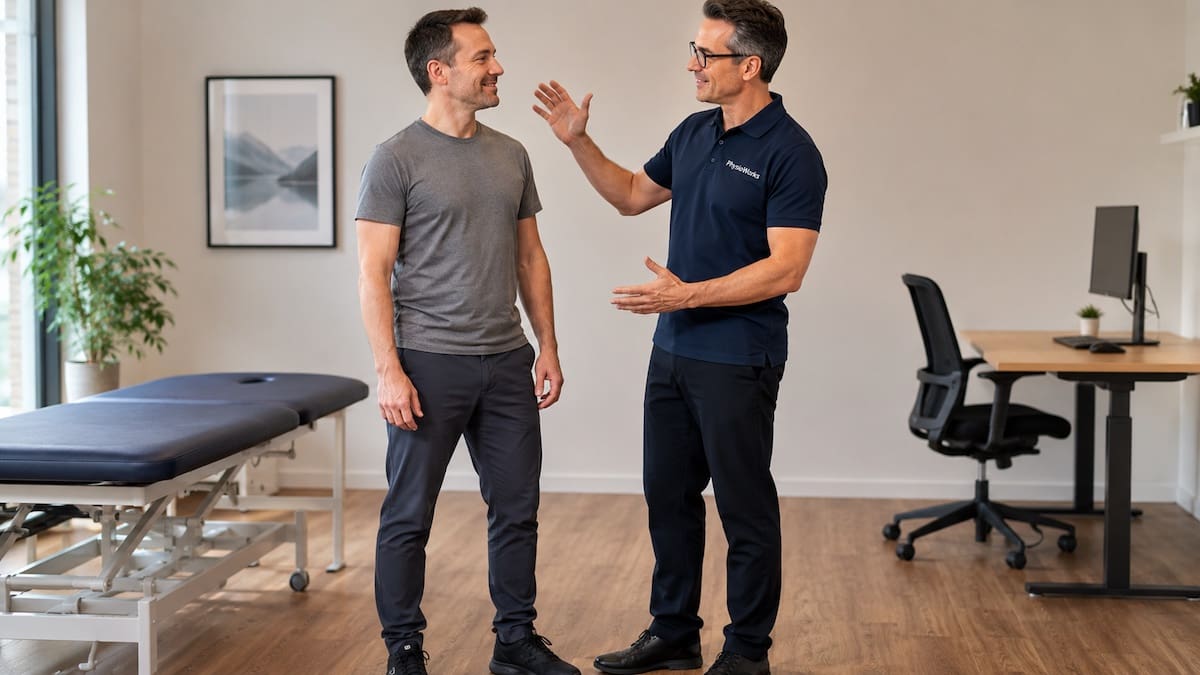
How Can You Improve Your Posture?

Physiotherapist discussing comfortable standing posture with an adult patient
A physiotherapist can assess how posture, movement, strength and daily tasks interact.

Practical posture guidance

Improving Posture Is About Movement, Not Perfection

Improving posture usually means moving more often, adjusting tasks and building enough strength and mobility to tolerate work, exercise and daily life comfortably. You do not need to hold one rigid position all day.

Improving posture is usually less about forcing your body into one “correct” position and more about moving regularly, improving physical capacity and making daily tasks more comfortable.

Posture may influence how your neck, back, shoulders and hips tolerate prolonged sitting, standing or repetitive work. However, posture is only one possible contributor to pain. Strength, activity levels, sleep, stress, previous injuries and general health may also influence symptoms.

For a broader explanation of posture, movement and available supports, see our posture guide.

Quick Answer

You can improve posture by changing position regularly, adjusting your workstation, improving strength and mobility, and gradually building tolerance for sitting, standing and other daily tasks. There is no single perfect posture that everyone should hold all day.

What Does Good Posture Actually Mean?

Good posture is a position that suits the task, feels reasonably comfortable and allows you to move and breathe without unnecessary tension.

Your posture will naturally change when you type, drive, lift, walk, exercise or relax. Therefore, a practical posture should not feel rigid or forced. Aim for positions that you can tolerate comfortably, then change position before fatigue or stiffness builds.

For a simple standing reference, see our guide to good standing posture.

Can Poor Posture Cause Pain?

Posture may contribute to pain when you hold one position for a long time or when your body does not yet have enough capacity for a particular task.

Even so, pain rarely comes from posture alone. Neck pain, back pain and shoulder discomfort often involve several contributing factors. These may include workload, stress, sleep, physical conditioning, previous injury and general health.

Changing position may improve comfort. However, this does not necessarily mean that your previous posture was harmful or that your spine was “out of alignment”.

Why Does Posture Become Uncomfortable?

Posture-related discomfort often develops when the duration or demand of a task exceeds your current tolerance. Common examples include:

  • working at a computer for long periods
  • using a laptop or phone with the screen positioned too low
  • remaining in one position without breaks
  • repeating the same movement throughout the day
  • reduced upper-back, shoulder or hip movement
  • reduced trunk, hip or upper-back strength
  • fatigue, stress or poor sleep

These factors do not automatically damage your spine. However, they may increase fatigue, stiffness or sensitivity when exposure continues for too long.

How Can You Improve Your Posture in Five Steps?

Begin with changes that are practical enough to repeat. The following approach suits many work, study, driving and daily-life situations.

STEP 1

Change Position

Stand, walk or shift position before stiffness builds. Even a brief change can reduce sustained loading.

STEP 2

Relax Excess Tension

Avoid constantly pulling your shoulders backwards or bracing your abdomen. Aim for an easy, relaxed position.

STEP 3

Adjust the Task

Bring your screen, keyboard, tools or work surface closer so you do not need to strain or reach repeatedly.

STEP 4

Move Comfortably

Use gentle neck, shoulder, upper-back and hip movements to reduce stiffness and restore movement variety.

STEP 5

Build Capacity

Strengthen your upper back, shoulders, trunk and hips so your body can tolerate daily activities for longer.

How Often Should You Change Position?

There is no exact movement schedule that suits everyone. As a practical starting point, change position or move briefly every 30 to 60 minutes.

You may need more frequent breaks if symptoms appear sooner. A movement break does not need to be long. Standing, walking for a minute, rolling your shoulders or changing your sitting position may be enough.

A Simple Movement Reminder

The best posture is often your next posture. Change position before discomfort builds rather than waiting until you feel very stiff.

How Can You Improve Sitting Posture?

Arrange your workstation around the task rather than trying to hold your body in one fixed position.

  • Position the screen near eye level where practical.

  • Keep the keyboard and mouse close.
  • Support your feet on the floor or a footrest.
  • Let your shoulders remain relaxed.
  • Use the chair back when it feels comfortable.
  • Alternate between sitting, standing and walking where possible.

A workstation adjustment may reduce unnecessary reaching and make it easier to vary your position throughout the day.

Which Exercises May Help Improve Posture?

Posture exercises should build movement options and physical capacity rather than force your spine into one fixed alignment.

Useful exercises may include:

  • upper-back rotation and extension movements
  • rows and other upper-back strengthening exercises
  • shoulder mobility and control exercises
  • trunk strengthening exercises
  • hip strengthening exercises
  • walking and general physical activity

The best exercise depends on your symptoms, health, work demands and current activity level. Exercises should feel manageable and should not cause progressively worsening pain, tingling or weakness.

Does Posture Affect Breathing?

Your sitting or standing position can influence how comfortably your chest and ribs move. A compressed or sustained position may make breathing feel less comfortable for some people.

However, you do not need to maintain a rigid upright position to breathe well. A relaxed position that allows comfortable chest and abdominal movement is usually more practical.

Can Posture Braces or Supports Help?

Posture products may provide a reminder, improve short-term comfort or support a particular task. However, they should not replace regular movement, exercise or gradual strengthening.

A support should feel comfortable and should not cause numbness, skin irritation, breathing restriction or increasing pain. See our posture products and support guide for further information.

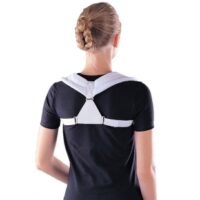
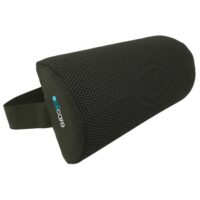
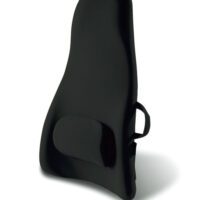
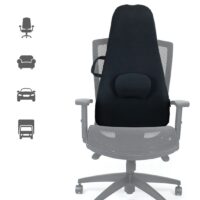
Posture Products

These posture products are commonly used by our physiotherapists to improve posture, postural strength, endurance and flexibility, plus assist home exercise programs.

View all posture products

When Should You Seek Physiotherapy Advice?

Consider a physiotherapy assessment when pain or stiffness:

  • persists despite changing your workstation or daily habits
  • limits work, exercise, sleep or normal activities
  • keeps returning
  • occurs with reduced movement or strength
  • makes it difficult to find a comfortable position

A physiotherapist can assess your movement, strength, task demands and symptom behaviour. Management may include education, exercise, activity modification and practical strategies suited to your work or daily routine.

Seek Prompt Medical Assessment

Arrange prompt assessment if symptoms include increasing arm or leg weakness, persistent numbness, loss of coordination, severe or unusual headaches, unexplained illness, chest pain, significant trauma or rapidly worsening pain.

Related Information

Frequently Asked Questions

How can I improve my posture?

Most people can improve posture by moving more regularly, increasing strength and mobility, and adjusting tasks such as prolonged sitting or computer work. A physiotherapy assessment may help identify the factors that matter most for you.

Is there a perfect posture I should hold all day?

No. There is no single perfect posture for everyone. Healthy posture allows natural variation and regular movement. Changing position is generally more practical than holding one fixed posture throughout the day.

Can poor posture cause neck or back pain?

Posture may contribute to neck or back discomfort, especially when you hold one position for a long time. However, pain usually involves several factors rather than posture alone.

How long does it take to improve posture?

Timeframes vary. Some people notice improved comfort within several weeks after changing their movement habits, workstation and exercise routine. Longer-term improvement depends on consistency and the factors contributing to symptoms.

When should I see a physiotherapist about posture?

Consider seeing a physiotherapist when pain persists, affects work or daily activity, keeps returning or occurs with weakness, tingling, headaches or worsening symptoms.

What Should You Do Next?

If posture-related pain or stiffness is affecting your work, exercise or daily routine, a physiotherapist can help identify practical changes and develop an individual exercise plan.

Choose your clinic and appointment pathway

Select a PhysioWorks clinic to continue to live booking, an appointment request or reception assistance.

Follow PhysioWorks

Get physiotherapy tips, exercise videos, recovery advice and blog updates.

References

  1. Lee S, de Barros FC, de Castro CSM, Sato TO. Effect of an ergonomic intervention involving workstation adjustments on musculoskeletal pain in office workers: a randomised controlled clinical trial. Industrial Health. 2021;59(2):78–85. View research.
  2. Titcomb DA, Melton BF, Miyashita T. The effects of postural education or corrective exercise on the craniovertebral angle in young adults with forward head posture. International Journal of Exercise Science. 2023;16(1):954–973. View research.
  3. Luger T, Ferenchak SA, Rieger MA, Steinhilber B. Work-break interventions for preventing musculoskeletal symptoms and disorders in healthy workers. Cochrane Database of Systematic Reviews. 2025;10:CD012886. View research.

What Is Good Posture?

Good posture standing side view showing natural spinal alignment

A comfortable standing position maintains natural spinal curves without forcing the body into a rigid pose.

Good posture is a comfortable, balanced way of sitting, standing or moving that allows your body to work without unnecessary effort. It does not mean holding yourself stiffly upright or maintaining one supposedly perfect position all day.

Your posture naturally changes with your activity, environment, body shape, strength and comfort. Regular movement and position changes are often more useful than repeatedly trying to correct yourself. For a broader explanation of posture-related symptoms and treatment options, visit our Posture guide.

Quick Answer

Good posture is comfortable and adaptable rather than rigid. Your spine should retain its natural curves while your muscles support you without excessive tension. However, there is no single perfect posture that suits every person or activity.

Changing position regularly, building strength and adjusting your work or study setup may help reduce stiffness and muscle fatigue.

Why Is Good Posture Important?

A comfortable posture allows your muscles, joints and connective tissues to share physical load. It may also make everyday tasks such as sitting, standing, lifting, walking and working feel easier.

However, posture is only one part of musculoskeletal health. Pain can also relate to activity levels, physical capacity, sleep, stress, previous injury and how long you remain in one position.

Research has not identified one spinal posture that causes pain in everyone. Even so, holding any uncomfortable position for too long may contribute to stiffness or muscle fatigue. Therefore, movement and variation remain important.

Is There One Perfect Posture?

No. People differ in height, body shape, spinal curves, mobility and daily demands. A posture that feels comfortable for one person may feel awkward for someone else.

Instead of aiming for one perfect position, consider whether your posture:

  • feels comfortable and sustainable;
  • allows relaxed breathing;
  • avoids unnecessary muscle tension;
  • supports the activity you are completing; and
  • can be changed easily when you begin to feel stiff.

Posture should remain flexible. You do not need to hold your shoulders back, flatten your spine or constantly tighten your abdominal muscles.

What Does Good Standing Posture Look Like?

A comfortable standing posture often includes the head balanced over the trunk, relaxed shoulders and weight distributed through both feet. Your neck and lower back should retain their natural curves rather than being deliberately flattened.

Small shifts in weight are normal. You may also feel more comfortable placing one foot on a low step, leaning briefly against a bench or changing stance during prolonged standing.

Read our dedicated Good Standing Posture guide for more practical advice.

What Does Good Sitting Posture Look Like?

A comfortable sitting position should provide enough support without forcing you to remain rigid. Your feet may rest on the floor or a foot support, while your chair supports your pelvis and lower back.

Screen height, desk position and chair setup can influence comfort. However, even a well-designed workstation cannot replace regular movement. Stand, walk or change position before stiffness becomes distracting.

Our Sitting Posture guide explains chair, desk and screen setup in more detail.

Find a Comfortable Position

Aim for a position that supports your task without excessive tension. Avoid forcing your shoulders, neck or lower back into an uncomfortable alignment.

Move Regularly

Change position, stand or walk before stiffness builds. Movement variation often matters more than maintaining one fixed posture.

Build Physical Capacity

Strength, mobility and endurance can improve your ability to tolerate work, study, lifting and prolonged positions.

Can Poor Posture Cause Neck or Back Pain?

Posture may contribute to symptoms for some people, particularly when they remain in one position for a prolonged period. Slumped sitting, repeated reaching or sustained neck rotation may temporarily increase muscle activity or discomfort.

Still, posture alone rarely explains persistent neck pain or back pain. Your physiotherapist may also consider joint mobility, muscle strength, nerve sensitivity, workload, previous injury and general health.

Therefore, changing posture may form one part of treatment, but it should not become a source of fear or constant self-correction.

How Often Should You Change Position?

There is no compulsory timetable that suits everyone. Instead, use comfort and concentration as practical guides.

During prolonged sitting or standing, try a brief position change every 20 to 30 minutes. This may involve standing, walking, stretching, changing chair position or completing a different task.

Frequent short changes are often more practical than waiting until you feel significantly stiff or sore.

Can You Improve Your Posture?

Yes. Posture can change through awareness, workstation adjustments, movement practice and improved physical capacity. However, the goal should be greater comfort and adaptability rather than achieving a visually perfect position.

A practical posture program may include:

  • adjusting chair, desk or screen height;
  • breaking up prolonged sitting or standing;
  • improving upper-back and shoulder mobility;
  • building trunk, hip and shoulder endurance;
  • practising comfortable sitting and standing options; and
  • gradually increasing tolerance for work or study demands.

See our Posture Exercises and Improving Posture Guide for practical strategies.

When Should You Seek Professional Advice?

Consider an assessment if posture-related discomfort is persistent, repeatedly limits activity or does not improve with regular movement and basic workplace changes.

Arrange an assessment if you experience:

  • recurring neck, shoulder or back pain;
  • pain when trying to sit or stand upright;
  • persistent headaches associated with neck discomfort;
  • numbness, tingling or weakness in an arm or leg;
  • difficulty tolerating work, study or driving; or
  • symptoms that continue to worsen.

A physiotherapy assessment can help determine whether your symptoms relate to posture, muscle endurance, joint mobility, nerve sensitivity or another condition.

Frequently Asked Questions

Is there one correct posture?

No. There is no single correct posture for every person or activity. A useful posture feels comfortable, suits the task and can be changed easily when you begin to feel stiff.

Should I sit up straight all day?

No. Holding yourself rigidly upright can become tiring. Use appropriate chair support and change position regularly rather than forcing one position throughout the day.

Can poor posture cause neck or back pain?

Posture may influence symptoms, particularly when one position is held for too long. However, pain can also relate to strength, workload, sleep, stress, previous injury and other health factors.

How often should I change my posture?

There is no compulsory schedule. As a practical guide, consider moving or changing position every 20 to 30 minutes during prolonged sitting or standing.

What is good posture when sitting?

Good sitting posture is a supported and comfortable position. Keep your work close, support your feet and lower back where helpful, and regularly change position.

Can physiotherapy help improve posture?

Yes. Physiotherapy may help identify factors affecting your comfort and provide tailored advice on mobility, strength, workstation setup and movement habits.

What This Means for You

Good posture is not about sitting or standing perfectly. Instead, aim for comfortable alignment, regular movement and enough physical capacity to manage your daily activities.

Start by changing position more often and adjusting any obvious workstation problems. If pain persists or posture concerns interfere with work, sleep or exercise, an individual assessment can provide clearer guidance.

Choose your clinic and appointment pathway

Select a PhysioWorks clinic to continue to live booking, an appointment request or reception assistance.

Posture Products

These posture products are commonly used by our physiotherapists to improve posture, postural strength, endurance and flexibility, plus assist home exercise programs.

View all posture products

Follow PhysioWorks

Get physiotherapy tips, exercise videos, recovery advice and blog updates.

Related Information

References

  1. Slater D, Korakakis V, O’Sullivan P, Nolan D, O’Sullivan K. “Sit Up Straight”: Time to Re-evaluate. J Orthop Sports Phys Ther. 2019;49(8):562–564. doi:10.2519/jospt.2019.0610.
  2. Swain CTV, Pan F, Owen PJ, Schmidt H, Belavy DL. No consensus on causality of spine postures or physical exposure and low back pain: an umbrella review. J Biomech. 2020;102:109312. doi:10.1016/j.jbiomech.2019.109312.
  3. Christensen SWMP, Palsson TS, Krebs HJ, Graven-Nielsen T, Hirata RP. Prolonged slumped sitting causes neck pain and increased axioscapular muscle activity during a computer task in healthy participants. Appl Ergon. 2023;110:104020. doi:10.1016/j.apergo.2023.104020.

Good Standing Posture

good standing posture whole-body alignment assessment in physiotherapy clinic

Whole-body standing posture assessment.

Good standing posture means standing in a relaxed, balanced position where your head, shoulders, ribs, pelvis, knees, and feet share load well. It should feel steady, comfortable, and easy to change, not stiff or forced.

Posture is not one perfect position. Your body needs movement, strength, endurance, and regular position changes. Long static standing can still cause fatigue, even when your alignment looks neat.

If standing feels painful, tiring, or hard to control, a physiotherapist can assess your posture, movement habits, strength, and work demands. For broader guidance, visit our Posture Correction, Exercises & Physiotherapy Guide.

Quick posture check:

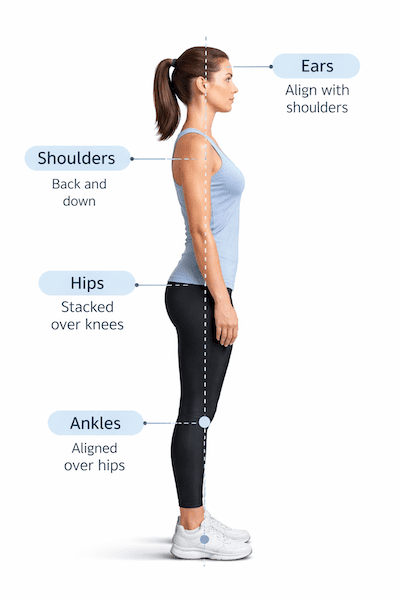
  • ears sit roughly over shoulders
  • ribs rest over pelvis
  • knees stay soft, not locked
  • weight spreads evenly through both feet
  • breathing feels relaxed, not braced

Why Does Good Standing Posture Matter?

Good standing posture matters because it helps your spine, joints, and muscles share load more evenly. This may reduce postural fatigue and improve comfort during work, school, sport, and daily activity.

Good standing posture can help you:

  • reduce muscle fatigue from long standing
  • spread load through your spine, hips, knees, and feet
  • avoid locking your knees or bracing your lower back
  • improve balance and body awareness
  • move more easily when you change position

However, posture alone rarely explains all neck or back pain. Sleep, stress, workload, strength, fitness, previous injury, and movement variety can all affect how your body feels.

standing posture correction cueing head shoulders rib cage and pelvis alignment

Simple standing posture cues.

How Do You Set Up Good Standing Posture?

You can set up good standing posture by stacking your head, ribs, pelvis, knees, and feet in a relaxed line. Aim for an easy tall position, not a stiff military pose.

  1. Head and neck: Gently lengthen through the crown of your head. Keep your chin lightly tucked.
  2. Shoulders: Let your shoulders sit wide and relaxed. Avoid squeezing them back hard.
  3. Rib cage: Keep your ribs stacked over your pelvis, not flared forwards.
  4. Spine: Keep a natural curve. Avoid over-arching or flattening your lower back.
  5. Hips and pelvis: Let your pelvis sit in a neutral, comfortable position.
  6. Knees: Keep your knees soft rather than locked back.
  7. Feet: Share weight across the heel, big toe, and little toe.

Use short resets during normal tasks. Check your posture when you stand up, wait in a queue, answer the phone, or move from sitting to standing.

What Is a Quick Wall Check for Standing Posture?

A wall check can help you feel a neutral standing position. It is a guide only, because body shape, spinal curves, comfort, and mobility vary between people.

  1. Stand with the back of your head, shoulder blades, and bottom lightly touching a wall.
  2. Keep your heels a few centimetres away from the wall.
  3. Slide your hand into the small of your back.
  4. You should feel a small, comfortable space.
  5. If the position feels painful, forced, or hard to hold, seek advice.

If the wall position feels difficult, a physiotherapist can assess your neck, spine, hips, knees, feet, balance, and muscle control. This can help identify what limits your posture.

Common Standing Posture Mistakes

Many posture habits come from work, study, phone use, driving, sport, or tiredness. Most habits improve better with small, regular corrections than with forceful “stand up straight” cues.

  • Forward head posture: your head drifts forward of your shoulders.
  • Rounded shoulders: your upper back slumps and your chest tightens.
  • Locked knees: your knees push back and your hips shift forwards.
  • Leaning on one leg: one side of your body takes more load.
  • Collapsed foot arches: foot position changes leg and hip alignment.
  • Over-bracing: you squeeze your shoulders, ribs, or stomach too hard.

What Exercises Help Standing Posture?

Posture exercises work best when they improve strength, mobility, balance, and endurance. A short, regular program usually works better than occasional long sessions.

Your physiotherapist may include:

  • deep neck flexor exercises
  • shoulder blade control exercises
  • thoracic mobility drills
  • core and hip strengthening
  • calf and foot strengthening
  • breathing and relaxation cues

Good starting points include posture exercises, correct sitting posture, and simple posture improvement tips.

When Should You See a Physiotherapist?

You should consider physiotherapy if posture changes cause pain, fatigue, stiffness, headaches, or recurring symptoms. A structured assessment can identify whether joint mobility, strength, balance, work setup, or movement habits are contributing.

Consider an assessment if:

  • you have neck, back, shoulder, hip, knee, or foot pain when standing
  • you feel tired or sore after short periods on your feet
  • your posture feels hard to change despite regular effort
  • you notice repeated symptoms with desk work, driving, lifting, or sport
  • you have a history of spinal, hip, knee, or foot problems

If your main issue is back discomfort, our good back posture tips and back pain prevention guide may also help.

What to do now:

  • check your posture using the wall test
  • avoid forcing a rigid upright position
  • practise small posture resets during the day
  • add simple strength and mobility exercises
  • book an assessment if standing causes pain or fatigue

Related Posture Resources

FAQs About Good Standing Posture

What is good standing posture?

Good standing posture means your ears, shoulders, hips, knees, and ankles line up comfortably from the side. Your ribs should sit over your pelvis, your knees should stay soft, and your weight should spread evenly through both feet.

How can I improve my standing posture?

You can improve standing posture by practising regular posture resets, strengthening postural muscles, and reducing long periods in one position. Gentle chin tucks, shoulder blade control, hip strength, and foot control exercises may help.

Can poor standing posture cause pain?

Poor standing posture can contribute to pain when it increases load on joints, muscles, and ligaments. It may affect the neck, back, shoulders, hips, knees, or feet, especially during long periods of standing.

How long does it take to improve standing posture?

Posture change usually takes weeks rather than days. Many people notice better awareness quickly, but strength, endurance, and movement habits need regular practice to change more reliably.

Should I stand perfectly straight all day?

You do not need to stand perfectly straight all day. A useful posture is one you can change easily. Regular movement, position changes, and relaxed alignment matter more than holding one rigid position.

When should I get help for posture?

Get help if posture changes cause pain, fatigue, stiffness, headaches, or recurring symptoms. A physiotherapist can assess your body, explain what is limiting your posture, and guide a practical treatment and exercise plan.

What to Do Next

If your posture feels difficult to maintain, start with short posture resets, movement breaks, and simple strength exercises. Avoid forcing your body into a stiff position.

Book a physiotherapy assessment if standing causes pain, fatigue, or recurring symptoms. A physiotherapist can assess your posture, movement, and strength, then guide a plan that suits your work and activity demands.

Choose your clinic and appointment pathway

Select a PhysioWorks clinic to continue to live booking, an appointment request or reception assistance.

Posture Products

These posture products are commonly used by our physiotherapists to improve posture, postural strength, endurance and flexibility, plus assist home exercise programs.

View all posture products

Follow PhysioWorks

Get physiotherapy tips, exercise videos, recovery advice and blog updates.

References

  1. Healthdirect Australia. How to improve your posture. Healthdirect Australia. Accessed July 6, 2026.
  2. Yang S, Boudier-Revéret M, Yi YG, Hong KY, Chang MC. Treatment of chronic neck pain in patients with forward head posture: a systematic narrative review. Healthcare. 2023;11(19):2604. doi:10.3390/healthcare11192604
  3. Picher P, Seixas A, Moreira-Silva I, Azevedo J, Cardoso R. Effects of global postural re-education on pain, functionality, and range of motion in chronic non-specific neck pain: a systematic review of randomized controlled trials. Healthcare (Basel). 2025;13(14):1689. doi:10.3390/healthcare13141689

What is the best sleeping position for back and neck pain?

Article by John Miller & Erin Runge
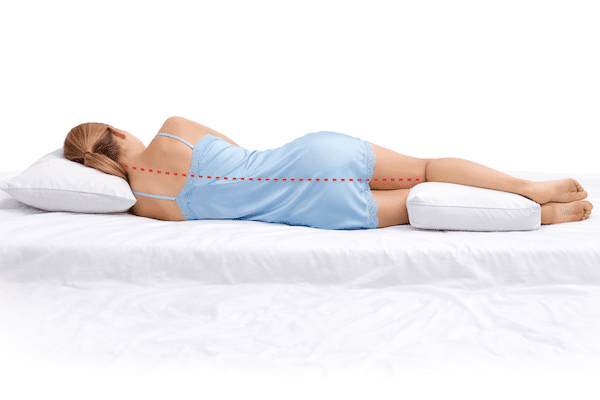
Best sleeping position for back and neck pain with side-lying spine support

Side sleeping with knee support can help reduce twisting through the lower back.

The best sleeping position for back and neck pain is usually the one that keeps your head, neck, spine and pelvis well supported. For many people, this means sleeping on the back with support under the knees, or on the side with a pillow between the knees.

There is no single perfect sleep posture for every body. Your most useful position depends on your symptoms, body shape, mattress, pillow height and how stiff or sensitive your back or neck feels in the morning. If symptoms keep affecting sleep, a musculoskeletal physiotherapy assessment can help identify whether posture, mobility, strength, nerve sensitivity or daily loading is part of the problem.

Quick Answer

  • Back sleeping: place a pillow under the knees to reduce lower back strain.
  • Side sleeping: keep knees slightly bent and place a pillow between them.
  • Neck support: choose a pillow that keeps your head level with your body.
  • Stomach sleeping: often strains the neck because it keeps it turned for hours.
  • Morning pain: review your pillow, mattress and how you get out of bed.

Why does sleeping position matter for back and neck pain?

Sleep holds your spine in one position for several hours. A poorly supported position may increase pressure on joints, muscles, discs or nerves. Over time, this can add to morning stiffness, neck pain, headaches, or lower back pain.

Support matters more than forcing a rigid posture. Your body should feel relaxed, with fewer gaps between your spine and the bed. A small pillow or towel can often improve comfort when placed under the knees, between the knees, or around the waist.

What is the best back-sleeping setup?

Back sleeping often suits people who feel worse with twisting. Place a pillow under your knees so your hips and knees bend slightly. This can reduce the pull on the lower back and help the spine rest in a more relaxed position.

Your head pillow should support the neck curve without pushing the chin down towards the chest. If your pillow is too high, your neck may sit flexed all night. If it is too low, your head may drop back and strain the upper neck.

Back Sleeping Checklist

  • Use one supportive head pillow.
  • Place one pillow under both knees.
  • Keep your chin relaxed, not tucked hard down.
  • Avoid a sagging mattress that lets your hips sink too far.

What is the best side-sleeping setup?

Side sleeping often feels comfortable for back and neck pain when the spine stays level. Bend the knees slightly and place a pillow between them. This helps reduce pelvis roll and lower back twisting.

Your head pillow should fill the space between your shoulder and ear. If your head tips down, the pillow is likely too low. If your head tips up, it is likely too high. Our best pillow for sleep guide explains how pillow height changes with sleep position and shoulder width.

Which sleeping positions may aggravate pain?

Stomach sleeping commonly places the neck in long rotation. It can also increase lower back extension, especially on a soft mattress. If you wake with neck stiffness, headaches, shoulder tightness or back ache, stomach sleeping may be one factor.

A tight foetal position may increase stiffness for some people because it rounds the spine for hours. However, some people with spinal stenosis feel better in a slightly flexed position. The key is comfort, symptom response and the ability to move well after waking.

How should you choose a pillow for neck pain?

Side sleeper using pillow support for neck alignment and sleep comfort
Pillow height should keep your neck level.

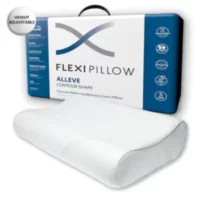
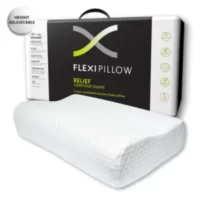
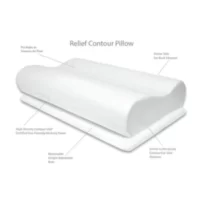
A pillow should support your head and neck in line with the rest of your body. Side sleepers often need more height than back sleepers. Back sleepers often need a medium height that supports the neck curve without pushing the head forward.

If you wake with neck pain, headaches, shoulder tightness, or arm symptoms, review your pillow first. You may also find our perfect pillow guide and signs of an unsupportive pillow helpful.

What mattress firmness helps back pain?

A mattress should support your body without sagging. Very firm beds can create pressure around the shoulders, hips and lower back. Very soft beds can let the spine sink and twist. Many people do better with a medium-firm surface, but comfort still varies between people.

Do not judge a mattress on one night. If your mattress is old, sagging, or clearly worse than other beds you sleep on, it may be worth reviewing. If pain continues, also check whether daily load, desk posture, exercise, stress or reduced movement is contributing.

How do you get out of bed safely with back or neck pain?

A simple log-roll can reduce sudden strain. Roll onto your side first. Then move your legs over the edge of the bed and push up with your arms. This is often easier than sitting straight up from lying on your back.

After standing, move gently before you rush into the day. Short walks, light mobility, heat, or your prescribed exercises may help if morning stiffness is a regular issue.

When should you seek help?

Book an assessment if pain keeps waking you, returns most mornings, spreads into your arm or leg, or limits work, exercise or daily activity. A physiotherapist can assess your neck, back, posture, movement, strength and symptom pattern.

Seek urgent medical care if back pain occurs with new bladder or bowel changes, saddle numbness, fever, unexplained weight loss, major trauma, or progressive leg weakness. For neck pain, urgent review is also important with progressive arm weakness, severe unexplained headache, dizziness with neurological symptoms, or symptoms after significant trauma.

Related PhysioWorks guides

Sleeping Position FAQs

What is the best sleeping position for back and neck pain?

Many people feel most comfortable sleeping on their back with a pillow under the knees, or on their side with a pillow between the knees. The aim is to keep the spine supported without long twisting or sagging.

Is side sleeping or back sleeping better?

Both can work. Back sleeping may reduce twisting. Side sleeping may feel better when the head, waist and knees are well supported. Your morning response is often the best guide.

Why can stomach sleeping cause neck pain?

Stomach sleeping often keeps the neck turned to one side for several hours. This can strain the upper neck joints and muscles, especially if your pillow is too high or your mattress lets your lower back sag.

What pillow height is best for neck pain?

The right height keeps your head level with your body. Side sleepers often need a higher pillow than back sleepers because the pillow must fill the shoulder-to-ear gap.

Should I put a pillow under my knees for back pain?

A pillow under the knees may help some back sleepers. It slightly bends the hips and knees, which can reduce lower back arching and help the back muscles relax.

When should I see a physiotherapist about sleep-related pain?

Book an assessment if pain keeps disturbing sleep, returns most mornings, spreads into the arm or leg, or does not improve after changing your pillow, mattress or sleeping setup.

What to do next

If sleep posture is adding to your back or neck pain, start with one simple change for a few nights. Try knee support, better pillow height, or a log-roll when getting out of bed.

If symptoms persist, book a PhysioWorks appointment. Your physiotherapist can assess your symptoms and help you choose a practical plan for sleep, posture, movement and daily loading.

Choose your clinic and appointment pathway

Select a PhysioWorks clinic to continue to live booking, an appointment request or reception assistance.

Pillow Support Products

View all pillow products

Back Pain Tips: 7 Evidence-Based Ways to Move Better, Hurt Less & Recover Faster

A Physiotherapist’s Guide to a Stronger, Healthier Back

Discover practical, research-based strategies to ease back pain, move with confidence, and build long-term strength. Written by physiotherapist John Miller, this concise guide blends science and decades of clinical experience to help you recover faster and stay active for life.

  • Clear, actionable advice grounded in current research
  • Whole-person approach: movement, sleep, mindset and care team
  • Includes a quick flare-up plan, FAQs and daily habits

Follow PhysioWorks

Get physiotherapy tips, exercise videos, recovery advice and blog updates.

References

  1. Cary D, Jacques A, Briffa K. Examining relationships between sleep posture, waking spinal symptoms and quality of sleep: A cross sectional study. PLoS One. 2021;16(11):e0260582. doi:10.1371/journal.pone.0260582
  2. Saini Y, Rai A, Sen S. Relationship between sleep posture and low back pain: A systematic review. Musculoskeletal Care. 2025;23(2):e70114. doi:10.1002/msc.70114
  3. Pang JCY, Tsang SMH, Fu ACL. The effects of pillow designs on neck pain, waking symptoms, neck disability, sleep quality and spinal alignment in adults: A systematic review and meta-analysis. Clinical Biomechanics. 2021;85:105353. doi:10.1016/j.clinbiomech.2021.105353
  4. Barbara AM, Grobelna A. Therapeutic mattresses for chronic pain. CADTH Health Technology Review. 2022.

Why Do My Joints Click When I Move?

Article by John Miller & Erin Runge

Clicking joints are common during everyday movements such as squatting, walking, reaching and stretching. Many people first notice joint noises during exercise or when returning to activity after rest.

Clicking without pain is often a normal variation of joint movement. However, clicking may warrant assessment when it becomes painful, follows an injury or occurs with swelling, locking, instability or reduced movement.

Joint sounds can arise from soft tissue movement, pressure changes inside the joint or changes in movement control during loading. For broader guidance on joint symptoms, see our joint pain guide.

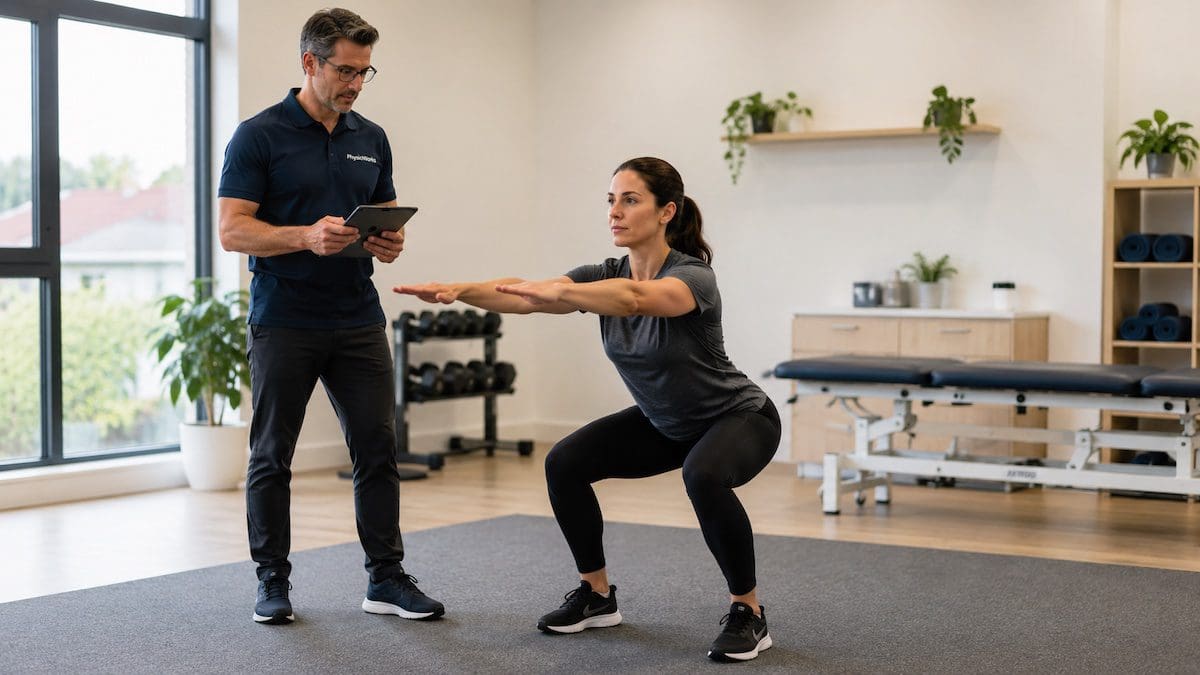
Physiotherapist assessing clicking joints during a controlled squat movement
Painless joint clicking is often assessed during movement.

Are Clicking Joints Usually a Problem?

Usually, clicking without pain is not a sign of damage. Arrange an assessment when clicking occurs with pain, swelling, repeated locking, giving way, reduced movement or symptoms following an injury.

Why Do Joints Click?

Joint noises can have several causes. The sound alone does not confirm that a joint is damaged.

Soft Tissue Movement

Tendons and muscles guide joint motion. A tendon may briefly move across a bony structure and produce a click. This commonly occurs around the knee, shoulder, hip and ankle.

Joint-Fluid Pressure Changes

Pressure changes within synovial fluid can produce popping or cracking sounds. This process does not automatically mean that joint damage has occurred.

Joint Loading

Joint compression can increase during squatting, running, stair climbing and lifting. Some people notice more joint noise during these loaded movements.

Movement Control Changes

Fatigue, weakness or coordination changes can affect how a joint moves. This may make clicking more noticeable during sport, exercise or repetitive tasks.

Do Clicking Joints Mean Damage or Arthritis?

No. Clicking, popping and crepitus are common in people who do not have pain or significant joint problems. Many healthy joints make noise throughout life without restricting movement or activity.

Joint noise also does not confirm arthritis. The clicking becomes more clinically relevant when it occurs with pain, swelling, stiffness, repeated locking, giving way or declining function.

When Should Clicking Joints Be Assessed?

Consider a physiotherapy assessment when clicking:

  • causes pain or discomfort
  • begins after a fall, twist or other injury
  • occurs with swelling or increasing stiffness
  • is associated with locking, catching or giving way
  • limits walking, exercise, work or sport
  • progressively worsens or reduces confidence with movement

A physiotherapist can assess joint range, strength, movement control and load tolerance. The assessment may help determine whether the sound is a normal variation or relates to a modifiable movement or loading issue.

Can Activity Levels Affect Joint Sounds?

Yes. Joint noises may become more noticeable after a period of reduced activity, during a sudden increase in exercise or when returning to sport following an injury.

Fatigue can also alter movement quality later in a training session. Gradual load progression, suitable recovery and improved strength may help reduce unwanted joint sounds over time.

What Can You Do About Clicking Joints?

If clicking is painless and your movement remains normal, you may only need to monitor it. Sensible strategies include:

  • continuing comfortable movement and exercise
  • increasing training loads gradually
  • noting whether pain, swelling or instability also occurs
  • avoiding repeatedly forcing a joint to click
  • building strength and movement control progressively
  • seeking assessment when symptoms worsen or follow an injury

Management for symptomatic clicking may include exercise rehabilitation, movement retraining, activity modification and gradual exposure to the movements that provoke symptoms.

Related Joint and Movement Information

What Should You Do Next?

If your joint clicks without pain and functions normally, you can usually continue your normal activities. However, assessment may help when clicking is painful, persistent, follows an injury or affects your confidence with movement.

A physiotherapist can assess the joint and help you choose an appropriate exercise, loading or rehabilitation plan.

Choose your clinic and appointment pathway

Select a PhysioWorks clinic to continue to live booking, an appointment request or reception assistance.

Follow PhysioWorks

Get physiotherapy tips, exercise videos, recovery advice and blog updates.

Frequently Asked Questions

Why do my joints click when I move?

Joints may click when tendons or other soft tissues move across nearby structures, when pressure changes occur inside joint fluid or when movement control changes during loading. Clicking without pain is often normal.

Are clicking joints a sign of arthritis?

Not necessarily. Many people without arthritis have joints that click, pop or crack. Arthritis is more likely to cause other symptoms such as persistent pain, swelling, stiffness or reduced function.

When should I see a physiotherapist for clicking joints?

Consider an assessment when clicking is painful, begins after an injury, progressively worsens or occurs with swelling, locking, giving way, stiffness or reduced confidence with movement.

Can exercises reduce joint clicking?

Exercises may improve strength, movement control and load tolerance. This can reduce bothersome joint noise for some people, particularly when weakness, fatigue or altered movement contributes to the clicking.

Is clicking without pain a problem?

Usually not. Clicking without pain, swelling, instability or reduced function is commonly a normal variation. Monitor the joint and seek advice if new symptoms develop.

Should I stop exercising if my joints click?

You usually do not need to stop exercising when the clicking is painless and your function remains normal. Reduce or modify the activity and seek advice when clicking occurs with pain, swelling, locking or instability.

References

  1. Couch JL, King MG, de Oliveira Silva D, et al. Noisy knees—knee crepitus prevalence and association with structural pathology: a systematic review and meta-analysis. Br J Sports Med. 2025;59(2):126–132. doi:10.1136/bjsports-2024-108866.
  2. Kawchuk GN, Fryer J, Jaremko JL, et al. Real-time visualization of joint cavitation. PLoS One. 2015;10(4):e0119470. doi:10.1371/journal.pone.0119470.

For further information about painful, stiff or irritated joints, see our joint pain causes, treatment and management guide.

Heat Packs: Why Does Heat Feel So Good?

Heat packs around neck and shoulders easing muscle tightness

Heat packs can provide soothing warmth for stiff muscles and joints.

Heat packs can feel soothing because warmth changes sensory signals, increases local blood flow and may reduce protective muscle tension. Many people use heat therapy at home for stiff muscles, neck tension, lower back pain, arthritis-related stiffness and period pain.

Heat does not fix every cause of pain. However, it may make movement feel easier when symptoms are linked to muscle tightness, familiar stiffness or longer-lasting aches. For a broader overview, read our heat therapy guide.

Quick Answer: Why Does Heat Feel So Good?

Warm skin signals can reduce how strongly pain is noticed by the nervous system. Heat may also increase local circulation and help guarded muscles feel less tense.

As a result, a heat pack may feel helpful when pain is achy, stiff, tight or long-lasting rather than newly injured, hot and swollen.

When Should You Use a Heat Pack?

Heat packs tend to suit pain that feels stiff, tight, achy or slow to warm up. They are often more useful for familiar or ongoing symptoms than for a newly injured area that is hot and swollen.

  • ongoing or recurrent muscle tightness
  • stiff joints that feel better with warmth
  • general muscle soreness after activity
  • persistent back or neck pain that feels tight or achy
  • morning stiffness that eases once you begin moving

Many people combine heat with gentle walking, mobility exercises or suitable muscle treatment strategies recommended by their physiotherapist.

Heat or Cold: Which One Makes More Sense?

Consider heat when pain feels stiff, tight, achy or familiar and warmth feels comfortable.
Consider cold when a recent injury feels hot, swollen or bruised and cooling feels soothing.
Ask for advice when symptoms are severe, worsening, spreading or stopping you from doing normal daily activities.

When Should You Avoid Heat?

Heat is not suitable for every painful area. Avoid a heat pack when warmth could worsen irritation, hide a more serious problem or increase the risk of a burn.

  • over a newly injured area that remains hot or markedly swollen
  • over a very red, inflamed or infected area
  • over skin with reduced feeling or numbness
  • where circulation is significantly impaired
  • directly over open wounds, broken skin or a fresh burn
  • when you cannot check the skin regularly
  • when heat makes symptoms worse

Extra care may be needed for children, older adults and people with diabetes, neurological conditions or reduced skin sensation. Seek individual advice when you are unsure.

For related information, see our pain management and muscle strain guides.

How Does Heat Assist Pain Relief?

Heat may ease pain by changing sensory input, increasing local circulation and helping guarded tissues feel more comfortable. The benefit is often temporary, so heat usually works best as part of a broader plan that includes movement, pacing and suitable exercise.

  • Changes sensory signals: warmth can reduce how strongly pain is noticed for a short period.
  • Reduces guarding: muscles may feel less tense when the area is comfortably warm.
  • Increases local blood flow: heat widens small blood vessels near the skin.
  • Supports movement: warming an area may make it easier to begin walking, stretching or completing home exercises.

Best Fit for Heat Packs

Heat packs tend to suit symptoms that feel stiff, tight, achy and familiar.

They are less suitable when pain is associated with marked swelling, redness, increasing warmth, broken skin or reduced sensation.

Why Choose a Wheat Heat Pack?

Wheat heat packs are popular because they are reusable, simple to warm and flexible enough to mould around common sore areas. Their shape can provide more targeted warmth than a shower or bath.

  • Convenient: many wheat packs can be heated in a microwave.
  • Flexible: the filling can mould around the neck, shoulders, lower back or joints.
  • Reusable: a well-maintained pack can provide repeated use.
  • Targeted: different shapes can suit different body areas.

Shaped options include long neck heat packs and back heat packs.

How to Use Heat Packs Safely

A heat pack should feel comfortably warm rather than very hot. Burns and fires can occur when wheat packs are overheated, reheated before cooling or placed beneath bedding.

  • Follow the heating instructions supplied with the pack.
  • Do not exceed the recommended microwave time.
  • Make sure the microwave turntable moves freely.
  • Shake or redistribute the filling after heating.
  • Use a towel or clothing layer when needed.
  • Check your skin after the first few minutes and regularly after that.
  • Use the pack for about 15 to 20 minutes unless advised otherwise.
  • Allow the pack to cool fully before reheating it.
  • Never place a heated wheat pack beneath bedding.
  • Do not sleep with a heated pack against your body.
  • Replace packs that smell burnt, appear scorched, feel unusually dry or have damaged fabric.

Healthdirect also advises following the manufacturer’s heating time and allowing wheat packs to cool properly because overheating may cause burns or fires.

If you are unsure whether heat is safe for your condition, speak with your physiotherapist, doctor or pharmacist.

Heat Packs for Ongoing Back or Neck Pain

Heat packs may help ongoing back or neck pain when symptoms feel muscular, stiff or guarded. Warmth can make it easier to begin moving, although it does not identify or correct the underlying cause of recurring pain.

Arrange an assessment when symptoms keep returning, spread into an arm or leg, disturb sleep or limit work, sport or daily activity. You can also read more about recurrent back pain and chronic muscle pain.

Related PhysioWorks Guides

Heat Pack FAQs

Can I sleep with a heat pack on?

No. Remove the heat pack before you go to sleep. You may not notice excessive heat or skin irritation while sleeping, and placing a wheat pack beneath bedding may increase fire and burn risks.

Is a heat pack better than a hot shower?

Neither option is always better. A warm shower heats a larger area, while a heat pack provides targeted warmth to one region, such as the lower back, neck or shoulders. Choose the option that feels comfortable and is safe for your skin and health.

Do heat packs help chronic back pain?

Heat packs may provide short-term relief when ongoing back pain feels tight, stiff or achy. They often work best alongside gentle movement, pacing and an exercise program suited to the cause of the symptoms.

Should I use heat or cold for a new injury?

Consider the symptoms rather than relying only on the time since injury. Avoid heat when the area remains markedly hot, swollen or red. A cold pack may feel more comfortable in this situation. Stop either treatment if it makes symptoms worse.

How long should I use a heat pack?

Many people use a heat pack for about 15 to 20 minutes. Check the skin regularly, allow the pack to cool fully before reheating and follow the product instructions.

When should I see a physiotherapist?

Consider physiotherapy when pain keeps returning, spreads, affects sleep or limits normal activity. Heat may ease symptoms temporarily, but an assessment can help identify contributing factors and guide suitable treatment and exercise.

What to Do Next

Use a heat pack when symptoms feel stiff, tight, achy and familiar, provided your skin sensation and circulation are normal. Avoid heat when the area is very hot, red, swollen, infected or numb.

If pain keeps returning, spreads or limits daily life, a physiotherapist can assess the likely cause and guide treatment, exercise and self-care. Book Online 24/7 when you are ready to choose the right next step.

Choose your clinic and appointment pathway

Select a PhysioWorks clinic to continue to live booking, an appointment request or reception assistance.

Shop Heat Pack Options

Choose a heat pack shape that fits the area you want to warm. Options include packs designed for the neck, shoulders, lower back and larger body regions.

Compare heat pack options and features.

Heat Products

These heat products are commonly used by our physiotherapists to provide comfort and safe warmth, improve flexibility, plus assist home exercise programs.

View all Heat products

Follow PhysioWorks

Get physiotherapy tips, exercise videos, recovery advice and blog updates.

References

  1. Freiwald J, Magni A, Fanlo-Mazas P, et al. A role for superficial heat therapy in the management of non-specific, mild-to-moderate low back pain in current clinical practice: a narrative review. Life (Basel). 2021;11(8):780. doi:10.3390/life11080780.
  2. Hotfiel T, Freiwald J, Hoppe MW, et al. Importance of heat therapy in the treatment of pain in the musculoskeletal system. Phys Ther Sport. 2024;67:55-61. doi:10.1016/j.ptsp.2024.01.004.
  3. Malanga GA, Yan N, Stark J. Mechanisms and efficacy of heat and cold therapies for musculoskeletal injury. Postgrad Med. 2015;127(1):57-65. doi:10.1080/00325481.2015.992719.
  4. Healthdirect Australia. Winter health hazards at home. Updated 2024. Accessed July 13, 2026.

Which PhysioWorks Clinics Stock Products?

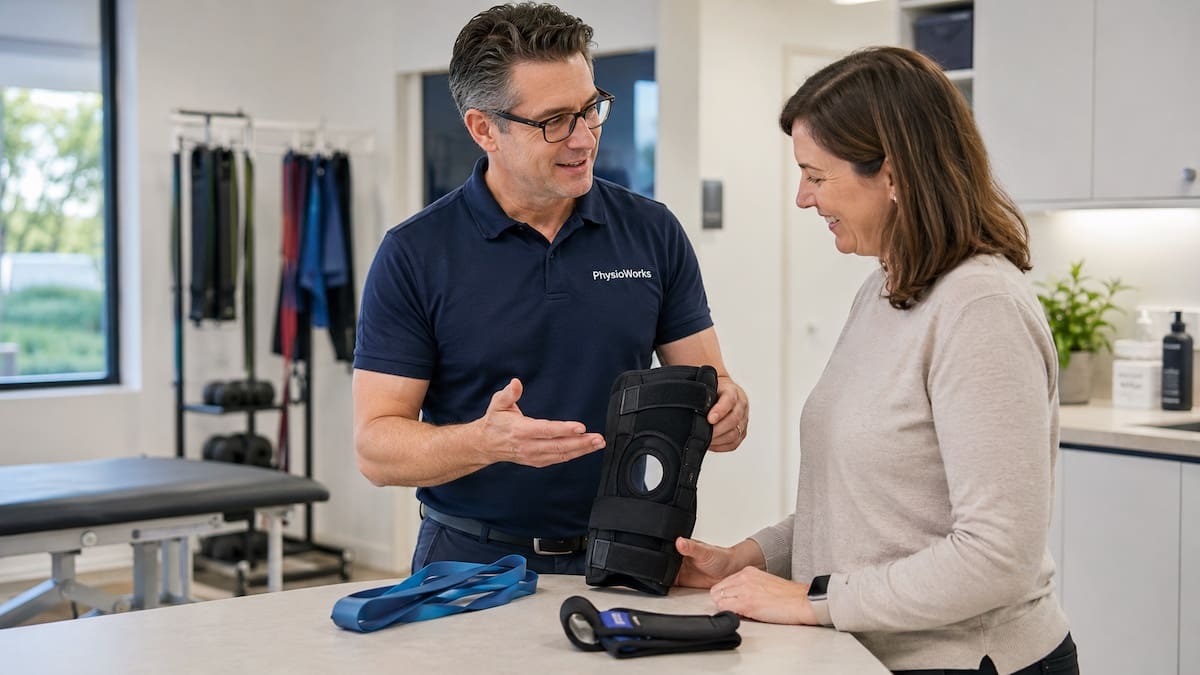
Physiotherapist helping a patient compare a knee brace and rehabilitation exercise band

Professional guidance can help with product selection and fit.

Most PhysioWorks clinics stock a small selection of rehabilitation, pain-management and injury-support products. However, the available brands, models and sizes vary between locations.

Sandgate PhysioWorks generally carries the largest clinic range. Meanwhile, the PhysioWorks online shop offers the widest overall choice.

Quick answer

Choose the online shop for the widest range. For local collection, call your preferred clinic before visiting to confirm the product, model and size are available.

Choose your next step

Shop the full range

Compare braces, supports, pain-management products and rehabilitation exercise equipment.

Shop Online

Check clinic stock

Find your preferred clinic and phone before travelling to confirm local availability.

View Clinic Phone Numbers

Need professional advice?

A physiotherapist can discuss product suitability, sizing and safe use when clinical guidance is appropriate.

View Appointment Options

Which PhysioWorks clinics stock products?

Most PhysioWorks clinics carry selected products for injury management, rehabilitation and exercise. However, stock changes and not every location holds every product, brand or size.

Sandgate generally carries the broadest in-clinic range. For the full catalogue, visit the PhysioWorks online shop.

Which product option suits you?

Your priority Best next step
Widest product choice Shop online.
Local collection Call your preferred clinic before travelling.
Larger in-clinic range Contact Sandgate PhysioWorks first.
Specific product or size Check online or ask reception to confirm availability.
Unsure what suits you Seek professional advice before choosing a specialised support or device.

What products can you buy from PhysioWorks?

PhysioWorks supplies practical products commonly used to support rehabilitation, comfort, exercise and injury management.

Braces and supports

Browse selected braces, supports, walking boots and related injury-management products.

Pain-management products

Browse selected products that may support comfort and symptom self-management.

Exercise equipment

Browse exercise and rehabilitation tools for supervised programs or suitable home exercise.

Availability varies. Check the product listing or speak with clinic reception before relying on immediate collection.

Why should you check Sandgate PhysioWorks first?

Sandgate PhysioWorks generally carries the largest PhysioWorks clinic product range. It may be a suitable first option when you need prompt collection, sizing guidance or help fitting a commonly stocked rehabilitation product.

Sandgate PhysioWorks

18 Bowser Parade, Sandgate QLD 4017

Call 07 3269 1122 or view the Sandgate clinic page.

Should you call before visiting?

Yes. Call before travelling to confirm that the clinic currently has the product, brand and size you need.

Reception may also direct you to another clinic or the online shop when your preferred location does not hold the required item.

Stock note: The website cannot confirm live shelf stock. Availability may change, particularly for popular sizes and specialised products.

Can a physiotherapist help you choose a product?

A physiotherapist may help when product selection depends on your diagnosis, injury stage, body size, symptoms or rehabilitation plan. They can also discuss whether a product may support your management or whether another approach would be more appropriate.

Do not use a brace, walking boot or pain-management device as a substitute for assessment when you have severe pain, marked swelling, deformity, substantial loss of function or worsening symptoms.

Frequently asked questions

Which PhysioWorks clinics stock products?

Most PhysioWorks clinics carry selected rehabilitation and injury-support products. However, the available products, brands and sizes vary between clinics. Sandgate generally carries the largest in-clinic range.

What products can you buy from PhysioWorks?

PhysioWorks supplies selected braces and supports, pain-management products, rehabilitation exercise equipment and other injury-management products.

Why should you check Sandgate PhysioWorks first?

Sandgate generally carries the largest PhysioWorks clinic product range. It may be a suitable first option for local collection, sizing guidance or help fitting a commonly stocked rehabilitation product.

Should you call before visiting a clinic?

Yes. Call before travelling to confirm the clinic currently has the product, brand and size you need.

Can you buy PhysioWorks products online?

Yes. The PhysioWorks online shop generally provides a broader selection than any single clinic and may suit people who need a particular product or size or prefer delivery.

Can a physiotherapist help you choose a product?

A physiotherapist may help when product selection depends on your diagnosis, injury stage, symptoms, body size or rehabilitation plan.

How do you find your nearest PhysioWorks clinic?

Visit the PhysioWorks clinics page to compare the six active clinic locations. Then call your preferred clinic to confirm product and size availability.

What should you do next?

Choose the online shop for the widest product range. For local collection, call your preferred clinic first. When you are unsure which product is appropriate, arrange professional advice rather than guessing the required support, model or size.

Choose your clinic and appointment pathway

Select a PhysioWorks clinic to continue to live booking, an appointment request or reception assistance.

Follow PhysioWorks

Get physiotherapy tips, exercise videos, recovery advice and blog updates.

30-day support
Eligible online product orders
Simple process
Refund, return, or exchange guidance
Approval first
Wait for return instructions

30-Day Money-Back Guarantee for PhysioWorks Products

Shop with confidence at PhysioWorks. Eligible online product orders are covered by our 30-day money-back guarantee unless a product is excluded for health or hygiene reasons.

If your product is faulty, damaged, incorrectly supplied, unsuitable in size, or otherwise not right for your needs, we can explain the next step and guide you through the correct process.

For most refund, return, or exchange requests, start with our dedicated Product Refund, Return or Exchange page.

Quick Answer

  • Eligible online product orders are covered for 30 days
  • Some products are excluded for health or hygiene reasons
  • Refund, return, and exchange requests should start with the correct return process
  • Do not send products back before approval has been issued

What Does the 30-Day Money-Back Guarantee Mean?

The PhysioWorks 30-day money-back guarantee gives eligible online shoppers added confidence when purchasing products through the PhysioWorks Shop. If an item is not suitable, we can review your request and explain whether a refund, replacement, or exchange may apply.

This guarantee works alongside the formal return pathway. Therefore, the best first step is not to post the item back immediately. Instead, follow the correct request process so the product can be assessed properly and matched to your order details.

Simple Return Pathway

  1. Open the Product Refund, Return or Exchange page
  2. Complete the Product Return Form
  3. Wait for approval and your Refund Authorisation Code
  4. Only send the product back once PhysioWorks has issued instructions

How Do You Start a Refund, Return, or Exchange?

If you need help with a product order, begin with our Product Refund, Return or Exchange page. That page explains how to begin the process, when a Refund Authorisation Code is needed, and what information may be required before anything is returned.

This step helps keep returns clear, traceable, and easier for both you and our team.

Which Situations May Qualify?

A refund, replacement, or exchange may apply if your product arrives damaged, is faulty, is not as described, or has been supplied incorrectly. In some cases, a size exchange may also be possible if the product remains in suitable condition.

If you are unsure whether your item may qualify, review the instructions on our refund, return, or exchange page and then contact PhysioWorks with your order details.

Which Products May Be Excluded?

Some products are excluded from the 30-day money-back guarantee for health or hygiene reasons. This is especially relevant for items that are worn, used beyond a basic fit check, damaged after delivery, or unsuitable for safe resale.

Downloadable or accessed digital products may also be treated differently. If you are uncertain, check the product page carefully before purchase or contact PhysioWorks for clarification.

Important: Please do not send products back before approval. Starting with the correct return process helps avoid delays and ensures your request can be assessed properly.

Does This Replace Your Australian Consumer Law Rights?

No. The PhysioWorks 30-day money-back guarantee is an additional store policy for eligible products. Your rights under Australian Consumer Law may still apply if goods are faulty, unsafe, not fit for purpose, or do not match their description.

If you want general consumer information, you can also read the ACCC guide to repair, replace, refund or cancel.

Need Help Before You Buy?

If you are still deciding which item suits you best, browse the PhysioWorks Shop or explore our product categories. Checking product details before ordering can reduce sizing issues and help you choose the right product the first time.

30-day support window
For eligible online product orders

Clear process
Refund, return, or exchange guidance

Helpful support
Before and after purchase

Frequently Asked Questions

How Long Do I Have to Request Help?

Eligible online product orders are covered by the PhysioWorks 30-day money-back guarantee unless the item is excluded for health or hygiene reasons. It is best to start the process as soon as possible.

Where Do I Begin a Product Refund, Return, or Exchange?

Start at the Product Refund, Return or Exchange page and complete the Product Return Form before sending anything back.

Can I Send the Product Back Straight Away?

No. Please wait until PhysioWorks has reviewed your request and issued the required approval steps. This helps prevent delays and makes the process easier to track.

Are All Products Covered?

No. Some products may be excluded for health or hygiene reasons, and some digital or downloaded items may not be refundable once accessed.

What if the Product Is Faulty, Damaged, or the Wrong Size?

These are common reasons to start a refund, replacement, or exchange request. Visit the refund, return, or exchange page to begin the correct process.

What to Do Next

If you need to arrange a refund, return, or exchange, start here:

Go to the Product Refund, Return or Exchange page

If you want help choosing a product before purchase, browse the PhysioWorks Shop or call PhysioWorks on 07 3269 1122.

You've just added this product to the cart: