FAQs

Frequently Asked Questions


What Is Pain?

What is pain physiotherapist explaining pain signals to a patient
Pain is shaped by signals, context, and protection.

What is pain? Pain is an unpleasant sensory and emotional experience that works as a protection signal. It can happen with injury, inflammation, overload, illness, nerve irritation, or increased nervous system sensitivity. Pain is real, but it does not always match the amount of tissue damage.

Some pain settles quickly as tissues calm down. Other pain lasts longer because the nervous system, sleep, stress, activity load, and previous experiences can all influence sensitivity. If your symptoms are ongoing or confusing, it may help to first understand broader pain conditions and practical pain management options.

A clear assessment can help separate common patterns such as nerve pain, persistent pain, and referred pain. This guide explains how pain works, why it can feel different from person to person, and when you should seek help.

What Is Pain?

Pain is your body’s warning and protection system. Your nervous system creates pain after weighing information from tissues, nerves, the spinal cord, the brain, and your current situation. Pain often helps you slow down, protect an irritated area, and change how you move while recovery happens.

Pain can also become less useful when it stays high after normal healing time. In that case, the nervous system may become more protective than it needs to be. That does not mean the pain is imagined. It means the pain system has become more sensitive.

How Can Pain Feel?

Pain can feel sharp, dull, aching, throbbing, burning, heavy, tight, stabbing, or electric. It may stay in one area or spread into another area. Some people notice pain only with movement, while others feel it at rest, at night, or after activity.

Common pain patterns may include:

  • sharp, dull, burning, throbbing, or electric discomfort
  • pain with movement, loading, or prolonged positions
  • stiffness, guarding, or reduced confidence to move
  • pain spreading into another area, such as an arm or leg
  • pins and needles, numbness, or weakness when nerves are involved

Why Does Pain Happen?

Pain often starts when specialised nerve endings, called nociceptors, detect possible threat. This may include pressure, heat, inflammation, chemical irritation, or tissue overload. Messages then travel through the nervous system to the spinal cord and brain.

The brain interprets these messages in context. It considers the body part, recent activity, past injury, stress, sleep, mood, beliefs, and the need to protect you. This is why two people can have similar tissue findings but very different pain experiences.

What Is the Difference Between Acute and Chronic Pain?

Acute pain usually starts after a recent injury, irritation, illness, or flare-up. It often settles as the tissues calm down and healing progresses.

Chronic pain, also called persistent pain, usually lasts longer than three months or beyond expected healing time. Persistent pain can involve ongoing tissue irritation, nerve sensitivity, increased nervous system protection, or a mix of factors. You can read more in our guide to chronic pain.

What Is Nerve Pain?

Nerve pain is pain caused by irritation, compression, inflammation, or injury to a nerve. It often feels burning, shooting, stabbing, or electric. It may also come with pins and needles, numbness, or weakness.

If your pain travels into an arm or leg, or follows a clear nerve pathway, a physiotherapist or doctor can help check whether a pinched nerve, spinal irritation, or another cause may be involved.

Can Pain Exist Without Ongoing Tissue Damage?

Yes. Pain can happen without ongoing tissue damage. The pain experience depends on both body signals and nervous system interpretation. For example, a paper cut can hurt sharply despite a small injury, while some larger tissue changes cause little pain.

This matters because treatment should match the pain driver. Some pain needs tissue healing and load protection. Other pain needs pacing, confidence-building movement, education, sleep support, and gradual exposure to activity.

How Does Physiotherapy Help with Pain Management?

Physiotherapy aims to identify what is most likely driving your pain and how it affects your movement, strength, work, sport, and daily function. Treatment may include education, pacing advice, hands-on care, movement retraining, and tailored exercise programs.

Many plans also use graded activity and exercise load management. The aim is to calm sensitivity, restore confidence, improve function, and help you return to meaningful activity without pushing too hard too soon.

Can Stress, Sleep, and Mood Change Pain?

Yes. Poor sleep, high stress, low mood, worry, and reduced activity can all make pain feel stronger or last longer. This does not make pain less real. It shows that pain is influenced by the whole person, not only the sore body part.

A practical pain plan often combines movement, education, pacing, recovery habits, and clear goals. For some people, this also includes medical review, medication advice from a doctor or pharmacist, or support from other health professionals.

When Should You Seek Urgent Medical Help for Pain?

Some pain patterns need urgent medical review rather than routine physiotherapy. Seek prompt medical care if pain follows major trauma, if it is linked with fever or unexplained weight loss, or if you notice new weakness, loss of bladder or bowel control, chest pain, or significant shortness of breath. Healthdirect also provides a useful overview of chronic pain and when further care may be needed.

Seek urgent medical attention if you notice:

  • new bladder or bowel control changes
  • progressive limb weakness or marked numbness
  • chest pain, severe breathlessness, fainting, or collapse
  • fever, unexplained weight loss, or pain after major trauma
  • severe pain that feels unusual, rapidly worsening, or medically concerning

Related PhysioWorks Guides

  1. Pain Conditions – Explore common pain types, causes, and symptom patterns.
  2. Pain Management – Learn practical ways physiotherapy may help with pain and function.
  3. Joint Pain Relief – Review joint-focused treatment and movement options.
  4. Back Pain Relief Physiotherapy – Read how assessment and treatment may help back pain.
  5. Physiotherapy Treatments – Browse broader treatment options across PhysioWorks.

Common Questions About Pain

Is pain always a sign of tissue damage?

No. Pain can happen with tissue damage, but the two do not always match. Some injuries hurt a lot and settle quickly. Some ongoing pain continues after tissues have healed. Pain needs context, not just a scan result or pain score.

How do I know if my pain is nerve pain?

Nerve pain often feels burning, shooting, electric, or sharp. You may also notice tingling, numbness, or weakness in a defined pattern. A physiotherapist or doctor can help separate nerve pain from joint, muscle, or referred pain.

Can exercise make pain worse?

Exercise can flare pain if it is too much, too fast, or poorly matched to your current irritability. However, the right dose often helps reduce sensitivity, improve movement, and rebuild strength. Progression matters more than pushing through pain without a plan.

What helps acute pain settle?

Acute pain often responds to relative rest, movement within tolerance, load modification, and early advice. Heat, ice, or short-term medication may help some people. The goal is to calm the flare, keep safe movement going, and avoid unnecessary deconditioning.

Why does chronic pain keep going?

Chronic pain may continue because the nervous system becomes more sensitive over time. Sleep problems, stress, reduced activity, fear of movement, and repeated flare-ups can all contribute. Management often combines education, pacing, exercise, and practical recovery strategies.

When should I see a physiotherapist for pain?

Consider physiotherapy if pain limits work, sport, sleep, or daily activity, or if it keeps returning. It is also worth getting checked if you are unsure whether the pain is from muscles, joints, nerves, or loading. Early guidance may help you choose the right next step.

What to Do Next

If pain is stopping you from moving well, training consistently, or sleeping comfortably, start with a clear assessment. A physiotherapist can help identify likely pain drivers, explain what may be contributing, and guide treatment that suits your goals.

The sooner you understand your pain pattern, the easier it is to choose a practical plan. That may include education, activity changes, hands-on treatment, pacing, or a graded exercise program designed around your symptoms and function.

What to do now:

  • note what makes your pain better, worse, or spread
  • keep moving within tolerance rather than stopping everything
  • seek urgent care if red flags are present
  • book an assessment if pain is ongoing, recurring, or confusing

Choose your clinic and appointment pathway

Select a PhysioWorks clinic to continue to live booking, an appointment request or reception assistance.

Follow PhysioWorks

Get physiotherapy tips, exercise videos, recovery advice and blog updates.

References

  1. Raja SN, Carr DB, Cohen M, et al. The revised International Association for the Study of Pain definition of pain: concepts, challenges, and compromises. Pain. 2020;161(9):1976-1982. doi:10.1097/j.pain.0000000000001939
  2. Middleton SJ, Barry AM, Comini M, et al. Studying human nociceptors: from fundamentals to clinic. Brain. 2021;144(5):1312-1335. doi:10.1093/brain/awab048
  3. Di Maio G, Castaldo G, Coppola N, et al. Mechanisms of transmission and processing of pain: a narrative review. Int J Mol Sci. 2023;24(5):4549. doi:10.3390/ijms24054549
  4. Cuenca-Martínez F, Suso-Martí L, La Touche R, et al. Pain neuroscience education in patients with chronic musculoskeletal pain: an umbrella review. Front Neurosci. 2023;17:1272068. doi:10.3389/fnins.2023.1272068

What Is Chronic Pain?

Physiotherapist explaining chronic pain and gradual activity planning with an adult patient

Understanding persistent pain can help you rebuild confidence through gradual movement and activity.

Chronic pain is pain that lasts or keeps returning for more than three months. It may begin after an injury, surgery or illness. Sometimes, however, there is no single clear cause.

Importantly, persistent pain does not always mean that tissues remain damaged. Changes in how the nervous system responds to danger can make movement, touch, stress, poor sleep or normal activity feel more painful. For a broader overview, visit our Pain Management guide.

Quick Answer

Chronic pain is pain that persists or returns for longer than three months. It may continue after tissues have healed because the nervous system has become more protective and sensitive.

Sleep, stress, activity changes, previous pain experiences and reduced confidence can also affect symptoms. A physiotherapy assessment may help identify the factors maintaining your pain and develop a gradual plan involving movement, pacing, strength, fitness and education.

How Does Acute Pain Protect You?

In the short term, pain can act like a protective alarm. Specialised nerve endings may respond to strong pressure, heat, cold, chemical irritation or tissue injury.

These signals travel through the nerves and spinal cord towards the brain. Your brain then considers the signals alongside the situation, your previous experiences and other information before producing a protective response.

That response may include moving away, bracing, resting or changing how you move.

Why Does Pain Become Chronic?

With chronic pain, the body’s protective alarm system can become more sensitive. As a result, everyday activity may feel more painful than expected.

This does not mean the pain is imagined. Instead, the nervous system may have become more protective, even when tissues have healed or remain stable.

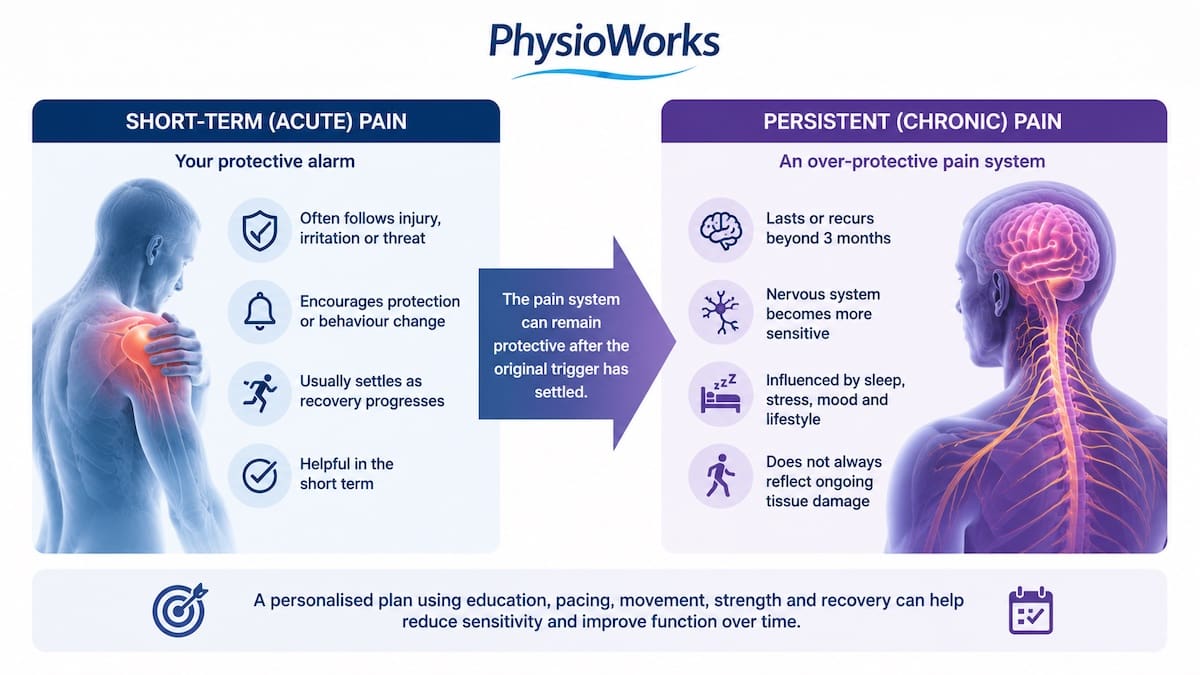
Diagram comparing short-term protective pain with persistent nervous system sensitivity

Acute pain usually protects you in the short term, while chronic pain may involve an increasingly sensitive and protective nervous system.

Can Nerves Near the Painful Area Become Sensitive?

Nerves near an irritated or previously injured area can become easier to trigger. Light touch, clothing pressure or minor movements may then feel unusually uncomfortable.

Neighbouring nerves may also become more reactive, which can increase the painful area or amplify symptoms.

How Can the Spinal Cord Amplify Pain?

The spinal cord helps process signals travelling between the body and brain. With persistent pain, this processing system may become more responsive.

It can feel as though the volume has been turned up. Pain may become easier to trigger and slower to settle, even when the original tissues are healing or stable.

How Do Sleep, Stress and the Brain Affect Pain?

The brain plays an important role in the pain experience. Poor sleep, stress, fear of movement, low mood and uncertainty may increase nervous-system sensitivity.

In turn, persistent pain can affect sleep, confidence, physical activity and emotions. This can create a difficult cycle, but the cycle can change.

Does Chronic Pain Mean Ongoing Damage?

Not always. Pain and tissue damage are related, but they are not the same thing.

Some people experience significant pain with little active tissue damage. Others may have visible changes on imaging but experience few or no symptoms.

A clinical assessment can help determine whether symptoms are more likely to involve ongoing tissue irritation, nerve pain, increased nervous-system sensitivity or a combination of factors.

What Can Trigger a Chronic Pain Flare-Up?

A flare-up is a temporary increase in pain or sensitivity. It does not automatically mean that new damage has occurred.

Activity Changes

A sudden increase in walking, work, exercise, lifting or household activity may exceed your current capacity.

Poor Sleep

Reduced or disrupted sleep can increase pain sensitivity and make symptoms harder to manage.

Stress and Worry

Stress, uncertainty and fear can increase muscle tension and nervous-system alertness.

Too Much Rest

Stopping activity completely may reduce strength, fitness and confidence, making normal loads feel harder.

What Can You Do During a Chronic Pain Flare-Up?

Temporarily Adjust the Load

Reduce the amount or intensity of aggravating activity rather than stopping all movement.

Keep Moving Gently

Continue familiar, comfortable movement within a manageable range. Short, regular activity is often easier than one long session.

Review Recent Triggers

Consider changes in workload, exercise, sleep, stress, travel, illness or daily routine.

Build Back Gradually

As symptoms settle, increase activity in small steps rather than returning immediately to your previous load.

When Should Chronic Pain Be Assessed?

Consider an assessment if pain limits your work, sport, walking, exercise, daily activity or sleep. An assessment may also help if symptoms keep returning despite rest or you feel unsure about what is safe.

Review may be particularly useful when fear of pain has led you to avoid movement, work or social activity.

When Should You Seek Medical Advice?

Seek prompt medical assessment if you develop:

  • new or progressive weakness or numbness
  • changes in bladder or bowel control
  • numbness around the groin or saddle area
  • unexplained fever, illness or weight loss
  • severe pain after significant trauma
  • chest pain, breathing difficulty or unexpected systemic symptoms
  • a marked change from your usual pain pattern

Call emergency services if symptoms appear severe or urgent.

How May Physiotherapy Help Chronic Pain?

Understand Your Pain

Your physiotherapist can explain possible contributors, review aggravating activities and help identify manageable starting points.

Rebuild Confidence

Graded exposure can help you return to movements and activities that have become difficult or worrying.

Improve Capacity

Progressive strengthening and aerobic exercise can improve your ability to manage work, sport and daily activity.

Manage Flare-Ups

Pacing and workload planning can help reduce repeated boom-and-bust activity cycles.

Review Contributing Factors

Sleep, stress, activity habits, movement confidence and general health may form part of the plan.

Coordinate Care

Your physiotherapist may recommend GP or specialist review when symptoms require further investigation or broader support.

Can Chronic Pain Improve?

Yes. Chronic pain can improve, although progress is not always linear. Most plans focus on increasing what you can safely do rather than waiting for pain to disappear before moving.

Start with regular, manageable activity. Then build strength, fitness and daily capacity gradually. Tracking flare patterns may also help identify useful changes.

A tailored plan should consider your symptoms, work, lifestyle, goals, sleep, confidence and current physical capacity.

What To Do Next

Begin by noting the activities that aggravate or settle your symptoms. Keep gentle movement in your week and avoid sudden changes in workload where possible.

If pain is limiting your daily life or you feel stuck, a physiotherapist can assess your symptoms and help develop a practical, gradual management plan.

Choose your clinic and appointment pathway

Select a PhysioWorks clinic to continue to live booking, an appointment request or reception assistance.

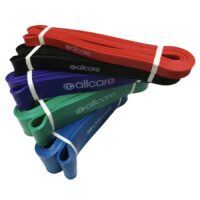
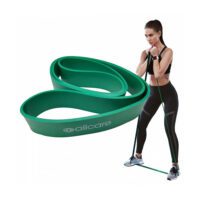
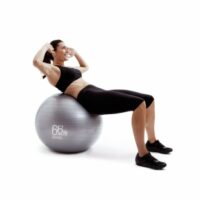
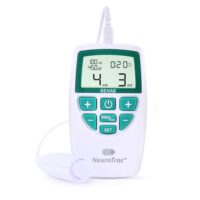
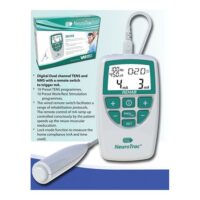
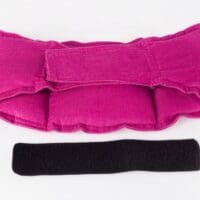
Pain Products

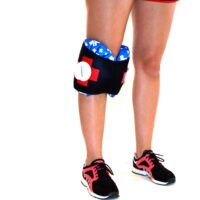
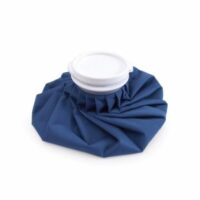
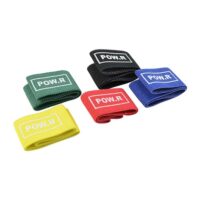
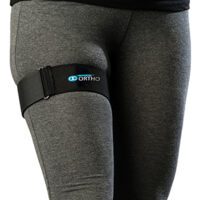
These pain products are commonly used by our physiotherapists to provide comfort and pain relief.

View all pain relief products

Related Information

Frequently Asked Questions

What is chronic pain?

Chronic pain is pain that lasts or keeps returning for longer than three months. It may involve increased nervous-system sensitivity, which can make normal activity feel more painful.

Does chronic pain always mean tissue damage?

No. Ongoing pain does not always mean ongoing tissue damage. Pain can persist because of changes in how nerves, the spinal cord and brain process signals. Sleep, stress, activity levels and previous pain experiences may also influence symptoms.

Why does chronic pain flare up?

Flare-ups may occur when the nervous system becomes more sensitive. Common triggers include sudden increases in activity, poor sleep, stress, illness, prolonged sitting and stopping activity completely.

Can exercise help chronic pain?

Often, yes. Graded exercise may improve strength, fitness, confidence and physical capacity. The key is to begin at a manageable level and progress gradually according to your symptoms and goals.

When should I see a physiotherapist for chronic pain?

Consider an assessment if pain limits sleep, work, sport or daily activity, or if symptoms keep returning despite rest. A physiotherapist can help identify contributing factors and develop a plan to improve function and manage flare-ups.

Follow PhysioWorks

Get physiotherapy tips, exercise videos, recovery advice and blog updates.

References

  1. Treede RD, Rief W, Barke A, et al. Chronic pain as a symptom or a disease: the IASP classification of chronic pain for the International Classification of Diseases. Pain. 2019;160(1):19–27. View research.
  2. Curatolo M, Arendt-Nielsen L. Central sensitisation and pain: pathophysiological and clinical implications. Pain Reports. 2023;8(6):e1107. View research.
  3. Jain SV, Karmacharya S. Relationship between sleep disturbances and chronic pain. Sleep Medicine Clinics. 2024. View research.

What Causes Pins and Needles?

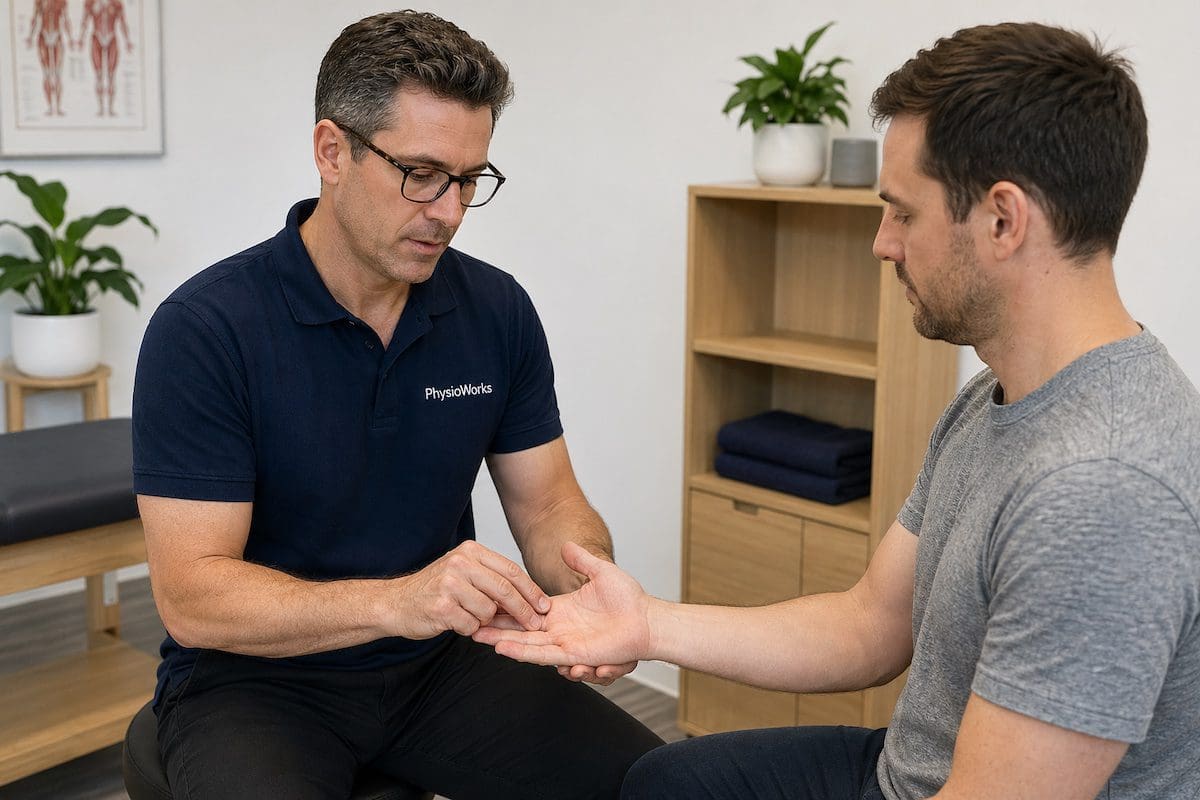
physiotherapist assessing hand tingling and pins and needles nerve symptoms

A physiotherapist checks sensation to help identify the cause of pins and needles.

Pins and needles usually happen when nerve signals are disrupted by pressure, irritation, or reduced blood flow around a nerve. Symptoms may feel like tingling, buzzing, prickling, burning, or an “electric” sensation.

Many episodes settle after you move position. However, repeated tingling may involve a pinched nerve, spinal nerve irritation, local nerve compression, or a broader nerve condition.

Quick answer: what causes pins and needles?

  • Brief pressure: common after sitting, sleeping, or leaning awkwardly.
  • Spinal nerve irritation: may cause tingling down an arm or leg.
  • Local nerve compression: can affect the hand, wrist, elbow, foot, or ankle.
  • Medical nerve conditions: may cause ongoing tingling in both feet or hands.

What Causes Pins and Needles?

Pins and needles occur when a nerve cannot send signals normally. This may happen from temporary compression, irritation near the spine, pressure on a nerve in the limb, or a wider condition affecting nerve health.

The pattern matters. Tingling in one hand may suggest a different driver from tingling down one leg or tingling in both feet.

Common Causes of Pins and Needles

Most causes fit into four broad groups. Some are simple and short-lived. Others need a clear assessment, especially when symptoms repeat or worsen.

1) Temporary Pressure on a Nerve

Simple pressure can cause short-lived tingling. Examples include sleeping on your arm, leaning on your elbow, sitting with crossed legs, or staying in one position too long.

Once pressure eases, sensation often returns within minutes. This type is usually not concerning if it fully settles and does not keep returning.

2) Neck or Back Nerve Irritation

Nerves exit the spine through small openings. If spinal joints, discs, or surrounding tissues irritate a nerve root, symptoms may travel into the arm, hand, leg, or foot.

Common examples include cervical radiculopathy from the neck and sciatica from the lower back. A bulging disc may also contribute to nerve irritation.

3) Local Nerve Compression in the Arm or Leg

Nerves can become compressed away from the spine. This may occur around the wrist, elbow, shoulder, hip, ankle, or foot.

Repetitive gripping, keyboard work, vibration exposure, awkward tool use, and sustained positions may increase irritation. If symptoms link with work or repeated loading, repetitive strain injury (RSI) may be part of the picture.

4) Broader Nerve Conditions

Some tingling reflects a wider nerve health issue. This may start in the toes or fingers and slowly progress. It may affect both sides rather than one clear pathway.

Potential causes include diabetes, vitamin B12 deficiency, thyroid conditions, alcohol-related nerve irritation, some medications, and peripheral neuropathy. Healthdirect provides a helpful Australian overview of peripheral neuropathy.

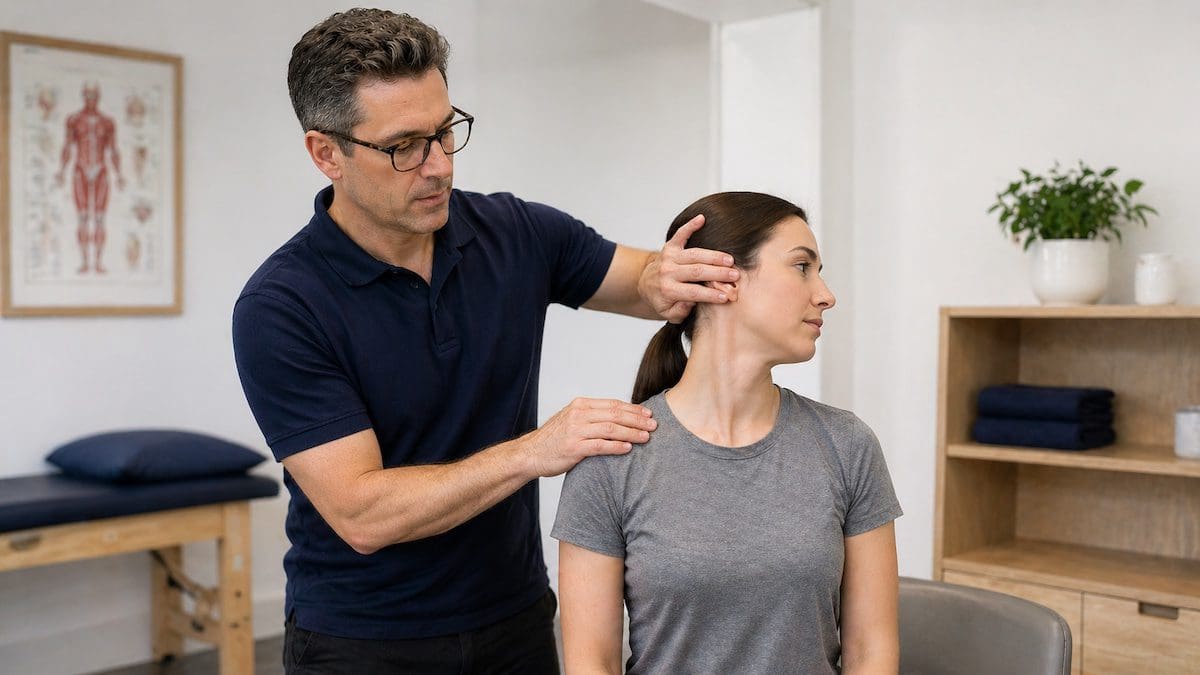
neck movement test assessing nerve irritation causing pins and needles symptoms

Specific neck movements may reproduce nerve symptoms and help identify their source.

When Are Pins and Needles Normal?

Short-lived pins and needles after an awkward position are common. They usually settle soon after you move, change posture, or remove pressure from the nerve.

However, symptoms deserve attention when they persist, return often, spread, or follow the same pathway through the arm, hand, leg, or foot.

When Should You Worry About Pins and Needles?

You should book an assessment if pins and needles last longer than expected, keep returning, spread, or occur with numbness, weakness, grip changes, or balance changes.

Book an assessment if you notice:

  • tingling lasting more than 30–60 minutes after changing position
  • symptoms returning in the same fingers, toes, arm, or leg
  • tingling spreading up or down the limb
  • reduced feeling, reduced grip, or muscle weakness
  • symptoms after a fall, collision, or significant injury

When Should You Seek Urgent Medical Care?

Seek urgent medical care if pins and needles occur with sudden neurological symptoms. These signs may indicate a serious medical condition that needs immediate assessment.

Seek urgent help for pins and needles with:

  • face drooping, speech changes, or one-sided weakness
  • new severe headache, confusion, or sudden vision changes
  • loss of bladder or bowel control
  • numbness in the saddle area
  • rapidly worsening weakness in an arm or leg

Can Physiotherapy Help Pins and Needles?

Physiotherapy may help when pins and needles relate to posture, movement, spinal irritation, local nerve compression, or nerve sensitivity linked with loading.

Your physiotherapist may check sensation, strength, reflexes, spinal movement, limb movement, posture, and symptom behaviour. Treatment may include education, activity changes, nerve mobility work, spinal movement exercises, load management, and graded strengthening.

Activity and Load Considerations

Small changes can reduce nerve irritation. The best approach depends on whether symptoms come from posture, spinal irritation, local compression, or repeated loading.

  • Change posture regularly: avoid staying in one position too long.
  • Modify gripping and tool use: reduce sustained clenching and vibration where possible.
  • Check sleep posture: avoid prolonged neck rotation or sleeping with a bent wrist.
  • Build tolerance gradually: increase training, lifting, and work demands in stages.

What Should You Do if Pins and Needles Keep Coming Back?

Track where the tingling occurs, how long it lasts, and what triggers it. Then book an assessment if symptoms repeat, spread, or affect strength, sensation, coordination, walking, or grip.

If symptoms suggest a broader medical cause, your physiotherapist may recommend GP review. For a deeper overview, start with our Nerve Pain and Pinched Nerve guides.

Frequently Asked Questions

What causes pins and needles in hands?

Pins and needles in the hands may come from temporary pressure, neck nerve irritation, or local nerve compression around the wrist, elbow, or shoulder. Repetitive tasks, sleeping posture, and sustained gripping can also contribute.

What causes pins and needles in feet?

Pins and needles in the feet may come from pressure on a local nerve, lower back nerve irritation, footwear pressure, circulation issues, or peripheral neuropathy. Repeated or spreading symptoms should be assessed.

Is pins and needles a sign of a pinched nerve?

It can be. A pinched or irritated nerve may cause tingling, numbness, burning, or electric sensations down an arm or leg. Assessment can help identify whether symptoms come from the spine or a local compression point.

Can posture cause pins and needles?

Yes. Sustained postures can increase pressure or tension around nerves, especially in the neck, shoulder, elbow, wrist, back, or hip. Regular position changes often help reduce short-lived symptoms.

Can repetitive work cause pins and needles?

Yes. Repetitive gripping, tool use, keyboard work, or vibration exposure can irritate nerves over time. Symptoms may appear in the hand, wrist, forearm, or fingers depending on the affected nerve.

When should pins and needles be checked?

Pins and needles should be checked if symptoms persist, return often, spread, or occur with numbness or weakness. You should also seek assessment if symptoms start after trauma or affect walking, balance, grip, or coordination.

What to Do Next

Pins and needles often reflect nerve irritation rather than permanent nerve damage. Still, repeated or spreading tingling needs a clear plan.

If your symptoms keep returning, spread, or come with weakness or numbness, book a physiotherapy assessment. Your clinician can help clarify whether the driver is spinal irritation, local nerve compression, or a broader issue needing medical review.

Choose your clinic and appointment pathway

Select a PhysioWorks clinic to continue to live booking, an appointment request or reception assistance.

Pain Products

These pain products are commonly used by our physiotherapists to provide comfort and pain relief.

View all pain relief products

Follow PhysioWorks

Get physiotherapy tips, exercise videos, recovery advice and blog updates.

Related Information

References

  1. Borrella-Andrés S, Marqués-García I, Lucha-López MO, et al. Manual therapy as a management of cervical radiculopathy: a systematic review. Biomed Res Int. 2021;2021:9936981. doi:10.1155/2021/9936981.
  2. Kuligowski T, Skrzek A, Cieślik B. Manual therapy in cervical and lumbar radiculopathy: a systematic review of the literature. Int J Environ Res Public Health. 2021;18(11):6176. doi:10.3390/ijerph18116176.
  3. Mauermann ML, Staff NP. Peripheral neuropathy: a review. JAMA. 2026;335(3):255-266. doi:10.1001/jama.2025.19400.

What Is the Shoulder Impingement Zone?

Article by John Miller & Erin Runge

What Is the Shoulder Impingement Zone?

The shoulder impingement zone is the part of your shoulder where the rotator cuff tendons and bursa can become compressed as they pass beneath the acromion at the top of the shoulder blade. This often happens during repeated overhead movement, lifting at shoulder height, or poor shoulder blade control. It sits within the broader group of shoulder pain conditions and commonly overlaps with shoulder impingement.

Many people notice pain when reaching up, hanging out washing, swimming, lifting weights, or reaching for a seatbelt. As the area becomes more irritated, the pain may spread down the upper arm, disturb sleep, or make your shoulder feel weak.

Quick scan: common signs

  • Pain when your arm moves out to the side or overhead
  • A painful arc near shoulder height
  • Pain lying on the sore shoulder
  • Weakness or pain with lifting and reaching
  • Symptoms linked with bursitis or rotator cuff irritation

Why does the shoulder impingement zone become painful?

The space under the acromion can become less comfortable when the tissues in that region are overloaded, irritated, or swollen. Common contributing factors include repeated overhead sport, gym training errors, work above shoulder height, shoulder blade control problems, rotator cuff weakness, and posture that keeps the shoulder sitting forward for long periods.

Rounded shoulder posture and poor shoulder blade rhythm can also increase the load through this area. If you play overhead sports, you may also find that related conditions such as swimmer’s shoulder or shoulder bursitis develop alongside rotator cuff irritation.

Who commonly gets shoulder impingement?

Shoulder impingement symptoms are common in people who do repeated overhead work or sport. This includes swimmers, tennis players, golfers, throwers, tradies, warehouse workers, painters, and gym-goers. It can also affect people whose shoulder becomes sore after a sudden increase in lifting, training load, or a period of poor shoulder mechanics.

What are the symptoms of shoulder impingement zone irritation?

The most common symptom pattern is a painful arc. That means your shoulder hurts most as your arm lifts around shoulder height and sometimes again near full elevation. Many people also notice pain at night, pain when dressing, and pain placing the hand behind the head or back.

  • Pain lifting the arm sideways or overhead
  • Pain reaching behind your back or fastening a bra
  • Pain reaching for a seatbelt
  • Upper arm pain that can travel towards the elbow
  • Weakness or pain with lifting, carrying, or pushing
  • Night pain when lying on the sore side

Why does it hurt at shoulder height?

This position often loads the rotator cuff and bursa most heavily. If those tissues are irritated, shoulder-height and overhead movements can reproduce symptoms quickly. That is why many people feel pain with shelves, hair washing, sports serves, or gym presses.

How is shoulder impingement diagnosed?

A physiotherapist will usually diagnose this pattern from your history, movement testing, strength, and symptom behaviour. They will also assess whether your symptoms fit better with rotator cuff tear, bursitis, stiffness, neck referral, or another shoulder condition.

Scans can sometimes help, especially if your symptoms are severe, persistent, or linked to trauma. However, imaging does not always match pain levels, so it should be interpreted together with a clinical assessment. For a broader consumer guide to shoulder pain and when to seek urgent care, see Healthdirect’s shoulder pain advice.

How is shoulder impingement usually treated?

Treatment usually starts with reducing irritation, improving movement quality, and rebuilding rotator cuff and shoulder blade strength. A physiotherapist may guide activity modification, taping, manual therapy, progressive loading, and a home exercise plan. For many people, structured rehabilitation works better than simply resting the shoulder.

Your program may include mobility work, posture correction, shoulder blade control drills, and graded strengthening. These types of rotator cuff exercises are often progressed within a broader exercise program so you can return to work, training, and overhead activity with more confidence.

When should you worry about shoulder impingement?

You should arrange an assessment if your pain is not settling, your shoulder feels weak, you cannot lift your arm properly, or your symptoms followed trauma. You should also seek prompt advice if the pain is severe at night, your shoulder is stiffening quickly, or you suspect a more significant rotator cuff injury.

Shoulder Impingement Zone FAQs

Is shoulder impingement the same as bursitis?

Not exactly. Shoulder impingement describes a pain pattern and tissue-loading problem around the subacromial space. Bursitis is one possible tissue response in that region. Some people have bursitis, some have rotator cuff irritation, and some have a mix of both.

Can poor posture contribute to shoulder impingement?

Yes. Posture is rarely the only cause, but rounded shoulders and poor shoulder blade control can increase load through the impingement zone. A physiotherapist will usually look at posture together with strength, mobility, work demands, and sport technique rather than blaming one factor alone.

Do I need a scan for shoulder impingement?

Not always. Many cases can be assessed well from your symptoms, movement, and strength. Scans may help when symptoms are severe, prolonged, traumatic, or when a rotator cuff tear or another diagnosis needs to be ruled in or out.

Can exercises help shoulder impingement?

Yes. Many people improve with a program that builds rotator cuff strength, shoulder blade control, and tolerance for overhead movement. The key is choosing the right exercises at the right stage, rather than pushing through painful loading too early.

Related shoulder conditions

What to do next

If shoulder-height or overhead movement keeps causing pain, don’t just wait for it to settle on its own. A proper assessment can help identify whether the main issue is rotator cuff irritation, bursitis, movement control, weakness, or another shoulder problem.

Your physiotherapist can explain what is driving your pain, guide the right exercises, and help you build back into work, sleep, sport, and training with a clear plan.

Choose your clinic and appointment pathway

Select a PhysioWorks clinic to continue to live booking, an appointment request or reception assistance.

Shoulder Products

These shoulder products are commonly used by our physiotherapists to improve strength, posture, movement, plus assist home exercise programs.

View all shoulder products

Follow PhysioWorks

Get physiotherapy tips, exercise videos, recovery advice and blog updates.

References

  1. Desmeules F, Bussières A, Roy JS, et al. Rotator Cuff Tendinopathy Diagnosis, Nonsurgical Medical Care, and Rehabilitation: A Clinical Practice Guideline. J Orthop Sports Phys Ther. 2025;55(4):235-274. doi:10.2519/jospt.2025.13182
  2. Karanasios S, Baglatzis G, Lignos I, Billis E. Manual Therapy and Exercise Have Similar Outcomes to Corticosteroid Injections in the Management of Patients With Subacromial Pain Syndrome: A Systematic Review and Meta-Analysis. Cureus. 2023;15(11):e48907. doi:10.7759/cureus.48907
  3. Pocovi NC. Appraisal of Clinical Practice Guideline: Rotator cuff tendinopathy diagnosis, nonsurgical medical care and rehabilitation: a clinical practice guideline. J Physiother. 2026;72(1):74. doi:10.1016/j.jphys.2025.11.002

What Is Your Rotator Cuff?

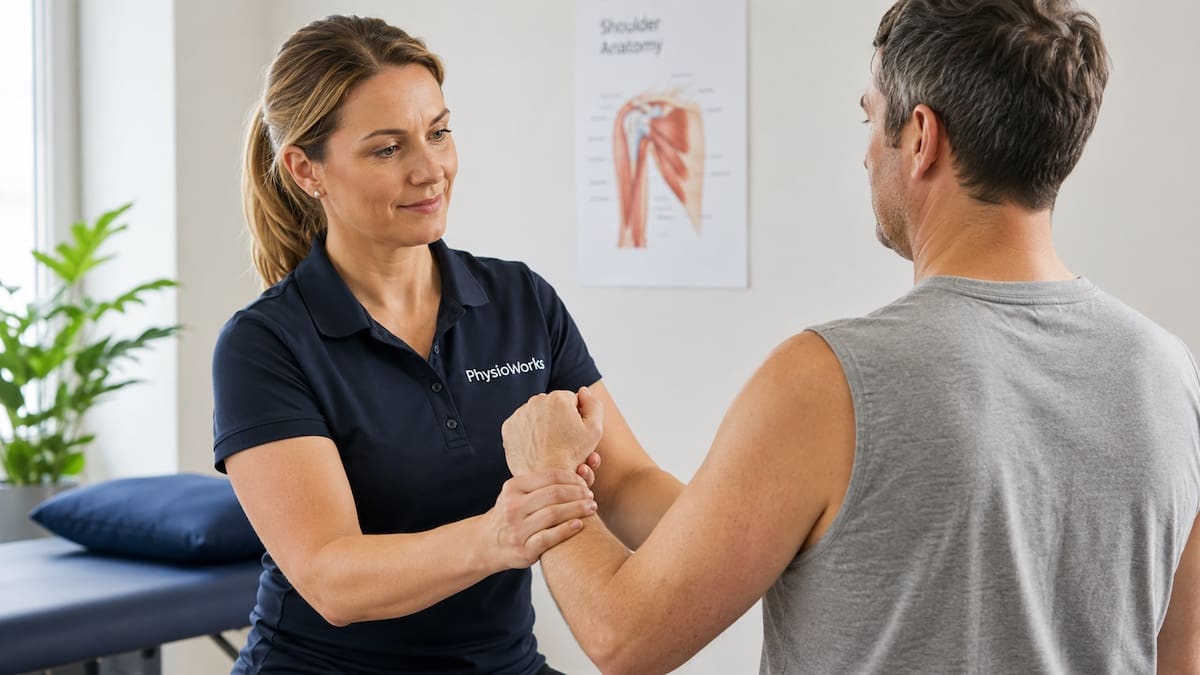
Rotator cuff external rotation shoulder assessment testing tendon control

Testing rotator cuff control.

Your rotator cuff is a group of four shoulder muscles and tendons. It helps keep the ball of your upper arm centred in the shoulder socket while you lift, reach, rotate, throw, push, pull, and control your arm.

If you are trying to understand shoulder pain, start with the broader shoulder pain guide. Then compare your symptoms with common rotator cuff injury patterns.

Quick Answer: What Is the Rotator Cuff?

The rotator cuff is a shoulder control system. It includes the supraspinatus, infraspinatus, teres minor, and subscapularis muscles. These muscles guide the shoulder joint, help hold the arm bone in the socket, and support smooth arm movement.

In simple terms, the rotator cuff gives your shoulder movement and stability. When it becomes irritated, weak, overloaded, or torn, daily tasks can become painful. Dressing, reaching overhead, sleeping on that side, gym work, throwing, or lifting may all feel harder.

Rotator cuff problems often overlap with shoulder impingement, shoulder bursitis, rotator cuff tendinopathy, and rotator cuff tear.

What Muscles Make Up the Rotator Cuff?

The rotator cuff has four muscles: supraspinatus, infraspinatus, teres minor, and subscapularis. Their tendons blend around the top of the shoulder and help keep the head of the humerus steady against the shoulder blade as your arm moves. The NCBI rotator cuff anatomy summary describes these muscles as key dynamic stabilisers of the shoulder.

  • Supraspinatus: helps start arm lifting, especially early abduction.
  • Infraspinatus: helps rotate the arm outwards.
  • Teres minor: assists external rotation and shoulder control.
  • Subscapularis: helps rotate the arm inwards and stabilise the front of the shoulder.

What Does the Rotator Cuff Do?

The rotator cuff controls shoulder movement and stability during lifting, reaching, pushing, pulling, and throwing. It gently compresses the ball of the upper arm into the shoulder socket so the larger shoulder muscles can move the arm with better control.

This is why rotator cuff strength matters. A strong, well-timed cuff helps your shoulder feel steadier when you reach overhead, lift away from your body, return to gym training, swim, play tennis, or throw.

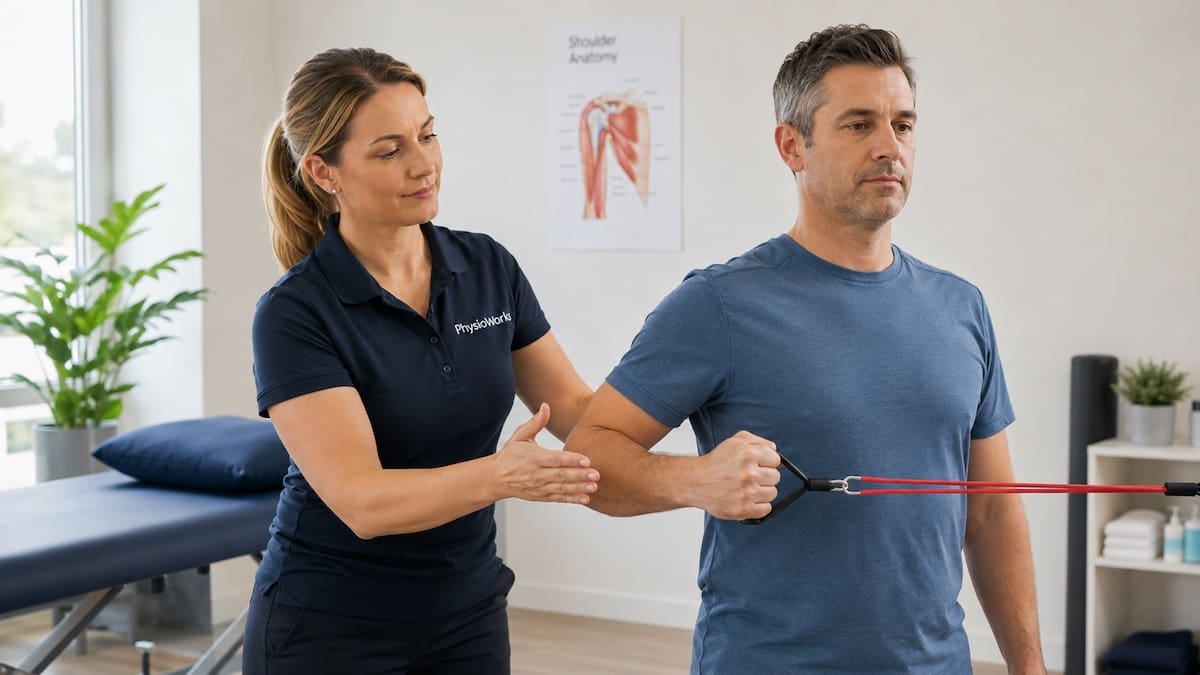
Rotator cuff band external rotation exercise improving shoulder tendon control

Building shoulder rotation control.

Rotator Cuff Function at a Glance

  • Stability: helps keep the shoulder centred.
  • Rotation: helps turn the arm inwards and outwards.
  • Lifting control: helps guide the arm during reaching and overhead movement.
  • Load control: helps the shoulder tolerate work, sport, and gym tasks.
  • Protection: shares load with the shoulder blade and larger shoulder muscles.

Common Causes of Rotator Cuff Problems

Rotator cuff problems can start after a sudden injury or build slowly over time. Common triggers include a fall, heavy lift, repeated overhead work, gym overload, throwing, swimming, or age-related tendon change.

Load changes matter. A shoulder may tolerate normal activity, then flare when training, work, DIY, or sport load rises faster than the cuff can adapt. Posture, shoulder blade control, sleep position, and neck stiffness can also affect symptoms.

What Injuries Affect the Rotator Cuff?

The rotator cuff is not one diagnosis. It is a group of tissues that can be affected in different ways. Common related conditions include:

How Do You Know If You Have a Rotator Cuff Injury?

Common rotator cuff symptoms include pain when lifting the arm, weakness, night pain, reduced function, and pain when reaching behind the back or away from the body. Some people notice a painful arc, where pain appears through part of the movement and then eases.

Symptoms alone do not confirm the exact diagnosis. A physiotherapist may assess your shoulder movement, strength, painful arc, shoulder blade control, neck contribution, and load tolerance. Imaging may help when symptoms are severe, persistent, traumatic, or do not follow the expected pattern.

Book sooner if: you had a fall, felt a pop, developed sudden weakness, cannot lift the arm, have bruising, or pain is disturbing sleep.

Routine assessment may suit: shoulder pain that keeps returning, limits gym or work, or does not settle with simple load changes.

How Is a Rotator Cuff Injury Treated?

Physiotherapy is often the first approach for many cuff-related shoulder problems. Treatment usually focuses on calming pain, restoring comfortable movement, improving shoulder blade control, and rebuilding rotator cuff strength.

Your plan should match your symptoms, tissue irritability, work demands, sport, age, and goals. It may include load management, strengthening, movement correction, sleep-position advice, manual therapy, and staged return to activity.

Can a Rotator Cuff Tear Heal Without Surgery?

Many people improve without surgery, especially when symptoms are matched with a clear rehab plan. However, larger tears, traumatic tears, sudden weakness, or loss of function may need medical review and imaging.

The right pathway depends on tear size, pain level, strength, function, age, tissue quality, and what you need your shoulder to do. A guided assessment can help decide whether rehab is suitable or whether a surgical opinion should be considered.

Should You Keep Exercising With Rotator Cuff Pain?

You may be able to keep exercising if symptoms are mild, predictable, and settle quickly. Reduce or modify exercises that cause sharp pain, worsening night pain, or next-day flare-ups.

Shoulder response Practical next step
Mild ache that settles within 24 hours Keep load light and progress slowly.
Pain during overhead lifting Reduce range, load, or volume.
Night pain or next-day flare Back off and seek guidance.
Sudden weakness after injury Book assessment promptly.

What Helps the Rotator Cuff Recover?

Rotator cuff recovery usually works best when load is changed, pain is monitored, and strength is rebuilt in stages. Early exercises may feel small, but they help restore control before heavier lifting, sport, or overhead work returns.

Related Shoulder Guides

These pages may help you compare symptoms and choose your next step:

Frequently Asked Questions

Is the rotator cuff a muscle or a tendon?

The rotator cuff includes both muscles and tendons. The muscles start on the shoulder blade, and their tendons attach near the top of the upper arm bone. Together, they help move and stabilise the shoulder.

What are the four rotator cuff muscles?

The four rotator cuff muscles are supraspinatus, infraspinatus, teres minor, and subscapularis. A common memory aid is SITS, using the first letter of each muscle.

Can you still move your arm with a rotator cuff tear?

Yes, many people can still move the arm with a rotator cuff tear. Movement depends on tear size, pain level, strength, and which tendon is involved. Sudden weakness after injury should be assessed promptly.

Does rotator cuff pain always mean surgery?

No. Many cuff-related shoulder problems improve with physiotherapy, load management, and strengthening. Surgery may be considered for some larger, traumatic, or function-limiting tears.

What does rotator cuff pain feel like?

Rotator cuff pain often feels like pain on the side or front of the shoulder. It may worsen with lifting, reaching, lying on the sore side, gym pressing, swimming, throwing, or reaching behind your back.

When should you get rotator cuff pain checked?

Book an assessment if shoulder pain persists, worsens, affects sleep, limits lifting, or follows a fall or heavy lift. Seek care sooner if you notice sudden weakness, bruising, deformity, numbness, or loss of function.

Rotator cuff overhead dumbbell reach drill restoring shoulder movement confidence

Restoring confident shoulder reach.

What to Do Next

If your symptoms sound like rotator cuff pain, compare them with our rotator cuff injury and shoulder pain guides. A physiotherapy assessment can help clarify whether your pain is more likely related to tendinopathy, tear, bursitis, impingement, or another shoulder condition.

Book an appointment if shoulder pain limits sleep, work, sport, gym training, or daily reaching tasks.

Choose your clinic and appointment pathway

Select a PhysioWorks clinic to continue to live booking, an appointment request or reception assistance.

Shoulder Products

These shoulder products are commonly used by our physiotherapists to improve strength, posture, movement, plus assist home exercise programs.

View all shoulder products

Follow PhysioWorks

Get physiotherapy tips, exercise videos, recovery advice and blog updates.

References

  1. Maruvada S, Madrazo-Ibarra A, Varacallo MA. Anatomy, Rotator Cuff. In: StatPearls. Treasure Island (FL): StatPearls Publishing; updated March 27, 2023.
  2. Desmeules F, et al. Rotator Cuff Tendinopathy Diagnosis, Nonsurgical Medical Care, and Rehabilitation. J Orthop Sports Phys Ther. 2025.
  3. Zhao Q, Palani P, Kassab NS, et al. Evidence-based approach to the shoulder examination for subacromial bursitis and rotator cuff tears: a systematic review and meta-analysis. BMC Musculoskelet Disord. 2024;25(1):1028. doi:10.1186/s12891-024-08144-z

Cortisone Injection for Shoulder Bursitis

Cortisone injections may provide short-term pain relief for some people with shoulder bursitis or rotator cuff-related shoulder pain, but rehabilitation remains central to longer-term recovery.

physiotherapist assessing shoulder pain before cortisone injection decision

Assessment helps determine whether a shoulder cortisone injection fits your treatment plan.

A cortisone injection for shoulder bursitis may reduce pain and short-term disability for some people, particularly when symptoms are limiting sleep, reaching, lifting or rehabilitation. However, the benefit is usually temporary. Cortisone does not repair damaged tendon tissue.

Shoulder pain may involve the subacromial bursa, rotator cuff tendons or several structures at the same time. Conditions commonly described as shoulder impingement or rotator cuff-related shoulder pain can produce similar symptoms. Assessment helps determine the most appropriate management pathway.

What Is a Cortisone Injection in the Shoulder?

A cortisone injection uses corticosteroid medication to reduce pain and inflammation. It may also contain local anaesthetic. For rotator cuff-related shoulder pain, the injection commonly targets the subacromial bursa rather than the rotator cuff tendon itself.

The injection does not correct the underlying cause of shoulder pain or repair tendon damage. Instead, short-term symptom relief may make it easier to restore movement and progress strengthening.

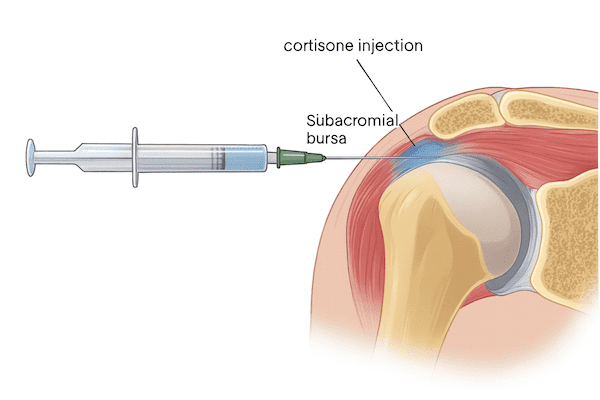
The diagram below shows a typical subacromial injection location.

cortisone injection shoulder illustration showing subacromial bursa injection

Diagram showing a typical cortisone injection location within the subacromial bursa.

When Might a Cortisone Injection Be Considered?

A corticosteroid injection may be considered when shoulder pain remains significant despite appropriate initial non-surgical care. Current clinical guidance does not recommend corticosteroid injection as first-line treatment for rotator cuff tendinopathy.

An injection discussion may be reasonable when:

  • pain continues to restrict reaching, lifting or normal daily activities;
  • night pain is significantly disrupting sleep;
  • pain is preventing useful rehabilitation progression;
  • appropriate early treatment has not provided enough relief; or
  • your physiotherapist and medical practitioner consider an injection appropriate within the broader rehabilitation plan.

Which Shoulder Problems May Be Relevant?

Corticosteroid injection may be considered for selected people with pain involving the subacromial region. Similar shoulder symptoms can have different causes, so the diagnosis should not be based on pain location or one clinical test alone.

Are Shoulder Cortisone Injections Safe?

Shoulder corticosteroid injections are generally well tolerated when used appropriately, but they are not risk-free. The potential benefits and risks depend on the injection site, dose, frequency, your health and the condition of the surrounding tissues.

Clinicians generally avoid injecting corticosteroid directly into a rotator cuff tendon. Repeated exposure may adversely affect tendon tissue, so repeated injections require careful medical consideration.

For subacromial corticosteroid injection, current rotator cuff tendinopathy guidelines recommend ultrasound guidance where available. Greater placement accuracy, however, does not mean an injection will provide a better long-term outcome than rehabilitation.

Injection or Rehabilitation?

An Injection May Be Worth Discussing When

  • pain remains high and significantly affects sleep or normal movement;
  • rehabilitation cannot progress because pain is too limiting;
  • appropriate initial conservative care has not provided enough relief; or
  • a medical practitioner considers an injection reasonable within the broader management plan.

Rehabilitation Remains Central When

  • strength, control or load tolerance needs to improve;
  • symptoms are responding to exercise and activity modification;
  • shoulder function is gradually improving; or
  • short-term pain relief is being used to help progress exercise and normal activity.

What Happens During a Shoulder Cortisone Injection?

A medical practitioner cleans the skin and places a needle into the intended bursa or joint space. Corticosteroid medication is then injected, sometimes with local anaesthetic. Ultrasound may be used to guide needle placement.

Local anaesthetic can provide temporary numbness before its effect wears off. The corticosteroid effect, when helpful, may take longer to develop.

Your medical practitioner should provide advice about activity following the procedure. Rehabilitation can then be resumed and progressed according to your symptoms, shoulder function and the advice of the clinicians involved.

How Effective Are Cortisone Injections Compared With Physiotherapy?

A 2025 systematic review and meta-analysis of 15 randomised controlled trials involving 1,785 participants found that corticosteroid injection combined with physiotherapy interventions may provide small to moderate improvements in pain and function in the short term compared with physiotherapy alone.

However, corticosteroid injection alone was generally not more effective than physiotherapy interventions, and injections were not superior at medium- or long-term follow-up. The certainty of the evidence ranged from moderate to mostly very low.

This supports using an injection selectively for short-term symptom management rather than viewing it as a replacement for active rehabilitation.

Why Does Rehabilitation Still Matter After an Injection?

Rotator cuff tendinopathy guidelines support active rehabilitation as an initial treatment. Exercise can address strength, movement capacity and the shoulder's ability to tolerate everyday, work and sporting loads.

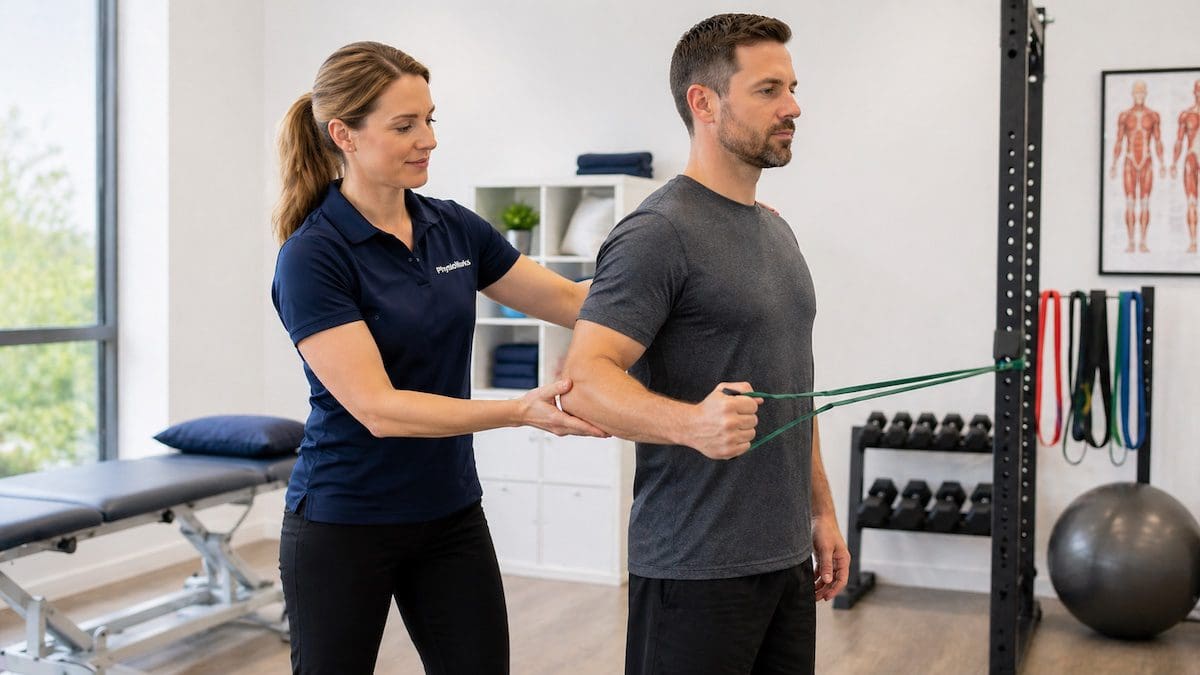
physiotherapist guiding rotator cuff rehab after shoulder cortisone injection

Progressive rehabilitation helps restore shoulder strength, movement and load tolerance.

When an injection provides useful symptom relief, rehabilitation can focus on rebuilding the physical capacity required for daily activities, work, gym or sport.

Your rehabilitation program may include:

  • rotator cuff strengthening;
  • scapular and shoulder control exercises;
  • shoulder and thoracic mobility where appropriate;
  • graded return to lifting, work, gym or sport; and
  • load modification while shoulder capacity improves.

Do Cortisone Injections Fix Rotator Cuff Tears?

No. Cortisone may reduce pain, but it does not repair torn rotator cuff tendon fibres. Management of a rotator cuff tear depends on factors such as the size and type of tear, symptoms, strength, function, age, activity requirements and treatment goals.

Progressive rehabilitation is appropriate for many rotator cuff tears. Persistent weakness, substantial loss of function or symptoms following significant trauma may warrant further medical assessment or imaging.

What Are the Risks and Limitations?

Most people tolerate shoulder corticosteroid injections without a major complication, but side effects can occur.

  • temporary increase in pain after the injection;
  • skin thinning or colour change around the injection site;
  • temporary elevation of blood glucose, particularly in people with diabetes;
  • infection, although this is uncommon; and
  • potential adverse effects on tendon health with repeated corticosteroid exposure.

When Should You Seek Professional Advice?

Consider professional assessment if shoulder pain continues to affect sleep, work, sport or normal daily activities. A physiotherapist can assess shoulder movement, strength, symptom behaviour and function, then help determine whether rehabilitation alone or medical review is the appropriate next step.

Related Shoulder Information

Common Questions About Shoulder Cortisone Injections

Is a cortisone injection for shoulder bursitis safe?

Shoulder cortisone injections are generally well tolerated when used appropriately, but they are not risk-free. Clinicians generally avoid injecting corticosteroid directly into a rotator cuff tendon, and repeated injections require caution because corticosteroid exposure may adversely affect tendon health.

How long does a shoulder cortisone injection last?

The response varies. Corticosteroid injections mainly provide short-term symptom relief, and some people gain little or no benefit. Current evidence does not show an advantage over physiotherapy at medium- or long-term follow-up for rotator cuff tendinopathy.

Where is cortisone injected for shoulder bursitis?

For subacromial shoulder pain or bursitis, corticosteroid is commonly injected into the subacromial bursa rather than directly into a rotator cuff tendon. Current clinical guidelines recommend ultrasound guidance where available for subacromial corticosteroid injection.

Can cortisone repair a rotator cuff tear?

No. Cortisone may reduce pain, but it does not repair torn tendon fibres. Rotator cuff tears may require progressive rehabilitation, load management and, in selected cases, further medical or surgical review.

Should you rest after a shoulder cortisone injection?

Follow the advice given by the medical practitioner who performs the injection. Activity may be modified briefly before movement and rehabilitation are progressively resumed according to your symptoms and the injection details.

What to Do Next

If shoulder pain is not settling, book a physiotherapy assessment. Your physiotherapist can assess the likely contributors to your symptoms, guide rehabilitation and discuss whether medical review for a corticosteroid injection may be useful within your broader treatment plan.

Choose your clinic and appointment pathway

Select a PhysioWorks clinic to continue to live booking, an appointment request or reception assistance.

Shoulder Products

These shoulder products are commonly used by our physiotherapists to improve strength, posture, movement, plus assist home exercise programs.

View all shoulder products

Follow PhysioWorks

Get physiotherapy tips, exercise videos, recovery advice and blog updates.

References

  1. Desmeules F, Roy JS, Lafrance S, et al. Rotator cuff tendinopathy diagnosis, non-surgical medical care and rehabilitation: a clinical practice guideline. J Orthop Sports Phys Ther. 2025;55(4):256-285. doi:10.2519/jospt.2025.13182.
  2. Lazzarini SG, Buraschi R, Pollet J, Bettariga F, Pancera S, Pedersini P. Effectiveness of additional or standalone corticosteroid injections compared to physical therapist interventions in rotator cuff tendinopathy: a systematic review and meta-analysis of randomized controlled trials. Phys Ther. 2025;105(3):pzaf006. doi:10.1093/ptj/pzaf006.
  3. Adamson NJ, Chew KS, Holst MV, Hansen TB. Ultrasound-guided versus landmark-guided subacromial corticosteroid injections in adults with shoulder pain: a systematic review and meta-analysis. Musculoskeletal Care. 2022;20(4):734-746. doi:10.1002/msc.1643.
  4. Puzzitiello RN, Patel BH, Forlenza EM, et al. Adverse impact of corticosteroid injection on rotator cuff tendon health and repair: a systematic review. Arthroscopy. 2020;36(5):1468-1475. doi:10.1016/j.arthro.2019.12.006.
  5. Shen PC, Su FC, Lin YS, et al. Ultrasound-guided versus landmark-guided injections for musculoskeletal pain: an umbrella review. J Rehabil Med. 2024;56:jrm40769. doi:10.2340/jrm.v56.40769.

How Can You Tell If You Have a Torn Rotator Cuff?

torn rotator cuff shoulder strength test during physiotherapy assessment

Shoulder strength testing can help identify signs of a torn rotator cuff.

If you think you have a torn rotator cuff, look for shoulder pain with weakness, night pain, and trouble lifting your arm. These clues matter most when pain starts after a fall, heavy lift, or shoulder dislocation.

Not every painful shoulder is a tear. A torn rotator cuff sits within the broader group of shoulder pain conditions. It helps to compare your symptoms with other shoulder problems early.

Some tears happen suddenly after a fall, heavy lift, or shoulder dislocation. Others build slowly as part of a broader rotator cuff injury pattern. Your next step depends on how the pain started, how much strength you have lost, and how well your shoulder works day to day.

How Do You Know if You Have a Torn Rotator Cuff?

A torn rotator cuff often causes shoulder pain, weakness, and trouble lifting or rotating your arm. Night pain and loss of overhead strength can raise suspicion. So can a sudden drop in function after a fall or lift.

A physiotherapy assessment still matters. Shoulder bursitis, tendinopathy, and frozen shoulder can feel similar.

Quick Self-Check: Could It Be a Torn Rotator Cuff?

A torn rotator cuff becomes more likely if you have one or more of these signs:

  • shoulder pain started after a fall, sudden lift, or dislocation
  • you have clear weakness when lifting your arm
  • shoulder pain wakes you at night
  • you struggle to reach overhead, dress, or wash your hair
  • your shoulder feels painful and weak, not just stiff

Important: These signs raise suspicion. They do not confirm a tear. A physiotherapist can help work out whether your pain fits a torn rotator cuff, tendinopathy, bursitis, frozen shoulder, or another shoulder injury.

What Is a Torn Rotator Cuff?

A torn rotator cuff means one or more shoulder tendons has partly or fully torn. These tendons help hold the shoulder steady. They also guide lifting and rotation.

Some tears are small and painful, but the shoulder still works. Larger tears can cause marked weakness, poor control, and trouble raising the arm.

If your symptoms sound more like tendon irritation than a tear, read about rotator cuff tendinopathy. Tendinopathy can overlap with the same pain pattern.

What Are the Two Main Types of Torn Rotator Cuff?

The two main types are traumatic tears and atraumatic tears. A traumatic tear follows a clear injury. An atraumatic tear develops more slowly through repeated loading, tendon change, or smaller repeated stresses.

Traumatic Torn Rotator Cuff

A traumatic torn rotator cuff often happens after a fall onto the arm, a sudden heavy lift, or a shoulder dislocation. These cases are usually easy to remember. Pain can be sharp. Sleep can become difficult. Arm strength often drops quickly.

Atraumatic Torn Rotator Cuff

An atraumatic torn rotator cuff develops without one clear injury. The tendon may change over time due to repeated overload, age-related change, or prolonged overhead use. Symptoms often build slowly and may feel like general rotator cuff irritation at first.

Common Torn Rotator Cuff Symptoms

  • pain at the top or outer part of the shoulder
  • pain that travels into the upper arm
  • weakness with lifting, reaching, or rotating
  • difficulty washing your hair or reaching into a cupboard
  • painful clicking, catching, or loss of smooth movement
  • sleep disruption from shoulder pain
  • pain when lying on the sore side

What Symptoms Make a Torn Rotator Cuff More Likely?

A torn rotator cuff becomes more likely when shoulder pain comes with weakness or loss of function. Night pain alone is not enough. Stronger clues include trouble lifting the arm, pain plus weakness after trauma, and poor control during reaching or overhead movement.

You may still be able to move the arm with a smaller tear. For more detail, read Can you lift your arm with a rotator cuff tear?

When Should You Worry About a Torn Rotator Cuff?

You should worry more about a torn rotator cuff if the pain started after trauma, you suddenly cannot lift the arm well, or your strength has dropped sharply. In these cases, prompt physiotherapy or medical review is sensible. Larger tears and related injuries sometimes need earlier imaging or a shoulder surgeon’s opinion.

Arrange an Assessment Promptly If You Have:

  • sudden weakness after a fall or heavy lift
  • constant shoulder pain that disrupts sleep
  • marked difficulty lifting the arm
  • significant bruising, deformity, or a recent dislocation
  • persistent symptoms that are not settling

Do You Need a Scan to Identify a Torn Rotator Cuff?

Not always. A skilled assessment often gives a strong early guide. It can help decide whether conservative care is suitable first.

Imaging becomes more important when there has been trauma, major weakness, poor recovery, or a question about surgery. For more on that question, read Can you diagnose a torn rotator cuff without an MRI?. You can also read more about rotator cuff tears and broader shoulder injuries.

How Is a Torn Rotator Cuff Treated?

Torn rotator cuff treatment depends on tear size, pain level, age, activity demands, and shoulder function. Many people start with physiotherapy, pain reduction advice, and a graded rehab plan. Others may need referral to a shoulder surgeon, especially after a major traumatic tear.

Physiotherapy commonly focuses on pain control, comfortable movement, shoulder blade control, and shoulder strength. A guided plan may also include rotator cuff exercises once the shoulder is ready.

torn rotator cuff external rotation band exercise for shoulder strength

External rotation can help rebuild shoulder control.

Treatment May Include:

  • shoulder assessment and diagnosis guidance
  • pain reduction advice and load modification
  • guided shoulder mobility work
  • rotator cuff and shoulder blade strengthening
  • return-to-work, gym, or sport planning
  • referral for imaging or specialist review when appropriate

How Do You Decide Between Physio, Imaging, and Surgery?

The decision depends on your injury story and shoulder function. A gradual shoulder problem with mild weakness often starts with physiotherapy. A sudden injury with major weakness, loss of arm lift, or suspected full-thickness tear needs earlier review.

Imaging may help confirm the tear pattern. However, the scan result still needs to match your symptoms, strength, goals, and daily demands.

Simple Decision Guide

  • Pain but reasonable strength: a physiotherapy assessment and guided rehab may be a suitable first step.
  • Sudden weakness after trauma: arrange prompt physiotherapy or medical review and discuss imaging.
  • Persistent night pain or worsening function: seek review rather than waiting for it to settle by itself.
  • Large tear or poor progress: your clinician may suggest imaging or specialist opinion.

torn rotator cuff overhead dumbbell rehab with physiotherapist supervision

Supervised strengthening helps rebuild overhead control.

Torn Rotator Cuff FAQs

Can a torn rotator cuff heal without surgery?

Some people improve well without surgery, especially with smaller or degenerative tears. Physiotherapy may help reduce pain, improve strength, and restore shoulder function. The right choice depends on your function, symptoms, age, tear pattern, and goals.

Does a torn rotator cuff always stop you lifting your arm?

No. Smaller or partial tears may still allow arm lifting. The movement often feels painful, weak, or awkward. Larger traumatic tears are more likely to cause major trouble lifting the arm away from the body or overhead.

Why does a torn rotator cuff hurt more at night?

Night pain is common because the shoulder can become more sensitive after daily loading. Lying on the sore side may also compress irritated tissues. Some people notice pain more at night because there are fewer distractions.

What is the difference between a torn rotator cuff and tendinopathy?

Tendinopathy means tendon irritation or tendon change without a clear full tear. A torn rotator cuff means some tendon fibres have partly or fully torn. Both can cause pain and weakness, so assessment helps separate them.

When do you need surgery for a torn rotator cuff?

Surgery is considered more often when there is a significant traumatic tear, ongoing weakness, poor function, or poor progress with rehabilitation. Your age, work, sport, imaging findings, and goals also matter.

Should you rest a torn rotator cuff completely?

Usually not for long. Short-term activity changes may help settle pain. Too much complete rest can leave the shoulder weaker and stiffer. Most people do better with a graded plan than with full inactivity.

What to Do Next

If you think you may have a torn rotator cuff, do not rely on pain alone to judge the problem. Focus on how the injury started, how much strength you have lost, and whether your shoulder is improving or getting worse.

A physiotherapist can assess your shoulder, explain whether your symptoms fit a torn rotator cuff or another diagnosis, and guide the next step. This may include rehab, imaging advice, or referral for specialist review when needed.

Related PhysioWorks Articles

Choose your clinic and appointment pathway

Select a PhysioWorks clinic to continue to live booking, an appointment request or reception assistance.

Shoulder Products

These shoulder products are commonly used by our physiotherapists to improve strength, posture, movement, plus assist home exercise programs.

View all shoulder products

Follow PhysioWorks

Get physiotherapy tips, exercise videos, recovery advice and blog updates.

References

  1. Altamimi TA, Alghamdi OS, Alzahrani MM, et al. A Narrative Review of Rotator Cuff Tear Management. Cureus. 2024;16(11):e75260. doi:10.7759/cureus.75260
  2. American Academy of Orthopaedic Surgeons. Management of Rotator Cuff Injuries Clinical Practice Guideline. Published August 18, 2025.
  3. Healthdirect Australia. Rotator cuff injury. Accessed June 21, 2026.

Can You Diagnose a Torn Rotator Cuff Without an MRI?

Rotator cuff tear shoulder strength test assessing suspected tendon injury without MRI
Shoulder strength testing can guide imaging decisions.

A torn rotator cuff does not always need an MRI. Your history, shoulder movement, strength tests and pain pattern can often show the likely problem. A scan may help when signs are unclear, weakness is strong, trauma is involved, or a surgeon needs more detail.

This guide explains when a physio check may be enough, when ultrasound may help, and when MRI may be worth discussing with your GP, physio or shoulder surgeon. For more detail, see our Rotator Cuff Tear page or our broader Shoulder Pain guide.

Direct Answer

No, MRI is not always needed for a torn rotator cuff. A shoulder exam can often show the likely injury and guide early care.

  • Shoulder tests check strength, pain, movement and function.
  • Ultrasound can show many cuff tears and can assess movement.
  • MRI helps when signs are complex, scans are unclear or surgery is being planned.

How Can a Physio Assess a Torn Rotator Cuff?

Your physio starts by asking how your shoulder pain began. A fall or heavy lift may need a different plan from pain that builds up slowly with gym, work, swimming or overhead sport.

Your check may include shoulder range, resisted strength tests, shoulder blade control and painful arc testing. Tests such as empty can, drop arm and external rotation lag may point to a supraspinatus or infraspinatus tendon problem.

These tests do not “see” the tendon like a scan. Yet they show how your shoulder works. They also show what loads trigger pain and whether early rehab is safe.

When Is Ultrasound Enough for a Torn Rotator Cuff?

Ultrasound may be enough when your symptoms, shoulder tests and scan results all fit together. It can show many cuff tears, tendon irritation, shoulder bursitis and related shoulder impingement signs.

Ultrasound can also assess movement. The sonographer can watch the tendon and nearby tissue while your arm moves. It is often easier to access and costs less than MRI.

Ultrasound May Be Useful When

  • your symptoms suggest a cuff tear or bursitis
  • pain persists despite sensible load changes
  • strength tests suggest tendon involvement
  • the scan result may change your treatment plan

When Is an MRI Needed for a Torn Rotator Cuff?

An MRI may be useful when your symptoms are complex, ultrasound is unclear, or a surgical opinion is being considered. MRI can show tear size, tendon retraction, muscle quality, joint cartilage, labrum and deeper tissue changes.

Your GP, physio or shoulder surgeon may discuss MRI sooner if you have major weakness after trauma, poor arm lift, ongoing night pain, or symptoms that do not match a simple tendon overload pattern.

Clinical Check, Ultrasound or MRI: Which Comes First?

Many people can start with a physio assessment. They can also begin safe rehab while scan decisions are made. The right order depends on your symptoms, age, activity level, injury history and goals.

Option What It Helps Clarify Common Use
Physio assessment Pain pattern, strength, movement, irritability, function and safe starting load. Often the first step for non-urgent shoulder pain.
Ultrasound Tendon tears, bursitis, tendon thickening and dynamic movement findings. Often used when a cuff tear is likely and imaging may guide care.
MRI Tear size, tendon retraction, muscle quality, labrum, cartilage and deeper structures. Useful for complex cases, unclear scans or surgical planning.

What Symptoms Suggest a Rotator Cuff Tear?

A cuff tear can cause pain, weakness, night pain and trouble lifting the arm. Symptoms vary because tears can be small, large, partial, full-thickness, sudden or age-related.

  • pain when lifting the arm out to the side or overhead
  • weakness with reaching, carrying, pressing or rotating the arm
  • night pain, especially lying on the sore shoulder
  • a painful arc during shoulder movement
  • trouble dressing, washing hair, reaching shelves or playing sport

These symptoms can overlap with Rotator Cuff Tendinopathy, bursitis, impingement and Frozen Shoulder. A clear check helps sort out which pattern fits best.

When Should You Seek Medical Review Sooner?

Book a prompt review if your pain follows a fall, collision, dislocation or sudden heavy lift and you cannot lift the arm normally. Also seek advice if weakness is marked, pain is getting worse, or sleep is disturbed for more than a short time.

Seek urgent medical care if shoulder pain occurs with chest pain, shortness of breath, fever, major swelling, deformity, new numbness, a cold or pale arm, or severe pain that will not ease.

Can You Start Physio Before Imaging?

Often, yes. Many shoulder problems improve with education, activity changes, pain-guided movement and gradual strength work. Your physio can also help decide whether you need a scan and which type may be most useful.

Early rehab should match your pain and function. If signs suggest a larger tear or another issue, your physio can discuss GP review, ultrasound, MRI or a shoulder surgeon opinion.

Rotator cuff rehab shoulder overhead strength exercise supervised by physiotherapist
Guided shoulder strengthening can support recovery.

Related PhysioWorks Guides

Rotator Cuff MRI FAQs

Can a physio diagnose a torn rotator cuff without an MRI?

A physio can often identify the likely cuff problem through your history, strength tests, shoulder movement and pain pattern. This is not the same as seeing the tendon on a scan. Still, it can guide early care and help decide whether imaging is needed.

Is ultrasound accurate for a torn rotator cuff?

Ultrasound can be useful for many cuff tears, especially when done by an experienced sonographer. It can also assess the shoulder as it moves. MRI may be better when ultrasound is unclear, symptoms are complex, or surgery is being planned.

When should I ask for an MRI?

Ask your GP, physio or shoulder surgeon about MRI if you have marked weakness after trauma, poor arm lift, lasting night pain, unclear ultrasound findings, or poor progress despite a clear plan.

Can a torn rotator cuff improve without surgery?

Yes, many people improve without surgery. Rehab needs to match the tear size, symptoms, strength and daily demands. Larger traumatic tears, ongoing weakness or poor function may need imaging and a shoulder surgeon opinion.

Can scans show tears that are not causing pain?

Yes. Some cuff tears appear on scans even when a person has little or no pain. This is why scan results should be matched with symptoms, strength, movement, age, work needs, sport demands and goals.

What To Do Next

If your shoulder feels weak, painful or hard to lift, a physio assessment can help clarify the likely cause. Your physio can assess movement, strength and pain, then discuss whether ultrasound, MRI or early rehab is the best next step.

If your pain followed trauma, your weakness is marked, or symptoms are getting worse, book a timely review rather than waiting for it to settle on its own.

Choose your clinic and appointment pathway

Select a PhysioWorks clinic to continue to live booking, an appointment request or reception assistance.

Shoulder Products

These shoulder products are commonly used by our physiotherapists to improve strength, posture, movement, plus assist home exercise programs.

View all shoulder products

Follow PhysioWorks

Get physiotherapy tips, exercise videos, recovery advice and blog updates.

References

  1. American Academy of Orthopaedic Surgeons. Management of Rotator Cuff Injuries Evidence-Based Clinical Practice Guideline. American Academy of Orthopaedic Surgeons; 2025.
  2. Madhavi P, P R, K V, G S, Varma G. Diagnostic Accuracy of USG and MRI for the Detection of Rotator Cuff Tears. Cureus. 2024;16(9):e70440. doi:10.7759/cureus.70440
  3. Farooqi AS, Lee A, Novikov D, et al. Diagnostic Accuracy of Ultrasonography for Rotator Cuff Tears. Orthop J Sports Med. 2021;9(10):23259671211035106. doi:10.1177/23259671211035106
  4. May T, Garmel GM. Rotator Cuff Injury. StatPearls. Updated 2023.
  5. Crookes T, Wall C. Chronic shoulder pain. Aust J Gen Pract. 2023;52(11):753-758.

Can You Lift Your Arm With a Rotator Cuff Tear?

Physiotherapist assessing shoulder strength during arm lifting for a possible rotator cuff tear
Resisted arm lifting can help assess shoulder strength, pain and movement control.

Yes. Many people can still lift their arm with a rotator cuff tear. A small or partial tear may cause pain or weakness without stopping movement completely. Even some people with a full-thickness tear can still raise their arm.

Being able to lift your arm therefore does not rule out a rotator cuff tear. Likewise, being unable to lift it does not by itself prove that you have a large tear.

Your movement can depend on which tendon is affected, tear size, pain, stiffness, shoulder strength and how effectively the other muscles around the shoulder compensate.

What can arm lifting tell you?

How you lift the arm can provide useful information about shoulder function. However, a physiotherapist or doctor usually considers your movement together with strength, pain, passive range, injury history and other examination findings.

You can lift, but it hurts

A rotator cuff problem is possible, but bursitis and other causes of shoulder pain can produce a similar pattern.

You can lift, but it feels weak

Pain, tendon weakness or altered shoulder control may make lifting feel difficult or unreliable.

You suddenly cannot lift

A sudden loss of active movement after an injury deserves prompt assessment.

The shoulder is very stiff

Frozen shoulder or arthritis may restrict movement even when rotator cuff strength is not the main problem.

Why can a rotator cuff tear make lifting difficult?

The rotator cuff consists of four muscles and their tendons around the shoulder. Together, they help control the ball of the shoulder joint as you lift, reach and rotate your arm.

A tear can reduce that control or strength. Pain can also inhibit muscle activity. Consequently, lifting may become painful, weak, jerky or difficult to repeat.

Some people can move comfortably below shoulder height but struggle overhead. Others first notice difficulty dressing, washing their hair, reaching into a cupboard, hanging washing or lifting something away from the body.

Can you lift your arm with a partial rotator cuff tear?

Often, yes. With a partial tear, some tendon fibres remain intact. The shoulder may retain enough strength and control to raise the arm despite the injury.

You may notice pain, weakness or reduced endurance instead of complete loss of movement. Overhead work, pressing exercises, throwing, swimming and repeated lifting may expose the problem more clearly.

Importantly, pain itself can make a shoulder feel weak. Your lifting ability therefore does not directly tell you the size of a tear.

Can you lift your arm with a full-thickness tear?

Yes, some people can. A full-thickness tear means the tendon is disrupted through its full depth, but other muscles may still help raise and control the arm.

Movement may remain surprisingly good in some people. In others, particularly with larger or more extensive tears, active elevation can become markedly weak or limited.

What symptoms commonly occur with a rotator cuff tear?

Symptoms vary considerably. Common features can include:

  • pain when raising the arm overhead or away from the body;
  • weakness with reaching, carrying or lifting;
  • pain when lying on the affected shoulder;
  • a painful arc during arm elevation;
  • difficulty with repeated overhead activity;
  • loss of confidence or control when lowering the arm; and
  • sudden weakness after a shoulder injury.

Rotator cuff tears sit within the broader group of rotator cuff injuries.

What else can make it hard to lift your arm?

Difficulty lifting your arm is not specific to a rotator cuff tear. Several other shoulder problems can produce similar symptoms.

Examples include shoulder impingement, shoulder bursitis, frozen shoulder, shoulder arthritis and a fractured humerus.

Pain referred from the neck can also affect shoulder comfort and apparent strength. This is one reason an examination is more useful than relying on a single movement test.

How is a painful or weak arm assessed?

A shoulder assessment may compare active movement with passive movement, test strength in different directions and consider which movements reproduce your symptoms.

Your physiotherapist may also assess shoulder stiffness, neck involvement and functional tasks relevant to your work, sport or daily activities.

Ultrasound or MRI may be considered when imaging is likely to influence management, particularly after significant trauma, marked weakness or when the clinical picture remains unclear.

Should you keep moving your arm?

Gentle movement is often appropriate, but repeatedly forcing painful or weak movement is not.

Light daily use may be reasonable when symptoms remain tolerable. Temporarily reduce activities that clearly aggravate the shoulder, particularly heavy lifting or repeated overhead loading.

If you cannot lift the arm after an injury, strength is deteriorating or normal tasks are becoming progressively harder, seek assessment rather than testing the shoulder repeatedly yourself.

Can a rotator cuff tear improve without surgery?

Yes. Many rotator cuff tears can be managed without surgery, depending on the tear, your symptoms, functional needs and individual circumstances.

Current clinical guidelines support physiotherapy as an effective management option for symptomatic small-to-medium full-thickness tears. Rehabilitation may focus on reducing aggravating loads, restoring comfortable movement and progressively improving shoulder strength and function.

A program may include appropriately selected rotator cuff exercises and broader shoulder exercises. Exercise choice and progression should reflect your symptoms and examination findings rather than the scan result alone.

Surgical review may be appropriate in some situations, including substantial traumatic tears, significant functional loss or persistent symptoms despite appropriate non-operative management.

When should you seek prompt assessment?

For less urgent symptoms, consider assessment when shoulder pain, weakness or loss of movement persists, interrupts sleep or prevents normal work, sport or daily activities.

Related shoulder information

FAQs about lifting your arm with a rotator cuff tear

Does being able to lift your arm mean your rotator cuff is not torn?

No. Many people with partial tears and some people with full-thickness tears can still raise their arm. Movement alone cannot confirm or exclude a rotator cuff tear.

Can you lift your arm with a full-thickness rotator cuff tear?

Yes. Some people retain useful arm elevation because other muscles help compensate. Larger or more extensive tears are more likely to cause marked weakness or loss of active elevation.

Does being unable to lift your arm mean the rotator cuff tear is severe?

Not necessarily. A significant tear can cause loss of active elevation, but severe pain, frozen shoulder, fracture and other shoulder problems can also limit movement. Sudden loss of lifting ability after an injury should be assessed promptly.

Do all rotator cuff tears need surgery?

No. Many rotator cuff tears can be managed without surgery. Physiotherapy can improve pain and function for many people, while surgical assessment may be appropriate for some traumatic, larger or persistently disabling tears.

What to do next

If you can still lift your arm but it is painful, weak or unreliable, an assessment can help determine what is limiting the movement and whether further investigation is useful.

  1. Reduce clearly aggravating loads

    Temporarily modify heavy or repetitive overhead activities that consistently increase your symptoms.

  2. Keep comfortable movement

    Continue gentle shoulder movement and light daily tasks when they remain reasonably comfortable.

  3. Have persistent weakness assessed

    Seek review when weakness, night pain or loss of movement persists or interferes with normal activity.

  4. Get sudden loss of lift checked promptly

    Arrange timely assessment if you suddenly cannot raise your arm after an injury.

Choose your clinic and appointment pathway

Select a PhysioWorks clinic to continue to live booking, an appointment request or reception assistance.

References

  1. American Academy of Orthopaedic Surgeons. Management of Rotator Cuff Injuries: Evidence-Based Clinical Practice Guideline. Published 2025.
  2. Zhan H, Li Y, Wang Y, et al. Incidence and risk factors of pseudoparesis in massive rotator cuff tears: a systematic review and meta-analysis. BMC Musculoskelet Disord. 2026. doi:10.1186/s12891-026-10098-3.
  3. Powell JK, Lewis J, Schram B, Hing W. Is exercise therapy the right treatment for rotator cuff-related shoulder pain? Uncertainties, theory, and practice. Musculoskeletal Care. 2024;22(2):e1879. doi:10.1002/msc.1879.
  4. Bush C, Gagnier JJ, Carpenter J, Bedi A, Miller B. Predictors of clinical outcomes after non-operative management of symptomatic full-thickness rotator cuff tears. World J Orthop. 2021;12(4):223-233. doi:10.5312/wjo.v12.i4.223.

How Can You Make Your Rotator Cuff Heal Faster?

Simple steps to calm shoulder pain, rebuild strength and reduce repeat flare-ups.

Rotator cuff healing assessment with resisted external rotation shoulder test

Rotator cuff load assessment

Rotator cuff healing usually improves when you reduce repeated irritation, keep the shoulder moving within comfort, and rebuild strength in stages. Pushing through sharp pain can slow progress. However, complete rest for too long can leave the shoulder stiff and weak.

Most rotator cuff problems need a plan that matches your pain, strength and daily load. For a broader guide, visit our rotator cuff injury page. If your symptoms sit within a wider pattern of shoulder pain, a full shoulder check may help identify the main driver.

Quick answer: you can support faster safe progress by reducing painful load, improving sleep position, keeping gentle movement, and adding graded strength work.

Avoid: sleeping on the sore side, heavy overhead lifting, sudden gym spikes, and long periods of complete rest.

What Helps Rotator Cuff Healing the Most?

The right amount of movement matters. You need enough activity to keep the shoulder mobile and strong. Yet too much load can keep the tendon or bursa irritated.

  • Reduce painful load: pause or modify heavy, repeated or awkward shoulder tasks.
  • Keep gentle movement: avoid guarding the arm all day if motion feels safe.
  • Start light strength: build control before heavier loading.
  • Improve sleep setup: support the arm and avoid lying on the sore side.
  • Progress slowly: increase weight, range, speed or volume one step at a time.

Why Can Rotator Cuff Healing Be Slow?

The rotator cuff helps centre and control your shoulder during lifting, reaching, pressing and throwing. These tendons work often. Symptoms can last when daily load keeps exceeding what the shoulder can tolerate.

Healing can also slow when people swing between doing too much and doing nothing. Short rest may calm a flare. However, rest alone will not rebuild strength for work, sport, gym or daily tasks.

This pattern is common with rotator cuff tendinopathy. It can also overlap with shoulder bursitis and shoulder impingement.

Common Recovery Blockers

  • sleeping on the painful shoulder
  • returning to overhead activity too soon
  • heavy pressing before control has returned
  • ignoring night pain or clear weakness
  • using passive care without rebuilding strength

Should You Use Ice, Rest, or Exercise?

Rotator cuff healing exercise using resisted external rotation band rehab

Controlled rotator cuff loading

Ice may help settle pain after an activity that stirs the shoulder. Use it as a short-term comfort tool, not as the full plan. Relative rest may also help during a flare, especially when one task keeps triggering pain.

Exercise often becomes the key step once pain is manageable. Early work may include gentle range, light cuff activation and shoulder blade control. Later, your program may add bands, rows, pressing progressions, overhead control, work tasks or sport loading.

Our exercise programs page explains how structured plans are built. You can also view examples on our rotator cuff exercises page.

How Do You Progress Without Flaring It?

Change one thing at a time. For example, increase the weight, range, speed, sets or frequency. Do not raise all of them in the same week.

Stage Main Goal Good Sign
Settle Reduce pain triggers and keep gentle movement. Pain eases within 24 hours after activity.
Rebuild Improve shoulder blade and rotator cuff strength. Exercises feel controlled without a next-day flare.
Return Restore overhead work, gym, sport or lifting. You can add load and recover well.

Load Check

Usually okay: mild discomfort that settles soon and does not worsen the next day.

Ease back: sharp pain, rising night pain, loss of strength, or pain that lasts into the next day.

How Can You Make Your Rotator Cuff Heal Faster at Night?

Night pain is common with rotator cuff problems. Lying on the sore side can compress sensitive tissues for hours. This may leave the shoulder worse in the morning.

Many people feel better lying on the other side with a pillow under the sore arm. Others prefer lying on their back with the arm lightly supported away from the body. Choose the position that reduces night pain and morning stiffness.

Simple Sleep Setup

  • avoid lying on the sore shoulder
  • support the sore arm with a pillow
  • keep the shoulder slightly forward
  • get advice if night pain keeps waking you

When Should You Get Your Shoulder Assessed?

Assessment may help if shoulder pain lasts more than two weeks, keeps returning, affects sleep, or limits work, sport, gym or daily tasks. It is also useful if you are unsure whether the problem is a rotator cuff tear, tendinopathy, bursitis, stiffness, or another source of pain.

Seek earlier advice after a fall, sudden strain, clear weakness, marked bruising, deformity, fever, unexplained weight loss, or new arm numbness. These signs may need medical review or imaging.

A shoulder physiotherapy assessment can help you understand your current load tolerance and choose a safer next step.

What Does This Mean for Your Recovery?

The fastest safe path is rarely one treatment. Rotator cuff healing usually improves when you calm the shoulder, keep useful movement, sleep in a better position, and rebuild strength in a graded way.

If pain keeps returning, you may need a clearer diagnosis or a better exercise dose. A physiotherapist can assess your shoulder, guide your plan, and help you return to normal activity with more confidence.

Related Information

What To Do Next

Rotator cuff healing loaded carry exercise for shoulder control progression

Functional shoulder control progression

If your rotator cuff pain keeps waking you, limits lifting, or flares when you return to gym or overhead work, book a physiotherapy assessment. A clear plan can help you settle symptoms, rebuild shoulder capacity, and know when to progress.

Choose your clinic and appointment pathway

Select a PhysioWorks clinic to continue to live booking, an appointment request or reception assistance.

Shoulder Products

These shoulder products are commonly used by our physiotherapists to improve strength, posture, movement, plus assist home exercise programs.

View all shoulder products

Follow PhysioWorks

Get physiotherapy tips, exercise videos, recovery advice and blog updates.

References

  1. Lafrance S, Frémont P, Lowry V, et al. Diagnosing, managing, and supporting return to work of adults with rotator cuff disorders: a clinical practice guideline. J Orthop Sports Phys Ther. 2022;52(10):647-664.
  2. de-Queiroz JHM, de-Medeiros MB, de-Lima RN, Cerdeira DQ. Exercise for rotator cuff tendinopathy. Rev Bras Med Trab. 2023;20(3):498-504. doi:10.47626/1679-4435-2022-698
  3. Lafrance S, Charron M, Roy JS, et al. The efficacy of exercise therapy for rotator cuff-related shoulder pain according to the FITT principle: a systematic review with meta-analyses. J Orthop Sports Phys Ther. 2024;54(7):1-26.
  4. Desmeules F, Roy JS, Lafrance S, et al. Rotator cuff tendinopathy diagnosis, non-surgical medical care and rehabilitation: a clinical practice guideline. J Orthop Sports Phys Ther. 2025.

FAQs

How can you make your rotator cuff heal faster?

You can support rotator cuff healing by reducing painful load, avoiding compression positions, keeping gentle movement, and adding staged strength work. A physiotherapist can help match the exercise dose to your symptoms, goals and shoulder capacity.

Should I rest a rotator cuff injury completely?

Complete rest is rarely helpful for long. Short relative rest may calm a flare. After that, most shoulders need comfortable movement and graded strength work to rebuild capacity.

Can I exercise with rotator cuff pain?

Often, yes. Exercise should not keep flaring your symptoms. Reduce heavy overhead work, painful pressing, or fast load changes until your shoulder tolerates a staged plan.

Does sleep position affect rotator cuff recovery?

Yes. Sleeping on the sore shoulder can increase compression and night pain. Many people feel better lying on the other side or on their back with the sore arm supported.

When should I get my rotator cuff checked?

Get assessed if pain lasts more than two weeks, keeps returning, wakes you at night, or limits work, sport, gym or daily function. Seek earlier care after trauma or sudden weakness.

You've just added this product to the cart: