Common Ankle Ligament Injuries: What Have You Hurt?


Common Ankle Ligament Injuries


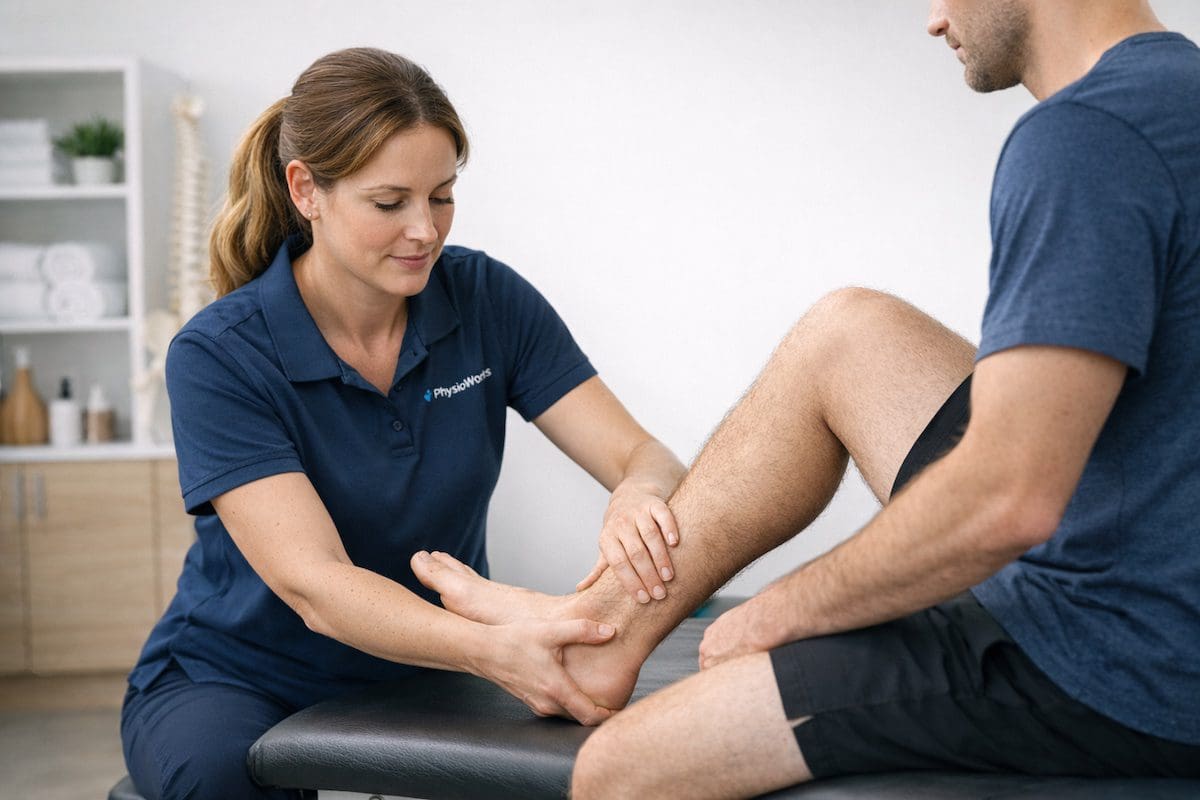
physiotherapist assessing ankle joint mobility with passive movement during ankle injury examination

Ankle joint assessment during physiotherapy


Common ankle ligament injuries usually happen when the foot rolls, twists, or lands awkwardly. The most common pattern is a lateral ankle sprain, which affects the ligaments on the outside of the ankle. A high ankle sprain affects the ligament system above the ankle joint and often takes longer to recover.

After a rolled ankle, early assessment can help separate a simple sprain from a more significant ligament injury, fracture concern, syndesmosis injury, or another cause of ongoing ankle pain. A clear diagnosis and staged rehabilitation may help reduce repeated sprains, stiffness, and long-term instability.


Common signs of ankle ligament injuries

  • pain after rolling, twisting, or landing awkwardly
  • swelling or bruising around the ankle
  • pain with walking, stairs, running, or sport
  • tenderness over the outside or inside ankle ligaments
  • a feeling that the ankle may give way
  • pain higher above the ankle in some sprains


What are common ankle ligament injuries?

Common ankle ligament injuries affect the strong bands of tissue that help stabilise the ankle during walking, landing, and change of direction. The most common injury is a lateral ankle sprain. This usually involves the anterior talofibular ligament, the calcaneofibular ligament, or both.

Less often, the deltoid ligament on the inside of the ankle is injured. A syndesmosis injury, often called a high ankle sprain, affects the ligaments between the tibia and fibula above the ankle joint.

  • Lateral ligament injuries: usually occur when the foot rolls inwards and stresses the outer ankle.
  • Deltoid ligament injuries: affect the inner ankle and can occur with a stronger twisting injury.
  • Syndesmosis injuries: involve the ligaments above the ankle joint and often feel worse with twisting or pushing off.

Which ankle ligaments are most often injured?

The anterior talofibular ligament is the most commonly injured ankle ligament. It often gets injured first during a lateral ankle sprain, especially when the foot points down and rolls in. With more force, the calcaneofibular ligament may also be injured. The posterior talofibular ligament is less commonly injured.

Ankle anatomy in simple terms

The main ankle joint joins the tibia, fibula, and talus. Below it sits the subtalar joint, which helps the foot adapt to uneven ground. Ligaments connect these bones and help stop excessive movement, especially during walking, landing, cutting, and sport.

What causes common ankle ligament injuries?

Most ankle ligament injuries happen after a twist, roll, awkward landing, sudden change of direction, or contact in sport. Previous sprains, reduced ankle strength, poor balance, and returning to sport too early can all increase your risk. If the ankle stays painful or unstable, related problems such as anterior ankle impingement or a repeat sprained ankle may also need review.

How do you know whether it is a low or high ankle sprain?

A low ankle sprain usually causes pain and swelling around the outside of the ankle. A high ankle sprain often causes pain above the ankle joint, especially with twisting, walking, cutting, or pushing off. High ankle sprains can take longer to recover because the syndesmosis helps control the joint between the lower leg bones.

Low vs high ankle sprain

  • Low ankle sprain: pain and swelling usually sit around the outside ankle ligaments.
  • High ankle sprain: pain often sits higher above the ankle and may worsen with twisting.
  • Recovery: high ankle sprains often need a slower and more careful return to running or sport.

What symptoms suggest an ankle ligament injury?

Symptoms depend on which ligament is involved and how severe the injury is. Mild sprains may mainly cause local tenderness and swelling. More severe injuries can make weight-bearing difficult and leave the ankle feeling unstable.

  • pain on the outside or inside of the ankle
  • swelling and bruising
  • pain with walking, running, jumping, or stairs
  • tenderness over the injured ligament
  • a feeling that the ankle may give way
  • pain higher above the ankle in syndesmosis injuries

How are common ankle ligament injuries diagnosed?

A physiotherapist will usually assess how the injury happened, where your pain sits, how much swelling you have, and whether you can walk. They may test ligament tenderness, ankle movement, loading tolerance, balance, and functional control. If your symptoms suggest a fracture, severe syndesmosis injury, or another structural problem, imaging may be recommended.

If you want broad public-health advice on early care, Healthdirect’s guide to sprained ankle management is a useful reference.



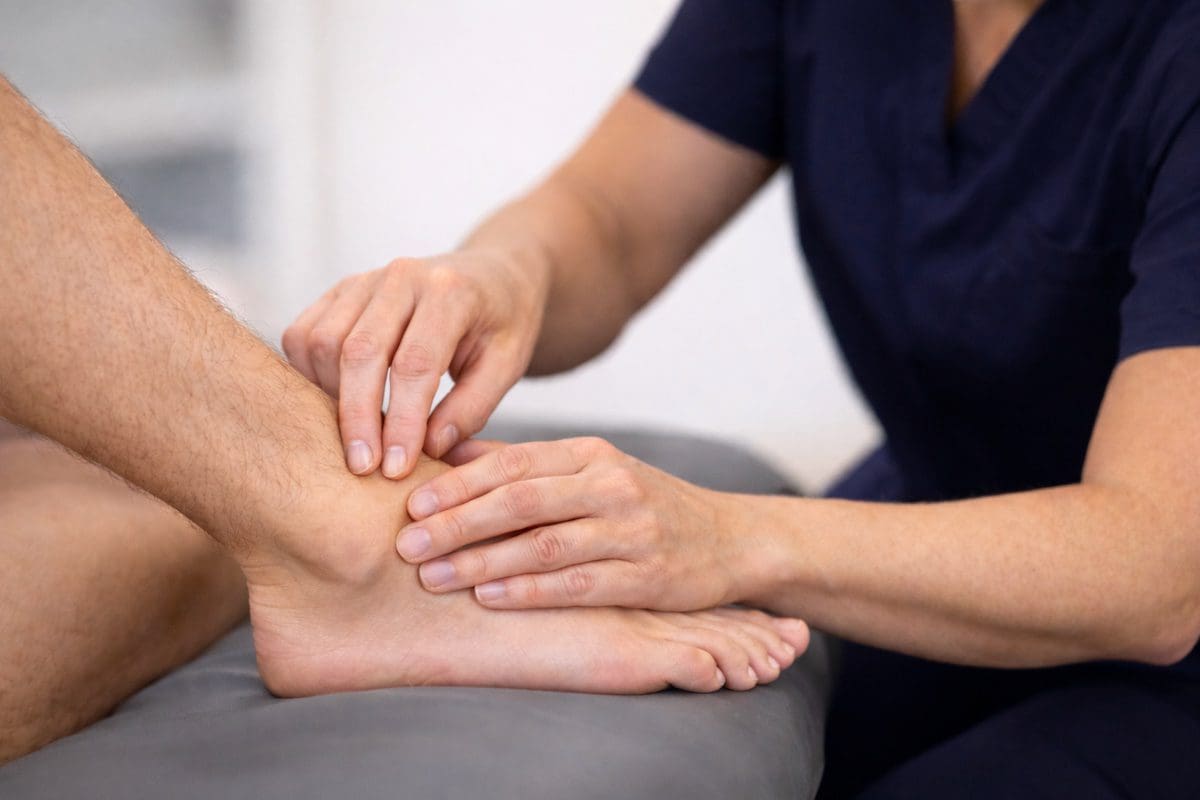

Lateral ankle ligament assessment with physiotherapist palpating anterior talofibular ligament

Lateral ankle ligament assessment


Why are ankle ligament injuries sometimes missed?

Ankle ligament injuries can overlap with fractures, tendon injuries, joint impingement, cartilage irritation, or syndesmosis injuries. A high ankle sprain may be missed when every rolled ankle is treated as a simple lateral sprain.

Ongoing pain after an apparently simple sprain may also point to a ligament tear, persistent instability, or another ankle diagnosis that needs more specific rehabilitation.

How can physiotherapy help ankle ligament injuries?

Physiotherapy for ankle ligament injuries usually starts by calming pain and swelling, protecting the ankle where needed, and helping you regain comfortable walking. Rehabilitation then progresses to mobility, calf and ankle strength, balance, landing control, and sport-specific loading.

Early stage focus

Early rehabilitation usually focuses on settling pain and swelling, restoring safe weight-bearing, and regaining comfortable ankle movement. Advice on load, strapping, bracing, footwear, or walking support may also help during this phase.

Progressive rehab focus

As symptoms improve, rehabilitation shifts toward calf and ankle strength, balance, direction-change control, landing mechanics, and graded return to running or sport. This matters because pain can settle before ankle control has fully recovered.


Concussion return to sport balance test performed by athlete with physiotherapist assessment

Balance training to improve ankle stability


Typical physiotherapy treatment may include

  • advice on early load modification and safe activity
  • manual therapy where stiffness limits motion
  • ankle and calf strengthening
  • balance and proprioception training
  • strapping or bracing advice when appropriate
  • graded return-to-running or return-to-sport planning

Why do ankle sprains keep recurring?

Ankle sprains often recur when swelling settles but strength, balance, and landing control have not fully returned. Some people regain walking before they regain ankle stability. This can increase the risk of rolling the ankle again during sport, uneven-ground walking, or fast direction changes.

How does balance training help reduce reinjury risk?

Balance training helps your ankle respond faster to sudden movement. It also improves control through the foot, calf, and lower leg. This type of rehabilitation is useful after lateral ankle sprains because it may reduce repeated giving way, improve confidence, and support a safer return to activity.

When should you seek help for an ankle ligament injury?

You should get your ankle assessed if you cannot comfortably take a few steps, swelling is severe, pain sits high above the ankle, the ankle keeps giving way, or symptoms are not improving over the first week. Repeated sprains also deserve review because ongoing instability can affect sport, work, and confidence with walking.

Related ankle injury pages

FAQs about common ankle ligament injuries

What is the most common ankle ligament injury?

The most common ankle ligament injury is a lateral ankle sprain. It usually affects the anterior talofibular ligament on the outside of the ankle.

How long do ankle ligament injuries take to heal?

Mild injuries may improve over a few weeks. More significant sprains and high ankle sprains often take longer. Recovery depends on swelling, pain, stability, walking tolerance, and whether strength and balance return properly.

Can you walk on a torn ankle ligament?

Sometimes you can walk with a torn or stretched ankle ligament, especially with a mild or moderate sprain. However, pain, swelling, and instability may still mean the ankle needs assessment and a graded recovery plan.

What is the difference between a low and high ankle sprain?

A low ankle sprain affects the ligaments around the outside of the ankle joint. A high ankle sprain affects the ligaments between the tibia and fibula above the ankle and often causes pain higher up.

Do ankle ligament injuries heal without surgery?

Many ankle ligament injuries improve without surgery. Assessment, appropriate protection, and progressive rehabilitation are often used first. Surgery is usually considered only for selected severe injuries or persistent instability that has not improved with conservative care.

Why does my ankle keep rolling after a sprain?

Repeated rolling can happen when strength, balance, landing control, or confidence have not fully returned. Persistent giving way after a sprain should be reassessed.


Running during football after ankle injury recovery with physiotherapist observing progress

Return to running after ankle rehabilitation


What to do next

If you think you have injured your ankle ligaments, book an assessment to clarify whether it is a simple lateral sprain, a high ankle sprain, or another ankle injury. A physiotherapist can guide pain control, movement, strength, balance, and your safe return to work, walking, exercise, or sport.


Book your appointment – 24/7

Select your preferred PhysioWorks clinic to book online or call.


Ankle Products

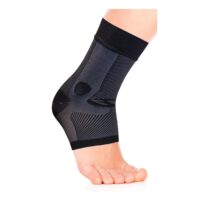
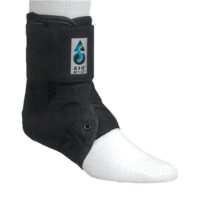
These ankle products are commonly used by our physiotherapists to improve ankle pain, strength, balance, proprioception, endurance and flexibility, plus assist home exercise programs.

View all ankle products


Follow PhysioWorks

Get free physiotherapy tips, exercise videos, recovery advice, and blog updates.

Facebook Instagram YouTube B X Email PhysioWorks


References

  1. Martin RL, Davenport TE, Fraser JJ, et al. Lateral ankle ligament sprains: revision 2021. J Orthop Sports Phys Ther. 2021;51(4):CPG1-CPG80. doi:10.2519/jospt.2021.0302
  2. Wagemans J, Bleakley C, Taeymans J, Schurz AP, Kuppens K, et al. Exercise-based rehabilitation reduces reinjury following acute lateral ankle sprain: a systematic review update with meta-analysis. PLoS One. 2022;17(2):e0262023. doi:10.1371/journal.pone.0262023
  3. Guo Y, Cheng T, Yang Z, Huang Y, Li M, Wang T. A systematic review and meta-analysis of balance training in patients with chronic ankle instability. Syst Rev. 2024;13(1):64. doi:10.1186/s13643-024-02455-x
  4. Melanson SW, Shuman VL. Acute Ankle Sprain. In: StatPearls [Internet]. Treasure Island (FL): StatPearls Publishing; 2026.


You've just added this product to the cart: