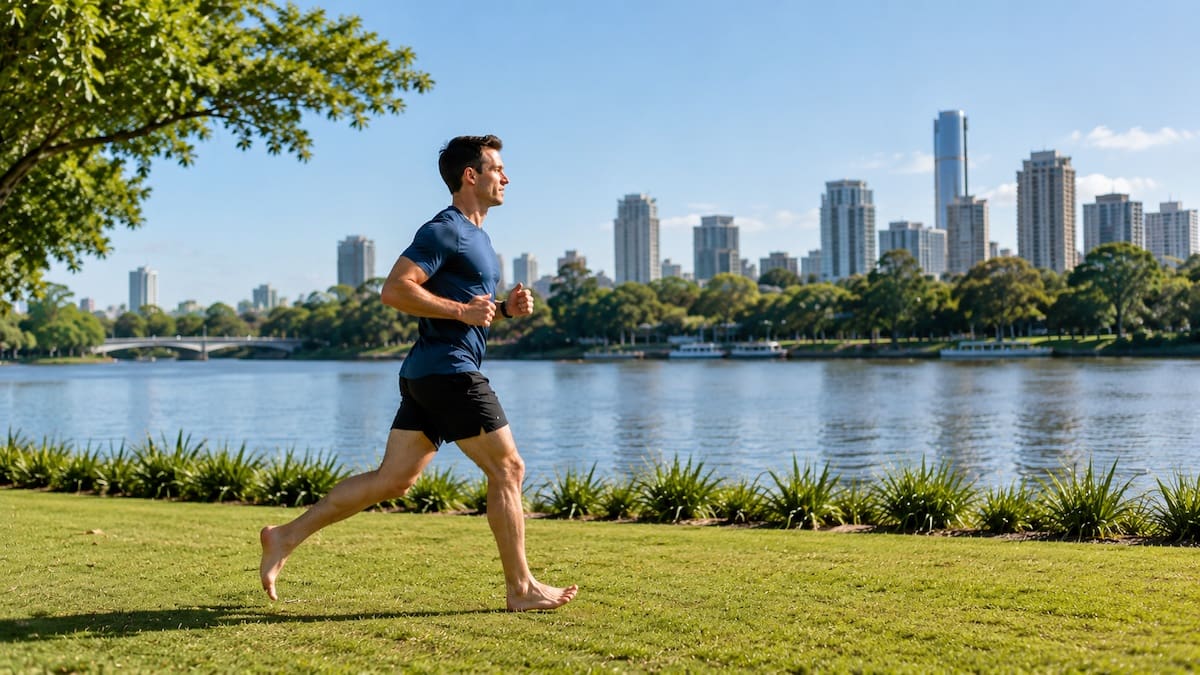
Barefoot running means running without shoes. Minimalist running uses shoes with little cushioning or support. Both can change how the feet and legs absorb running loads. However, neither has been shown to prevent running injuries overall.
Barefoot running changes how load is distributed through the feet, calves and Achilles tendons.
Barefoot running means running without shoes. Minimalist running involves shoes with little cushioning, a low heel-to-toe difference and fewer support features than conventional running shoes.
People often discuss these approaches together because both can influence running mechanics. However, minimalist footwear still provides some protection and does not reproduce every feature of completely barefoot running.
Removing conventional shoes changes the feedback your feet receive from the ground. This may influence:
stride length and running cadence;
how your foot contacts the ground;
calf and Achilles tendon loading;
pressure beneath the forefoot; and
how forces are distributed through the legs.
Not everyone responds in the same way. Some runners naturally shorten their stride or land closer to the middle or front of the foot. Others continue to land on their heels.
There is no need to force a particular foot-strike pattern simply because you are running barefoot.
Is Barefoot Running Better Than Running in Shoes?
Neither approach is universally better. Conventional running shoes and barefoot running change how forces move through the body.
Barefoot running
May increase sensory feedback and encourage shorter steps. However, it can increase loading through the calf, Achilles tendon and forefoot.
Conventional running shoes
Provide cushioning and protection from the surface. They can influence comfort and load distribution but cannot eliminate running-injury risk.
What matters most
Training load, recovery, strength, previous injuries, running surfaces and the size of any change all influence how well you tolerate running.
If you already run comfortably in conventional footwear, there is no proven injury-prevention reason to switch.
You may still prefer barefoot or minimalist running for personal reasons. Any change should suit your training history, symptoms and goals.
How Does Barefoot Running Change Your Loading?
Running creates forces whether you wear shoes or not. The important question is how these forces are distributed and whether your muscles, tendons and bones can tolerate them.
Calf Muscles and Achilles Tendon
Moving towards a forefoot landing may increase the work performed by the calf muscles and Achilles tendon.
This change can be challenging if you have not trained these tissues for the increased demand. It may be particularly relevant if you already experience Achilles pain or persistent calf tightness.
Forefoot and Metatarsals
Forefoot landing patterns and minimalist footwear may increase demands on the bones and soft tissues beneath the front of the foot.
If loading increases too quickly, some runners develop forefoot pain or bone stress reactions. Localised bone pain requires particular caution.
Knee and Hip
Some forefoot-strike running patterns reduce certain knee-loading measures compared with rearfoot striking.
However, these changes often shift more work towards the ankle and calf. Lower loading at one joint does not automatically mean a lower overall injury risk.
What Does Recent Research Show?
A 2026 randomised controlled trial involving 140 recreational runners compared minimalist footwear, running retraining and a control programme.
The researchers found no significant difference in overall running-injury incidence between groups. However, injury location differed, particularly among runners who completed the running-retraining programme.
A systematic review and meta-analysis published online in August 2026 examined injury risk during the transition to minimalist footwear. It reported a moderate increase in musculoskeletal injury prevalence compared with conventional footwear, including problems affecting the forefoot, Achilles tendon and calf.
The findings support a cautious, structured transition when changing footwear or running technique. However, much of the available research concerns minimalist footwear rather than completely barefoot running.
The main message: barefoot and minimalist running redistribute load. They have not been shown to prevent running injuries overall.
Who Might Consider Trying Barefoot Running?
Barefoot running may interest people who enjoy experimenting with running technique, prefer less structured footwear or want to experience different sensations while running.
A cautious trial may be reasonable if you:
currently run without significant pain;
can reduce your usual training load during the transition;
have access to a smooth, clean and predictable surface;
understand the importance of monitoring soreness; and
are comfortable returning to conventional shoes if symptoms develop.
There is no need to become a full-time barefoot runner. Some people use brief barefoot sessions while completing most of their running in conventional shoes.
When Should You Get Advice Before Trying Barefoot Running?
Some health conditions and injury histories make a major footwear change less suitable without individual assessment.
Seek professional advice before changing your running style if you have:
current Achilles tendon pain or persistent morning stiffness;
calf pain or a recent calf strain;
plantar heel pain or recurring foot pain;
forefoot pain or a previous bone stress injury;
reduced sensation in your feet, including diabetic neuropathy;
impaired circulation, foot wounds or a history of foot ulcers;
a recent lower-limb injury; or
pain that already changes your running stride.
How Can You Transition to Barefoot Running?
Introduce barefoot running gradually. Your feet, calves and Achilles tendons need time to adapt to unfamiliar loading.
There is no single timetable that suits every runner. The following progression provides a practical starting framework.
Start With Comfortable Walking
Try short periods of barefoot walking on a smooth, clean and safe surface. Monitor your feet, calves and Achilles tendons later that day and the following morning.
Introduce a Very Short Running Exposure
Once walking feels comfortable, try a brief, easy barefoot running interval. Continue using your usual shoes for most of your running. Avoid hills, speed work and rough surfaces initially.
Change One Variable at a Time
Do not increase barefoot duration, speed, hills and weekly running distance together. Keep the rest of your training predictable while your tissues adapt.
Check Your Next-Day Response
Mild unfamiliar muscle soreness may occur. However, increasing Achilles stiffness, localised forefoot pain or discomfort that changes your walking suggests the exposure was too high.
Progress Only After a Stable Response
Repeat a tolerable exposure before increasing it. Do not progress simply because a set number of days has passed. Increase gradually when the current exposure is comfortable and your next-day response remains stable.
A complete transition may take several months, particularly if you have been using highly cushioned footwear or are making a substantial change in running mechanics.
Supporting your training with appropriate calf strengthening, foot exercises and lower-limb conditioning may help build capacity for unfamiliar loads.
Importantly, no exercise programme can guarantee that you will avoid injury.
Should You Change Your Foot Strike?
You do not need to force a forefoot landing to run barefoot.
Some runners naturally move from a heel-first strike towards a midfoot or forefoot landing when changing footwear.
However, deliberately forcing an exaggerated forefoot strike can increase loading through the calf, Achilles tendon and forefoot.
A relaxed, comfortable stride is generally a more useful starting point than trying to copy one supposedly ideal running technique.
Other factors, including overstriding, cadence, speed, hills and fatigue, may influence your running mechanics.
If you experience recurring pain or remain unsure about your technique, a running assessment can help determine whether an individual change may be worthwhile.
Signs You May Be Progressing Too Quickly
Some mild, short-lived muscle soreness can occur when you introduce unfamiliar activity. However, symptoms should not progressively worsen as you repeat your sessions.
Watch for:
calf soreness that increases with each run;
Achilles pain or morning stiffness that continues to build;
sharp or bruised discomfort beneath the forefoot;
localised tenderness over a metatarsal bone;
new plantar heel or arch pain;
blisters, skin damage or numbness;
pain that causes limping or a protective stride; or
symptoms that remain noticeably worse after each exposure.
If these symptoms appear, reduce or pause barefoot running. Return to comfortable footwear and a tolerable level of activity while symptoms settle.
Persistent or worsening symptoms should be assessed rather than repeatedly tested through further running.
When Should You Have a Running Assessment?
A physiotherapy running assessment may help if pain keeps returning, you are uncertain how to progress or changing your footwear has not improved your symptoms.
Your physiotherapist may review:
recent and longer-term training load;
foot, calf, hip and lower-limb strength;
ankle and big-toe mobility;
running cadence, stride and foot-strike characteristics;
current footwear and running surfaces;
previous injuries and current symptoms; and
an appropriate strengthening and return-to-running plan.
The goal is not simply to make your running technique look different. Assessment helps identify factors that may influence your symptoms and which changes are worth considering.
Barefoot running is an option, not a requirement. Some runners enjoy it, while others remain more comfortable in conventional footwear.
Current evidence does not establish barefoot or minimalist running as a reliable way to prevent running injuries overall.
Changing your footwear or running pattern shifts load between different tissues. Your ability to adapt depends on your training history, strength, symptoms and rate of progression.
If you choose to experiment, start with short exposures, monitor your next-day response and remain flexible about your footwear choices.
When pain persists or you are unsure where to begin, a physiotherapist can help assess your situation and plan a suitable next step.
Abran G, Schwartz C, Dardenne N, Delvaux F, Croisier JL. Minimalist footwear and softer running technique alter injury location but not incidence in recreational endurance runners. American Journal of Sports Medicine. 2026;54(1):109–117. View the randomised controlled trial.
Sánchez-Del Río E, Galán-Arriero I, Palomo-Fernández I, Marcos-Tejedor F, Martín-Casado L. Injury risk associated with the transition to minimalist footwear in runners: A systematic review and meta-analysis. Gait & Posture. 2027;131:110614. Published online August 2026. View the systematic review.
Zhang X, Deng L, Yang Y, Xiao S, Li L, Fu W. Effects of 12-week transition training with minimalist shoes on Achilles tendon loading in habitual rearfoot strike runners. Journal of Biomechanics. 2021;128:110807. View the study.
Johnson CD, Davis IS. What differentiates rearfoot strike runners with low and high vertical load rates? Gait & Posture. 2022;96:149–153. View the study.
Woodard CE. A correlational analysis of reported injury incidence between barefoot and shod runners. Journal of Sports Medicine and Physical Fitness. 2026;66(2):272–279. View the study.
Barefoot Running FAQs
Is barefoot running good for you?
Barefoot running may suit some runners, but it is not automatically healthier or safer than running in shoes. It redistributes load through the feet and legs. Your response depends on training history, strength, symptoms and how gradually you adapt.
Does barefoot running reduce running injuries?
Research has not established that barefoot running reduces overall running-injury rates. Studies of minimalist footwear show changes in running mechanics and injury location, but rapid transitions may increase calf, Achilles tendon and forefoot problems.
Who should avoid barefoot running?
People with active foot, calf or Achilles pain, suspected bone stress injury, reduced foot sensation, impaired circulation or foot wounds should seek advice before attempting a major footwear change. Individual assessment can help determine suitability.
How should I transition to barefoot running?
Begin with comfortable barefoot walking on a suitable surface. Introduce very short, easy running exposures once walking feels comfortable. Keep most running in your usual shoes initially, increase gradually and monitor symptoms later that day and the following morning.
What injuries can occur during a barefoot running transition?
Potential problems include calf soreness or strain, Achilles tendinopathy, plantar heel pain, forefoot pain, blisters and bone stress injuries. These may occur when unfamiliar running loads increase faster than your tissues can adapt.
Do I need to land on my forefoot when running barefoot?
No. You should not force an exaggerated forefoot landing. Some runners naturally change their foot strike when running barefoot, but deliberately adopting a new pattern may increase calf, Achilles tendon and forefoot loading.
Can I combine barefoot running with normal running shoes?
Yes. Some runners use brief barefoot sessions as a training variation while completing most running in conventional shoes. Keep the exposure small enough to avoid increasing symptoms or disrupting normal training.