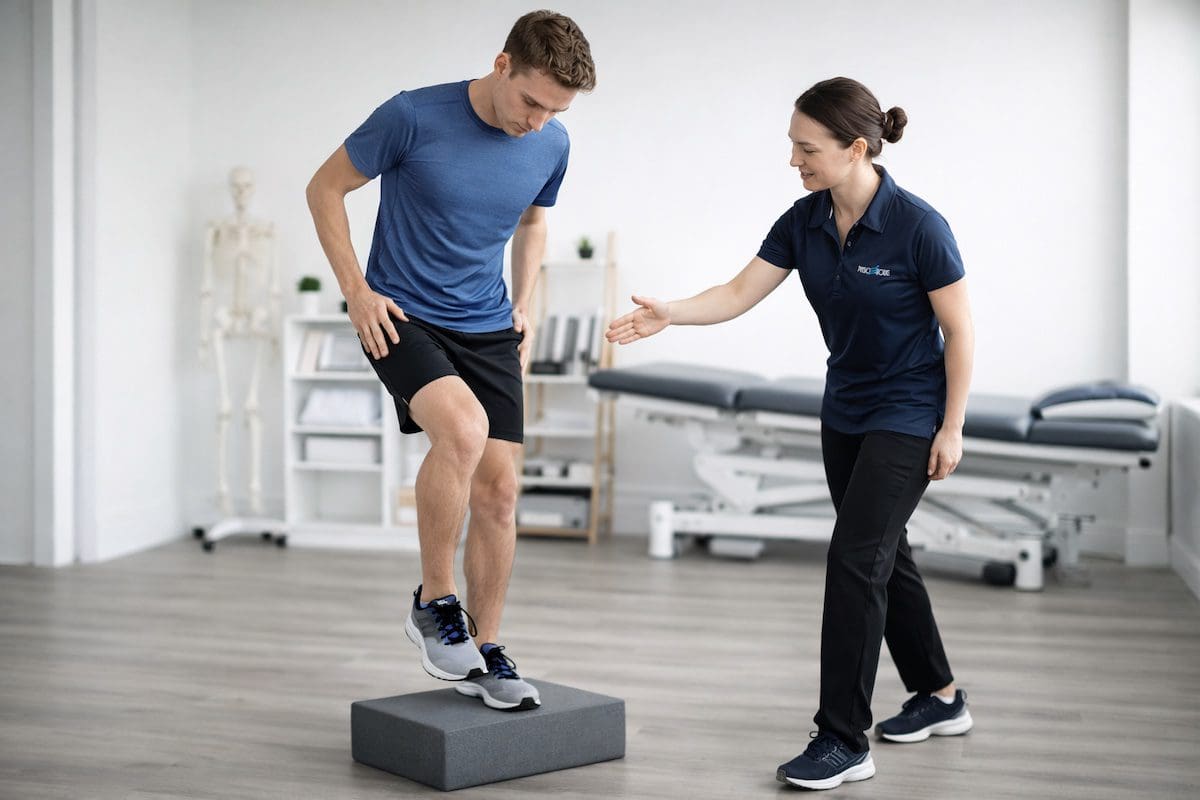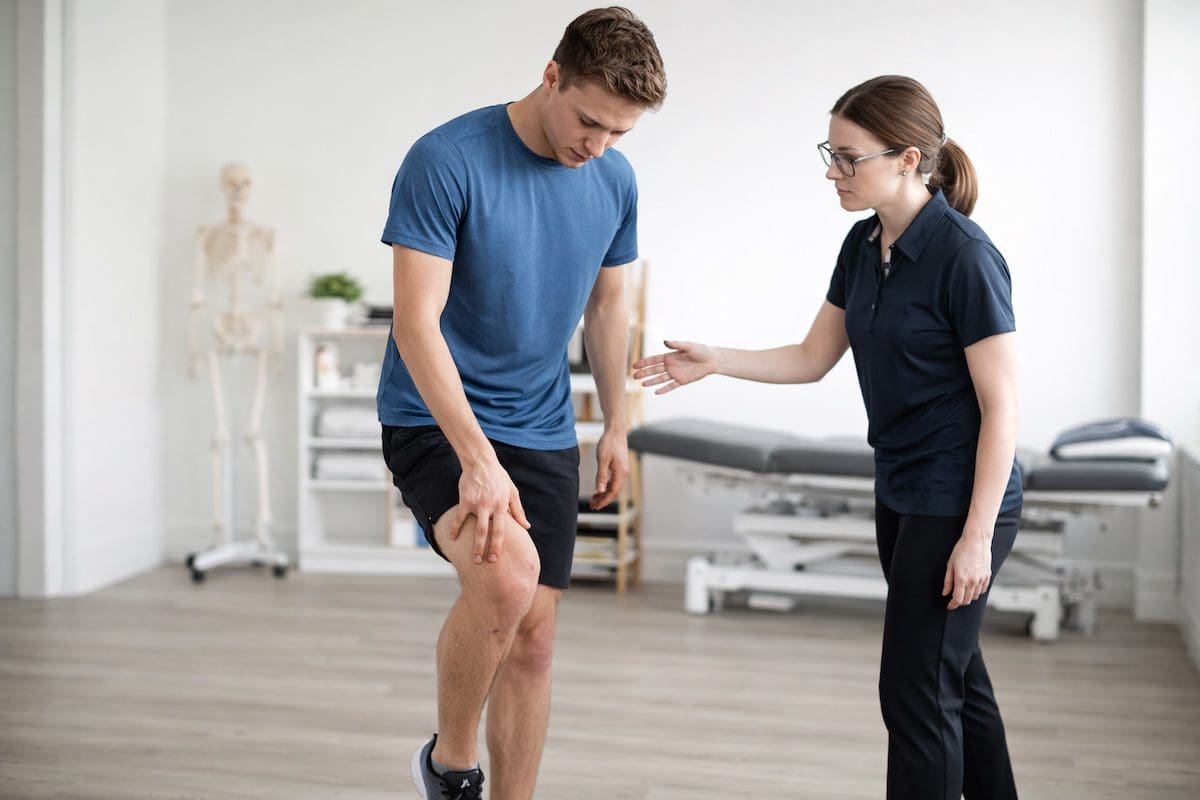
Running injuries most often affect the knee, shin, Achilles tendon, calf, foot and hip. Many develop gradually when a recent running demand exceeds the capacity of a muscle, tendon, joint or bone.
Common pattern
Pain builds during a run, appears afterwards or feels worse the next morning.
Important clue
Symptoms often follow a change in distance, speed, hills, frequency, surface or recovery.
Seek assessment
Book earlier when pain changes your stride, causes limping or becomes sharp and localised.
Which running injuries are most common?
Running-related injuries can affect muscles, tendons, joints, bones and other supporting tissues. Some start suddenly, such as an ankle sprain or calf strain. However, many build over several runs as repeated loading exceeds the tissue’s current capacity.
The eight conditions below account for many of the knee, shin, calf, heel, foot and thigh symptoms reported by recreational runners.
Runner’s knee
Pain around or behind the kneecap. It commonly becomes noticeable during hills, stairs, squats or longer runs.
Shin splints
A broader area of exercise-related pain along the shin. Symptoms often follow a change in impact load or training volume.
Achilles tendinopathy
Pain and stiffness around the Achilles tendon. Morning stiffness and discomfort at the start of running are common features.
Plantar fasciopathy
Pain under the heel or arch. The first steps after rest may feel uncomfortable before symptoms ease with movement.
ITB syndrome
Pain around the outside of the knee. It may appear at a similar point during each run, particularly on hills.
Calf strain
A sudden or gradually worsening pain in the calf. Faster running, sprinting and hills can increase calf demand.
Hamstring injury
Pain at the back of the thigh or near the sitting bone. Symptoms may affect faster running, acceleration and longer strides.
Bone stress injury
Focal bone pain that may progress from running pain to discomfort with hopping, walking or normal daily activity.
Where do runners commonly feel pain?
Front or outside of the knee
Front-of-knee pain may relate to runner’s knee, also called patellofemoral pain. Symptoms often become noticeable during downhill running, stairs, squats or after sitting with the knee bent.
Pain on the outside of the knee may fit an iliotibial band presentation. However, several knee structures can cause pain in a similar area. The location alone does not confirm a diagnosis.
Along the shin
A broad area of tenderness along the inner shin often fits shin splints. By contrast, a small and sharply localised painful area raises more concern about a bone stress injury.
Shin pain warrants earlier assessment when hopping is painful, symptoms persist after exercise or discomfort begins affecting walking.
Behind the ankle or in the calf
Achilles tendinopathy commonly causes pain, stiffness or thickening around the tendon. Symptoms may feel worse during the first steps in the morning or when beginning a run.
A calf strain is more likely when pain starts suddenly during acceleration, hills or faster running. Significant weakness, swelling or difficulty pushing through the foot requires prompt assessment.
Under the heel or through the foot
Plantar fasciopathy often causes pain under the heel, particularly during the first few steps after getting out of bed or standing after rest.
Forefoot pain has several possible causes, including metatarsal overload, nerve irritation and bone stress. Persistent focal pain should not be managed simply by continuing to run through it.
At the hip, groin or back of the thigh
Hip and thigh symptoms may involve the gluteal tendons, hamstrings, hip joint or surrounding muscles. Proximal hamstring symptoms often sit close to the lower buttock and may become uncomfortable during faster running or prolonged sitting.
Groin pain has several possible sources. Assessment becomes more important when pain persists, affects walking or does not settle after a reasonable reduction in training.
Why do running injuries happen?
Running injuries rarely have one isolated cause. Instead, they usually reflect an interaction between recent training, previous injuries, recovery, health, tissue capacity and the demands of the runner’s chosen pace, terrain and distance.
Common contributing factors may include:
- A longer individual run than your body has recently tolerated
- Adding speed, hills and distance within the same training period
- Returning quickly after illness, injury or a break from running
- Insufficient recovery between demanding sessions
- Reduced calf, thigh, hip or trunk capacity
- A previous injury that has not regained full strength or running tolerance
- A sudden change in shoes, running surface or training environment