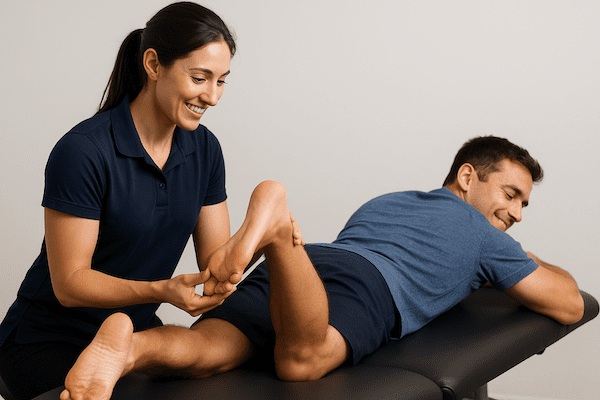
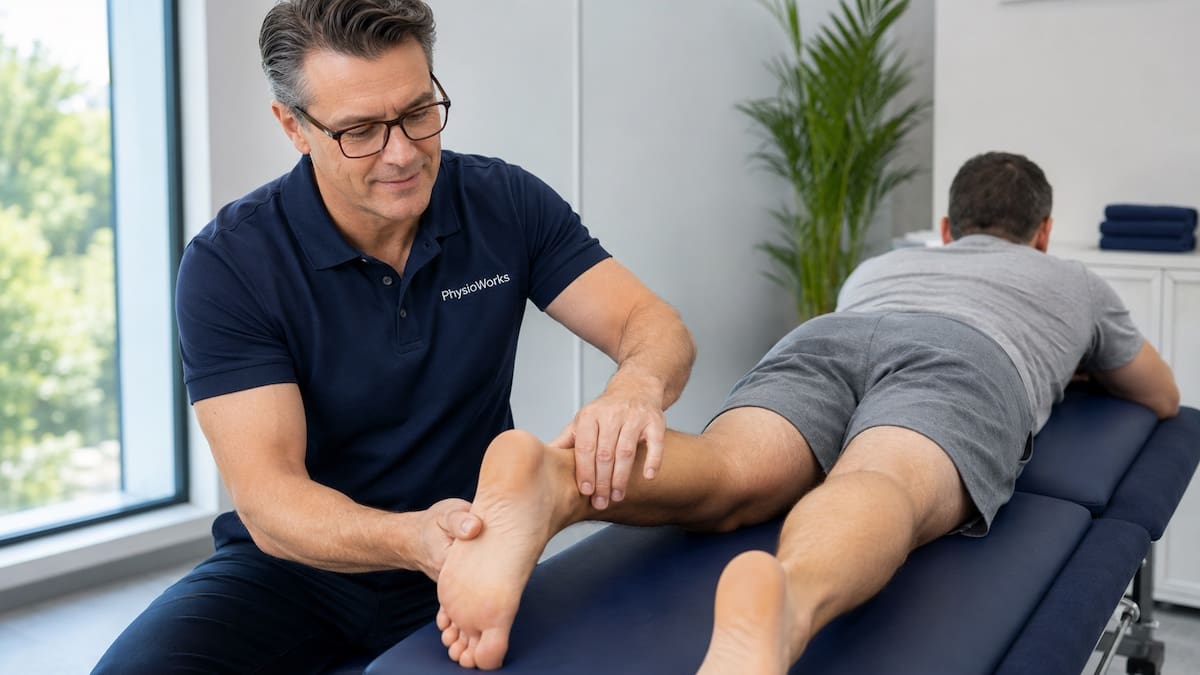
Achilles assessment considers the exact pain location, tendon response and nearby heel structures.
Achilles enthesopathy affects the Achilles tendon attachment at the heel, while mid-portion Achilles tendinopathy affects the tendon higher above the heel. This difference matters because insertional symptoms are often more sensitive to compression, particularly when the ankle moves into deeper dorsiflexion.
Both presentations can cause Achilles pain, morning stiffness and reduced tolerance for walking, running or sport. However, their early rehabilitation may need to start differently.
Insertional pain
Pain is focused at the Achilles attachment on the back of the heel.
Mid-portion pain
Pain is usually felt through the tendon body several centimetres above the heel.
Why it matters
Insertional symptoms may be aggravated by compression from deep ankle dorsiflexion, stretching or heel-drop exercises below step level.
What Is the Difference Between Achilles Enthesopathy and Achilles Tendinopathy?
The main difference is where the symptoms occur.
The enthesis is the area where the Achilles tendon attaches to the calcaneus, or heel bone. Pain and tendon change in this region may be described as Achilles enthesopathy or insertional Achilles tendinopathy.
Mid-portion Achilles tendinopathy affects the tendon body higher above the heel, commonly around 2–6 cm from the insertion.
Insertional Achilles pain
Pain sits at the heel attachment. Compression between the tendon and heel bone can contribute to symptoms, particularly in deeper ankle dorsiflexion.
Mid-portion Achilles pain
Pain sits higher in the tendon body. Repeated tendon loading during running, hopping, jumping and push-off is commonly provocative.
Key Differences at a Glance
Achilles enthesopathy / insertional tendinopathy
Pain location: directly at the back of the heel where the Achilles attaches.
Common aggravators: hills, deep ankle bending, aggressive calf stretching, heel-drop exercises below step level and pressure from firm footwear.
Early rehabilitation: reduce excessive compression while maintaining appropriate tendon loading, then progressively restore strength and range.
Mid-portion Achilles tendinopathy
Pain location: usually several centimetres above the heel.
Common aggravators: running, jumping, hopping, repeated calf work, sprinting and hard push-off.
Early rehabilitation: progressive calf and Achilles loading matched to symptoms, strength and activity goals.
What Is Achilles Enthesopathy?
Achilles enthesopathy describes a problem involving the tendon attachment at the back of the heel. In clinical practice, symptomatic tendon change in this area often overlaps with the term insertional Achilles tendinopathy.
The insertion is exposed to both tendon tension and compression against the heel bone. Symptoms can therefore increase when the ankle moves into deeper dorsiflexion, such as during uphill walking, deep calf stretching or calf raises performed with the heel dropping below a step.
Some people also have irritation of the bursa between the Achilles tendon and heel or a nearby bony prominence. This is one reason retrocalcaneal bursitis can feel similar to insertional Achilles tendon pain.
What Is Mid-Portion Achilles Tendinopathy?
Achilles tendinopathy can also affect the tendon body above the heel. This is called mid-portion Achilles tendinopathy.
Symptoms commonly include local tendon pain, morning stiffness, tenderness and reduced tolerance for running, jumping, hills, stairs or repeated calf loading. The tendon may also feel thicker than the other side.
A training increase, return to sport, extra hill work, faster running, increased jumping or reduced calf capacity can contribute when the tendon is exposed to more load than it currently tolerates.
What Symptoms Help Tell Them Apart?
The exact location of pain often provides the clearest clue.
Insertional pain: tenderness is directly at or very close to the heel attachment.
Mid-portion pain: tenderness usually sits several centimetres above the heel.
Morning stiffness: may occur with either presentation.
Running and hopping pain: may occur with either presentation as tendon load rises.
Deep ankle dorsiflexion pain: is particularly relevant when insertional compression contributes.
Tendon thickening: may occur, but its presence does not determine pain severity on its own.
Broader heel pain and calf pain can come from several structures, so pain location alone does not confirm the diagnosis.
How Are Achilles Enthesopathy and Tendinopathy Assessed?
A physiotherapist will usually combine your symptom history with an examination of the Achilles tendon and surrounding structures.
Assessment may include:
the exact location and behaviour of your pain
Achilles and heel tenderness
ankle movement and symptom response to dorsiflexion
single-leg calf raise strength and endurance
walking, stair, hopping or running tolerance
recent changes in training, work or activity load
footwear and heel-counter pressure
comparison with the other side where useful
Ultrasound or MRI may help when symptoms remain unclear, behave unusually or fail to improve as expected. Imaging is not always necessary because tendon changes seen on scans do not always match a person’s symptoms.
What Else Can Cause Pain at the Back of the Heel?
Not all posterior heel pain is Achilles tendinopathy. Other possibilities include retrocalcaneal bursitis, calf injury, bone or joint problems, referred pain and inflammatory conditions.
A sudden loss of Achilles function requires assessment for a possible tendon rupture.
Why Does Compression Matter for Insertional Achilles Pain?
When the ankle bends upwards, the Achilles insertion can be compressed against the heel bone. That compression is particularly relevant in insertional Achilles tendinopathy.
A 2025 randomised clinical trial compared rehabilitation with lower versus higher Achilles tendon compression. The lower-compression program limited dorsiflexion during exercise, avoided calf stretching and used heel lifts. It produced greater improvements in Achilles symptoms and function over 12 and 24 weeks.
This does not mean the tendon should avoid loading. Instead, it supports choosing an appropriate starting range and gradually increasing tendon demand as symptoms and capacity improve.
Should You Stretch Insertional Achilles Tendinopathy?
Aggressive calf stretching is often unhelpful during an irritable insertional presentation because deeper dorsiflexion can increase compression at the tendon attachment.
Similarly, traditional heel-drop exercises performed with the heel descending below a step may not be the best starting exercise for an irritable Achilles insertion.
Early strengthening can instead begin through a more comfortable ankle range. More dorsiflexion can be reintroduced progressively when appropriate.
Mid-portion Achilles tendinopathy may tolerate a broader movement range, although exercise selection should still reflect pain, strength and individual response.
How Is Achilles Enthesopathy Treated?
Insertional Achilles rehabilitation usually aims to maintain useful activity while reducing the most provocative compression and rebuilding tendon capacity.
A rehabilitation plan may include:
temporarily reducing steep hills, jumping or other provocative loads
adjusting shoes that press directly on the painful heel
avoiding aggressive calf stretching during an irritable stage
calf strengthening that initially avoids excessive dorsiflexion
temporary heel elevation when clinically appropriate
progressive restoration of calf strength and endurance
gradual return to walking, running, jumping or sport demands
A temporary heel lift may reduce insertional compression for some people. However, footwear, comfort, movement and individual response should be considered rather than assuming heel lifts suit everyone.
How Is Mid-Portion Achilles Tendinopathy Treated?
Progressive tendon loading is a central part of treatment for mid-portion Achilles tendinopathy. The exercise program may use controlled calf raises followed by progressively heavier, faster or more functional loading as tendon capacity improves.
The aim is not simply to make pain disappear during exercise. Rehabilitation should rebuild the strength and load tolerance needed for the person’s walking, work, running or sport demands.
Complete rest is not usually required for Achilles tendinopathy. Many people can remain active while temporarily modifying the activities that cause the largest symptom flare.
For runners, this may mean reducing hills, speed, distance, jumping or weekly frequency for a period rather than stopping all running automatically.
Pay attention to how the tendon responds during activity and later that day or the following morning. Increasing pain, limping or a persistent next-day flare may indicate that the current dose is too high.
When Should You See a Physiotherapist?
Consider a physiotherapy assessment when Achilles or heel pain is affecting walking, stairs, work, exercise, running or sport, particularly when symptoms persist or keep returning.
Understand tendon overload, reduced load tolerance and progressive rehabilitation.
Achilles Enthesopathy vs Achilles Tendinopathy FAQs
Is Achilles enthesopathy the same as insertional Achilles tendinopathy?
The terms overlap considerably. Achilles enthesopathy describes involvement of the tendon attachment or enthesis at the heel. Insertional Achilles tendinopathy describes symptomatic Achilles tendon pathology in the same insertional region. The exact diagnosis may depend on the clinical presentation and whether nearby structures are also involved.
Where does insertional Achilles tendinopathy hurt?
Insertional Achilles tendinopathy usually causes pain directly at the back of the heel where the Achilles tendon attaches to the calcaneus. Pressure from footwear, hills and deeper ankle dorsiflexion may aggravate symptoms.
How is mid-portion Achilles tendinopathy different?
Mid-portion Achilles tendinopathy usually causes pain several centimetres above the heel rather than directly at the tendon attachment. Repeated running, hopping, jumping and calf loading commonly provoke symptoms.
Should you stretch insertional Achilles tendinopathy?
Aggressive calf stretching may aggravate an irritable Achilles insertion because deeper ankle dorsiflexion increases tendon compression against the heel. Rehabilitation may initially use strengthening through a shallower range before gradually restoring more dorsiflexion.
Can heel lifts help insertional Achilles pain?
A temporary heel lift may help some people by reducing ankle dorsiflexion and compression at the Achilles insertion. It is not necessary for everyone, so footwear, comfort and response should guide its use.
Can you keep running with Achilles tendinopathy?
Many people can continue some running with suitable load modification. Distance, speed, hills and frequency may need temporary adjustment. Increasing pain, limping or a persistent next-day flare can indicate that the current running load is too high.
What to Do Next
If pain at the back of your heel is affecting walking, running, work or sport, identifying the exact pain location is a useful first step. A physiotherapist can assess whether your symptoms fit insertional Achilles tendinopathy, mid-portion Achilles tendinopathy, bursitis, rupture or another cause and then match rehabilitation to your presentation.
Choose your clinic and appointment pathway
Select a PhysioWorks clinic to continue to live booking, an appointment request or reception assistance.