AC Joint Pain – Acromioclavicular Joint
AC Joint Pain – Acromioclavicular Joint Sprain


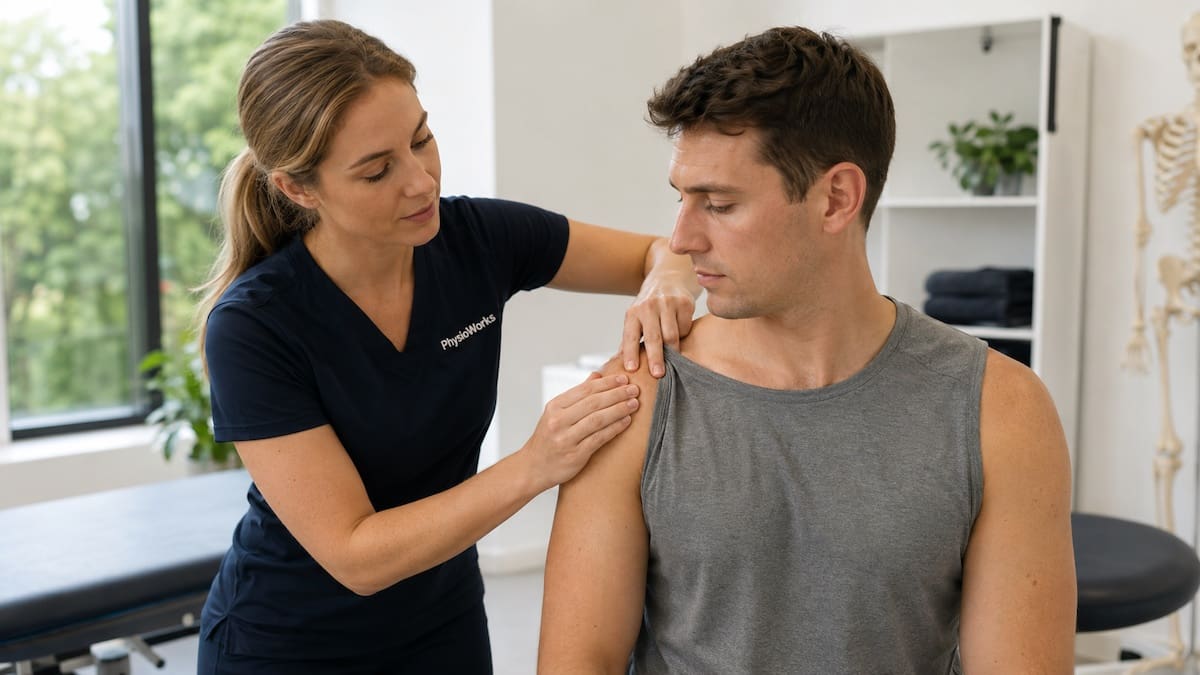
AC joint pain is often felt at the top of the shoulder where the collarbone meets the shoulder blade. An injury to this joint is called an acromioclavicular joint sprain or AC joint sprain. It is also commonly called a shoulder separation.
AC joint injuries often follow a fall or direct impact onto the shoulder. Symptoms can include local pain, swelling, pain reaching across the body, discomfort with pressing or lifting, and sometimes a visible bump at the end of the collarbone.
An AC joint sprain is different from a shoulder dislocation. This guide explains AC joint symptoms, injury severity, assessment, physiotherapy, rehabilitation and return to work, gym or sport.
If your symptoms are less specific, start with our shoulder pain guide.
When Should AC Joint Pain Be Assessed Urgently?
Seek prompt medical assessment after a significant fall, collision or other shoulder trauma if your symptoms suggest a more serious injury.
What Is the AC Joint?
The acromioclavicular joint sits at the top of your shoulder. It is the small joint where the clavicle, or collarbone, meets the acromion, which forms part of the shoulder blade.
The AC joint helps coordinate shoulder movement and transfers forces between the arm and the trunk. Several ligaments support the joint. An injury can stretch or tear these ligaments and may change the normal alignment of the joint.
Higher-grade injuries can create a visible bump where the end of the collarbone becomes more prominent.
How Do AC Joint Injuries Happen?
Most traumatic AC joint sprains occur when force is transmitted through the point of the shoulder. Common mechanisms include:
- falling directly onto the side or point of the shoulder;
- a tackle or collision during contact sport;
- a cycling or bike crash;
- a fall that transmits force through the arm and shoulder; and
- other high-load impacts to the shoulder girdle.
The severity of the injury depends on the direction and size of the force and how much ligament damage occurs.
What Are the Symptoms of an AC Joint Sprain?
Symptoms are usually concentrated around the top of the shoulder and the outer end of the collarbone.
- Pain at the top of the shoulder
- Tenderness over the AC joint
- Pain reaching across the body, such as reaching for a seatbelt
- Pain with pushing, pressing or lifting
- Pain with overhead activity
- Swelling or bruising after trauma
- Difficulty lying on the injured shoulder
- A visible bump or step in some higher-grade injuries
AC Joint Sprain or Shoulder Dislocation?
An AC joint sprain and a shoulder dislocation are different injuries.
An AC joint sprain affects the joint between the collarbone and shoulder blade. A shoulder dislocation occurs when the head of the upper arm bone comes out of the main shoulder socket.
Both injuries can follow significant trauma. If your shoulder looks out of place, movement is severely restricted, or you are unsure which injury has occurred, seek medical assessment.
How Are AC Joint Injuries Graded?
Clinicians commonly classify traumatic AC joint injuries according to the amount of ligament damage and displacement between the collarbone and shoulder blade.
Lower-grade injury
The AC ligaments are sprained or partly disrupted while the joint remains relatively well aligned.
Type III injury
There is more substantial disruption of the main AC and coracoclavicular ligament support, usually with clearer displacement.
Higher-grade injury
Less common injuries can involve greater or unusual displacement and generally require specialist assessment.
The injury grade is only one part of the decision. Pain, function, occupation, sporting demands, instability and progress over time also influence management.
How Is AC Joint Pain Diagnosed?
A physiotherapist or doctor will usually ask how the injury occurred and which movements reproduce your symptoms. Assessment may include shoulder movement, strength, cross-body reach, local tenderness and joint stability.
Imaging may be appropriate after trauma. An X-ray can help assess joint alignment and rule out a fracture. Further imaging may be considered when another injury is suspected.
Other traumatic shoulder conditions can include a rotator cuff tear, clavicle fracture or shoulder dislocation.
What Can Physiotherapy Do for AC Joint Pain?
Physiotherapy usually follows a staged approach based on the severity of your injury and the activities you need to regain.
Early rehabilitation aims to protect the injured joint while maintaining comfortable movement. As symptoms improve, treatment progresses towards strength, shoulder control and tolerance of work, gym or sporting loads.
Your physiotherapist may help with:
- activity and load modification;
- strategies to manage pain and irritation;
- restoring comfortable shoulder movement;
- shoulder-blade control exercises;
- progressive rotator cuff, deltoid and scapular strengthening;
- strapping or support advice where appropriate;
- graded return to lifting and pressing;
- work-specific rehabilitation; and
- return-to-sport testing and progression.
You can also read about rehabilitation after a ligament injury.
Early Management of an AC Joint Sprain
Early management aims to settle irritation while avoiding unnecessary loss of shoulder movement.
- Temporarily reduce heavy pressing, dips, push-ups and painful overhead lifting.
- Continue gentle shoulder movement within a comfortable range.
- Use cold therapy if it helps settle pain after an acute injury.
- Support the arm temporarily if the weight of the arm increases symptoms.
- Avoid repeatedly testing painful movements during the early phase.
- Delay contact sport until the shoulder has been appropriately assessed and progressed.
Can You Keep Training With an AC Joint Injury?
Training decisions should depend on your symptoms, injury severity and how the shoulder responds during and after activity.
Lower load
Gentle movement may be reasonable when it remains comfortable and does not noticeably increase symptoms afterwards.
Modify
Some lower-body training or light pulling exercises may be possible if the shoulder remains comfortable and well supported.
Avoid for now
Heavy pressing, dips, painful overhead loading and contact drills should wait until the shoulder can tolerate them safely.
If activity causes sharp top-of-shoulder pain, increasing instability or a clear next-day flare, reduce the load and have the shoulder reassessed.
Exercises and Strengthening for AC Joint Pain
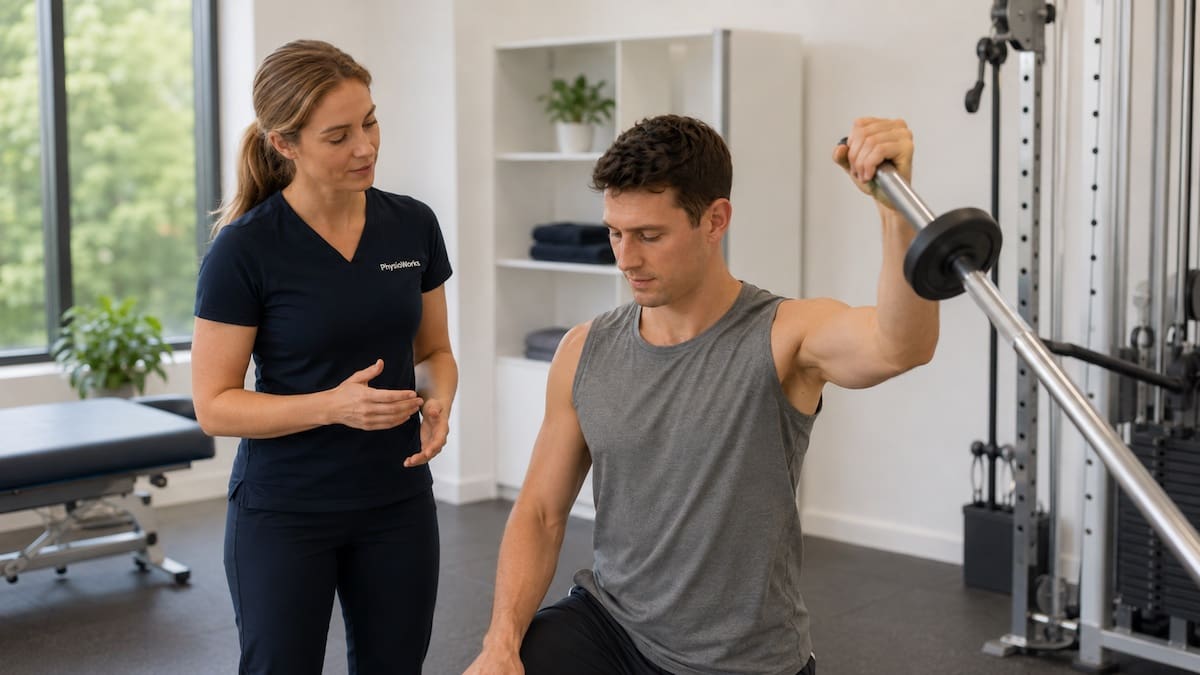
Most people benefit from progressive shoulder strengthening once acute pain begins to settle. Exercise choice should match the injury severity, movement tolerance and your work or sporting goals.
Early exercises may focus on comfortable shoulder movement and shoulder-blade control. Resistance can then progress towards rotator cuff strengthening, pulling, pressing and overhead tasks.
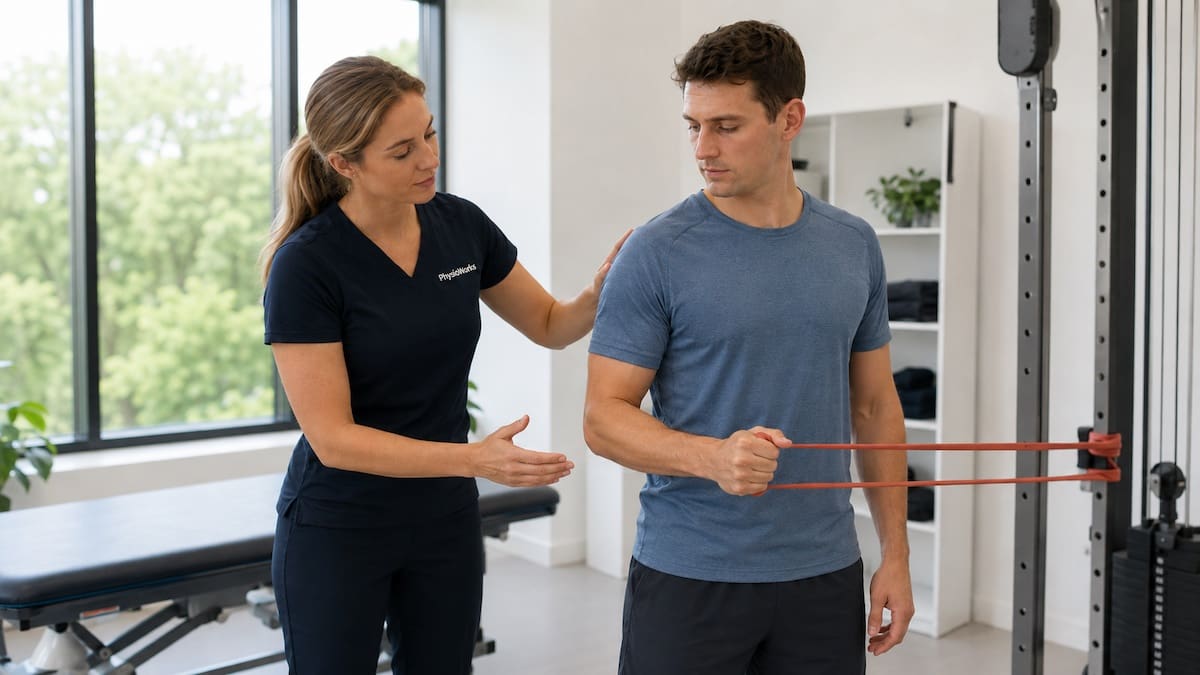
For general exercise options, see our shoulder exercises guide. Progress to heavier gym-based strengthening only when your shoulder tolerates daily activity and lighter resistance.
How Long Does an AC Joint Sprain Take to Recover?
Recovery varies according to the amount of ligament injury, symptoms and the demands placed on the shoulder. Many lower-grade sprains improve over several weeks. Higher-grade injuries may require a longer rehabilitation period, particularly before heavy work, pressing or contact sport.
Rather than relying on time alone, rehabilitation should progress according to movement, strength, load tolerance and function.
-
Settle pain and protect the joint
The early goal is to reduce irritation while maintaining safe, comfortable shoulder movement.
-
Restore movement and control
Progress when reaching, dressing and light daily activities become easier and shoulder movement improves.
-
Rebuild shoulder strength
Increase pulling, pressing and overhead resistance gradually without producing a significant flare.
-
Reintroduce work, gym or sport demands
Progress towards the specific lifting, contact, throwing or other tasks needed for your usual activities.
Returning to Gym and Work
A gradual return to lifting usually works better than immediately testing maximum strength. Start with comfortable movement, then light resistance, and progressively rebuild pressing, pulling and overhead capacity.
For a physical job, rehabilitation should also reflect your actual work demands. This may include lifting, carrying, sustained arm use, overhead activity and repeated tasks.
Read more about sports physiotherapy if your recovery involves higher-level training or sporting demands.
Returning to Sport After an AC Joint Injury
A staged return to sport helps determine whether the shoulder can cope with increasing speed, load, impact and fatigue.
Useful return-to-sport checkpoints may include:
- comfortable full or near-full shoulder movement;
- good shoulder-blade control;
- strength approaching the uninjured side for important movements;
- tolerance of sport-specific loading;
- ability to throw, press, fall or tackle where relevant; and
- confidence during impact or contact tasks when required.
These criteria are more useful than relying on a calendar date alone.
Can a Shoulder Support Help?
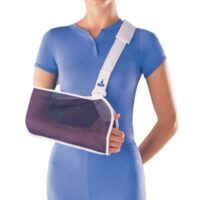
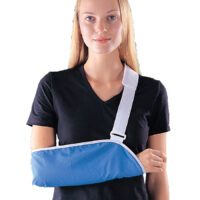
Some people find temporary shoulder support or strapping useful during the early phase of an AC joint injury. It may reduce discomfort during selected activities, but it does not replace rehabilitation or progressive strengthening.
Your physiotherapist can advise whether support, strapping or activity modification is appropriate for your presentation.
When Is Surgery Considered?
Surgery is not required for every AC joint injury. Many injuries can be managed without an operation.
Orthopaedic assessment may be considered for some higher-grade injuries, unusual displacement patterns, significant ongoing instability or persistent problems that affect work or sport despite appropriate rehabilitation.
The decision can depend on injury severity, symptoms, occupation, sporting demands, functional limitations and individual goals.
If surgery is required, rehabilitation remains important for restoring shoulder movement, strength and function. See our post-operative shoulder physiotherapy guide.
How Can You Reduce Future AC Joint Flare-Ups?
- Build shoulder and upper-back strength progressively.
- Develop good shoulder-blade control during lifting and pressing.
- Increase pressing volume gradually.
- Avoid sudden increases in heavy overhead training.
- Progress contact-sport exposure in stages.
- Reduce load temporarily if sharp AC joint pain returns.
Related PhysioWorks Articles
- Shoulder Pain – explore common shoulder symptoms and conditions.
- Rotator Cuff Tear – another shoulder injury that can follow trauma.
- Shoulder Impingement – shoulder pain associated with lifting and overhead movement.
- Shoulder Bursitis – pain associated with irritation around the shoulder.
- Shoulder Dislocation – a different traumatic shoulder injury requiring appropriate assessment.
- Clavicle Fracture – a collarbone injury that may need to be excluded after significant trauma.
Frequently Asked Questions
What is an AC joint sprain?
An AC joint sprain is an injury to the ligaments at the top of the shoulder where the collarbone meets the shoulder blade. It is often called a shoulder separation. Severity ranges from a mild ligament sprain to more substantial joint disruption.
How do I know if I need an X-ray for AC joint pain?
An X-ray may be recommended after significant trauma, especially with severe pain, obvious deformity, marked swelling or concern about a fracture or dislocation. A clinician can assess whether imaging is appropriate.
Can physiotherapy help AC joint pain?
Physiotherapy can help guide activity modification, restore shoulder movement and progressively rebuild strength and load tolerance. Rehabilitation can also prepare the shoulder for work, gym or sport.
How long does an AC joint sprain take to improve?
Recovery depends on the severity of the injury and the activities you need to regain. Lower-grade sprains may improve over several weeks, while higher-grade injuries can take longer, particularly before heavy lifting or contact sport.
When can I return to sport after an AC joint injury?
Return to sport usually follows improvement in pain, shoulder movement, strength and sport-specific load tolerance. Contact and impact tasks should also be tested progressively when relevant to your sport.
References
- de Groot C, Giesberts AME, van Mourik JBA, et al. Management of acromioclavicular injuries – current concepts. Journal of Clinical Medicine. 2023.
- Ma Y, Li S, Chen Z, et al. Surgical advances in the treatment of acromioclavicular joint dislocation. Journal of Clinical Medicine. 2024.
- Vossen RJM, et al. Choice of acromioclavicular dislocation treatment should not be based on osteoarthritis risk: a systematic review. Journal of Clinical Medicine. 2024.
- Garcia AV, et al. Reliability of the ISAKOS modification to subclassify acromioclavicular injuries. Orthopaedic Journal of Sports Medicine. 2022.
- Sciascia A, Kibler WB, Uhl TL, et al. Acromioclavicular joint injuries: clinical commentary with practice considerations. International Journal of Sports Physical Therapy. 2022.
What to Do Next
If you have pain at the top of your shoulder after a fall, collision or other injury, a physiotherapy assessment can help determine the likely severity, screen for other shoulder injuries and plan your rehabilitation.
Your rehabilitation can then progress according to your symptoms and the work, gym or sporting activities you want to return to.
Choose your clinic and appointment pathway
Select a PhysioWorks clinic to continue to live booking, an appointment request or reception assistance.
Shoulder Products
These shoulder products are commonly used by our physiotherapists to improve strength, posture, movement, plus assist home exercise programs.
- EMS Machines, Pain Management, TENS Machine, TENS Machine & EMS
NeuroTrac Rehab (TENS Machine + EMS)
$285.00Add to cartQuick View -
-
 Ice & Heat, Pain Management, Uncategorized
PhysiPak Universal Heat pack
$79.00Select optionsQuick View - Liniments & Gels, Massage Liniments, Pain Management
Fisiocrem
$16.95 – $39.95Select optionsQuick View -
-

-
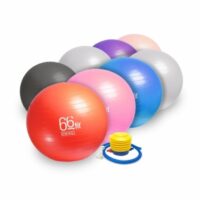
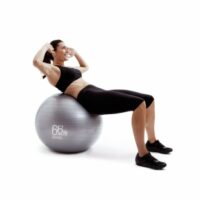 Exercise Balls, Back, Exercise Equipment, Knee, Shoulder
66fit Exercise Balls | Core & Rehab Stability Ball
$32.00 – $57.00Select optionsQuick View -
-
 Exercise Equipment, Resistance Band
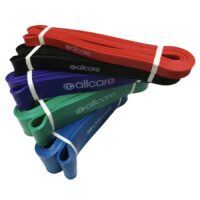
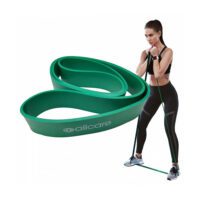
AllCare Powerloop Bands
$24.95 – $79.95Select optionsQuick View -
-
 Exercise Equipment, Knee, Resistance Band
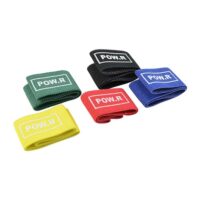
POW.R Fabric Mini Loop Bands
$12.00 – $55.00Select optionsQuick View -

-
-

-