
Patellar Tendinopathy
Patellar Tendinopathy (Jumper’s Knee)
Patellar tendinopathy causes load-related pain in the patellar tendon, usually just below the kneecap. Jumping, landing, sprinting, squatting and other high-load knee activities commonly aggravate symptoms.


Where it hurts
Pain commonly sits at the lower edge of the kneecap or in the upper patellar tendon.
Common triggers
Jumping, landing, sprinting, stairs, squats and repeated acceleration can increase symptoms.
What usually helps
Load management and progressive strengthening are central to rebuilding tendon capacity.
The patellar tendon connects the kneecap to the tibia at the top of the shin. It transfers force when you straighten the knee and helps manage high loads during running, jumping and landing.
Patellar tendinopathy is one possible cause of front-of-knee pain. Other conditions can produce symptoms in a similar area, so the pain location alone does not confirm the diagnosis.
What Is Patellar Tendinopathy?
Patellar tendinopathy is a painful tendon disorder associated with reduced tolerance to load. It most commonly affects the upper part of the patellar tendon near the lower edge of the kneecap.
The condition is often called jumper’s knee because repeated jumping and landing can place substantial load through the tendon. However, patellar tendinopathy can also affect runners, gym users and people whose work or recreation involves repeated high-load knee activity.
Tendinopathy is not simply an inflammatory problem. Symptoms and tendon capacity can change over time, so rehabilitation usually focuses on managing current load while progressively restoring the strength and function needed for normal activity or sport. You can read more about the broader principles in our tendinopathy guide.
What Causes Patellar Tendinopathy?
Patellar tendinopathy often develops when the load placed on the tendon increases faster than its current capacity to tolerate that load.
Examples include a rapid increase in jumping, sprinting, running, plyometric training, heavy squats or other demanding knee exercises. Symptoms may also appear after returning quickly to training following illness, injury, holidays or another period of reduced activity.
Common loading situations
- a sudden increase in training volume or intensity
- adding more jumping, landing or sprint sessions
- returning rapidly to sport after time away
- increasing heavy squat, lunge or leg-press training
- adding hills, acceleration or change-of-direction work
- repeated high-load sessions without enough recovery
Strength, movement capacity, previous symptoms and the demands of your sport or activity can also influence how much load the tendon currently tolerates. There is rarely one single cause.
What Are the Symptoms of Patellar Tendinopathy?
The most typical symptom is localised pain just below the kneecap. Pain is usually related to load and often becomes more noticeable as jumping, running or resistance-training demand increases.
- pain at the lower edge of the kneecap or upper patellar tendon
- pain during or after jumping and landing
- pain with squats, lunges or heavy leg exercises
- discomfort with stairs or downhill activity
- pain during sprinting or acceleration
- stiffness or soreness after loading or periods of rest
- reduced confidence or power during jumping activities
Some people notice that symptoms ease after warming up, only to return later in the session or afterwards. That pattern can occur with tendinopathy, but it does not prove that the patellar tendon is the source of the pain.
What Else Can Cause Pain Below the Kneecap?
Several knee conditions can produce pain around the front of the knee. Assessment may need to distinguish patellar tendinopathy from patellar tendon enthesopathy, patellofemoral pain, fat-pad irritation and other causes of knee pain.
Age also matters. In growing athletes, pain near the patellar tendon attachments may come from growth-related conditions rather than adult-type tendinopathy.
How Is Patellar Tendinopathy Assessed?
Assessment starts with your symptom history, recent changes in activity and the exact location and behaviour of the pain. A physiotherapist may then examine knee movement, tendon tenderness, lower-limb strength and how your symptoms respond to loading.
Depending on your activity level, assessment may include:
- squatting and single-leg squatting
- step-down or lunge tasks
- quadriceps strength testing
- calf and hip strength assessment
- hopping and landing when appropriate
- running, jumping or sport-specific movement
- review of recent training volume and intensity
Do you need an ultrasound or MRI?
Not always. Many presentations can initially be assessed clinically. Ultrasound or MRI may be considered when symptoms are persistent, severe or unclear, when another injury is suspected, or when the result is likely to change management.
Importantly, tendon changes seen on imaging do not always match the amount of pain a person experiences. Scan findings therefore need to be interpreted alongside the clinical presentation.
How Is Patellar Tendinopathy Treated?
Exercise-based rehabilitation and appropriate load management are usually central to non-surgical treatment. Complete rest may temporarily reduce symptoms, but rest alone does not prepare the tendon for the loads required by sport, work or exercise.
Recent evidence supports progressive tendon-loading exercise as a useful treatment approach. However, research does not show that one exercise method is best for every person. Exercise choice, load and progression should match your symptoms, current capacity and goals.
-
Adjust aggravating load
Temporarily reduce the activities that repeatedly flare symptoms. This may mean changing jump volume, sprint intensity, running load or heavy gym work rather than stopping all exercise.
-
Build strength
Progressive quadriceps and lower-limb strengthening helps rebuild the capacity needed for stairs, squatting, running and sport. Isometric or slower resistance exercises may be useful starting options for some people.
-
Increase tendon loading
Exercises can progress towards heavier squats, split squats, step-downs, knee-extension work or leg press exercises where appropriate.
-
Restore faster loading
People returning to running and jumping sports may later need hopping, landing, acceleration, deceleration and change-of-direction exercises.
-
Return to sport progressively
Training volume and intensity can increase in stages as symptoms, strength and performance improve. Athletes may also benefit from structured return-to-sport testing.
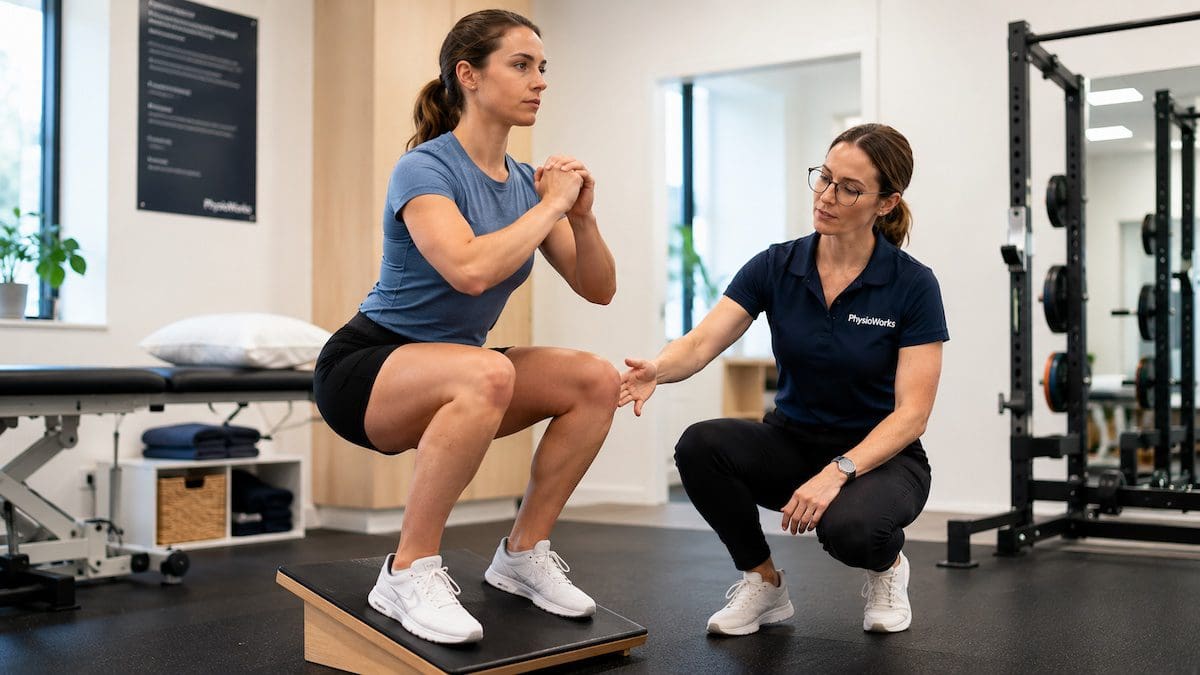
Should Exercise Hurt During Patellar Tendinopathy Rehabilitation?
A small amount of discomfort during exercise may be acceptable for some people with patellar tendinopathy, but there is no single pain rule that suits everyone.
More important is the overall response to loading. Exercise should remain controlled, symptoms should not keep escalating through the session, and your knee should recover reasonably afterwards. A clear and sustained increase in pain or loss of function may indicate that the previous load was too high.
Your physiotherapist can help set practical loading limits and adjust the program according to your response.
Can You Keep Training With Jumper’s Knee?
Often, yes. Many athletes can continue some training while reducing the activities that place the greatest load on the painful tendon.
For example, you may temporarily reduce repeated jumping or sprinting while maintaining suitable strength, conditioning and technical work. The right balance depends on your symptoms, sport, training schedule and current tendon capacity.
Repeated flare-ups after similar sessions suggest that the current training dose may still be too high. In that situation, modify the load and rebuild progressively rather than repeatedly stopping and restarting.
Can Patellar Tendinopathy Improve Without Surgery?
Yes. Many people improve with non-surgical management based on progressive exercise and sensible load modification.
Tendons adapt over time, so long-standing symptoms can require several months of consistent rehabilitation. Surgery is generally reserved for selected persistent cases after an adequate period of well-managed non-surgical care.
When Should You See a Physiotherapist?
Consider an assessment if pain below the kneecap is limiting running, jumping, stairs, gym training or sport, or if symptoms keep returning when activity increases.
Assessment is also useful when you are unsure whether the patellar tendon is actually causing the pain. Several conditions can produce similar front-of-knee symptoms, and the rehabilitation approach may differ.
What Should You Do Next?
If patellar tendon pain is affecting your activity, a physiotherapy assessment can help clarify the likely pain source, identify your current loading tolerance and develop an individual rehabilitation plan.
The aim is not simply to make the tendon less sore. Rehabilitation should progressively prepare your knee for the strength, speed and energy-storage demands of the activities you want to return to.
Choose your clinic and appointment pathway
Select a PhysioWorks clinic to continue to live booking, an appointment request or reception assistance.
Patellar Tendinopathy FAQs
Why do I have pain below my kneecap?
Pain below the kneecap can come from overload of the patellar tendon, particularly when jumping, landing, sprinting or heavy knee loading has increased. However, several other knee conditions can cause pain in a similar area, so the pain location alone does not confirm patellar tendinopathy.
Is jumper’s knee the same as patellar tendinopathy?
Yes. Jumper’s knee is a common name for patellar tendinopathy. The term reflects its association with jumping sports, although runners, gym users and other active people can also develop the condition.
What exercises help patellar tendinopathy?
Rehabilitation may include isometric or slow resistance exercises before progressing to heavier squats, split squats, knee-extension or leg-press work. Hopping, landing, running and jumping drills may be added later when they match the person’s goals and current tendon capacity.
How long does patellar tendinopathy take to improve?
Recovery varies. A recent flare may settle relatively quickly, while long-standing patellar tendinopathy can require several months of progressive strengthening and activity modification. The required timeframe also depends on the level of sport or activity you need to return to.
Should I stretch a sore patellar tendon?
Stretching may be useful when nearby muscles are stiff, but it is not the main treatment for patellar tendinopathy. Progressive strength and tendon-loading exercises usually play a more important role, and aggressive stretching can aggravate symptoms in some people.
When is imaging useful for patellar tendon pain?
Ultrasound or MRI may be useful when symptoms are persistent, severe or unclear, when a significant injury is suspected, or when the result could change management. Imaging findings do not always match pain, so scans should be interpreted alongside the clinical assessment.
References
- Liu Y, Li C, Yang F. Comparative effectiveness of exercise interventions for patellar tendinopathy: a systematic review and network meta-analysis of randomized controlled trials. BMC Sports Sci Med Rehabil. 2026;18:296. doi:10.1186/s13102-026-01743-4.
- Breda SJ, Oei EHG, Zwerver J, et al. Effectiveness of progressive tendon-loading exercise therapy in patients with patellar tendinopathy: a randomised clinical trial. Br J Sports Med. 2021;55(9):501–509. doi:10.1136/bjsports-2020-103403.
- Challoumas D, Pedret C, Biddle M, et al. Management of patellar tendinopathy: a systematic review and network meta-analysis of randomised studies. BMJ Open Sport Exerc Med. 2021;7(4):e001110. doi:10.1136/bmjsem-2021-001110.
- Pavlova AV, Shim J, Moss R, et al. Effect of resistance exercise dose components for tendinopathy management: a systematic review with meta-analysis. Br J Sports Med. 2023;57(20):1327–1334. doi:10.1136/bjsports-2022-105754.
