
A practical physiotherapy FAQ for knee pain going up or down stairs.
Knee Pain on Stairs: Why It Happens and What Helps


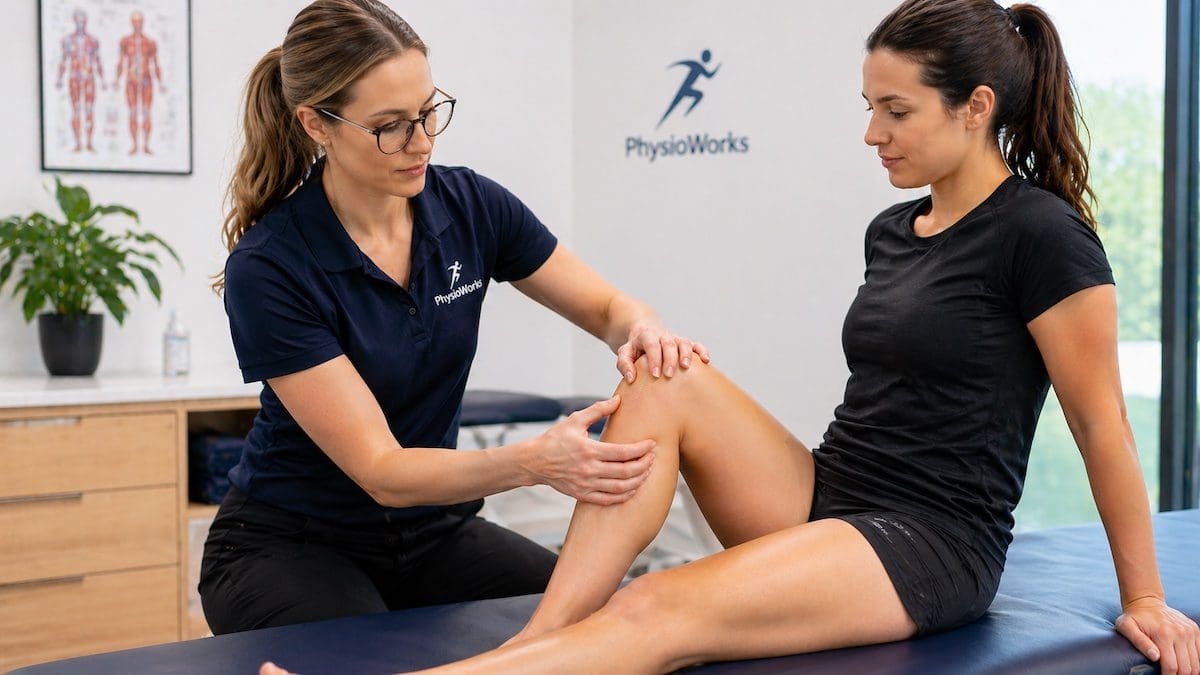
Knee pain on stairs often happens when the kneecap joint is sensitive under load. It may affect climbing, descending, squatting, kneeling, hills, running, or standing from a low chair.
Common causes include patellofemoral pain syndrome, chondromalacia patella, patellar tendon overload, meniscus irritation, or knee arthritis. Stairs load the knee joint more than level walking, so they often reveal weakness, irritation, or movement-control problems.
Quick Answer: Why Do Stairs Hurt My Knee?
- Going upstairs loads the kneecap as you push your body upward.
- Going downstairs often hurts more because the thigh muscles control your body weight as the knee bends.
- Pain around or behind the kneecap often points to patellofemoral joint irritation.
- Pain below the kneecap may involve the patellar tendon.
- Swelling, locking, giving way, or trauma needs closer assessment.
Why Does My Knee Hurt Going Up and Down Stairs?
Knee pain on stairs usually means the knee is working harder than it can currently tolerate. As the knee bends under body weight, the kneecap presses more firmly against the thigh bone.
If the kneecap does not glide well, or the hip and thigh muscles do not control the leg well, the joint and nearby soft tissues may become painful. This pattern is common in Runner’s Knee and other forms of patellofemoral pain.
What Symptoms Commonly Occur With Knee Pain on Stairs?
Symptoms vary, but many people notice a clear pattern linked to bending the knee under load.
- Pain at the front of the knee or behind the kneecap
- Pain when climbing or descending stairs
- Discomfort with squats, hills, kneeling, running, or cycling
- Stiffness after sitting with the knee bent
- Grinding, clicking, or crunching around the kneecap
- Swelling, warmth, locking, or giving way in more irritated knees
What Causes Knee Pain on Stairs?
Several knee problems can cause stair pain. The pain location, onset, swelling pattern, and mechanical symptoms help guide the likely cause.
| Pain pattern | Possible cause | Common clues |
|---|---|---|
| Front knee or behind kneecap | Patellofemoral pain syndrome | Worse with stairs, squats, hills, running, or sitting |
| Grinding or ache behind kneecap | Chondromalacia patella | Pain with hills, stairs, kneeling, or loaded bending |
| Deep ache, stiffness, swelling | Knee osteoarthritis | Morning stiffness, swelling, reduced walking tolerance |
| Sharp pain, catching, locking | Meniscus irritation or tear | Twisting pain, swelling, catching, or blocked movement |
| Pain below kneecap | Patellar tendon overload | Pain with stairs, jumping, running, or loaded squats |
Why Is Going Down Stairs Often Worse?
Going down stairs often hurts more because your quadriceps control your body weight as the knee bends. This increases demand through the kneecap joint.
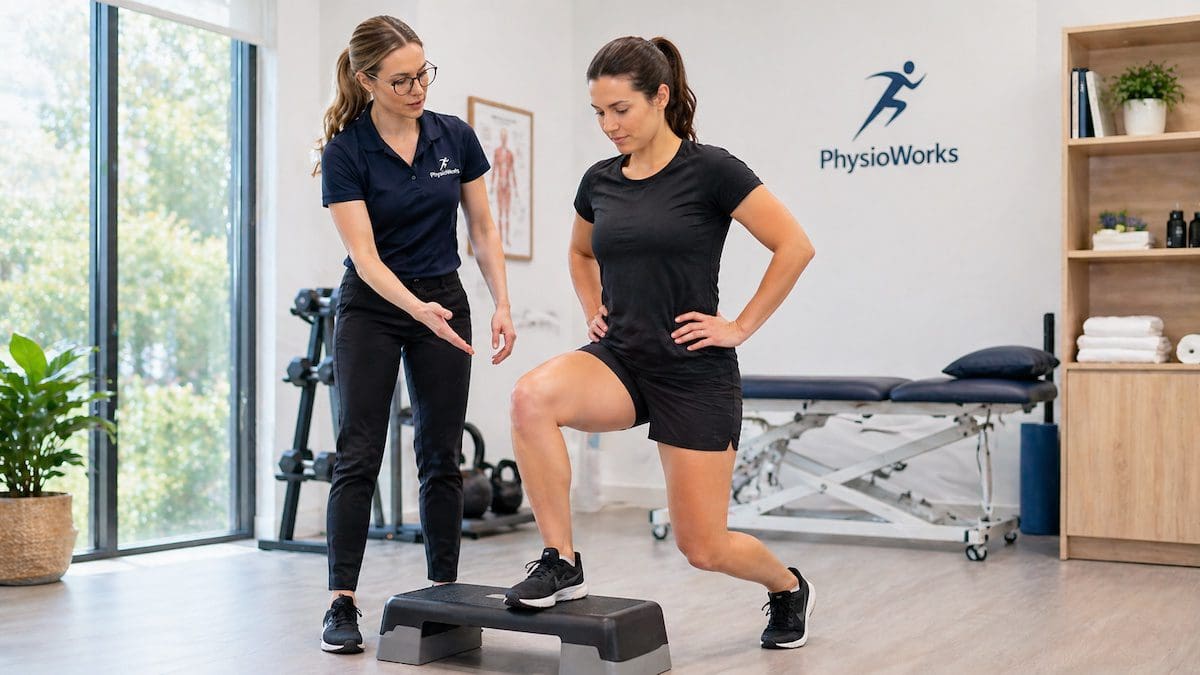
If your hip, thigh, or calf muscles lack strength or timing, your knee may drift inward or load unevenly. A step-down assessment can show whether your stair pain relates to strength, joint sensitivity, or knee biomechanics.
Stair Pain Decision Guide
Mild pain that settles quickly: reduce stair volume, use the handrail, and start gentle strengthening.
Sharp pain, swelling, locking, or giving way: arrange physiotherapy or medical assessment before pushing through.
Pain after a fall or twist: seek prompt assessment, especially if you cannot walk normally.
How Do Physiotherapists Assess Knee Pain on Stairs?
A physiotherapy assessment helps identify which structure is irritated and why stairs trigger symptoms. Your physiotherapist may review your knee history, pain location, swelling pattern, training load, footwear, and daily activity demands.
They may also assess knee range of motion, kneecap mobility, joint tenderness, hip strength, quadriceps strength, calf control, balance, foot posture, squat technique, and step-down movement. Imaging is not always needed, but it may help when symptoms are severe, traumatic, persistent, or unclear.
What Treatment Helps Knee Pain on Stairs?
Knee pain on stairs treatment usually starts with calming irritation, improving movement control, and building strength. The right plan depends on your diagnosis, pain level, current function, and goals.
- Exercise therapy: hip, quadriceps, calf, and trunk strengthening to improve stair tolerance.
- Movement retraining: coaching step-downs, squats, sit-to-stand, and stair technique.
- Load management: adjusting stairs, hills, running, gym work, or sport while the knee settles.
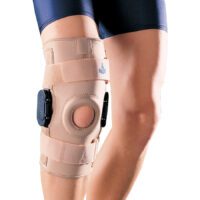
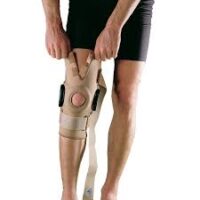
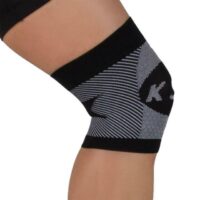
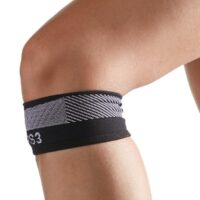
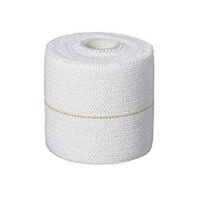
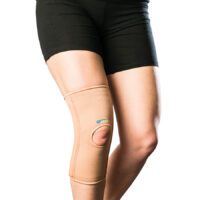
- Taping or bracing: short-term support for some kneecap pain presentations.
- Manual therapy: joint or soft tissue techniques where stiffness contributes.
- Footwear or orthotic advice: support where foot posture affects knee loading.
- Return-to-activity planning: graded progressions for work, walking, running, gym, or sport.
Physiotherapy works better when treatment matches your stair pain trigger. For example, kneecap pain usually needs different progressions from meniscus pain, knee arthritis, or patellar tendon overload.
What Can I Do Now for Knee Pain on Stairs?
You can often keep moving if symptoms stay mild and settle quickly. Repeated sharp pain usually means your knee needs a short-term load change and a clearer strength plan.
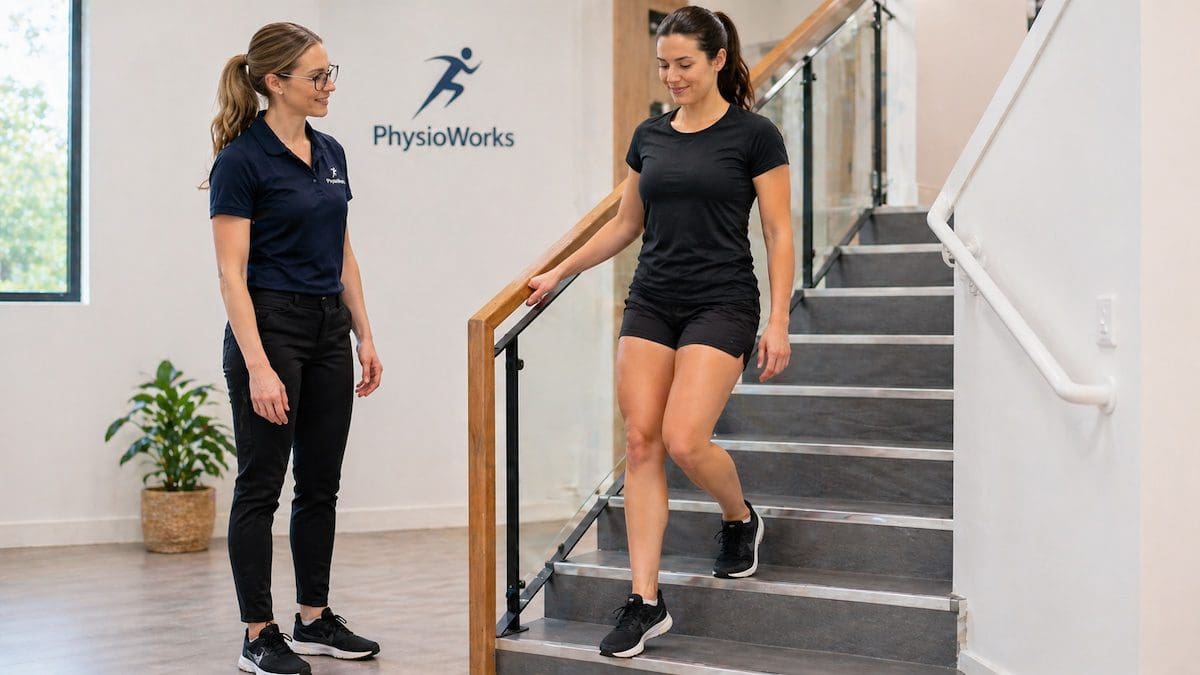
- Use the handrail to reduce knee load.
- Take one step at a time during flare-ups.
- Limit repeated stair trips while pain is high.
- Avoid deep squats, hills, or jumping if they flare symptoms.
- Start gentle strength work that does not worsen symptoms.
- Use ice or heat if it helps your pain settle.
- Book an assessment if pain is not improving within one to two weeks.
When Should I Worry About Knee Pain on Stairs?
Seek assessment sooner if your knee pain is worsening, swollen, unstable, locking, or linked to trauma. These signs may point to joint irritation or an injury that needs a clearer diagnosis.
- You cannot fully bend or straighten the knee.
- You cannot walk or weight-bear normally.
- Your knee gives way, locks, or catches repeatedly.
- You have marked swelling after a twist or fall.
- You have fever, redness, severe night pain, or unexplained symptoms.
- Pain limits work, sport, sleep, or daily stairs.
Knee Pain on Stairs FAQs
Why do my knees hurt when I go up and down stairs?
Knees often hurt on stairs because bending under load places extra pressure through the kneecap joint. Patellofemoral pain syndrome, chondromalacia patella, tendon overload, meniscus irritation, or knee arthritis can make this load painful.
Why do my knees hurt going down stairs but not up?
Going down stairs usually places greater demand on the quadriceps and kneecap because your muscles control your body weight against gravity. This can expose weakness, poor control, or kneecap sensitivity.
Is knee pain on stairs always arthritis?
No. Arthritis is only one possible cause. Many people with knee pain on stairs have patellofemoral pain syndrome, chondromalacia patella, tendon overload, or movement-control issues rather than significant joint wear.
What exercises help knee pain on stairs?
Helpful exercises often include hip strengthening, quadriceps strengthening, step-ups, sit-to-stand drills, calf strengthening, and controlled squats. The right exercise depends on your assessment findings and current pain level.
Is it safe to keep using stairs with knee pain?
It is often safe to keep using stairs if pain stays mild and settles quickly afterwards. Use a handrail, reduce repeated trips, and avoid pushing through sharp pain. Instability, swelling, catching, or worsening pain needs assessment.
Should I see a physiotherapist or doctor first?
For gradual knee pain on stairs without major trauma, a physiotherapist is usually a suitable first contact. Seek urgent medical care if you suspect fracture, infection, severe injury, or cannot weight-bear normally.
How long does knee pain on stairs take to improve?
Some people improve within a few weeks. Longer-standing or more complex knee pain may need several months of progressive strengthening and load management. Your physiotherapist can estimate timing after assessment.
Related Knee Articles at PhysioWorks
- Knee Pain
- Patellofemoral Pain Syndrome
- Chondromalacia Patella
- Runner’s Knee
- Knee Arthritis
- Meniscus Tear
- Patellar Tendinopathy
- Knee Biomechanics
What Should You Do Next?
You do not have to keep avoiding stairs. If knee pain limits your home life, work, exercise, or sport, a PhysioWorks physiotherapist can assess the cause and guide a practical plan.
Book an appointment today to have your knee assessed and start working towards stronger, more confident stair climbing.
Choose your clinic and appointment pathway
Select a PhysioWorks clinic to continue to live booking, an appointment request or reception assistance.
Knee Support Products
These knee support products are commonly used by our physiotherapists to help reduce strain, improve stability, and support your recovery at home.
-

 Exercise Equipment, Resistance Band
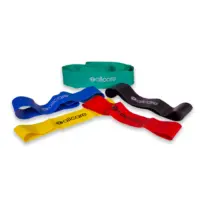
AllCare Powerloop Bands
$22.00 – $65.00Select optionsQuick View - Liniments & Gels, Massage Liniments, Pain Management
Fisiocrem
$16.95 – $39.95Select optionsQuick View -
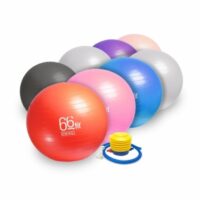
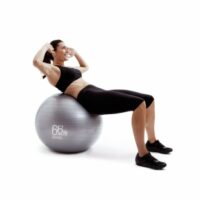 Exercise Balls, Back, Exercise Equipment, Knee, Shoulder
66fit Exercise Balls | Core & Rehab Stability Ball
$32.00 – $57.00Select optionsQuick View -
-
-
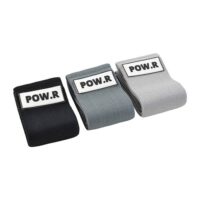
- Exercise Equipment, Resistance Band
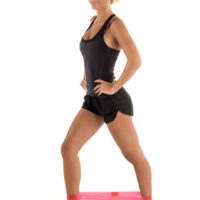
POW.R Wide Fabric Loop Resistance Band
$14.95 – $49.95Select optionsQuick View -
-

 Calf, Elbow, Ice & Heat, Knee, Pain Management
Victor Elastic Cold Sleeve
$44.00 – $60.00Select optionsQuick View -
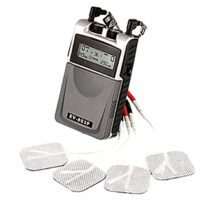
- EMS Machines, Pain Management, TENS Machine, TENS Machine & EMS
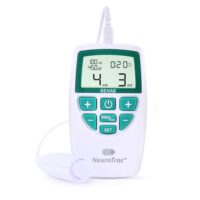
NeuroTrac Rehab (TENS Machine + EMS)
$285.00Add to cartQuick View -
 Exercise Equipment, Knee, Resistance Band
POW.R Fabric Mini Loop Bands
$12.00 – $55.00Select optionsQuick View -

-
-







References
- Neal BS, Lack SD, Lankhorst NE, et al. Best practice guide for patellofemoral pain based on synthesis of a systematic review, patient voice and expert clinical reasoning. Br J Sports Med. 2024;58(24):1486-1495.
- Willy RW, Hoglund LT, Barton CJ, et al. Patellofemoral Pain: Clinical Practice Guidelines Linked to the International Classification of Functioning, Disability and Health From the Academy of Orthopaedic Physical Therapy of the American Physical Therapy Association. J Orthop Sports Phys Ther. 2019;49(9):CPG1-CPG95. doi:10.2519/jospt.2019.0302
- Bump JM, Lewis L. Patellofemoral Syndrome. StatPearls. Updated 2023.
- Institute for Quality and Efficiency in Health Care. Osteoarthritis of the knee: What can you do to strengthen your knees?. InformedHealth.org. Updated May 15, 2024.
