
Sprained Finger


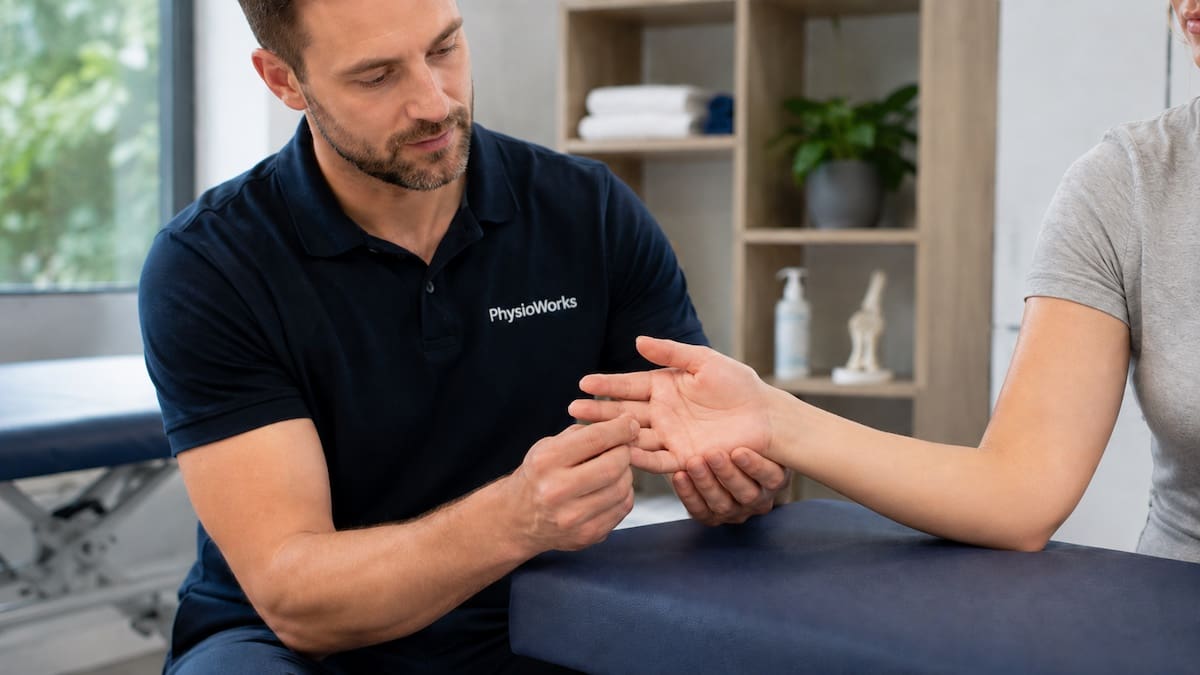
A sprained finger is a ligament injury around one of the finger joints. It often happens when the finger bends too far, jams against a ball, catches during sport, or twists during a fall.
Most mild finger sprains improve with the right mix of protection, swelling control, movement, and graded strengthening. However, some finger injuries look minor at first but later become stiff, weak, or unstable. If your pain spreads into the hand or wrist, our hand and wrist pain guide explains other common causes.
A physiotherapist can assess the joint, check movement and grip, and help decide whether taping, splinting, exercises, or imaging advice is needed. They can also screen for injuries that may mimic a sprain, such as a broken finger fracture or volar plate injury.
Quick answer: A sprained finger usually causes joint pain, swelling, stiffness, and reduced grip. Get it checked if it looks crooked, feels unstable, bruises badly, or you cannot bend or straighten it normally.
Early care: protect the joint, reduce painful gripping, use short bouts of ice if helpful, and keep gentle movement within comfort.
What Is a Sprained Finger?
A sprained finger occurs when a ligament around a finger joint stretches or tears. Ligaments help keep the joint stable when you grip, catch, throw, climb, type, or lift.
Finger sprains often affect the proximal interphalangeal joint, or PIP joint. This is the middle joint of the finger. They can also affect the knuckle, called the MCP joint, or the joint near the fingertip, called the DIP joint.
What Are the Symptoms of a Sprained Finger?
Symptoms depend on the force of the injury and which ligament is involved. A mild sprain may feel sore but stable. A larger sprain may feel loose, swollen, or hard to move.
- Joint pain with bending, gripping, catching, or twisting lids
- Swelling around the injured finger joint
- Stiffness when making a fist or straightening the finger
- Bruising after a fall, collision, or ball impact
- Reduced grip strength or early hand fatigue
- Instability, where the finger feels loose or unreliable
Is It a Sprain, Fracture, or Volar Plate Injury?
A sprain affects the ligament. A fracture affects the bone. A volar plate injury affects a strong structure on the palm side of the PIP joint. It helps stop the finger bending too far backwards.
These injuries can overlap after a jammed finger. That is why assessment matters if the finger is badly swollen, bruised, crooked, or hard to move. Your physiotherapist may recommend medical review or imaging when a fracture, dislocation, avulsion injury, or tendon injury is suspected.
Get assessed promptly if:
- the finger looks bent, rotated, or out of shape
- you cannot fully bend or straighten the joint
- the joint feels loose compared with the other hand
- pain or swelling worsens after the first 24–48 hours
- you notice numbness, coldness, colour change, or spreading bruising
How Are Sprained Fingers Graded?
Finger sprains are often described by severity. The grade helps guide protection, taping, splinting, exercise, and return-to-sport timing.
- Grade 1: mild ligament stretch with pain but little or no looseness.
- Grade 2: partial ligament tear with swelling, pain, stiffness, and some laxity.
- Grade 3: complete ligament tear with marked instability or poor joint control.
Higher-grade sprains need closer review because ongoing instability can affect gripping, typing, tools, and ball-handling. If your thumb is the main problem, see our related guide on sprained thumb.
How Can Physiotherapy Help a Sprained Finger?
Physiotherapy for a sprained finger aims to protect the healing ligament, reduce swelling, restore movement, and rebuild grip strength. Your plan should match the joint involved, the injury grade, your work demands, and your sport or activity goals.
A physiotherapist may assess joint tenderness, swelling, range of motion, grip strength, finger alignment, and ligament stability. They may also check nearby structures if wrist or thumb symptoms are present, including possible wrist tendinopathy.
Treatment Options You Can Discuss
- Relative rest: reduce painful gripping, catching, climbing, or ball impact early.
- Swelling control: use elevation, gentle movement, compression, or short bouts of ice where helpful.
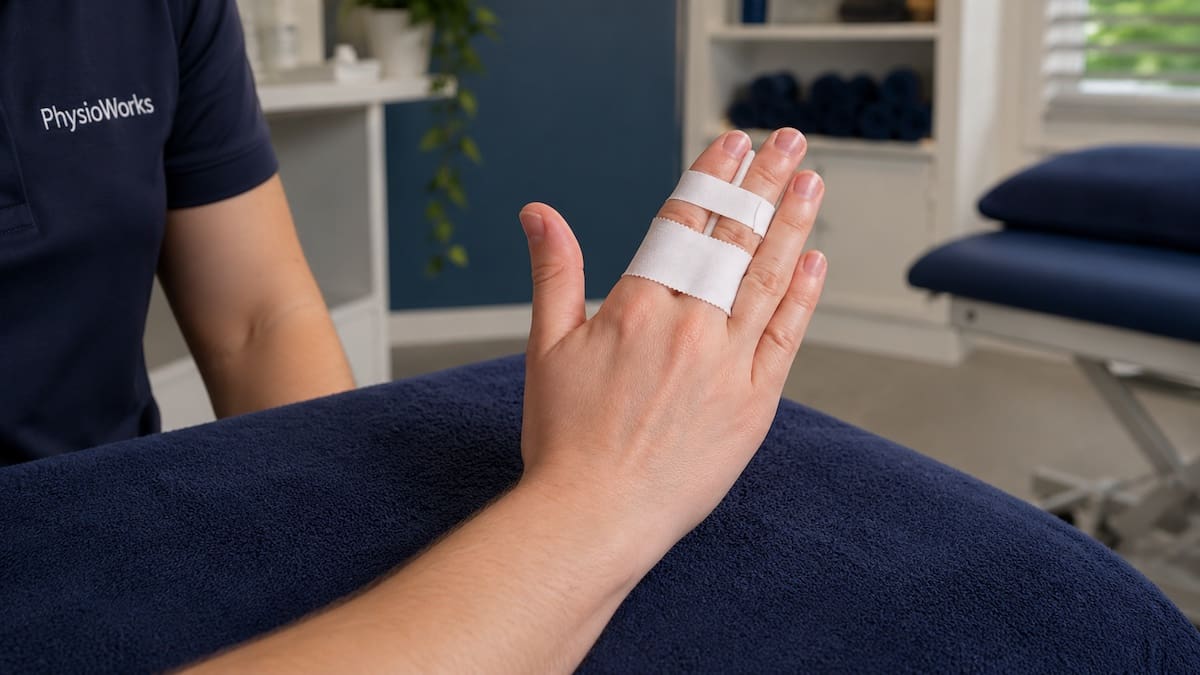
- Buddy taping: support the injured finger beside a neighbouring finger during selected tasks.
- Splinting: protect higher-grade sprains, unstable joints, or volar plate injuries when needed.
- Range-of-motion exercises: regain bending and straightening without forcing the joint.
- Grip strengthening: rebuild tolerance for lifting, typing, tools, gym work, or sport.
- Return-to-sport planning: progress catching, passing, tackling, or ball contact at the right time.
Can I Keep Playing Sport With a Sprained Finger?
Some people can keep training with modified drills once pain settles and the finger is well supported. However, playing too early can increase swelling, stiffness, or joint looseness.
Before returning to ball contact, your finger should have useful movement, tolerable grip, and enough support for the sport. Taping may help during the early return phase, but it should not hide a finger that is unstable or worsening. For ball-sport examples, see our volleyball injuries guide.
Simple return-to-sport checklist
- You can bend and straighten the finger without sharp pain.
- Swelling is settling rather than increasing after activity.
- You can grip, catch, or hold equipment with control.
- Taping or splinting feels supportive, not restrictive or painful.
- Your symptoms do not worsen the next day.
How Long Does a Sprained Finger Take to Heal?
A mild sprained finger may settle within two to three weeks. Moderate sprains often need four to eight weeks before gripping and sport feel more normal. More severe sprains, unstable joints, or injuries linked with a fracture or volar plate injury may take longer.
Recovery is not only about pain. Finger stiffness can last if the joint stays swollen or protected for too long. A balanced plan should protect the ligament while keeping safe movement going.
Related PhysioWorks Guides
Finger injuries often sit within a broader hand, wrist, and sport-load picture. These related guides may help you compare symptoms and choose your next step:
- Hand and Wrist Pain – broader causes of hand, wrist, and finger pain.
- Broken Finger Fracture – when a finger injury may involve bone.
- Volar Plate Injury – common after a finger hyperextension injury.
- Sprained Thumb – useful if the injury involves the thumb rather than the fingers.
- Sports Injury Physiotherapy – return-to-training and return-to-sport support.
Sprained Finger FAQs
What is a sprained finger?
A sprained finger is a ligament injury around a finger joint. It often happens when the finger bends too far, jams against a ball, or twists during a fall or sport.
How do I know if my finger is sprained or broken?
Sprains and fractures can both cause pain, swelling, bruising, and loss of movement. A finger that looks crooked, cannot move normally, or becomes very swollen after impact should be assessed. Imaging may be needed if a fracture or avulsion injury is suspected.
Should I buddy tape a sprained finger?
Buddy taping may help support a mild sprained finger during selected tasks. It should feel comfortable and should not cause numbness, colour change, or more pain. More significant injuries may need a different splint or medical review.
How long does a sprained finger take to heal?
Mild sprains may settle in two to three weeks. Moderate sprains often take four to eight weeks. More severe injuries can take longer, especially if the joint is unstable or the injury also involves a fracture, tendon, or volar plate.
Can I still train with a sprained finger?
You may be able to train with modifications once pain settles and the finger is supported. Avoid drills that increase swelling, sharp pain, or instability. Ball contact and gripping loads should return gradually.
When should I get a sprained finger checked?
Get it checked if the finger is crooked, very swollen, unstable, numb, cold, or hard to bend or straighten. Also book an assessment if pain or stiffness is not improving after a few days of sensible care.
What To Do Next
If your finger is very swollen, looks out of shape, feels unstable, or cannot move normally, arrange an assessment soon. If symptoms are mild, start with protection, relative rest, gentle movement, and support during painful tasks.
Book a physiotherapy review if pain, swelling, stiffness, or grip weakness limits work, sport, gym training, or daily use. A physiotherapist can help you protect the joint, reduce stiffness risk, and progress strength at the right pace. You can also start from our PhysioWorks clinics page if you need help choosing a location.
Choose your clinic and appointment pathway
Select a PhysioWorks clinic to continue to live booking, an appointment request or reception assistance.
Hand Products
These hand products are commonly used by our physiotherapists to improve strength, movement, and home exercise programs.
-
 Braces & Supports, Hand, Thumb, Wrist
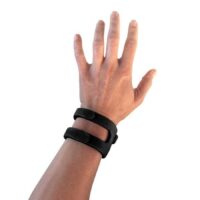
OPPO 1188 Wrist and Thumb Support
$30.00Select optionsQuick View -
-


-
-
-
 Exercise Equipment, Gift Ideas, Massage Tools
Smooth n Spiky Massage Balls (2 Pack)
$20.00Select optionsQuick View -
-
-
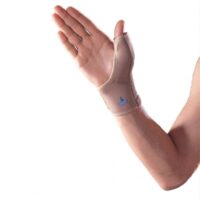 Braces & Supports, Hand, Thumb, Wrist
Wrist and Thumb Support – OPPO 1089
$44.00Select optionsQuick View -
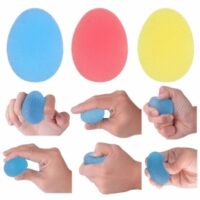
-
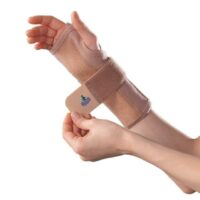 Braces & Supports, Hand, Wrist
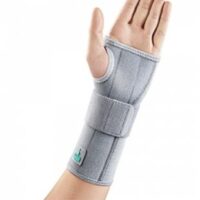
Wrist Splint with Elastic Strap – OPPO 2182
$45.00Select optionsQuick View -


Follow PhysioWorks
Follow us for practical injury recovery tips, exercise ideas, and hand and wrist care advice.


References
- Mergoum A, Larson N, Kulesza K, et al. Tendon and ligament injuries of the finger and thumb in athletes: a narrative review. BMJ Open Sport Exerc Med. 2025;11(2):e002475. doi:10.1136/bmjsem-2025-002475
- Grange M, et al. Management of stable proximal interphalangeal joint volar plate injuries with figure-of-8 orthoses: a parallel-group randomized controlled trial. J Hand Ther. 2024.
- Caviglia D, Ciolli G, Fulchignoni C, Rocchi L. Chronic post-traumatic volar plate avulsions of the finger proximal interphalangeal joint: a literature review of different surgical techniques. Orthop Rev (Pavia). 2021;13(1):9058.
- Sahin MS, Duygulu F, Kocadal O, et al. Midterm clinical outcomes of collateral ligament repair of the thumb and lesser digits: a retrospective analysis of 35 cases. BMC Musculoskelet Disord. 2022;23:689.
