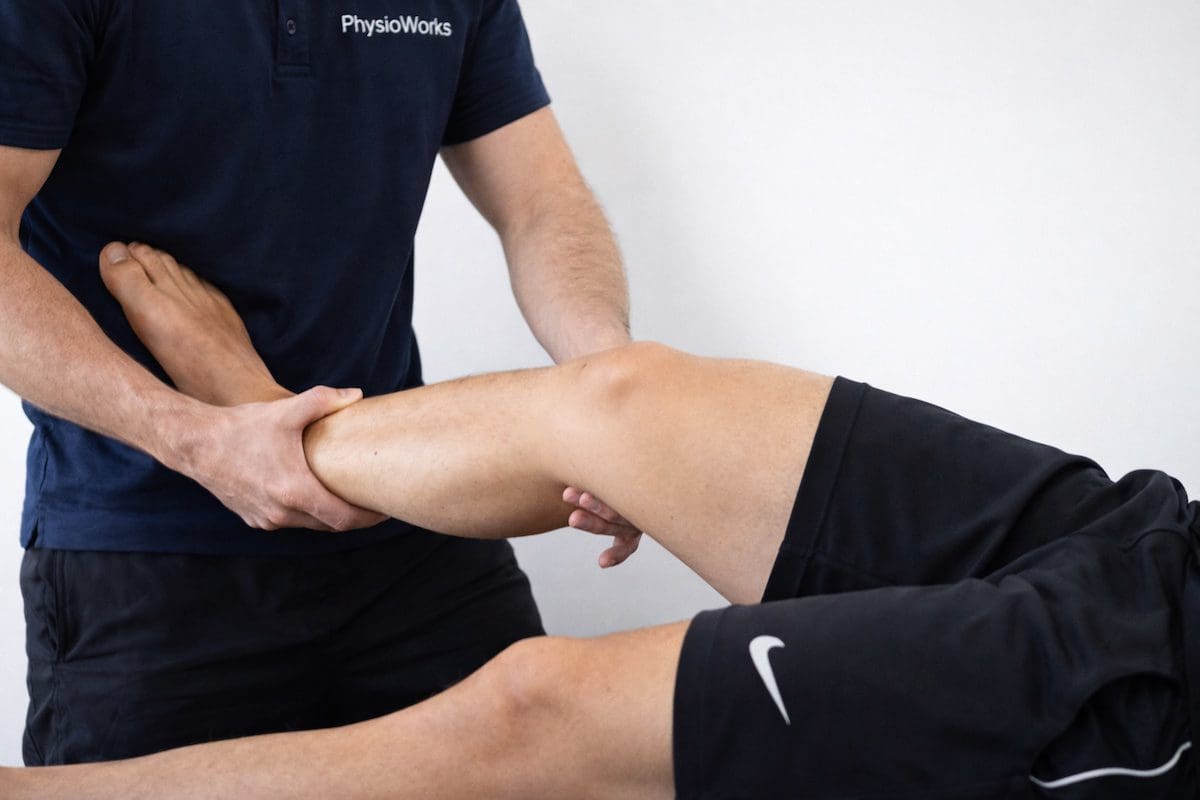
ACL pivot shift knee stability test during a physiotherapy assessment.
ACL injury FAQs answer common questions about anterior cruciate ligament tears, including symptoms, diagnosis, MRI scans, braces, rehabilitation, surgery, the Cross Bracing Protocol and return to sport.
What are the early signs of an ACL injury?
An ACL injury is a sprain or tear of the anterior cruciate ligament inside the knee. The ACL helps control forward movement and rotation of the shin bone.
Pop or shift
You may hear or feel a pop, sudden shift or giving-way sensation at the time of injury.
Rapid swelling
Swelling can develop over the first few hours after the injury.
Instability
The knee may feel unreliable during turning, landing, stairs or single-leg loading.
Pain
Walking, twisting or changing direction may be painful soon after the injury.
Loss of confidence
You may stop trusting the leg when pushing off, landing or changing direction.
Understand when reconstruction may be considered and what rehabilitation involves.
How is an ACL injury diagnosed?
An ACL injury is often suspected from how the injury happened and a focused examination of the knee. Your physiotherapist may assess swelling, range of movement, ligament stability, walking and functional control.
MRI is not always essential to first suspect an ACL tear. However, it can help confirm the diagnosis and identify associated injuries involving the meniscus, cartilage or other ligaments.
No. Some people regain good knee stability and function with structured rehabilitation without ACL reconstruction. Others may consider surgery when instability continues, their sport or work involves frequent pivoting or cutting, or associated knee injuries affect the decision.
Physiotherapy is important whether treatment is surgical or non-surgical. Decisions should consider symptoms, knee stability, associated injuries, activity goals, work demands and response to rehabilitation.
A rehabilitation-first approach may be considered when
the knee becomes functionally stable
daily activities improve with rehabilitation
you are willing to complete structured strength and movement training
you and your treating team agree that a non-operative trial is appropriate
Surgery may be considered when
the knee continues to buckle or give way
you want to return to activities involving substantial cutting or pivoting
associated meniscus or multi-ligament injuries affect knee stability
Some people can function well without ACL reconstruction, particularly when rehabilitation restores strength, movement control and confidence and the knee does not repeatedly give way.
Research has also reported MRI evidence of ACL continuity or healing in some people managed without reconstruction. However, MRI appearance alone does not prove that normal ligament function has returned. Symptoms, knee stability, activity goals and functional testing remain important.
The protocol generally requires early diagnosis, careful patient selection and close supervision by clinicians familiar with the approach. It does not replace individual discussion about rehabilitation, surgery or associated knee injuries.
How long does ACL recovery take?
ACL recovery generally takes months rather than weeks. The exact timeline depends on the injury, associated knee damage, whether treatment is surgical or non-surgical, your activity goals and how the knee responds to rehabilitation.
Progress should be based on symptoms and function rather than the calendar alone.
Settle the knee
Early rehabilitation usually aims to reduce swelling, regain full knee extension, improve walking and restore muscle activation.
Build strength and control
Progressive exercises target the quadriceps, hamstrings, calf, hip muscles and trunk while rebuilding single-leg control.
Return to running and landing
When appropriate, rehabilitation progresses to jogging, hopping, landing, acceleration, deceleration and change-of-direction tasks.
Complete return-to-sport testing
Strength, hopping, movement quality, confidence, agility and sport-specific tasks can help guide whether you are ready for higher-level training and competition.
How can you reduce the risk of another ACL injury?
ACL injury-prevention programmes commonly use strength, balance, landing control, cutting technique and neuromuscular training. These programmes are particularly relevant to sports involving frequent jumping, landing, pivoting and sudden deceleration.
Regular neuromuscular warm-up programmes may reduce ACL injury risk when athletes perform them consistently and with appropriate technique. Read the ACL injury prevention guide.
ACL Injury FAQs
Can you walk on a torn ACL?
Sometimes. Many people can still walk after an ACL injury, so being able to walk does not rule out a tear. Instability, swelling, pain and loss of confidence with turning or single-leg activity are often more useful clues.
Do you always need an MRI for an ACL injury?
No. The history of the injury and a skilled knee examination can strongly suggest an ACL tear. MRI may help confirm the diagnosis and identify associated injuries involving the meniscus, cartilage or other ligaments.
Is an ACL brace enough to fix the injury?
No. A brace does not replace rehabilitation or automatically restore normal ACL function. Bracing may be used in selected situations, including specific rehabilitation protocols, but its role depends on the individual injury and treatment plan.
What is the Cross Bracing Protocol for ACL injury?
The Cross Bracing Protocol is an emerging non-surgical approach that combines a structured period of knee bracing with physiotherapist-guided rehabilitation. Early research has reported MRI evidence of ACL continuity in selected patients, but the approach is still developing and is not standard care for every ACL tear.
Can an ACL heal without surgery?
Some ACL injuries have shown evidence of healing or continuity on MRI without reconstruction. However, MRI appearance does not automatically mean normal ligament function has returned. Knee stability, symptoms, activity goals and functional testing remain important.
What sports place the ACL most at risk?
ACL injuries commonly occur in sports involving pivoting, cutting, landing and sudden deceleration. Examples include football codes, netball, basketball, soccer, volleyball and skiing.
How long does ACL swelling take to settle?
Swelling may improve over days to several weeks, depending on the severity of the injury and whether other knee structures were injured. Rapid swelling after a twisting injury is one reason to arrange an assessment.
What happens if you delay ACL treatment?
Delayed assessment may allow swelling, stiffness, weakness and poor movement control to persist. If the knee repeatedly gives way, assessment can help identify associated injuries and guide an appropriate rehabilitation or surgical pathway.
When can you return to sport after an ACL injury?
Return to sport should consider symptoms, strength, movement quality, confidence and sport-specific testing rather than time alone. Returning before adequate recovery may increase the risk of poor performance or another knee injury.
When should you seek help for a suspected ACL injury?
Arrange an assessment if the knee swells rapidly, feels unstable, locks, or is difficult to trust during walking, stairs, turning or sport. Early assessment can identify associated injuries and establish an appropriate management plan.
Learn how structured neuromuscular training may help lower ACL injury risk.
What should you do next?
If you suspect an ACL injury, avoid repeatedly testing the knee with twisting, cutting or sport. An early assessment can help identify associated injuries, manage swelling and stiffness, and establish an appropriate rehabilitation pathway.
A PhysioWorks physiotherapist can assess your knee and help guide decisions about rehabilitation, imaging, specialist review, work, training and eventual return to sport.
Choose your clinic and appointment pathway
Select a PhysioWorks clinic to continue to live booking, an appointment request or reception assistance.