
Exercise Programs


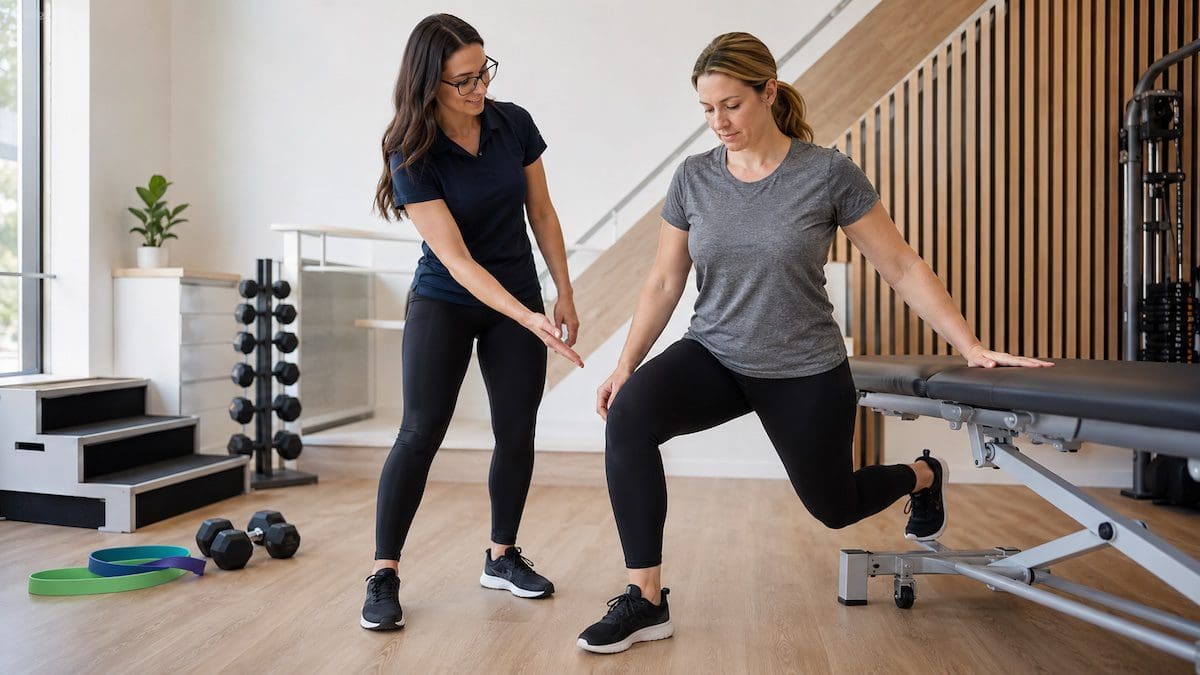
Supervised exercise programs help match load and control.
Exercise programs are tailored rehabilitation plans used in physiotherapy to improve strength, mobility, balance, movement control, and confidence after injury, surgery, pain, or repeated flare-ups. A good program starts at the right level, then progresses as your body adapts.
At PhysioWorks Brisbane, our physiotherapists work alongside accredited exercise physiologists to match your plan to your injury, goals, current fitness, and load tolerance. This matters because many people start exercising after pain settles, then stall when the plan is too hard, too vague, or not matched to their recovery stage.
A physiotherapy exercise program is a structured set of movements, strengthening drills, mobility work, balance tasks, or return-to-sport exercises. Rather than using a generic gym plan, your clinician chooses exercises based on your diagnosis, symptoms, capacity, and goals.
An exercise program may suit you if you:
- keep getting pain with work, sport, gym, or daily activities
- feel weak, stiff, unstable, or unsure after injury
- need a staged return after surgery or a sports injury
- want clear progressions instead of guessing what to do next
- need a practical plan that fits your time, equipment, and confidence
What Conditions Can Exercise Programs Help?
Exercise programs may help a wide range of musculoskeletal problems and recovery goals. Your clinician may prescribe targeted exercises for knee pain, shoulder pain, back pain, rotator cuff injuries, or Achilles tendinopathy.
They are also commonly used during post-operative rehabilitation, after a sports injury, or as part of injury prevention programs. Exercise programs may also support care for neck pain, lower limb rehabilitation, balance retraining, and general reconditioning.
Who Benefits from an Exercise Program?
Exercise programs suit many people, from active athletes to office workers, post-operative patients, and people rebuilding confidence after recurring pain. The right program should match your body, not just your diagnosis.
You may benefit if you:
- get recurring pain with work, sport, or daily tasks
- feel weak, stiff, or unstable after an injury
- want to return to running, the gym, or team sport
- have had surgery and need staged progressions
- need a structured plan instead of guessing what exercises to do
- have an ongoing condition where regular exercise supports health and function
Importantly, the best program is the one you can do consistently. As a result, we prioritise practical exercises that suit your time, equipment, confidence, and current symptoms.
How Exercise Programs Work
Exercise programs work by exposing your body to the right type and amount of load. Depending on your needs, this may improve muscle strength, tendon capacity, joint control, balance, coordination, movement efficiency, and tolerance to everyday tasks.
A physiotherapist may combine exercise therapy with other treatment approaches such as strengthening exercises, stretching exercises, mobility work, hands-on treatment, education, pacing, and load management. This helps your rehabilitation stay matched to your symptoms and stage of recovery.
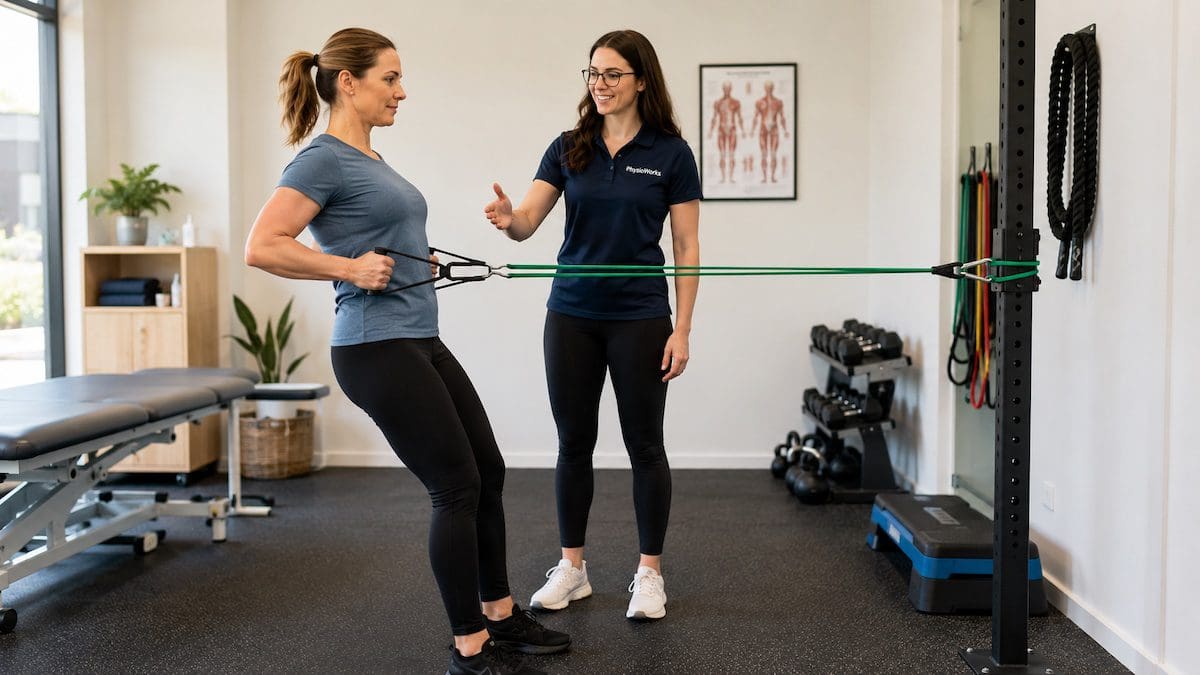
Exercise programs progress with clear coaching and control.
Types of Exercise Programs
Not every program looks the same. Your exercises may include:
- mobility or range-of-motion exercises
- muscle activation and early-stage control drills
- strength and endurance exercises
- balance and proprioception training
- motor control and movement retraining
- functional lifting, squatting, stepping, or reaching tasks
- running, jumping, or sport-specific return-to-play drills
Some people need simple home exercises. Others need gym-based progressions or a staged return-to-sport plan. Therefore, the program should reflect what you actually need to get back to.
The Role of a Physiotherapist and an Accredited Exercise Physiologist
A physiotherapist helps identify what is driving pain or restriction, then selects exercises to improve movement, control, and tolerance to load. An accredited exercise physiologist focuses on safe, structured exercise prescription, progression, and long-term behaviour change, especially when health conditions or deconditioning complicate training.
Together, they may help you:
- choose the right starting level so you do not flare up
- progress exercises at the right pace
- improve strength, balance, and capacity for work or sport
- build a plan you can actually follow
- adjust training around sleep, stress, and busy weeks
How Physiotherapists Design Exercise Programs
Physiotherapists design exercise programs by matching exercises to your symptoms, movement limits, training history, recovery goals, and current load tolerance. This helps the program start at a realistic level and progress safely.
Your first appointment usually includes a detailed history and movement assessment. Next, your clinician identifies key contributing factors such as strength deficits, joint stiffness, poor movement control, load intolerance, or training errors. Then you will usually trial a small number of exercises that suit your current level.
If needed, we can coordinate care across physiotherapy and exercise physiology to keep the plan consistent. After that, you leave with a clear plan, including:
- what to do, how often, and how hard it should feel
- what is normal post-exercise soreness
- what symptoms suggest the plan needs adjusting
- when to progress, and what to progress to next
Typical Progression of an Exercise Program
Most exercise programs change as you improve. Early on, your plan may focus on pain reduction, gentle activation, movement confidence, and basic control. After that, it often shifts towards strengthening, endurance, and better tolerance to load.
In the later stages, the focus may move to functional tasks, work demands, or sport-specific drills. This staged progression helps you build capacity without guessing what to do next. Meanwhile, your clinician can modify dosage, range, tempo, resistance, and rest to keep progress steady.
Benefits of Exercise Programs
A well-matched physiotherapy exercise program may help you:
- improve strength and joint support
- move with better control and confidence
- increase tolerance for work, walking, gym, or sport
- reduce the risk of repeated flare-ups
- return more safely to your usual activities
- build long-term habits that support recovery and health
Common Mistakes That Slow Progress
Many setbacks come from doing too much too soon. On the other hand, doing too little can also stall progress. Therefore, the right exercise dose matters.
Common issues include:
- starting sessions when already significantly flared up
- poor technique on key lifts or control drills
- inconsistent weeks followed by catch-up sessions
- progressing weight before movement quality is ready
- copying someone else’s program rather than following your own stage of recovery
These problems are usually fixable. Regular reviews help you stay on track and adjust the plan before minor setbacks become bigger ones.
Risks and Considerations
Exercise is helpful for many people, but the wrong exercise or the wrong dose can aggravate symptoms. In other words, the right exercise at the wrong time may still irritate the tissue. Progression should match your injury stage, recovery goals, and overall health.
For general Australian health guidance, see Healthdirect’s exercise and physical activity overview.
When Should You Seek Professional Advice?
You should consider professional advice if pain keeps returning, if you are unsure what type of exercise is safe, if symptoms worsen when you try to progress, or if you are preparing to return to demanding work or sport.
Professional guidance may help when you need a clear starting point, staged progressions, or a plan that adapts around pain, work demands, training load, and recovery goals.
Related Articles
These pages can help you choose the right next step for your condition, training goal, or recovery stage.
- Exercise Programs for Athletes
- Build strength and resilience, then return to sport with a structured rehabilitation plan.
- Post-Operative Exercise Rehabilitation
- Follow staged progressions that suit your surgery, healing stage, and recovery goals.
- Customised Exercise Programs for Injury Prevention
- Reduce injury risk by improving control, strength, and load tolerance.
- Exercise Physiology
- See how accredited exercise physiologists support structured exercise prescription and progression.
- Strengthening Exercises
- Learn how progressive strengthening supports recovery, function, and return to activity.
- Pre-Exercise Assessment
- Check your starting point before increasing training load or returning to exercise.
Exercise Program FAQs
What is an exercise program in physiotherapy?
An exercise program in physiotherapy is a tailored set of exercises matched to your condition, symptoms, goals, and current capacity. It may include strength work, mobility, balance, movement control, or return-to-sport drills.
How often should I do my exercise program?
Frequency depends on your symptoms, recovery stage, goals, and the type of exercise prescribed. Many people start with a few short sessions each week, then progress as tolerance improves.
Can exercise make my pain worse at first?
Some temporary soreness can occur when you begin or progress an exercise program. Sharp pain, increasing pain, or symptoms that linger may mean the load is too high or the exercise is not suitable yet.
When should I get help with an exercise program?
Consider professional help if pain keeps returning, symptoms worsen when you progress, or you are unsure which exercises are safe. Guidance may also help when you are returning to demanding work, sport, or gym training.
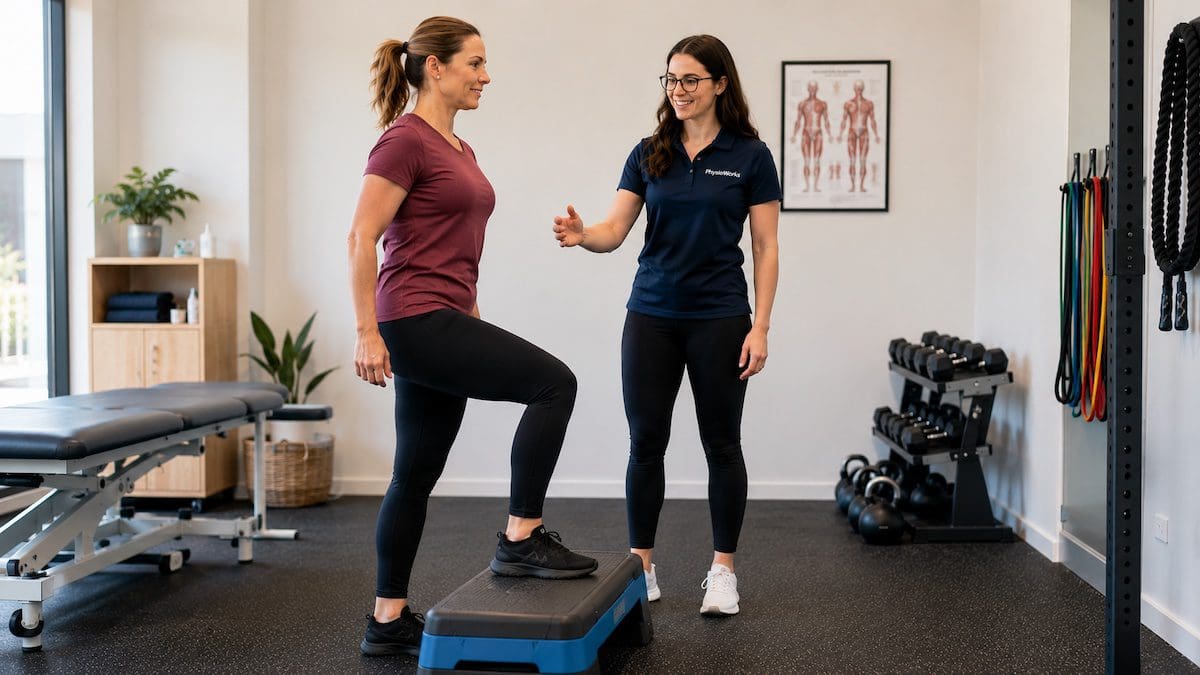
Staged progressions can build movement confidence.
What should you do now?
- Book an assessment if pain keeps returning or exercise keeps flaring symptoms.
- Bring your current gym, home, or rehab program to your appointment.
- Tell your clinician what you need to return to: work, sport, gym, walking, or daily life.
- Ask what symptoms are acceptable and what signs mean the plan needs changing.
What to Do Next
If pain, weakness, poor confidence, or repeated flare-ups are holding you back, book an assessment. A physiotherapist or accredited exercise physiologist can help map out a practical plan, then adjust it as you improve.
If you already train, bring your current program or a list of exercises you do. That way, we can refine what you are doing rather than starting from scratch.
Choose your clinic and appointment pathway
Select a PhysioWorks clinic to continue to live booking, an appointment request or reception assistance.
Strength Products
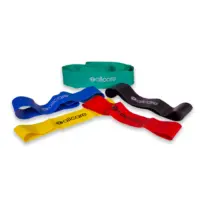
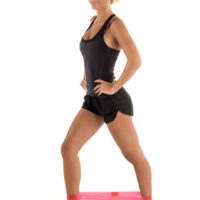
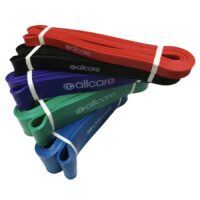
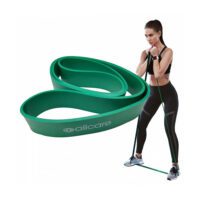
These strength products are commonly used by our physiotherapists to improve strength, controlled movement, plus assist home exercise programs.
-
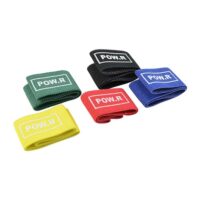 Exercise Equipment, Knee, Resistance Band
POW.R Fabric Mini Loop Bands
$12.00 – $55.00Select optionsQuick View -
-
-
 Exercise Equipment, Resistance Band
AllCare Powerloop Bands
$24.95 – $79.95Select optionsQuick View -
- Gift Ideas, Back, Christmas Gift Ideas, Exercise Balls, Exercise Equipment, Knee, Pelvic Floor, Product Search
66fit Pilates Balls
$14.95 – $16.95Select optionsQuick View -

-
-
-


- Exercise Equipment, Back, Elbow, Foot, Hand & Wrist, Knee, Resistance Band, Shoulder
Resistance Bands Pre-Packed 1.5m
$10.95Select optionsQuick View -
 Exercise Equipment, Resistance Band, Shoulder
Resistance Band Anchor Stirrup
$13.00Add to cartQuick View





Social Media
Stay up to date with exercise tips, injury management, tendon and muscle care, plus recovery ideas by following us on social media.


References
- Hayden JA, Ellis J, Ogilvie R, Stewart SA, Bagg MK, Stanojevic S, et al. Exercise therapy for chronic low back pain. Cochrane Database Syst Rev. 2021;9(9):CD009790. doi:10.1002/14651858.CD009790.pub2
- Lambert TE, Harvey LA, Avdalis C, Chen LW, Jeyalingam S, Pratt CA, et al. An app with remote support achieves better adherence to home exercise programs than paper handouts in people with musculoskeletal conditions: a randomised trial. J Physiother. 2017;63(3):161-167.
- Si J, Wang X, Xu Y, et al. Effectiveness of home-based exercise interventions on pain, physical function and quality of life in individuals with knee osteoarthritis: a systematic review and meta-analysis. J Rehabil Med. 2023.
- Hayden JA, Ellis J, Ogilvie R, et al. Some types of exercise are more effective than others in people with chronic low back pain: a network meta-analysis. J Physiother. 2021;67(4):252-262. doi:10.1016/j.jphys.2021.09.004
