When Are Pins and Needles Normal?
Short-lived pins and needles after an awkward position are common. They usually settle soon after you move, change posture, or remove pressure from the nerve.
However, symptoms deserve attention when they persist, return often, spread, or follow the same pathway through the arm, hand, leg, or foot.
When Should You Worry About Pins and Needles?
You should book an assessment if pins and needles last longer than expected, keep returning, spread, or occur with numbness, weakness, grip changes, or balance changes.
Book an assessment if you notice: - tingling lasting more than 30–60 minutes after changing position
- symptoms returning in the same fingers, toes, arm, or leg
- tingling spreading up or down the limb
- reduced feeling, reduced grip, or muscle weakness
- symptoms after a fall, collision, or significant injury
When Should You Seek Urgent Medical Care?
Seek urgent medical care if pins and needles occur with sudden neurological symptoms. These signs may indicate a serious medical condition that needs immediate assessment.
Seek urgent help for pins and needles with: - face drooping, speech changes, or one-sided weakness
- new severe headache, confusion, or sudden vision changes
- loss of bladder or bowel control
- numbness in the saddle area
- rapidly worsening weakness in an arm or leg
Can Physiotherapy Help Pins and Needles?
Physiotherapy may help when pins and needles relate to posture, movement, spinal irritation, local nerve compression, or nerve sensitivity linked with loading.
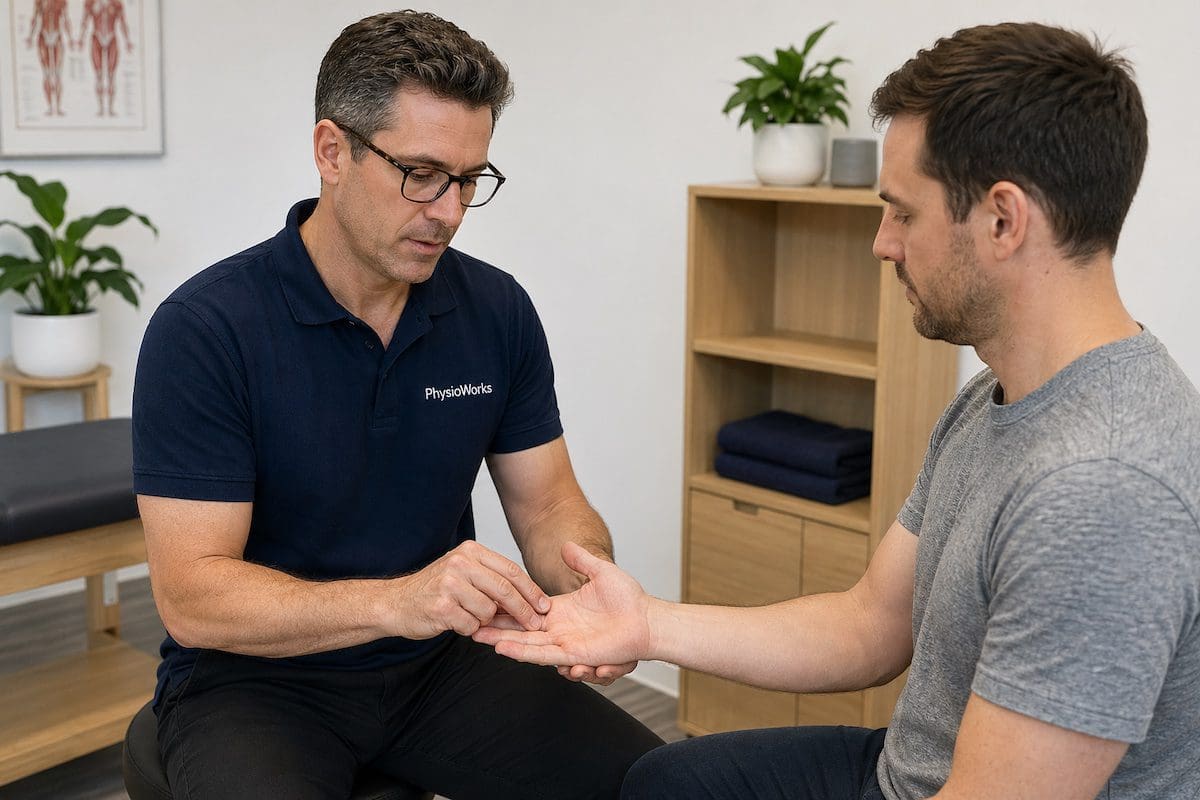
Your physiotherapist may check sensation, strength, reflexes, spinal movement, limb movement, posture, and symptom behaviour. Treatment may include education, activity changes, nerve mobility work, spinal movement exercises, load management, and graded strengthening.
Activity and Load Considerations
Small changes can reduce nerve irritation. The best approach depends on whether symptoms come from posture, spinal irritation, local compression, or repeated loading.
- Change posture regularly: avoid staying in one position too long.
- Modify gripping and tool use: reduce sustained clenching and vibration where possible.
- Check sleep posture: avoid prolonged neck rotation or sleeping with a bent wrist.
- Build tolerance gradually: increase training, lifting, and work demands in stages.
What Should You Do if Pins and Needles Keep Coming Back?
Track where the tingling occurs, how long it lasts, and what triggers it. Then book an assessment if symptoms repeat, spread, or affect strength, sensation, coordination, walking, or grip.
If symptoms suggest a broader medical cause, your physiotherapist may recommend GP review. For a deeper overview, start with our Nerve Pain and Pinched Nerve guides.
Frequently Asked Questions
What causes pins and needles in hands?
Pins and needles in the hands may come from temporary pressure, neck nerve irritation, or local nerve compression around the wrist, elbow, or shoulder. Repetitive tasks, sleeping posture, and sustained gripping can also contribute.
What causes pins and needles in feet?
Pins and needles in the feet may come from pressure on a local nerve, lower back nerve irritation, footwear pressure, circulation issues, or peripheral neuropathy. Repeated or spreading symptoms should be assessed.
Is pins and needles a sign of a pinched nerve?
It can be. A pinched or irritated nerve may cause tingling, numbness, burning, or electric sensations down an arm or leg. Assessment can help identify whether symptoms come from the spine or a local compression point.
Can posture cause pins and needles?
Yes. Sustained postures can increase pressure or tension around nerves, especially in the neck, shoulder, elbow, wrist, back, or hip. Regular position changes often help reduce short-lived symptoms.
Can repetitive work cause pins and needles?
Yes. Repetitive gripping, tool use, keyboard work, or vibration exposure can irritate nerves over time. Symptoms may appear in the hand, wrist, forearm, or fingers depending on the affected nerve.
When should pins and needles be checked?
Pins and needles should be checked if symptoms persist, return often, spread, or occur with numbness or weakness. You should also seek assessment if symptoms start after trauma or affect walking, balance, grip, or coordination.
What to Do Next
Pins and needles often reflect nerve irritation rather than permanent nerve damage. Still, repeated or spreading tingling needs a clear plan.
If your symptoms keep returning, spread, or come with weakness or numbness, book a physiotherapy assessment. Your clinician can help clarify whether the driver is spinal irritation, local nerve compression, or a broader issue needing medical review.