
Bulging Disc
Bulging Disc Symptoms, Causes & Treatment


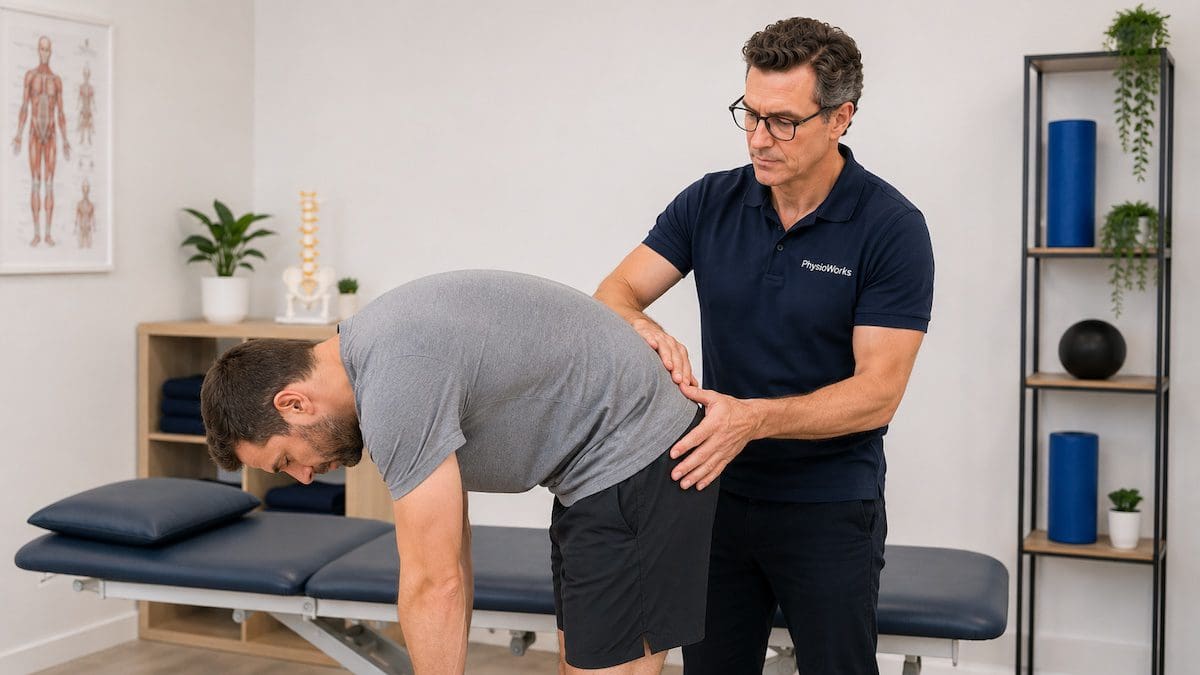
A clinical assessment helps determine whether a disc finding is relevant to your symptoms.
A bulging disc is a scan finding where part of a spinal disc extends beyond its usual boundary. It may cause no symptoms, or it may contribute to back pain, stiffness, buttock pain or sciatica when nearby sensitive tissue or a nerve root becomes irritated.
Many disc bulges are found in people without pain. A scan finding must match your symptoms, movement pattern and neurological signs before it can reasonably explain your problem. Most people improve without surgery through education, suitable activity and progressive rehabilitation.
What Is a Bulging Disc?
A bulging disc occurs when the outer contour of a spinal disc extends beyond the edge of the adjacent vertebrae. Spinal discs sit between the vertebrae, absorb load and allow movement. A bulge usually involves a broad section of the disc rather than a focal displacement.
People often use “bulging disc”, “slipped disc” and “herniated disc” interchangeably. Clinically, the terms describe different imaging appearances. The scan label alone does not establish the cause of pain or predict recovery.
| Term | What it generally describes | Does it always cause pain? |
|---|---|---|
| Disc bulge | A broad extension of the disc beyond its usual boundary. | No. It may be an incidental finding. |
| Disc protrusion | A more focal displacement where the base is wider than the outward extension. | No. Relevance depends on symptoms and clinical signs. |
| Disc extrusion | Disc material extends further than the width of its connection to the disc. | No, although nerve irritation may be more likely in some cases. |
A bulging disc is one possible contributor to lower back pain. Similar symptoms may arise from lumbar facet joint pain, a pulled back muscle, sacroiliac joint pain or spinal stenosis.
What Are Common Bulging Disc Symptoms?
Symptoms vary according to the spinal level involved, pain sensitivity and whether a nerve root is irritated. Some people notice only local back pain. Others develop symptoms into the buttock, thigh, calf or foot.
- Lower back pain or stiffness
- Pain spreading into the buttock or leg
- Burning, tingling, pins and needles or numbness
- Reduced leg strength in some nerve-related presentations
- Pain aggravated by sitting, bending, coughing, sneezing or lifting
- Reduced tolerance for walking, work, sleep, gym, sport or daily tasks
Symptoms do not always follow the same pattern. Some people feel worse with sitting or bending, while others feel worse standing or walking. This variability is one reason individual assessment matters.
Can a Bulging Disc Cause Sciatica?
Yes. A lumbar disc bulge may cause sciatica if inflammation or mechanical pressure irritates a nerve root. Symptoms can include pain, tingling, numbness or weakness travelling from the lower back into the buttock and leg.
Not all leg pain is sciatica. Hip, joint, muscle, tendon and other nerve conditions can produce similar symptoms. Examination helps determine whether nerve-root involvement is likely and whether further medical review is needed.
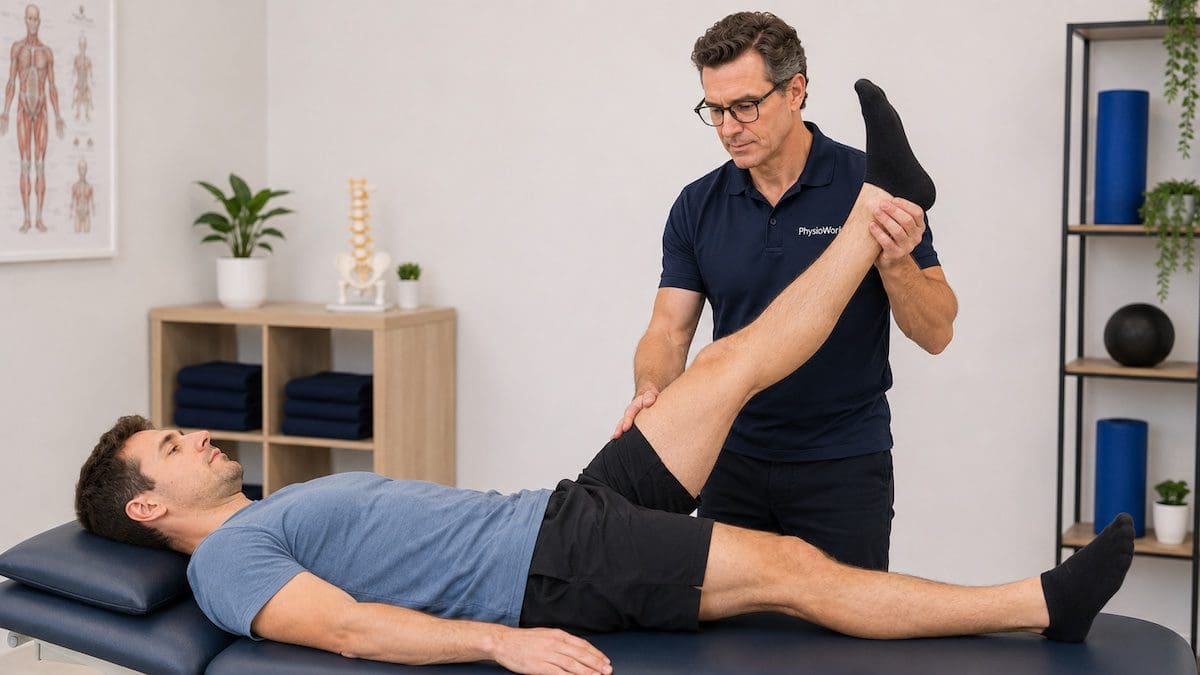
Leg pain, numbness or weakness may require neurological and nerve-mobility testing.
Why Do Disc Bulges Develop?
Disc bulges commonly develop as part of age-related change in the spine and are also found in people without back pain. Symptoms can appear after a change in loading or activity, although one movement or event is not always the cause.
-
Age-related change
Discs naturally change in hydration, height and shape over time. These changes are common, including in people without pain.
-
Load change
A sudden increase in lifting, bending, work, gym or sport may exceed current tissue and movement tolerance.
-
Repeated aggravation
Long sitting periods or repeated tasks may provoke symptoms when there is too little movement variety or recovery.
Genetics, smoking, sleep, general health and previous back episodes may also influence disc health and pain. Reduced fitness or trunk capacity can affect how well someone tolerates activity, but a bulge does not mean the spine is fragile.
How Is a Bulging Disc Assessed?
Assessment begins with your symptom history, function, movement responses and a neurological screen when required. A physiotherapist may check walking, spinal movement, strength, reflexes, sensation and nerve-related symptoms. They will also screen for features that warrant medical review.
-
Clarify the symptom pattern
Identify where symptoms travel, what aggravates or eases them, and how they affect sleep, work and activity.
-
Check movement and function
Assess relevant spinal, hip and functional movements to find tolerable directions and meaningful limitations.
-
Screen the nervous system
Test strength, reflexes, sensation and nerve mobility when leg pain, numbness or weakness is present.
-
Plan the next step
Match treatment to the findings or arrange medical review or imaging when the presentation requires it.
Do You Need an MRI?
Most new episodes of uncomplicated lower back pain do not need immediate imaging. MRI may be considered when severe or progressive neurological signs are present, serious pathology is suspected, symptoms remain disabling despite appropriate care, or the result is likely to change management.
Imaging must be interpreted carefully because disc bulges and other age-related findings are common in people without pain. Your GP or specialist can determine whether imaging is appropriate for your presentation.
How Is a Bulging Disc Treated?
Treatment aims to reduce irritation, restore confidence and progressively rebuild the capacity needed for daily life. The plan should match your symptom behaviour, neurological findings, goals and general health.
-
Education and pacing
Understand the likely pain driver, use tolerable positions and vary activity without unnecessary fear or prolonged rest.
-
Graded exercise
Build walking, spinal movement, trunk, hip and leg capacity, then progress towards lifting, work, gym or sport.
-
Manual therapy
Hands-on treatment may help short-term pain or stiffness when used as part of an active rehabilitation plan.
-
Work and lifting strategies
Adjust task dose, workstation habits and lifting technique while gradually rebuilding tolerance to normal demands.
Depending on the findings, your program may use back pain exercises, core stability training or Pilates for back pain. Soft tissue treatment or dry needling may help some people with associated muscle pain, but passive treatment should not replace gradual activity restoration.
Should You Exercise With a Bulging Disc?
Most people benefit from continuing suitable movement rather than stopping activity completely. Gentle walking, position changes and individual exercises can reduce stiffness and support recovery. The correct type and dose depend on how irritable your symptoms are.
A temporary increase in back discomfort does not always mean harm. However, stop and seek advice if exercise causes increasing leg pain, spreading numbness, new weakness or a clear loss of function.
| Response | What it may mean | Practical action |
|---|---|---|
| Symptoms remain mild and settle soon afterwards | The activity dose may be suitable. | Continue and progress gradually. |
| Back pain rises moderately but returns to baseline | The dose may be near your current limit. | Reduce range, load or duration, then reassess. |
| Leg pain spreads further, numbness increases or weakness appears | Nerve irritation may be worsening. | Stop the aggravating activity and arrange assessment. |
How Long Does Recovery Take?
Recovery time varies, but many episodes improve substantially over several weeks with appropriate conservative care. Nerve-related symptoms may take longer than local back pain. Progress depends on symptom severity, neurological involvement, general health, work demands and confidence with movement.
Recovery is rarely perfectly linear. Short flare-ups can occur while activity increases. The overall trend in pain, sleep, walking, strength and function matters more than one difficult day.
Can You Prevent Another Flare-Up?
No strategy can prevent every episode, but better physical capacity and sensible load progression can reduce avoidable flare-ups.
- Change position regularly during long sitting periods.
- Build walking and general fitness gradually.
- Progress lifting, gym and sport loads rather than making sudden jumps.
- Strengthen your trunk, hips and legs.
- Use practical lifting strategies that match the task.
- Address recurring symptoms before they become highly limiting.
- Support recovery through adequate sleep, stress management and general health care.
When Is a Bulging Disc an Emergency?
Most disc-related pain is not an emergency, but possible cauda equina syndrome or rapidly worsening neurological loss requires urgent medical assessment.
Related Back Pain Information
Bulging Disc FAQs
Can a bulging disc heal on its own?
Many people improve without surgery. Disc tissue and inflammation may change over time, while movement tolerance and confidence improve. Treatment focuses on symptoms and function rather than requiring a scan to look normal.
Is walking good for a bulging disc?
Walking is often helpful when the dose suits your symptoms. Start with short, regular walks and adjust the distance if back or leg symptoms remain noticeably worse afterwards.
Should I rest or keep moving?
Brief relative rest may help during a strong flare, but prolonged bed rest can slow recovery. Most people do better with comfortable movement, regular position changes and a gradual return to activity.
Do I need an MRI for a bulging disc?
Not always. Imaging is usually reserved for presentations where serious pathology or significant neurological loss is suspected, symptoms remain disabling, or the result would change management.
What should I avoid with a bulging disc?
Temporarily reduce tasks that clearly aggravate symptoms, such as repeated heavy bending or lifting. Avoid broad or permanent restrictions. The goal is to rebuild normal movement and load tolerance progressively.
Can exercise make a bulging disc worse?
An unsuitable exercise dose can flare symptoms, but well-selected exercise usually supports recovery. Seek review if exercise causes spreading leg pain, increasing numbness or new weakness.
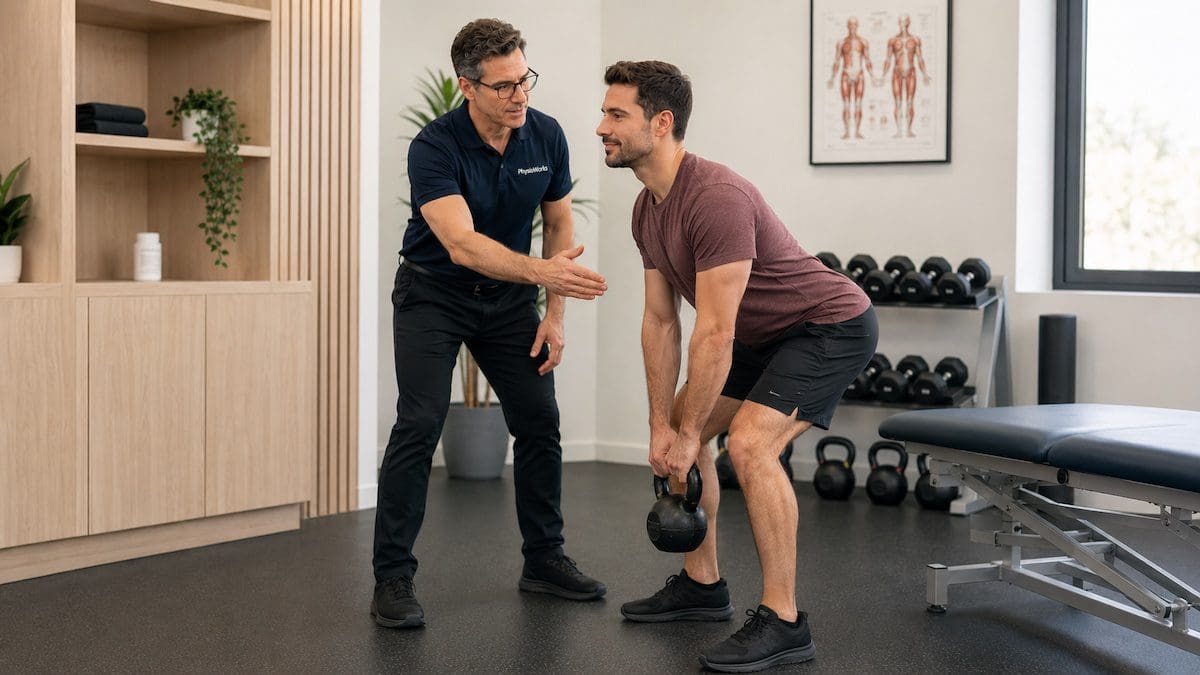
Graded rehabilitation builds confidence with bending, lifting and everyday activity.
What to Do Next
Book an assessment if back or leg symptoms are persistent, recurring or limiting sleep, work, walking or exercise. A physiotherapist can assess whether the pattern suggests disc-related pain, sciatica or another cause and develop a suitable rehabilitation plan.
Choose your clinic and appointment pathway
Select a PhysioWorks clinic to continue to live booking, an appointment request or reception assistance.
Back Support Products
These back support products are commonly used by our physiotherapists to help reduce back pain, improve comfort, and support your recovery at home.
-
 Back, Braces & Supports, Maternity, Posture
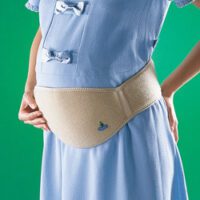
Maternity Back Support – OPPO 2062
$60.00 – $64.00Select optionsQuick View -
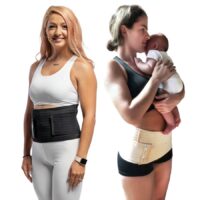
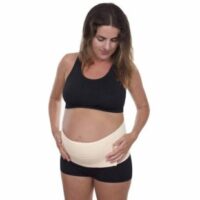 Back, Braces & Supports, Maternity, Posture
Pregnancy Belly Band & C-Section 3-in-1
$94.99Select optionsQuick View - Braces & Supports, Back, Maternity, SIJ
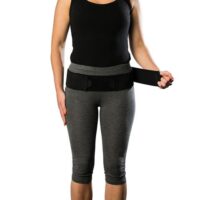
AOM38 AllCare Ortho Core Stability Belt
$49.95Select optionsQuick View -
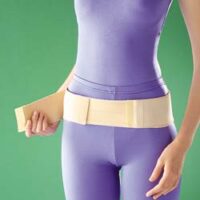 Back, Braces & Supports, Maternity, SIJ
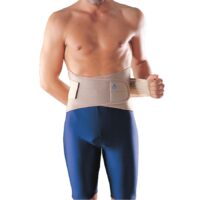
Core Stability Support – OPPO 3462
$54.00Select optionsQuick View -
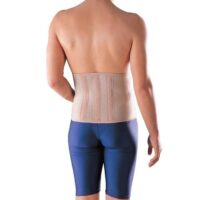
-
-
 Braces & Supports, Back, Maternity, SIJ
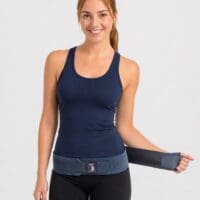
Maternity Support Belt – OPPO 4062
$37.00Select optionsQuick View -
References
- Yaman O, Guchkha A, Vaishya S, Zileli M, Zygourakis C, Oertel J, et al. The role of conservative treatment in lumbar disc herniations: WFNS Spine Committee recommendations. World Neurosurg X. 2024;22:100277. doi:10.1016/j.wnsx.2024.100277.
- George SZ, Fritz JM, Silfies SP, Schneider MJ, Beneciuk JM, Lentz TA, et al. Interventions for the management of acute and chronic low back pain: revision 2021. J Orthop Sports Phys Ther. 2021;51(11):CPG1-CPG60. doi:10.2519/jospt.2021.0304.
- Du S, Cui Z, He C, Li J, et al. Clinical efficacy of exercise therapy for lumbar disc herniation: a systematic review and meta-analysis of randomised controlled trials. Front Med (Lausanne). 2025;12:1531637. doi:10.3389/fmed.2025.1531637.
- Kilpikoski S, Häkkinen AH, Repo JP, Kyrölä K, Multanen J, Kankaanpää M, et al. The McKenzie Method versus guideline-based advice in the treatment of sciatica: 24-month outcomes of a randomised clinical trial. Clin Rehabil. 2024;38(1):72-84. doi:10.1177/02692155231196393.
- National Institute for Health and Care Excellence. Low back pain and sciatica in over 16s: assessment and management. NICE guideline NG59. Updated 2020.
