
What Is Therapeutic Ultrasound in Physiotherapy?


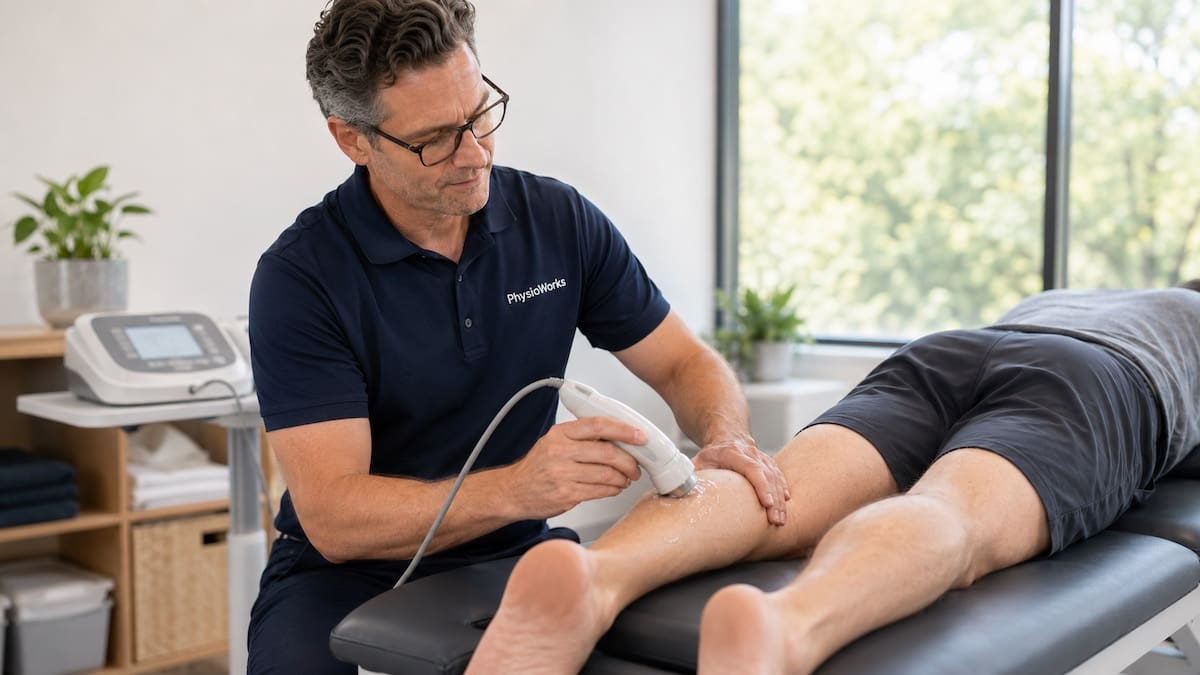
Ultrasound treatment example for a calf muscle injury.
Therapeutic ultrasound is a physiotherapy treatment that uses sound waves through the skin. A physiotherapist may use it for selected soft tissue, tendon, joint, or lactation-related problems after an assessment. It usually sits beside physiotherapy treatment, exercise, advice, load control, and hands-on care.
The sound waves pass from a small probe through gel on the skin. Depending on the settings, the aim may be mild warmth, gentle tissue movement, or comfort during a broader treatment session. If your symptoms are recent, our acute injury treatment guide may help you choose the right early step.
Quick Summary
- Therapeutic ultrasound uses sound waves, not diagnostic imaging.
- It may help comfort or tissue warmth in selected cases.
- Research is mixed, so it should not be used as a stand-alone treatment.
- Exercise, education, and load management remain central for most injuries.
- Your physiotherapist should explain why it is being used.
Looking for the full treatment overview? Read our main guide: Therapeutic Ultrasound Physiotherapy. It explains how this modality may fit into a treatment plan and what to consider next.
Does Therapeutic Ultrasound Help Injuries?
It may help some people, but results vary. Research has found possible pain or function gains in selected musculoskeletal conditions. Other reviews show little added value for some injuries, such as acute ankle sprains.
This is why your physiotherapist should match the treatment to your injury, goals, stage of healing, and response to loading. If it does not add clear value, another treatment option may make more sense.
How May Therapeutic Ultrasound Help?
Therapeutic ultrasound may be used when pain, stiffness, or soft tissue sensitivity limits movement. It may assist comfort during a session, especially when paired with active rehabilitation.
A physiotherapist may use it to warm deeper tissues before movement or hands-on care. Pulsed settings may be used when heat is not the goal. Continuous settings may be used when mild warmth is helpful.
It is not a stand-alone fix. Most muscle strains, ligament injuries, tendon problems, and joint conditions still need the right mix of movement, loading, strength work, and advice.

Shoulder soft tissue ultrasound treatment example.
When Might a Physio Consider It?
- Soft tissue irritation
- Calf strain or tear when symptoms and timing suit its use
- Muscle strain during a staged rehab plan
- Ligament sprain or tear when symptoms suit its use
- Tendinopathy where comfort is limiting exercise tolerance
- Local joint or soft tissue stiffness
- Mastitis or blocked ducts as part of broader care
Can Therapeutic Ultrasound Be Used for Mastitis?
In selected cases, physiotherapists may use therapeutic ultrasound for mastitis or blocked ducts. This should sit within a broader care plan that may include your GP, lactation consultant, and women’s health physiotherapist.
Seek medical review promptly if you have fever, chills, rapidly spreading redness, worsening pain, or feel generally unwell.
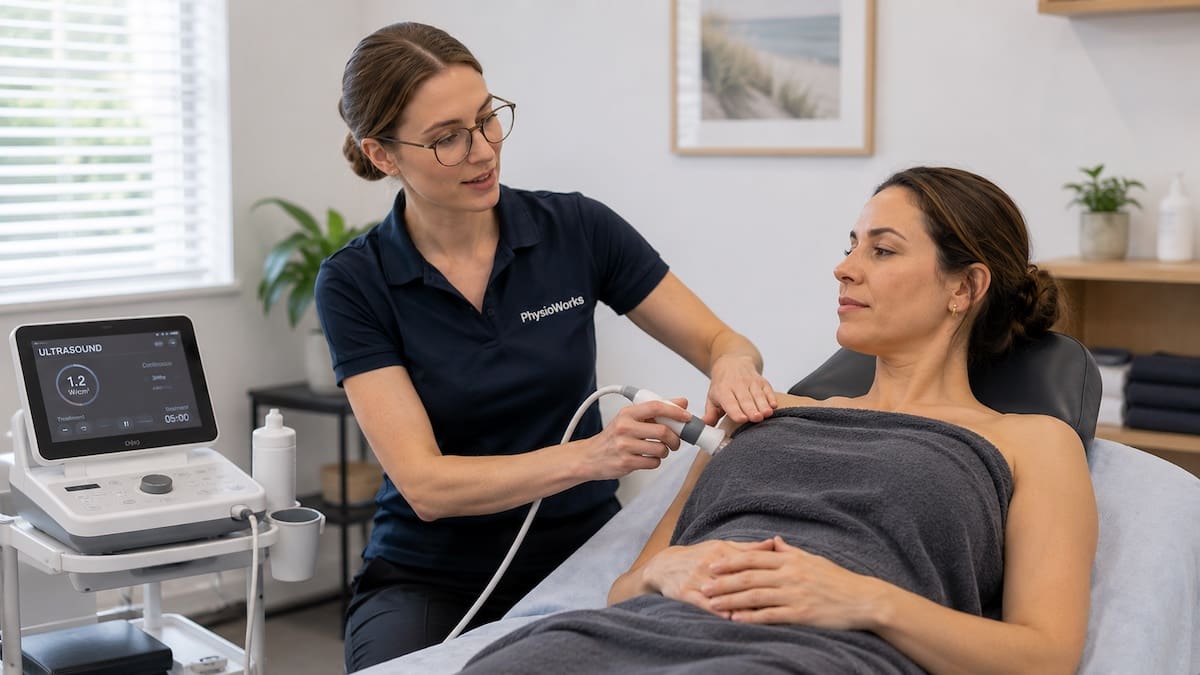
Discreet ultrasound setup for selected mastitis care.
What Happens During Treatment?
Treatment usually takes about three to ten minutes. Your physiotherapist applies gel to the skin, then keeps the probe moving over the treatment area. Some people feel mild warmth. Others feel very little.
Dose depends on the body area, tissue depth, injury stage, sensitivity, and treatment goal. Your physiotherapist should explain why it is being used and what it adds to your plan. They may also discuss other common physiotherapy treatment techniques.
How Does Therapeutic Ultrasound Work?
The treatment probe contains crystals that vibrate when power passes through them. This creates sound waves. These waves move through the skin and into the tissues below.
Settings can change for deeper or shallower tissues. They can also change if the goal is heat or no heat. Dose matters, so therapeutic ultrasound should be applied by a trained clinician who understands safety precautions.
When Is Therapeutic Ultrasound Not Used?
Physiotherapists avoid therapeutic ultrasound in some situations. Tell your physiotherapist about your medical history before treatment starts.
- Known or suspected cancer in the treatment area
- Active infection
- Major blood vessel problems
- Growth plates in children
- Eyes, skull, or reproductive organs
- Directly over the abdomen during pregnancy
- Some post-surgical or nerve-related regions
Is This Treatment Right for You?
Therapeutic ultrasound may suit you if a physiotherapist has assessed your injury and believes it may help comfort or movement during rehab.
It may not suit you if exercise, load advice, bracing, taping, hands-on care, or medical review is the more useful next step.
Questions to Ask Your Physiotherapist
- What is this treatment aiming to change?
- How will we check whether it helps?
- What should I do after the session?
- Which exercise or loading plan supports the treatment?
- When should we change the plan if symptoms do not improve?
Related Information
- Therapeutic Ultrasound Physiotherapy
- Electrotherapy and Local Modalities
- Physiotherapy Treatment
- Acute Injury Treatment
- Sports Injury Physiotherapy
- Calf Strain and Tear
- Soft Tissue Injuries
- Tendinopathy
- Mastitis and Blocked Ducts
- Common Physiotherapy Treatment Techniques
Therapeutic Ultrasound FAQs
What is therapeutic ultrasound in physiotherapy?
Therapeutic ultrasound is a physiotherapy technique that uses sound waves through the skin. It does not create images like diagnostic ultrasound. A physiotherapist may use it for selected soft tissue, tendon, joint, or lactation-related problems as part of a broader plan.
Does therapeutic ultrasound help soft tissue injuries?
It may help comfort in selected cases, but research is mixed. Some conditions may respond better than others. For many injuries, exercise, load management, advice, and graded return to activity remain more important than ultrasound alone.
What does therapeutic ultrasound feel like?
Many people feel little during treatment. Some notice mild warmth. Tell your physiotherapist if it feels hot, sharp, uncomfortable, or unusual so they can adjust or stop the treatment.
How long does therapeutic ultrasound take?
Most sessions involve about three to ten minutes of ultrasound. The exact time depends on the treatment area, tissue depth, injury stage, and goal of treatment.
Is therapeutic ultrasound safe?
It is generally considered safe when used by a trained clinician and screened properly. It is not suitable for all body areas or all health conditions, so assessment and safety checks matter.
Is therapeutic ultrasound the same as diagnostic ultrasound?
No. Diagnostic ultrasound creates images of tissues. Therapeutic ultrasound is a treatment tool that applies sound waves through a handheld probe. Your physiotherapist should explain which type is being discussed.
What to Do Next
If you have a new injury, ongoing pain, or a flare-up that is not settling, book a physiotherapy assessment. Your physiotherapist can explain whether therapeutic ultrasound belongs in your plan or whether another treatment path makes more sense.
For a deeper overview, read our main Therapeutic Ultrasound Physiotherapy guide.
Choose your clinic and appointment pathway
Select a PhysioWorks clinic to continue to live booking, an appointment request or reception assistance.
Muscle & Soft Tissue Products
These muscle and soft tissue products are commonly used by our physiotherapists to relax or loosen muscles, improve strength, comfort, flexibility, and home exercise programs.
-


-
-

- Liniments & Gels, Massage Liniments, Pain Management
Fisiocrem
$16.95 – $39.95Select optionsQuick View -
 Exercise Equipment, Knee, Resistance Band
POW.R Fabric Mini Loop Bands
$12.00 – $55.00Select optionsQuick View -
-
-
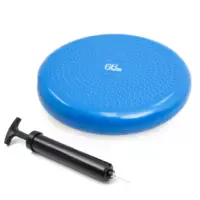
 Exercise Balls, Back, Exercise Equipment, Knee, Shoulder
66fit Exercise Balls | Core & Rehab Stability Ball
$32.00 – $57.00Select optionsQuick View -
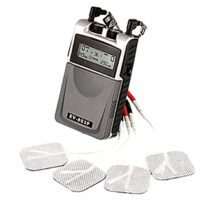
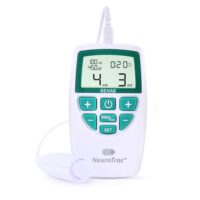
- EMS Machines, Pain Management, TENS Machine, TENS Machine & EMS
NeuroTrac Rehab (TENS Machine + EMS)
$285.00Add to cartQuick View -
-
-


-

 Exercise Equipment, Resistance Band
AllCare Powerloop Bands
$24.95 – $79.95Select optionsQuick View









References
- Guan H, Zhang L, Wang Y, et al. Ultrasound therapy for pain reduction in musculoskeletal diseases: a systematic review and meta-analysis. Ther Adv Musculoskelet Dis. 2024;16:1759720X241267217. doi:10.1177/1759720X241267217
- Li X, Wang Y, Zhang Y, et al. Efficacy and safety of low-intensity ultrasound therapy in the management of myofascial pain syndrome: a systematic review and meta-analysis. J Pain Res. 2024;17:4321-4336. doi:10.2147/JPR.S489977
- van den Bekerom MPJ, Struijs PAA, Blankevoort L, Welling L, van Dijk CN, Kerkhoffs GMMJ. Therapeutic ultrasound for acute ankle sprains. Cochrane Database Syst Rev. 2011;(6):CD001250. doi:10.1002/14651858.CD001250.pub2
- Rutjes AWS, Nüesch E, Sterchi R, Jüni P. Therapeutic ultrasound for osteoarthritis of the knee or hip. Cochrane Database Syst Rev. 2010;(1):CD003132. doi:10.1002/14651858.CD003132.pub2
