
Rugby Union Injuries: Common Injuries and Return to Play
A practical rugby union injury guide covering warning signs, rehabilitation and staged return to play.


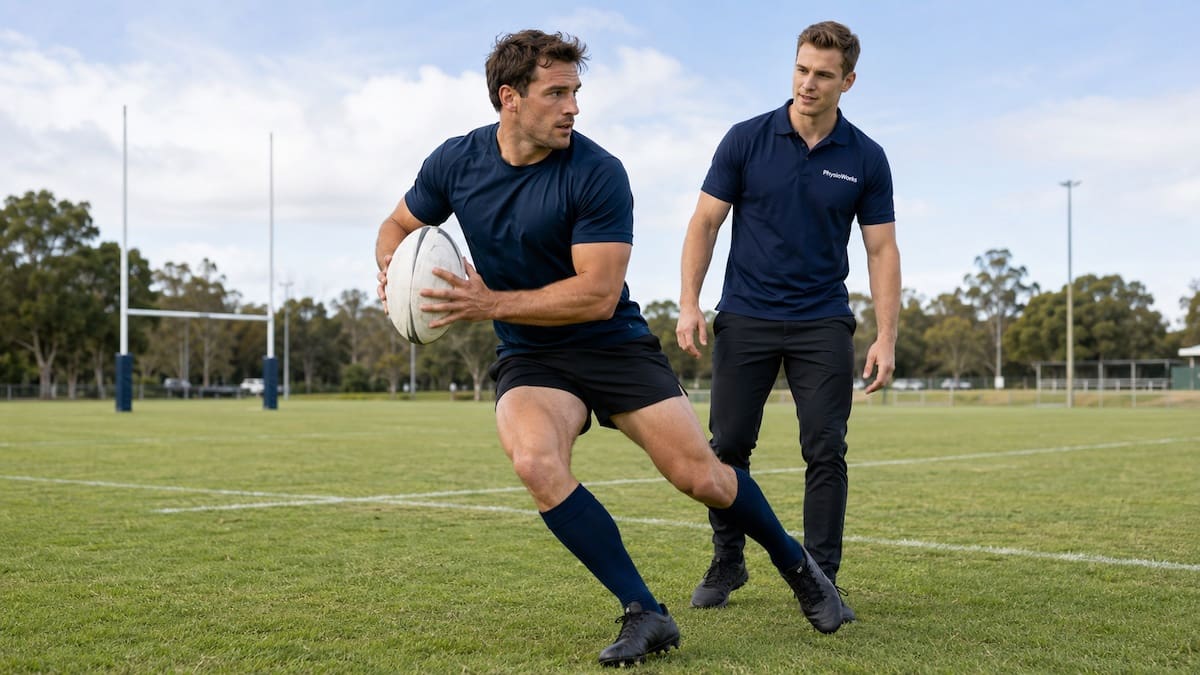
Field-based assessment of rugby movement and control.
Rugby union injuries commonly affect the knee, shoulder, head, thigh, hamstring, groin, ankle and neck. Rugby combines repeated collisions with sprinting, tackling, scrummaging, jumping, kicking and rapid changes of direction.
Some injuries occur suddenly during contact or an awkward landing. Others build as repeated running, kicking and training loads exceed the player’s current capacity. This guide explains common injury patterns, warning signs and the steps involved in returning to rugby.
Quick Rugby Injury Check
- Stop play immediately after suspected concussion, shoulder dislocation, severe pain or a major loss of function.
- Arrange an assessment when swelling, weakness, instability or pain continues after training or match play.
- Return progressively through skills, running, controlled contact, full training and match exposure.
Explore Football Injury Guides
Compare playing demands, injury patterns and rehabilitation needs across football codes.
What Are the Most Common Rugby Union Injuries?
Rugby injuries develop through direct contact, rapid acceleration, twisting, planted-foot rotation and repeated training load. Tackles, scrums, rucks and awkward landings can cause sudden injuries. Sprinting, kicking and repeated change of direction can also overload muscles and tendons.
The knee, shoulder and head are frequent problem areas. The hamstring, groin, thigh and ankle also tolerate substantial match and training loads.
A 2026 systematic review reported 19.9 time-loss injuries and 33.6 medical-attention injuries per 1000 rugby union player-hours. Lower-limb injuries were most common, followed by head and upper-limb injuries.1
Where Does Pain Occur During Rugby?
The action that aggravates your symptoms can help identify which body region needs assessment. However, a playing action does not confirm a diagnosis.
Tackling and Falling
Shoulder, AC joint, head, neck and rib symptoms may follow direct contact or landing on the arm.
Scrums, Rucks and Mauls
Repeated bracing and collision loads can affect the neck, shoulder, back, hip and knee.
Sprinting and Chasing
High-speed running commonly loads the hamstring, calf, groin and hip flexor muscles.
Sidestepping and Cutting
Rapid direction changes can load the ACL, meniscus, ankle and adductor muscles.
Jumping and Landing
Poor landing position or contact in the air may affect the knee, ankle or shoulder.
Kicking
Repeated kicking can load the groin, hip flexors, quadriceps and hamstrings.
Rugby Injuries by Body Region
Head, Neck and Shoulder
Contact, tackles and falls can transfer force through the upper body.
Hip, Groin and Thigh
Contact, acceleration, kicking and sidestepping load the upper leg.
Knee
Contact, rotation, cutting and awkward landings can affect knee stability.
Calf, Ankle and Foot
Running, tackling and change of direction can overload the lower leg.
Why Does Rugby Union Cause Injuries?
Rugby union combines repeated collisions with sprinting, deceleration, sidestepping, jumping and unpredictable contact. During one passage of play, a player may load the shoulder in a tackle, rotate through the knee during a step and sprint immediately afterwards.
Fatigue can change body position, reaction speed and decision-making. Late tackles, poorer leg control and rushed contact technique can therefore increase injury risk. Surface quality, footwear, contact exposure and sudden increases in weekly training load may also contribute.
Does Playing Position Affect Injury Risk?
Forwards usually tolerate more repeated contact, scrummaging, rucking and close-range collision load. Backs often face greater sprint exposure, open-field tackling and high-speed change of direction.
Junior and adolescent players may experience changing strength, coordination and body size during growth. Training and match demands should progress with the player’s current capacity rather than age alone.
Suspected Concussion?
Stop play immediately and remove the player from the field. A player with suspected concussion should not return to play that day.
Follow the current Rugby Australia concussion pathway and arrange appropriate medical assessment before returning to contact training or matches.
When Does a Rugby Injury Need Prompt Assessment?
Do not continue playing if an injury causes severe pain, major swelling, deformity, giving way, locking, neurological symptoms or difficulty walking. A suspected shoulder dislocation, significant knee injury or neck injury may require urgent medical assessment.
Book a physiotherapy assessment when pain, weakness, swelling or reduced confidence continues after training. Repeated flare-ups when sprinting, tackling or cutting can indicate that the player has not yet rebuilt enough capacity for rugby.
How Can Physiotherapy Help Rugby Injuries?
Physiotherapy for rugby injuries starts by identifying the likely injured structure and the demands the player needs to regain. Assessment may include joint movement, swelling, strength, landing control, cutting mechanics and tolerance to running or contact positions.
Management may include:
- education about the injury and expected recovery pathway
- short-term protection and load modification
- strength and movement rehabilitation
- running, jumping and change-of-direction progressions
- position-specific rugby drills
- graduated contact preparation
- objective return-to-sport testing
Learn more about sports injury physiotherapy, browse the wider sports injury hub, or review the acute sports injury clinic pathway.
An exercise physiologist may support later-stage conditioning and work-capacity development. Massage may help short-term comfort or recovery, but it should support rather than replace a complete rehabilitation plan.
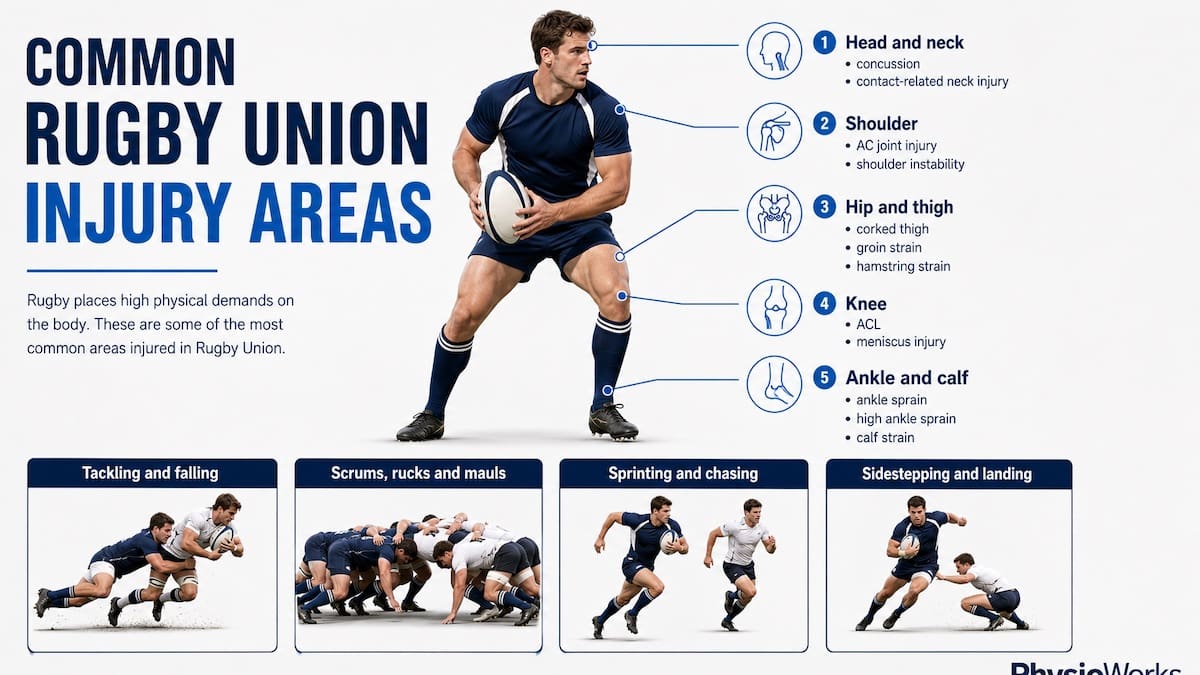
Common rugby injury areas reflect contact, running and change-of-direction demands.
How Can Rugby Injuries Be Prevented?
Rugby injury prevention works best when players develop contact tolerance, strength, movement skill and recovery together. No exercise program removes all risk. However, structured preparation may reduce avoidable injuries and improve readiness.
Warm-Up
Use progressive running, balance, landing and contact-readiness drills before training and matches.
Strength
Maintain hamstring, groin, calf, trunk, neck and shoulder strength throughout the season.
Technique
Practise tackling, landing, deceleration and sidestep control before fatigue becomes excessive.
Recovery
Monitor soreness, sleep, fatigue and next-day symptoms before adding more training load.
Build contact exposure progressively rather than stacking several demanding sessions together. Players with repeated injuries may benefit from a targeted injury prevention program and the practical advice in our injury prevention essentials.
Community teams can also use World Rugby Activate or a comparable structured warm-up.
How Do You Return Safely to Rugby?
Return to rugby should progress from lower-risk activity to full match demands. The exact pathway depends on the injury, playing position and competition level.
Return-to-Rugby Progression
- Settle symptoms: pain, swelling and irritability remain controlled during daily activity.
- Rebuild capacity: strength, mobility, running tolerance and basic rugby skills improve.
- Add sport demands: sprinting, cutting, jumping, bracing and controlled contact progress gradually.
- Resume full training: complete normal sessions without a major symptom increase during or the next day.
- Return to matches: contact confidence, conditioning and position-specific readiness support match exposure.
Players should tolerate rugby skills under fatigue before expecting full game performance. Pain-free jogging alone does not prove readiness for sprinting, tackling or repeated contact.
Related Football Injury Guides
- Rugby league injuries — collision, running and tackle-related injury patterns.
- AFL injuries — jumping, kicking, sprinting and contact-related injuries.
- Soccer injuries — running, kicking and change-of-direction injuries.
- Football injuries — explore the broader football injury cluster.
Rugby Injury FAQs
What are the most common rugby union injuries?
Common rugby union injuries affect the thigh, hamstring, knee, shoulder, ankle, neck and head. Rugby exposes players to collisions, sprinting, cutting, kicking and repeated contact load.
What should I do straight away after a corked thigh?
Stop playing, protect the area and avoid aggressive stretching early. Arrange an assessment if bruising, swelling, pain or walking difficulty increases.
How do I know if my knee injury needs assessment?
Seek assessment for rapid swelling, giving way, locking, reduced movement or pain that prevents running and training. These signs may occur with meniscus or ligament injuries.
What should I do if I suspect concussion?
Stop playing immediately and leave the field. Do not return that day. Follow Rugby Australia’s concussion pathway and obtain appropriate medical assessment before returning to contact.
Can physiotherapy help prevent repeat rugby injuries?
Physiotherapy may help identify strength, movement and workload factors linked with repeat injury. A progressive rehabilitation and return-to-rugby program can then address the player’s specific demands.
What To Do Next
If a rugby injury is limiting training, tackling, sprinting or match play, a physiotherapist can assess the problem and plan a staged return to rugby.
Choose your clinic and appointment pathway
Select a PhysioWorks clinic to continue to live booking, an appointment request or reception assistance.
Muscle & Soft Tissue Products
These muscle and soft tissue products are commonly used by our physiotherapists to relax or loosen muscles, improve strength, comfort, flexibility, and home exercise programs.
-

-
 Exercise Equipment, Knee, Resistance Band
POW.R Fabric Mini Loop Bands
$12.00 – $55.00Select optionsQuick View -
-


-
-
-
-

-
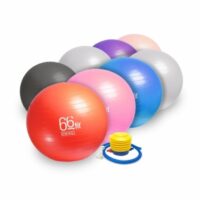
 Exercise Balls, Back, Exercise Equipment, Knee, Shoulder
66fit Exercise Balls | Core & Rehab Stability Ball
$32.00 – $57.00Select optionsQuick View -
-
-
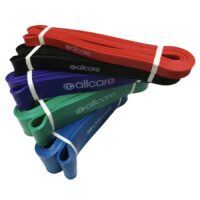
 Exercise Equipment, Resistance Band
AllCare Powerloop Bands
$24.95 – $79.95Select optionsQuick View - EMS Machines, Pain Management, TENS Machine, TENS Machine & EMS
NeuroTrac Rehab (TENS Machine + EMS)
$285.00Add to cartQuick View - Liniments & Gels, Massage Liniments, Pain Management
Fisiocrem
$16.95 – $39.95Select optionsQuick View













References
- Laaksonen J, Vaajala M, Pakarinen O, Liukkonen R, Kuitunen I. Epidemiology of rugby injuries: a systematic review and meta-analysis. BMJ Open Sport Exerc Med. 2026;12:e001999.
- Murray-Smith S, Williams S, Whalan M, Peoples GE, Sampson JA. The incidence and burden of injury in male adolescent community rugby union in Australia. Sci Med Footb. 2023;7(4):315-322.
- King D, Barden C, Quarrie KL, et al. Injury rates, mechanisms, risk factors and prevention strategies in youth rugby union: a systematic review and meta-analysis. Sports Med. 2023;53(9):1835-1858.
- Rugby Australia. Concussion Management.
- World Rugby. What is Activate and why should coaches use it?.
