
Shoulder Dislocation
Shoulder Dislocation
A shoulder dislocation occurs when the ball of the upper arm completely leaves the shoulder socket. It usually causes sudden pain, loss of movement and sometimes a visible change in shoulder shape. A shoulder that remains out of position needs urgent medical care.


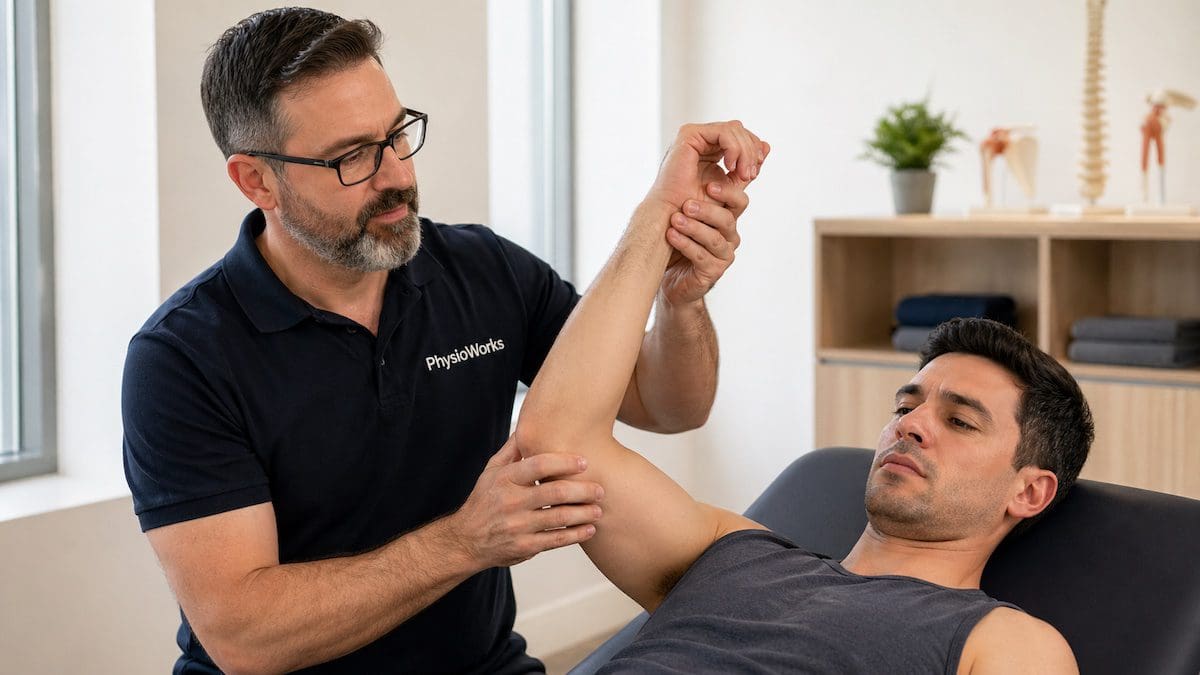
Clinical assessment can identify movement loss, weakness and ongoing instability after a shoulder dislocation.
A shoulder subluxation is a partial dislocation. The joint shifts partly out of position and then returns. Both injuries can stretch or damage the tissues that stabilise the shoulder.
After the joint has been put back into position, rehabilitation may help restore movement, strength, stability and confidence. Treatment should reflect the injury, your age, associated tissue damage and the demands of daily life, work or sport.
Immediate care
Support the arm and seek prompt medical assessment.
Common imaging
X-rays usually check the joint position and look for a fracture.
Rehabilitation
Recovery progresses through movement, strength, control and task-specific loading.
For broader information, explore shoulder pain conditions or read about shoulder instability.
What Is a Shoulder Dislocation?
The shoulder joint contains the rounded head of the upper arm bone, called the humeral head. It sits in a shallow socket called the glenoid.
A complete dislocation occurs when the humeral head leaves the socket. Because the shoulder has a wide range of movement, it relies on its capsule, ligaments, labrum, rotator cuff and shoulder blade muscles for stability.
A traumatic dislocation may stretch or tear these tissues. It can also injure nearby bone, cartilage, tendons, nerves or blood vessels.
What Is the Difference Between a Dislocation and Subluxation?
What Causes a Dislocated Shoulder?
Most shoulder dislocations follow trauma. Common causes include a fall, tackle, collision, awkward landing or forceful overhead movement.
During an anterior dislocation, the arm is often forced backwards while lifted away from the body. Previous dislocation, joint laxity and reduced shoulder control may increase the risk.
Sports that place the arm in vulnerable positions include rugby, martial arts, swimming, cricket, volleyball and throwing sports.
When labral damage is suspected, read about shoulder labrum injuries.
What Are the Main Types of Shoulder Dislocation?
Anterior dislocation
The humeral head moves forwards out of the socket. This is the most common type.
Posterior dislocation
The humeral head moves backwards. It may follow a seizure, electric shock or high-force trauma.
Inferior dislocation
The humeral head moves below the socket. The arm may become fixed overhead.
What Is Multidirectional Shoulder Instability?
Multidirectional instability means the shoulder feels loose or unstable in more than one direction. It is different from a single traumatic dislocation and may occur with generalised joint laxity, repeated overhead activity or reduced muscular control.
Management commonly focuses on rotator cuff endurance, shoulder blade control and progressive loading. Learn more about shoulder instability.
What Are the Symptoms of Shoulder Dislocation?
A complete dislocation usually causes sudden pain, loss of movement and a visible change in shoulder contour. A subluxation may feel as though the joint briefly slips or pops out and back in.
- Sudden shoulder pain after an injury
- Visible deformity or flattening of the shoulder contour
- Inability or marked difficulty moving the arm
- A popping-out or slipping sensation
- Ongoing looseness, apprehension or giving way
- Numbness, tingling or weakness in the arm or hand
- Swelling, bruising or muscle spasm
How Is a Shoulder Dislocation Diagnosed?
A clinician considers the injury mechanism, symptoms and visible shoulder position. They also check skin colour, circulation, sensation and muscle function before and after the joint is reduced.
X-rays commonly confirm the joint position and check for fractures. Other imaging may help when pain, weakness or instability continues.
X-ray
Checks joint alignment and associated fractures.
MRI or MR arthrogram
May assess the labrum, capsule, rotator cuff and cartilage.
CT scan
May assess shoulder-socket or humeral-head bone loss before surgery.
Someone with a suspected fracture may need assessment for a fractured humerus. Persistent weakness may also require assessment for a rotator cuff tear.
What Other Injuries Can Occur?
A shoulder dislocation can injure more than the tissues that hold the joint in position. Associated injuries may affect recurrence risk, rehabilitation and whether a surgical opinion is appropriate.
Bankart lesion
An injury to the lower front part of the labrum and capsule that may contribute to recurrent instability.
Hill-Sachs lesion
An impression injury on the humeral head caused when it contacts the edge of the socket.
Rotator cuff injury
More common after dislocation in adults over 40, particularly when weakness continues.
Axillary nerve injury
May cause numbness over the outer shoulder or weakness in the affected arm.
Fracture
The humerus or shoulder socket may be injured during the dislocation.
Circulation injury
A cold, pale or blue hand requires urgent medical assessment.
How Can Physiotherapy Help After a Shoulder Dislocation?
Physiotherapy uses staged rehabilitation to restore comfortable movement, shoulder control, strength and confidence.
The program should reflect your injury pattern, age, associated tissue damage, recurrence risk, treatment choice and daily, work or sporting demands.
There is no single recovery timeline. Progress depends on symptoms, movement, imaging findings, medical advice and whether the shoulder was treated surgically.
-
Protect and settle the shoulder
Early care follows medical and sling instructions while managing pain and maintaining safe movement in nearby joints.
-
Restore comfortable movement
Exercises gradually restore shoulder range without forcing positions that cause marked pain or apprehension.
-
Build strength and stability
Rehabilitation develops rotator cuff strength, shoulder blade control, endurance and joint-position awareness.
-
Return to work, exercise or sport
Later rehabilitation adds lifting, overhead control, speed, power, contact preparation and activity-specific tasks.
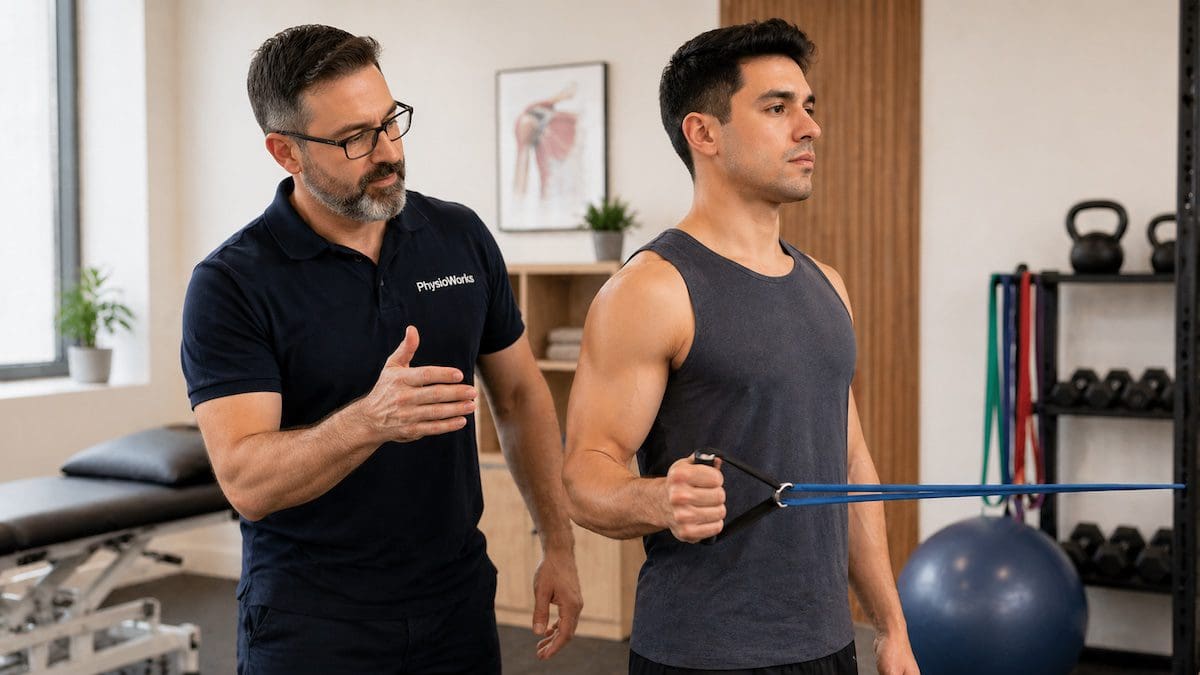
Progressive rotator cuff exercise can help rebuild shoulder control after a dislocation.
How Are Exercises Progressed?
External rotation exercises are often introduced once the shoulder is safe to load. Resistance, range, speed and arm position should progress according to symptoms and the demands of daily activity, work, gym or sport.
Browse general shoulder exercise information, but follow individual guidance after a recent dislocation.
How Does Age Affect Recovery?
Age influences recurrence and associated injury risk, although it does not determine treatment by itself. Sport, occupation, previous instability, joint laxity, labral injury and bone loss also matter.
Under 25
Recurrence risk is often higher, particularly when returning to collision or demanding overhead sport.
Age 25 to 40
Treatment depends strongly on activity demands, ongoing instability and associated structural injury.
Over 40
Persistent weakness may suggest an associated rotator cuff injury and need further assessment.
Can a Shoulder Dislocation Happen Again?
Yes. Recurrent instability is more common in younger people and those returning to collision or high-demand overhead sport.
Risk may also increase with previous episodes, persistent apprehension, generalised joint laxity, labral injury and significant bone loss.
Rehabilitation may improve shoulder control and reduce modifiable risk. However, exercise cannot reverse every structural injury.
Who May Respond Well to Non-Surgical Treatment?
Many people recover well with structured physiotherapy, particularly after a first-time dislocation when recurrence risk is lower.
Non-surgical management may be suitable when the person:
- Has experienced a first-time dislocation
- Does not participate in collision or high-risk overhead sport
- Has no major shoulder-socket or humeral-head bone loss
- Regains stable day-to-day function during rehabilitation
- Has reducing apprehension and improving confidence
- Can complete a progressive strength and control program
When May an Orthopaedic Opinion Help?
An orthopaedic opinion may help when the risk of another dislocation is high or the shoulder remains unreliable despite appropriate rehabilitation.
- Repeated dislocations or subluxations
- Giving way during work, daily tasks or sport
- Participation in high-demand collision or overhead sport
- Significant labral injury or bone loss
- Ongoing apprehension in required shoulder positions
- Heavy lifting or overhead work requirements
- Failure to regain dependable function
Can Risk Scores Decide the Best Treatment?
Clinical risk scores can support decision-making by combining factors such as age, activity demands, injury pattern and imaging findings.
However, a score estimates risk. It should not determine treatment by itself. The decision should also reflect your symptoms, goals, work, sport, confidence and preferences.
What Is Shoulder Stabilisation Surgery?
Shoulder stabilisation surgery aims to improve joint stability after repeated dislocation or significant structural injury.
Common procedures repair or tighten the labrum and capsule. Other procedures may address bone loss from the shoulder socket or humeral head.
The procedure selected depends on the direction of instability, number of episodes, tissue damage, bone loss, age and activity demands.
What Happens During Rehabilitation After Surgery?
Post-operative rehabilitation begins by protecting the surgical repair. Sling use and movement restrictions depend on the procedure and the surgeon’s protocol.
Early protection
Follow the surgeon’s sling, wound-care and movement instructions while managing pain and swelling.
Movement restoration
Progress shoulder movement gradually within the limits set by the procedure and surgeon.
Strength and function
Rebuild rotator cuff strength, shoulder blade control and lifting capacity before advancing to work, gym or sport tasks.
Learn more about post-operative rehabilitation.
When Can You Return to Sport?
Return to sport should depend on function rather than time alone. Contact sport, throwing and high-speed overhead activity usually need a longer progression than general exercise.
Return-to-sport criteria may include:
- Near-full and comfortable shoulder movement
- Adequate rotator cuff and shoulder blade strength
- No meaningful apprehension in required positions
- Good control during reaching, lifting and landing tasks
- Tolerance of progressive training loads
- Successful completion of sport-specific drills
- Medical or surgical clearance where required
When Can You Return to Work?
Return-to-work timing depends on the role. Desk duties may resume earlier than heavy lifting, repeated overhead work, climbing or manual handling.
A graded plan may include temporary restrictions, modified duties and progressive exposure to lifting, carrying and overhead tasks.
Shoulder Dislocation FAQs
How long does a shoulder dislocation take to heal?
Recovery time varies. Comfortable day-to-day movement may improve over several weeks, while strength, control and confidence can take several months. Contact sport, throwing and demanding overhead work often require a longer staged program.
Do I need physiotherapy after a shoulder dislocation?
Physiotherapy commonly helps restore movement, rebuild rotator cuff and shoulder blade control and guide a safe return to activity. The program should reflect your age, injury, recurrence risk, imaging and work or sport demands.
What is the difference between a shoulder dislocation and subluxation?
A dislocation means the upper arm bone completely leaves the socket. A subluxation is a partial slip in which the joint shifts partly out and returns. Both injuries can damage the tissues that stabilise the shoulder.
Can a shoulder dislocation happen again?
Yes. Repeat instability is more common in younger people, collision-sport athletes and those with previous dislocations, labral damage or bone loss. Repeated episodes may require an orthopaedic opinion.
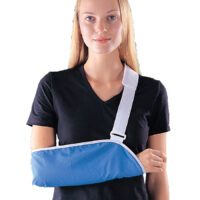
Should I wear a sling after a shoulder dislocation?
A sling may provide short-term comfort and protection. The recommended duration varies, and prolonged immobilisation may increase stiffness. Follow the instructions from your emergency clinician, doctor, surgeon or physiotherapist.
Can I exercise after a shoulder dislocation?
Exercise can begin when it is safe for your injury stage. Early exercises often focus on comfortable movement and gentle muscle activation. Resistance, overhead loading, speed and contact should progress gradually.
When can I return to sport after shoulder stabilisation surgery?
Timing varies by procedure and sport. Clearance depends on movement, strength, control, symptoms, sport-specific testing and surgeon guidance rather than time alone.
What to Do Next
If your shoulder looks out of place after an injury, seek urgent medical care. Do not attempt to put it back yourself.
After the shoulder has been reduced, arrange further assessment if pain, weakness, movement loss, apprehension or instability continues.
Your next step should reflect your age, associated injury, recurrence risk and work or sporting demands.
Choose your clinic and appointment pathway
Select a PhysioWorks clinic to continue to live booking, an appointment request or reception assistance.
Shoulder Products
These shoulder products are commonly used by our physiotherapists to improve strength, posture, movement, plus assist home exercise programs.
-
-

-
 Exercise Balls, Back, Exercise Equipment, Knee, Shoulder
66fit Exercise Balls | Core & Rehab Stability Ball
$32.00 – $57.00Select optionsQuick View -
-
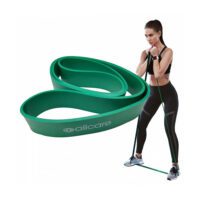 Exercise Equipment, Resistance Band
AllCare Powerloop Bands
$22.00 – $65.00Select optionsQuick View -
-

-
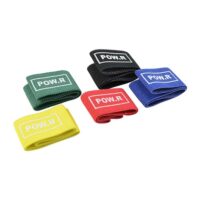 Exercise Equipment, Knee, Resistance Band
POW.R Fabric Mini Loop Bands
$12.00 – $55.00Select optionsQuick View - Liniments & Gels, Massage Liniments, Pain Management
Fisiocrem
$16.95 – $39.95Select optionsQuick View -

-
-
-
- EMS Machines, Pain Management, TENS Machine, TENS Machine & EMS
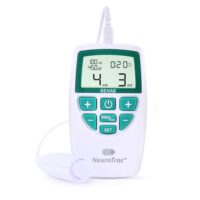
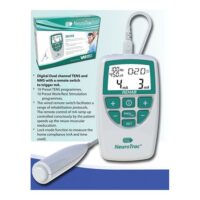
NeuroTrac Rehab (TENS Machine + EMS)
$299.95Add to cartQuick View -




References
- Marigi EM, Wilbur RR, Song BM, et al. The Nonoperative Instability Severity Index Score: Is It Predictive in a Larger Shoulder Instability Population at Long-Term Follow-Up? Arthroscopy. 2022;38(1):22-27. doi:10.1016/j.arthro.2021.05.021.
- Cutteridge J, Dixon J, Garrido P, et al. A systematic review and meta-analysis of operative versus non-operative management for first-time traumatic anterior shoulder dislocation in young adults. Shoulder & Elbow. 2025;17(2). doi:10.1177/17585732241254693.
- Wright AC, et al. Risk Factors Associated With First-Time and Recurrent Shoulder Instability. Orthop J Sports Med. 2024;12(4).
- Agency for Clinical Innovation. Shoulder dislocation fact sheet. NSW Health.
- Healthdirect Australia. Shoulder stabilisation surgery. Healthdirect Australia.
