
Discoid Meniscus
A discoid meniscus is a thicker, broader variation of the knee meniscus. It most often affects the lateral meniscus and may cause clicking, pain, swelling or difficulty straightening the knee.


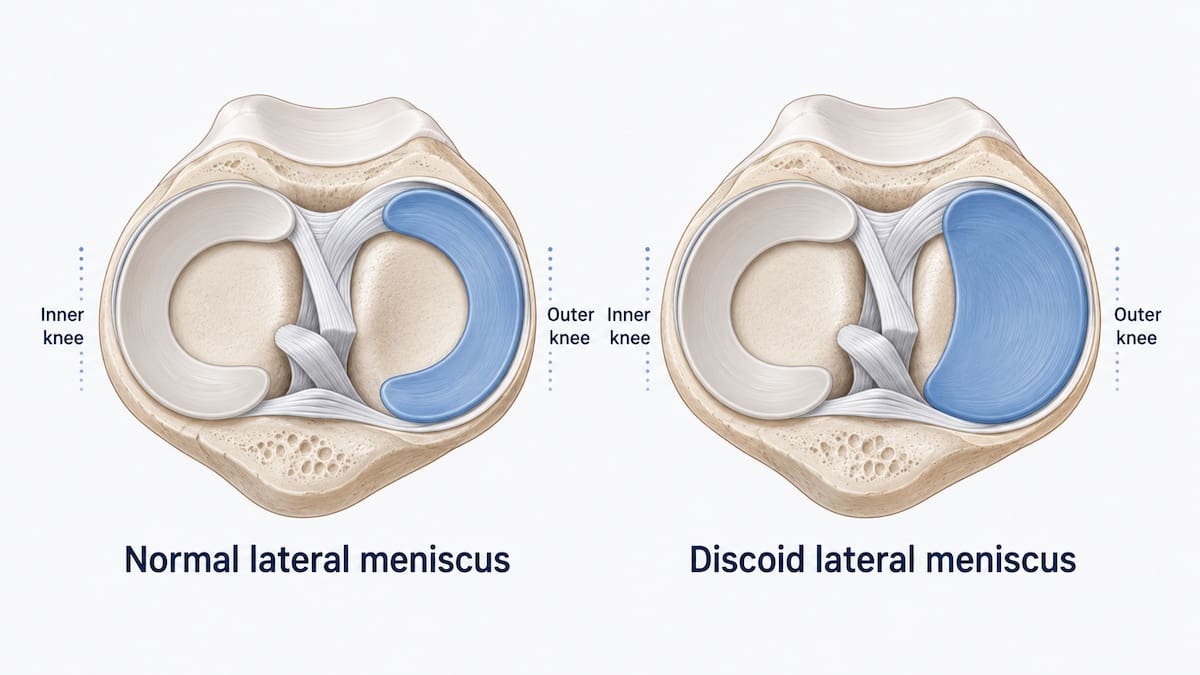
A meniscus is a strong pad of fibrocartilage that helps distribute load, absorb shock and support knee stability. Each knee has a medial meniscus on the inside and a lateral meniscus on the outside.
A discoid meniscus most commonly affects the lateral meniscus. Its broader shape and altered attachments can make it more vulnerable to abnormal movement, instability or tearing. However, the anatomical variation itself does not always cause pain.
Symptoms can resemble those of a meniscus tear or another cause of knee pain. A clinical assessment can help determine what may be contributing to the symptoms.
What Is a Discoid Meniscus?
A typical meniscus has a curved or C-shaped appearance. A discoid meniscus covers more of the top of the shin bone and is usually thicker than a typical meniscus.
The variation is considered congenital, which means it develops before birth. Its exact cause is not fully understood. It may affect one or both knees and often remains unnoticed unless symptoms develop.
Usual location
The lateral meniscus on the outer side of the knee is affected most often.
Common age group
Symptoms are frequently recognised during childhood or adolescence, although they can appear later.
Not always painful
Some people have a discoid meniscus without pain, swelling or activity restrictions.
What Are the Symptoms of a Discoid Meniscus?
Symptoms vary considerably. Some children have painless clicking, while others develop pain, swelling or mechanical symptoms that interfere with walking and sport.
Possible symptoms include:
- Clicking, clunking or snapping during knee movement
- Pain along the outer knee joint line
- Swelling after running, jumping or sport
- A catching or locking sensation
- Difficulty fully straightening the knee
- A feeling that the knee is giving way
- Reduced confidence during turning or changing direction
A tear or unstable portion of the discoid meniscus may increase pain, swelling and mechanical symptoms.
How Is a Discoid Meniscus Diagnosed?
A physiotherapist or doctor will ask about the symptoms, when they began and whether the knee catches, locks or swells. The examination may assess:
- Knee bending and straightening
- Joint-line tenderness
- Swelling within the knee
- Walking, squatting and single-leg control
- Clicking, catching or other mechanical symptoms
- Strength and movement differences between the legs
Standard X-rays do not show the meniscus clearly. However, they may help exclude some other causes of knee symptoms.
Magnetic resonance imaging, commonly called an MRI, can show the shape of the meniscus and help identify a tear, instability or another knee injury. Imaging findings should be considered alongside the person’s symptoms and clinical assessment.
Does a Discoid Meniscus Need Treatment?
Management depends on the symptoms rather than the meniscus shape alone. A discoid meniscus found incidentally may not require active treatment when it causes no pain, swelling, locking or functional restriction.
No symptoms
Observation and general activity may be appropriate when the knee is comfortable and functioning normally.
Mild or occasional symptoms
Assessment, load modification and rehabilitation may help address irritation, weakness and reduced knee control.
Persistent mechanical symptoms
Repeated locking, restricted movement, ongoing swelling or a symptomatic tear may require an orthopaedic opinion.
Treatment decisions should consider the person’s age, symptoms, activity, examination findings and imaging. Individual management can vary.
How Can Physiotherapy Help?
Physiotherapy cannot change the anatomical shape of a discoid meniscus. However, it may help manage symptoms, restore function and guide activity when surgery is not required.
A rehabilitation program may include:
- Temporary modification of painful running, jumping or pivoting activities
- Exercises for quadriceps, hamstring, calf and hip strength
- Knee balance and movement-control exercises
- Gradual progression of running, landing and change-of-direction tasks
- Advice about returning to school sport or club sport
- Monitoring for increasing swelling, locking or loss of movement
Assessment may also help distinguish a discoid meniscus from other causes of knee pain in young people, including Osgood-Schlatter disease, fat pad syndrome and other sports knee injuries.
When Is Surgery Considered?
Surgery may be considered when symptoms remain significant or when the knee repeatedly locks, cannot fully straighten or has a symptomatic tear or unstable meniscus.
When surgery is appropriate, the aim is generally to preserve as much healthy meniscal tissue as possible. Depending on the findings, treatment may involve reshaping the meniscus, repairing a tear or stabilising an unstable attachment.
Removing the entire meniscus is generally avoided where possible because the meniscus helps distribute load and protect the knee joint.
What Happens After Surgery?
Rehabilitation varies according to the surgical procedure. Recovery after reshaping alone may differ from recovery after a meniscal repair.
-
Protect the healing knee
Early restrictions may apply to walking, knee movement or weight-bearing, particularly after a repair.
-
Restore movement and muscle control
Rehabilitation usually progresses knee range, swelling control and quadriceps activation.
-
Rebuild strength and balance
Exercises gradually become more challenging as comfort, control and healing improve.
-
Prepare for running and sport
Later rehabilitation may include landing, jumping, running and change-of-direction exercises.
A surgeon and physiotherapist should guide the progression. People recovering from an operation may also find the knee arthroscopy rehabilitation guide helpful.
When Should You Seek Help?
Arrange an assessment when a child or teenager experiences:
- Repeated knee locking or catching
- Difficulty fully straightening the knee
- Recurring swelling after activity
- Persistent outer-knee pain
- A limp or reduced participation in normal activities
- Symptoms that are worsening rather than settling
Early assessment does not mean surgery will be necessary. It can clarify the likely cause, identify functional limitations and determine whether rehabilitation, imaging or specialist review is appropriate.
Choose your clinic and appointment pathway
Select a PhysioWorks clinic to continue to live booking, an appointment request or reception assistance.
References
- Birchard Z, Sweeney KR. Discoid Meniscus. StatPearls Publishing; updated 2024.
- Trisolino G, et al. The discoid lateral meniscus in children: a narrative review of pathology, diagnosis and treatment. Ann Joint. 2022.
- Tapasvi S, Shekhar A, Eriksson K. Discoid lateral meniscus: current concepts. J ISAKOS. 2021;6(1):14-21.
- Kocher MS, Logan CA, Kramer DE. Discoid lateral meniscus in children: diagnosis, management, and outcomes. J Am Acad Orthop Surg. 2017;25(11):736-743.
- Ahn JH, Kim KI, Wang JH, Jeon JW, Cho YC, Lee SH. Long-term results of arthroscopic reshaping for symptomatic discoid lateral meniscus in children. Arthroscopy. 2015;31(5):867-873.
Discoid Meniscus FAQs
What is a discoid meniscus?
A discoid meniscus is a congenital variation in which a knee meniscus is broader and thicker than usual. It most commonly affects the lateral meniscus on the outer side of the knee.
Is a discoid meniscus always painful?
No. Many people have no pain or functional problems. Symptoms may develop if the meniscus is unstable, irritated or torn.
Can a discoid meniscus cause knee locking?
Yes. An unstable or torn discoid meniscus can cause catching, locking or difficulty fully straightening the knee. A knee that remains mechanically locked needs prompt assessment.
How is a discoid meniscus diagnosed?
Diagnosis is based on the symptoms, a clinical knee examination and, when required, MRI findings. Standard X-rays do not show the meniscus clearly.
Can physiotherapy change a discoid meniscus?
Physiotherapy cannot change the meniscus shape. However, rehabilitation may help improve strength, movement control, activity tolerance and recovery before or after surgery.
Does a discoid meniscus require surgery?
Not always. A symptom-free discoid meniscus may only require observation. Surgery may be considered for persistent pain, repeated locking, restricted knee movement or a symptomatic tear.
