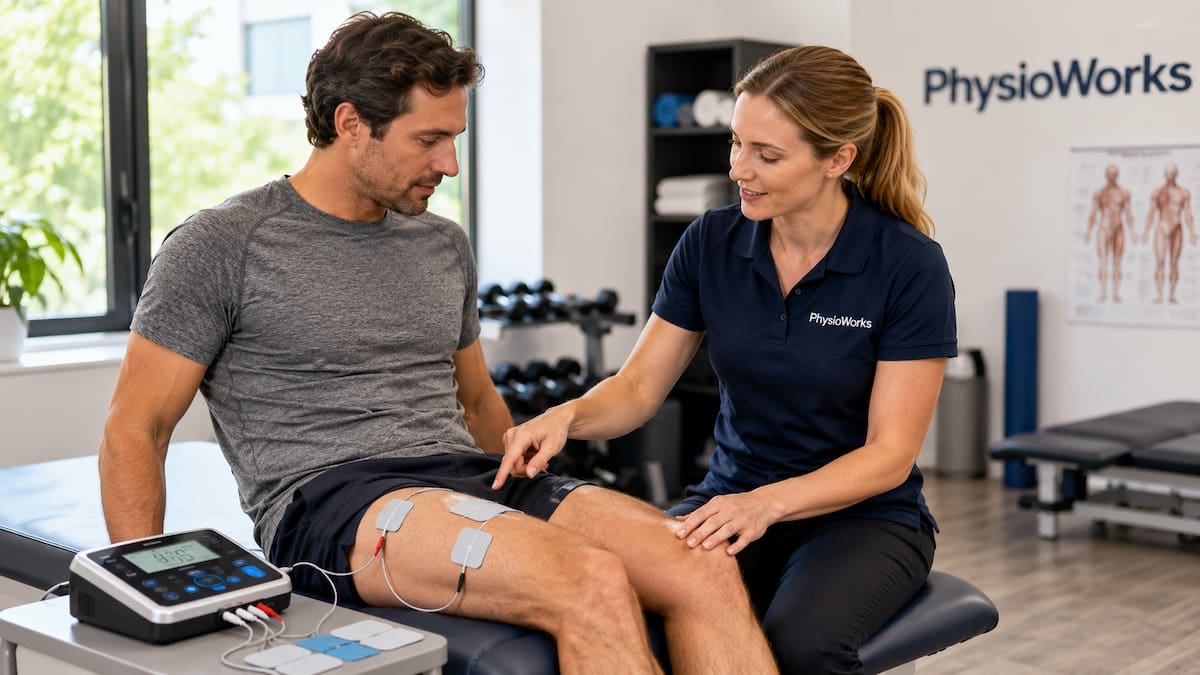
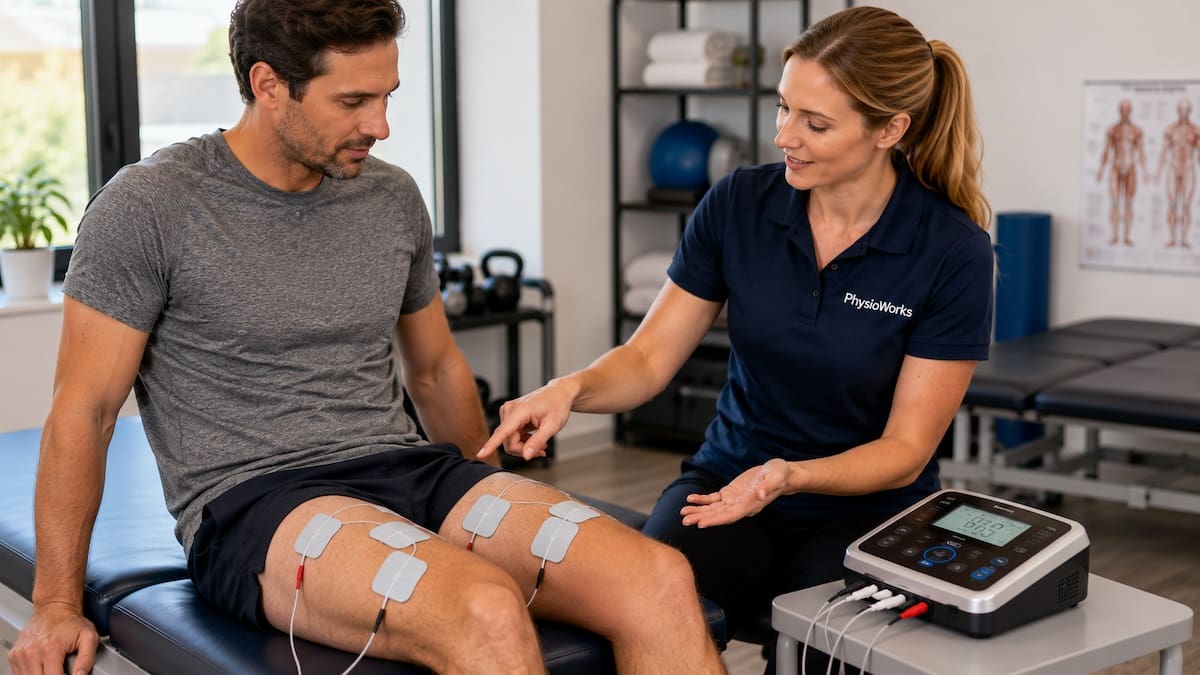
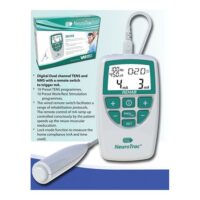
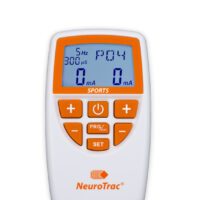
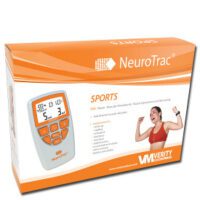
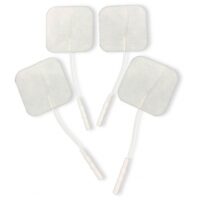
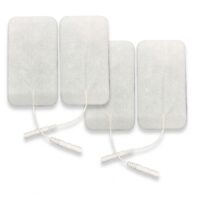
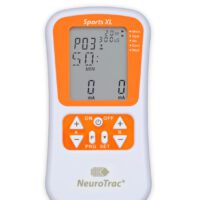
EMS pads positioned over the quadriceps during rehabilitation.
Main EMS goal
Produce a controlled muscle contraction to support activation or strength.
Best used with
Active exercise and a progressive rehabilitation or strengthening program.
EMS or TENS?
EMS targets muscle contraction. TENS mainly aims to provide temporary pain relief.
EMS does not replace an appropriate diagnosis, active exercise or progressive load management. If pain relief is your main goal, read what a TENS machine does.
An EMS machine may be useful when a muscle is weak, inhibited or difficult to activate after injury, surgery or reduced activity. It may also provide an additional strengthening stimulus when normal resistance exercise is temporarily limited.
For example, EMS may form part of muscle injury rehabilitation, post-operative rehabilitation or a gradual return to activity.
Depending on the situation, EMS may support:
early muscle activation after injury or surgery
strengthening when heavier loading is temporarily limited
muscle control during rehabilitation
conditioning alongside active exercise
a structured home rehabilitation program
The appropriate use depends on the muscle being treated, your health history, the stimulation settings and your rehabilitation goals.
EMS can create a visible, controlled quadriceps contraction.
How Does an EMS Machine Work?
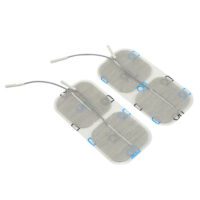
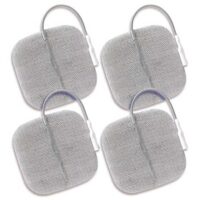
EMS pads sit on clean skin over the target muscle. The device sends electrical pulses through the pads, stimulating motor nerves and causing the muscle to contract.
The strength of the contraction depends on factors such as electrode position, stimulation intensity, pulse settings and the muscle being treated.
Repeated contractions may help maintain or improve muscle activation and strength in some rehabilitation or training settings. However, results vary between people and EMS protocols.
Does an EMS Machine Build Muscle?
EMS can improve strength in some settings. Research in healthy adults has found that electrical stimulation can produce strength gains, although study methods and stimulation protocols vary considerably.
EMS should not be viewed as an automatic shortcut to stronger muscles. The contraction needs to be strong enough to provide a meaningful stimulus, and active resistance exercise remains important for developing functional strength when it is safe and suitable.
For rehabilitation, the aim is usually to progress from assisted or electrically stimulated muscle activation towards active strengthening and functional movement.
EMS Machine vs TENS Machine
EMS and TENS devices may look similar, and some machines provide both modes. However, the treatment goals differ.
EMS
Main goal: muscle contraction and activation.
Main target: motor nerves and muscle.
Common use: muscle activation, strengthening support and rehabilitation.
EMS may suit people who need additional help with muscle activation or strengthening. Its usefulness depends on the underlying problem and how it fits with the overall rehabilitation plan.
People recovering from injury: EMS may provide an additional stimulus while normal loading is rebuilt.
People recovering from surgery: EMS may be considered when pain, swelling or reduced activity makes a muscle difficult to activate.
Athletes: EMS may complement selected activation or strengthening exercises.
General exercisers: EMS may supplement training when used for a defined goal rather than as a replacement for exercise.
When Could EMS Be Used?
EMS is commonly considered when the main goal is to improve muscle activation or provide a strengthening stimulus. A physiotherapist may use it during rehabilitation or teach you how to incorporate it into a home exercise program.
How Often Should You Use an EMS Machine?
There is no single EMS schedule that suits everyone. Frequency depends on the rehabilitation goal, stimulation intensity, muscle response, skin tolerance and the instructions for the particular device.
Some rehabilitation programs use relatively frequent short sessions, while stronger muscle-loading sessions may require more recovery time. Follow your device instructions and any program provided by your clinician.
More stimulation is not necessarily better. Stop and seek advice if you develop unusual pain, significant skin irritation, marked muscle soreness or other concerning symptoms.
Is an EMS Machine Safe?
EMS can be used safely by many people when the device is appropriate and the instructions are followed. However, electrical stimulation is not suitable for every person or every body area.
Do not place electrodes across the chest, over the head, or over the front or sides of the neck. Avoid placing pads over broken, infected or irritated skin. Extra caution is required where sensation is reduced.
Seek medical or clinical advice before using EMS if you have an implanted electronic device, epilepsy, significant heart or circulation problems, pregnancy, altered sensation, recent surgery or uncertainty about the cause of your symptoms.
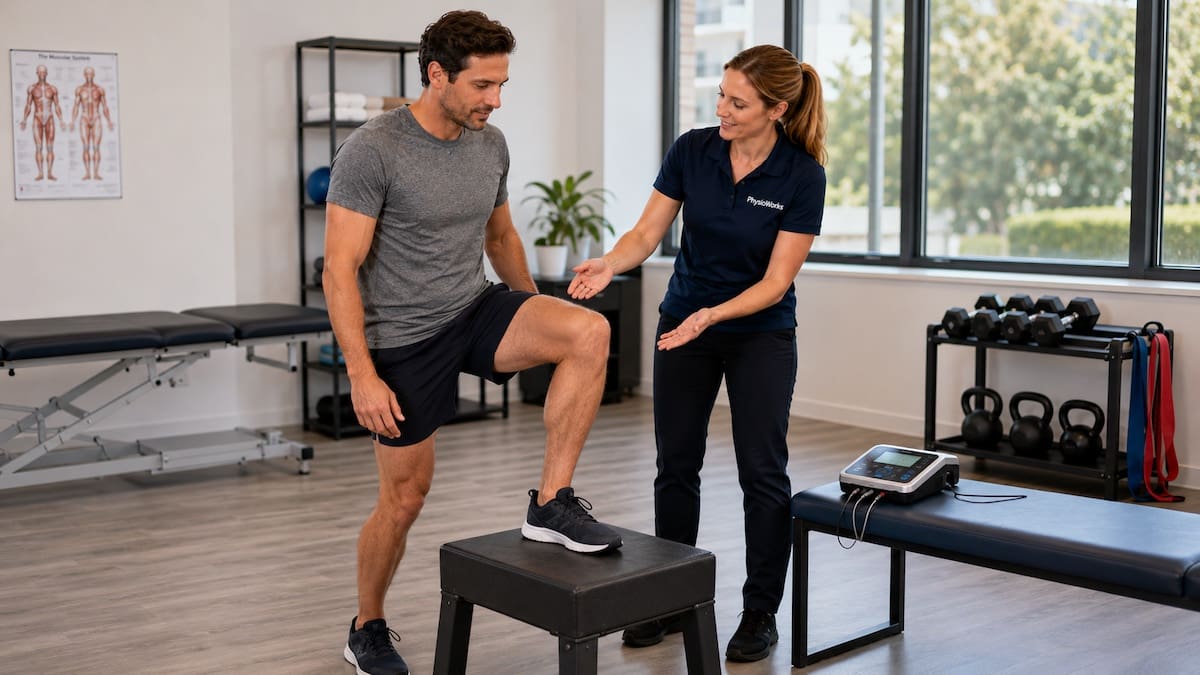
EMS may be combined with active strengthening during rehabilitation.
Can Exercise Physiology Help With EMS?
Once muscle activation improves, rehabilitation should usually progress towards active strengthening and functional exercise where appropriate.
If you need a structured exercise program, an Accredited Exercise Physiologist may help with progressive strength, balance, endurance or return-to-function training.
EMS Machine FAQs
What does an EMS machine actually do?
An EMS machine sends controlled electrical pulses to a muscle so it contracts. This may support muscle activation during rehabilitation, particularly when the muscle is weak, inhibited or difficult to activate voluntarily.
Does an EMS machine build muscle?
EMS may support muscle activation and strength in some settings. However, meaningful strengthening usually requires an adequate contraction and appropriate progression. EMS should not replace active resistance exercise when normal exercise is safe and suitable.
How often can I use an EMS machine?
Frequency depends on your rehabilitation goal, stimulation intensity, skin tolerance, muscle response and the instructions for your device. Follow the manufacturer’s guidance and any plan provided by your clinician.
Where should EMS pads be placed?
Place EMS pads over the intended target muscle on clean, healthy skin according to the device instructions or your clinician’s guidance. Avoid the chest, head, front and sides of the neck, damaged skin and unsuitable areas of reduced sensation.
Who should check with a healthcare professional before using EMS?
Seek advice before using EMS if you have an implanted electronic device, epilepsy, significant heart or circulation problems, pregnancy, altered sensation, recent surgery or another medical condition that may affect safe use.
What is the difference between EMS and TENS?
EMS stimulates motor nerves and produces muscle contractions. TENS mainly stimulates sensory nerves and is commonly used for temporary pain relief. Some devices include both settings, so check which mode is selected before use.
What to Do Next
If you are considering EMS for an injury, after surgery or because a muscle is difficult to activate, ask your physiotherapist whether it suits your situation.
A physiotherapist can help you identify the appropriate muscle, electrode position, stimulation level and exercises to combine with EMS.
If you already understand how to use EMS safely and know that it suits your needs, you can also compare available EMS machines.
Choose your clinic and appointment pathway
Select a PhysioWorks clinic to continue to live booking, an appointment request or reception assistance.