
Shoulder Replacement Physiotherapy & Rehabilitation
Shoulder Replacement Physiotherapy & Rehabilitation
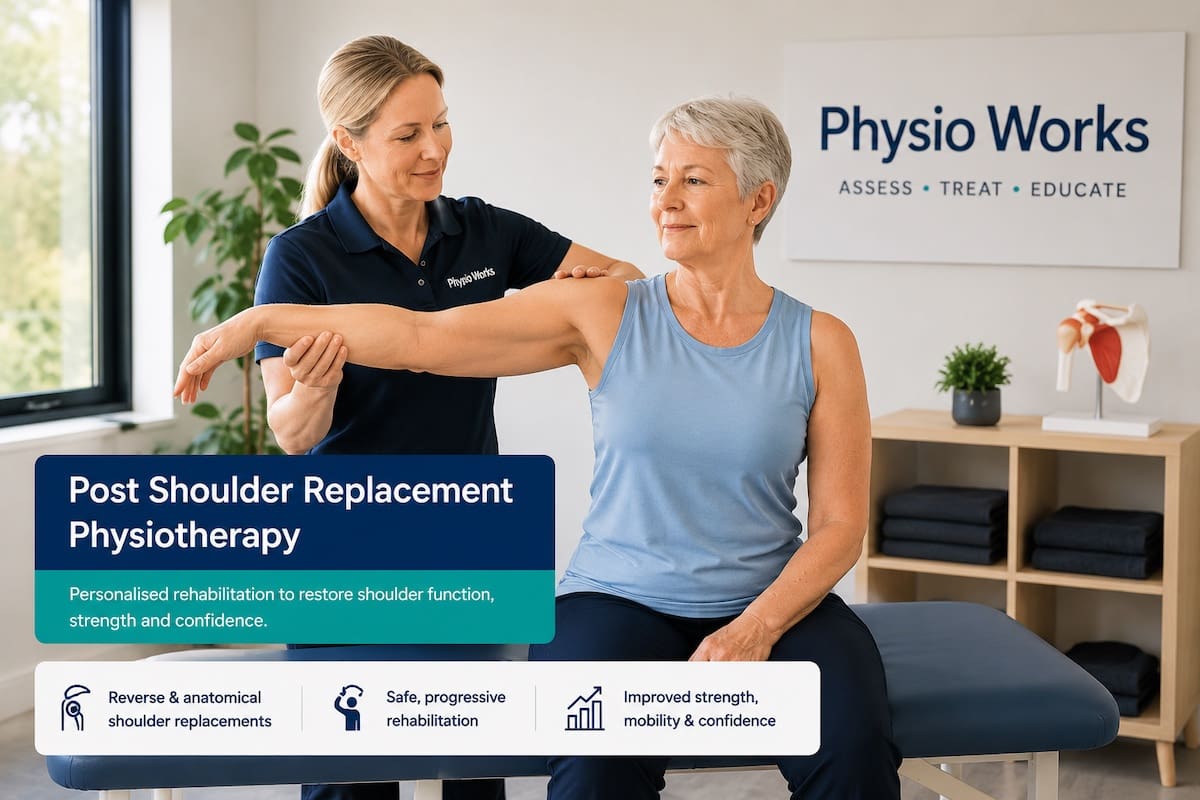
Physiotherapy after shoulder replacement helps protect healing tissues, restore useful shoulder movement and progressively rebuild strength for everyday activities. Rehabilitation should match the operation you have had, particularly whether your shoulder replacement is anatomical or reverse.
Anatomical replacement
Preserves the usual ball-and-socket arrangement and generally depends on a functioning rotator cuff.
Reverse replacement
Reverses the joint configuration and changes the shoulder mechanics, increasing the functional role of the deltoid.
Rehabilitation
Progression should reflect your procedure, tissue healing, surgeon’s instructions, symptoms and functional goals.


What Is a Shoulder Replacement?
A shoulder replacement, also called shoulder arthroplasty, replaces damaged parts of the shoulder joint with artificial components. It may be considered when problems such as advanced shoulder arthritis cause substantial pain, stiffness and loss of function despite appropriate non-surgical care.
The operation performed matters when planning rehabilitation. Two of the main procedures are anatomical total shoulder replacement, often shortened to aTSA or aTSR, and reverse total shoulder replacement, often shortened to rTSA or rTSR.
Other procedures, such as shoulder hemiarthroplasty, also exist. Your operation report and surgeon’s instructions help your physiotherapist identify exactly what was replaced and which tissues need protection.
What Is the Difference Between Anatomical and Reverse Shoulder Replacement?
Both operations replace damaged joint surfaces, but they create different shoulder mechanics. This difference is important when setting movement precautions, selecting exercises and deciding how strength should be progressed.
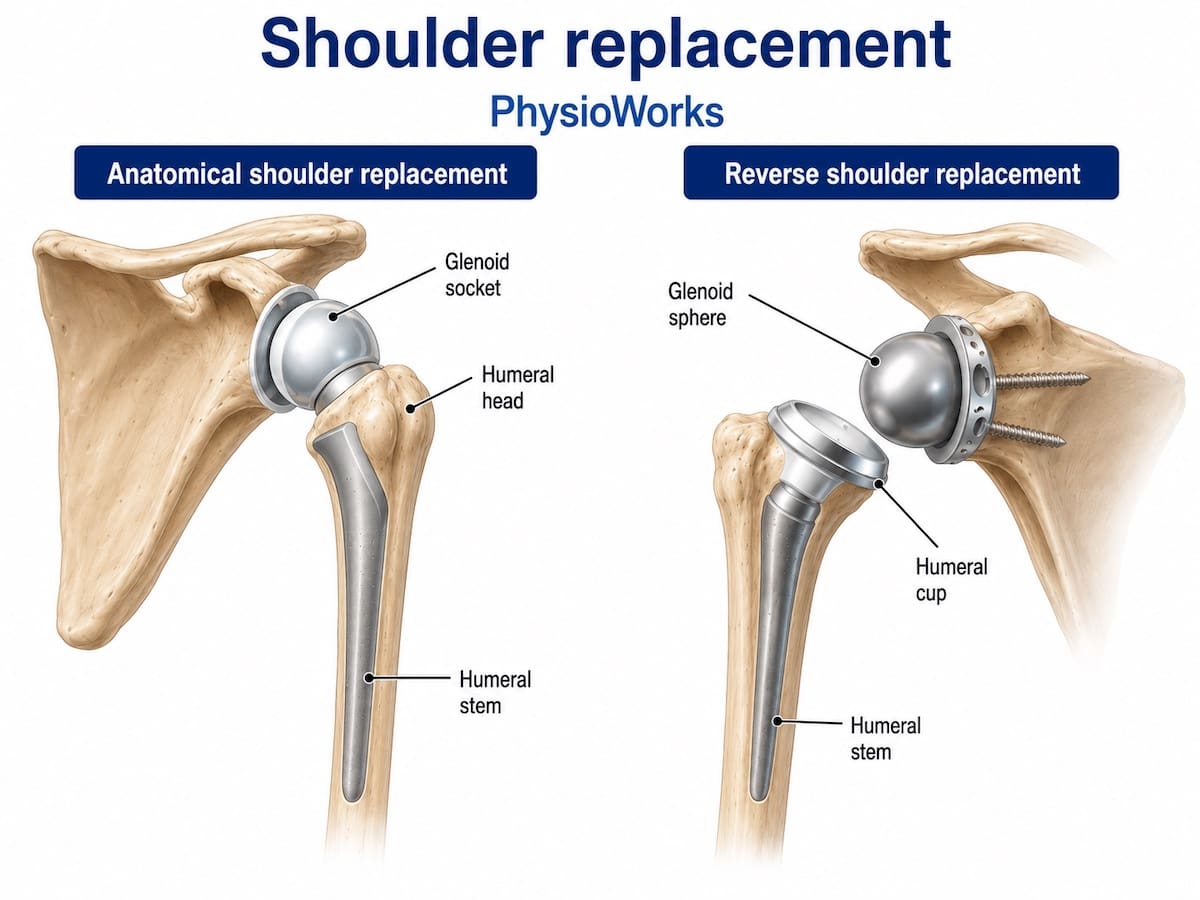
Anatomical shoulder replacement
An anatomical shoulder replacement recreates the usual arrangement of the joint. A prosthetic ball replaces the humeral head at the top of the upper-arm bone, while a socket component replaces the damaged glenoid surface on the shoulder blade.
A functioning rotator cuff is important because it helps centre and control the replaced joint. The operation may also involve releasing and repairing the subscapularis tendon at the front of the shoulder.
For this reason, early rehabilitation may need to protect the subscapularis or other repaired tissues before stronger internal-rotation and loading exercises are introduced. The exact restrictions depend on the surgical technique and your surgeon’s protocol.
Reverse shoulder replacement
A reverse shoulder replacement switches the ball-and-socket arrangement. A ball, called a glenosphere, is fixed to the glenoid side of the joint. A concave cup sits on the humeral side.
The altered geometry changes how the shoulder produces movement and increases the contribution of the deltoid muscle. Reverse replacement is commonly used when the rotator cuff cannot provide the function required for an anatomical replacement.
Rehabilitation therefore needs to respect the mechanics and stability of the reverse prosthesis rather than simply copying an anatomical shoulder replacement program.
Why Does the Type of Shoulder Replacement Matter to Rehabilitation?
An anatomical replacement generally relies more heavily on the rotator cuff, while a reverse replacement relies more on the deltoid and altered joint mechanics.
These differences can change:
- which tissues need protection during early healing
- permitted shoulder movement during the early stages
- when active movement begins
- when resistance exercises are appropriate
- which muscles receive greater rehabilitation emphasis
- expected movement and strength outcomes
- return-to-work, gym and recreational planning
This is why shoulder replacement rehabilitation should be procedure-specific rather than based on a generic shoulder exercise program.
When Should Physiotherapy Start After Shoulder Replacement?
Rehabilitation often begins soon after surgery. Hospital-based care may include advice about sling use, comfortable positioning, wound management, permitted shoulder movement and exercises for the elbow, wrist and hand.
Outpatient post-operative shoulder physiotherapy can then continue your rehabilitation using your surgeon’s instructions.
The appropriate starting point varies according to the type of replacement, surgical approach, additional procedures, tissue and bone quality, symptoms and individual health factors.
What Does Shoulder Replacement Physiotherapy Involve?
Rehabilitation usually moves from protection and controlled movement towards active shoulder use, progressive strengthening and functional activity.
The overall sequence is similar to other forms of post-operative physiotherapy, but the details need to match your shoulder replacement.
-
Protect the shoulder
Early rehabilitation protects the new joint and any repaired tissues. Your physiotherapist also checks sling use, positioning and the movements your surgeon has permitted.
-
Restore movement gradually
Passive or assisted movement may progress towards active shoulder movement as healing, control and surgical restrictions allow.
-
Develop active shoulder control
Rehabilitation retrains coordinated movement between the replaced joint, shoulder blade and surrounding muscles.
-
Rebuild strength
Resistance is introduced progressively when appropriate. Exercise selection differs between anatomical and reverse replacements and should respect any repaired tissues.
-
Return to useful activities
Later rehabilitation focuses increasingly on reaching, dressing, household tasks, work, lifting, gym exercise and suitable recreational activities.
How Does Rehabilitation Differ After Reverse Shoulder Replacement?
Reverse shoulder replacement changes the biomechanics of the shoulder. Rehabilitation therefore commonly places greater emphasis on developing efficient deltoid and shoulder-blade function.
The goal is useful and controlled shoulder function rather than forcing the joint towards a predetermined range of movement.
Some reverse replacement protocols also restrict particular combined shoulder positions during the early healing period because they may place greater stress on the replaced joint. These restrictions vary with implant design, surgical approach and surgeon preference.
Current research does not identify one rehabilitation timetable that is best for every reverse shoulder replacement. Studies comparing earlier and more delayed mobilisation generally support an individualised approach rather than automatic progression according to time alone.
How Does Rehabilitation Differ After Anatomical Shoulder Replacement?
An anatomical shoulder replacement relies more heavily on the rotator cuff to control the joint. Appropriate rotator cuff strengthening may therefore become important later in rehabilitation.
However, the subscapularis is commonly affected during the surgical approach. Depending on how it was managed, early external rotation, active internal rotation or resisted internal rotation may need to remain limited while the repair heals.
The American Society of Shoulder and Elbow Therapists recommends staged rehabilitation that initially protects affected soft tissues and then progressively restores movement and loading. Your surgeon’s procedure and individual restrictions remain important when applying these principles.
What Will Your Physiotherapist Assess?
Your physiotherapist will first consider your operation, surgeon’s instructions and current stage of recovery. Assessment may then include:
- pain and symptom behaviour
- wound and post-operative concerns within physiotherapy scope
- sling use and permitted activities
- passive, assisted and active shoulder movement
- shoulder-blade movement and control
- appropriate deltoid and rotator cuff function
- elbow, wrist and hand movement
- sleep and comfortable positioning
- dressing and personal care
- reaching and lifting capacity later in recovery
- work requirements
- gym, recreation and sporting goals
A general shoulder physiotherapy assessment may examine many of the same movement and strength factors, but post-operative assessment gives greater priority to surgical precautions and tissue healing.
What Are the Main Stages of Shoulder Replacement Rehabilitation?
Early protection phase
The early phase focuses on protecting the operation while maintaining safe movement and general function.
A sling is commonly used during this stage. The duration and circumstances in which it can be removed vary according to the procedure and surgeon.
Movement restoration phase
As healing progresses, rehabilitation may move from passive and assisted movement towards increasingly active shoulder control.
The goal is not simply to obtain the largest possible range. Movement should remain useful, controlled and appropriate for the healing stage.
Strengthening phase
Strengthening is progressively introduced once the joint and repaired tissues can tolerate greater load.
Anatomical replacement may place greater emphasis on appropriate rotator cuff function. Reverse replacement rehabilitation usually gives greater attention to the deltoid and shoulder-blade muscles.
Functional rehabilitation phase
Later rehabilitation increasingly reflects the activities that matter to you. These may include dressing, reaching overhead, carrying, housework, driving, work tasks, shoulder exercises, gym training or suitable sport and recreation.
How Long Does Shoulder Replacement Rehabilitation Take?
Recovery after shoulder replacement usually develops over several months rather than a few weeks. However, there is no single recovery timetable that applies to everyone.
Progress can be influenced by:
- the type of shoulder replacement
- additional surgical procedures or tendon repairs
- the surgical approach
- pre-operative movement and strength
- rotator cuff and deltoid function
- bone and tissue quality
- general health
- pain and swelling
- your work and activity requirements
- your surgeon’s rehabilitation protocol
For this reason, clinical milestones are often more useful than progressing simply because a particular number of weeks has passed.
What Exercises Are Used After Shoulder Replacement?
Exercise selection changes substantially through rehabilitation. Early exercises may focus on permitted assisted shoulder movement and maintaining movement in the elbow, wrist and hand.
Later rehabilitation may include:
- assisted shoulder elevation
- controlled active shoulder movement
- shoulder-blade control exercises
- deltoid strengthening
- appropriate rotator cuff strengthening after anatomical replacement
- graded reaching exercises
- functional lifting and carrying
- progressive gym-based strengthening
- work- or activity-specific exercise where appropriate
The correct exercise, range and load depend on your operation and rehabilitation stage. An exercise that is useful later in recovery may be inappropriate during early healing.
General shoulder exercise programs should therefore not replace your surgeon-specific post-operative program during the protected stages of recovery.
Can Physiotherapy Help With Stiffness After Shoulder Replacement?
Some stiffness is expected after shoulder replacement, particularly while the shoulder is being protected.
Physiotherapy can assess whether movement is progressing as expected and guide exercises that gradually restore useful range without unnecessarily stressing healing structures.
Aggressively forcing shoulder movement is not automatically better. Rehabilitation needs to balance mobility with protection of the new joint and repaired tissues.
When Can You Stop Wearing the Sling?
Sling recommendations differ between operations and surgeons. The sling may protect healing structures as well as provide comfort during early recovery.
Follow the instructions supplied by your surgical team rather than stopping sling use solely because your shoulder feels more comfortable.
When Can You Drive After Shoulder Replacement?
Driving requires enough movement, strength and control to steer and respond safely to unexpected situations.
You should not drive while a sling or other restriction prevents safe vehicle control, or while medication affects alertness, judgement or reaction time.
Your surgeon should guide your return to driving. Your physiotherapist can assess whether your movement and functional control are progressing towards the physical requirements of driving.
When Can You Return to Work?
Return-to-work timing depends on both your operation and your job.
Desk-based or modified duties may be possible earlier than work involving repeated reaching, lifting, pushing, pulling, carrying or overhead activity.
Your physiotherapist can break your work into specific physical demands and progressively prepare the shoulder for those tasks.
Can You Return to the Gym After Shoulder Replacement?
Gym exercise can form part of later shoulder replacement rehabilitation when the shoulder is ready for increasing resistance.
Loading should progress gradually. Exercise selection should reflect the type of replacement, available movement, strength, surgeon’s advice and the activities you want to resume.
Heavy pressing, pulling or repeated overhead loading should not automatically resume simply because everyday activities have become comfortable.
Can You Play Sport After Shoulder Replacement?
Some people wish to return to activities such as golf, swimming, racquet sports or recreational exercise after shoulder replacement.
Whether an activity is suitable depends on your replacement, shoulder function, expected forces, previous experience and your surgeon’s recommendations.
Your physiotherapist can progressively prepare movement, strength and physical capacity for appropriate activities. Higher-load, contact or repetitive overhead sports deserve specific discussion with your surgeon.
When Should You Contact Your Surgeon or Doctor?
Pain, swelling and difficulty moving the shoulder are common during early recovery. However, new or rapidly worsening symptoms need appropriate assessment.
Contact your surgeon or treating medical team if you develop unexpected wound problems, a sudden change in shoulder position or function, new neurological symptoms, or recovery that is changing in a way that concerns you.
How Can PhysioWorks Help After Shoulder Replacement?
PhysioWorks physiotherapists can continue your rehabilitation after discharge from hospital and coordinate the program with your surgeon’s instructions.
Your physiotherapist can review your operation, current movement, strength, symptoms and functional goals before planning the next rehabilitation stage.
Treatment may include education, movement progression, individually selected exercises, progressive strengthening and preparation for everyday, work and recreational activities.
If you have your operation report, post-operative exercise sheet or surgeon’s rehabilitation protocol, bring it to your first appointment. These documents can help your physiotherapist match rehabilitation more closely to your procedure and precautions.
You can also review the broader post-operative shoulder physiotherapy guide or explore the PhysioWorks shoulder conditions hub for related information.
What to Do Next
If you have recently undergone an anatomical or reverse shoulder replacement, arrange physiotherapy with your surgeon’s post-operative instructions where possible.
Your physiotherapist can assess your current rehabilitation stage and help you progress movement, shoulder control, strength and everyday function while respecting your operation and healing tissues.
Shoulder Replacement Physiotherapy FAQs
Do I need physiotherapy after a shoulder replacement?
Physiotherapy commonly forms part of shoulder replacement rehabilitation. Your program should reflect your operation, surgeon’s instructions, movement, symptoms and stage of recovery.
Is reverse shoulder replacement rehabilitation different?
Yes. A reverse replacement changes shoulder mechanics and increases the functional role of the deltoid. Precautions, exercise selection and expected movement can therefore differ from an anatomical replacement.
Why does an anatomical shoulder replacement need different rehabilitation?
An anatomical replacement depends more on the rotator cuff to control the joint. The subscapularis tendon may also have been released and repaired during surgery, which can affect early movement and strengthening restrictions.
When can strengthening start after shoulder replacement?
Timing varies according to the procedure, repaired tissues and surgeon’s protocol. Resistance should be introduced when healing and your rehabilitation stage make loading appropriate rather than according to one universal timeframe.
Can I damage my shoulder replacement by exercising too early?
Exercises that exceed your movement or loading precautions may place unnecessary stress on the new joint or healing tissues. Follow your surgeon’s restrictions and progress exercise in stages rather than using pain alone to decide when to increase load.
Should I bring my surgeon’s rehabilitation protocol?
Yes. Bring your surgeon’s protocol, operation report or post-operative instructions if available. They help your physiotherapist identify procedure-specific precautions and progression limits.
How long does shoulder replacement recovery take?
Recovery usually develops over several months, but the timeframe varies. The type of replacement, additional repairs, pre-operative function, tissue healing, general health and activity goals all influence progression.
References
- Kennedy JS, Garrigues GE, Pozzi F, et al. The American Society of Shoulder and Elbow Therapists’ consensus statement on rehabilitation for anatomic total shoulder arthroplasty. J Shoulder Elbow Surg. 2020;29(10):2149-2162. doi:10.1016/j.jse.2020.05.019.
- Polio W, Brolin TJ. Postoperative Rehabilitation After Shoulder Arthroplasty. Phys Med Rehabil Clin N Am. 2023;34(2):469-479. doi:10.1016/j.pmr.2022.12.010.
- Sachinis NP, Yiannakopoulos CK, Berthold DP, Franz A, Beitzel K. Can we accelerate rehabilitation following reverse shoulder arthroplasty? A systematic review. Shoulder Elbow. 2024;16(2):214-227. doi:10.1177/17585732221144007.
- Bardsley JL, Daw RLC, Gibson J, et al. Physiotherapy treatment for reverse total shoulder arthroplasty: Results of a patient-centred rehabilitation guideline using functional and patient-reported outcome measures. Shoulder Elbow. 2024;16(3):330-335. doi:10.1177/17585732221133532.
- Martín-Molina MDC, Ramírez-Pérez L, Cuesta-Vargas AI. Physiotherapy Intervention on the Improvement of Postsurgical Outcomes in Patients With Reverse Total Shoulder Arthroplasty: A Systematic Review. Am J Phys Med Rehabil. 2026;105(6):486-494. doi:10.1097/PHM.0000000000002895.
Choose your clinic and appointment pathway
Select a PhysioWorks clinic to continue to live booking, an appointment request or reception assistance.
