
Shockwave Therapy
Shockwave Therapy: What Does the Evidence Support?
Shockwave therapy can help some musculoskeletal conditions, but the evidence is much stronger for some problems than others. This guide separates conditions with better research support from those where evidence remains mixed or does not support routine treatment.
What Is Shockwave Therapy?
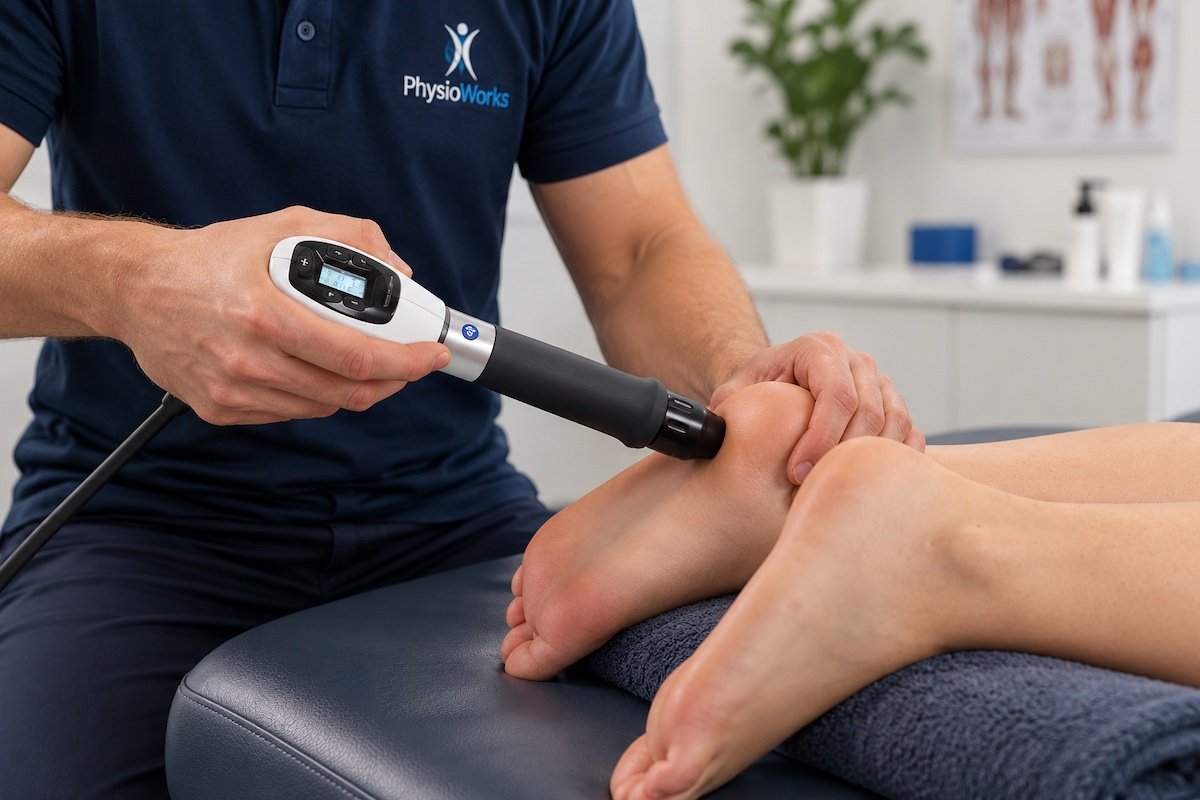
Extracorporeal shockwave therapy, commonly called ESWT or shockwave therapy, applies mechanical acoustic energy to a targeted area from outside the body. Despite its name, it does not deliver an electrical shock.
Treatment may use focused shockwave therapy or radial pressure wave therapy. These technologies generate and deliver energy differently, so results from one treatment protocol cannot always be assumed to apply directly to another.
Shockwave therapy is generally best considered an adjunct to rehabilitation. For most tendon problems, it should not automatically replace progressive exercise, load management or an accurate assessment of the cause of your symptoms.
Shockwave Therapy Evidence at a Glance
We have grouped common musculoskeletal uses of shockwave therapy into three practical evidence categories. These ratings reflect the overall direction and certainty of current research. They do not guarantee that an individual person will or will not respond.
GREEN — Better Supported
Current research provides comparatively stronger support for shockwave therapy in appropriately selected patients.
Includes: persistent plantar fasciopathy and chronic lateral epicondylalgia (tennis elbow).
AMBER — Mixed or Developing Evidence
Research suggests possible benefit, but results are inconsistent, evidence certainty is limited or patient selection appears particularly important.
Includes: calcific rotator cuff tendinopathy, greater trochanteric pain syndrome, Achilles tendinopathy and knee osteoarthritis.
RED — Poor Evidence for Routine Use
Current evidence does not provide convincing support for routine shockwave therapy for these presentations.
Includes: patellar tendinopathy and non-calcific rotator cuff tendinopathy.
GREEN — Where Is Shockwave Therapy Better Supported?
Persistent Plantar Fasciopathy
Persistent plantar fasciopathy, commonly called plantar fasciitis, has some of the strongest evidence supporting shockwave therapy among common musculoskeletal conditions.
Systematic reviews and meta-analyses have reported improvements in pain and function. A 2023 systematic review found high-quality evidence of a substantial effect on pain and function for plantar fasciitis, while a 2024 systematic review also supported ESWT as a treatment option for plantar fasciopathy.
Shockwave is not necessarily the whole treatment plan. Calf and foot strengthening, load management, footwear and other individual contributing factors may remain important.
Chronic Lateral Epicondylalgia — Tennis Elbow
Shockwave therapy may also help some people with persistent tennis elbow, also called lateral elbow tendinopathy or lateral epicondylalgia.
A 2024 systematic review comparing shockwave therapy with corticosteroid injection found that corticosteroid injection produced better results at one month, while shockwave therapy produced more favourable pain and functional outcomes at three and six months on several measures.
Progressive strengthening and management of gripping, lifting, work and sporting loads remain important parts of rehabilitation.
AMBER — Where Is the Evidence Mixed?
Calcific Rotator Cuff Tendinopathy
Shockwave therapy may reduce pain and disability in some people with calcific rotator cuff tendinopathy.
A 2024 systematic review of 21 randomised controlled trials found potential benefits compared with sham treatment. Higher-energy treatment also produced better results than lower-energy treatment in some comparisons. However, the certainty of the evidence was rated very low, and ultrasound-guided needling performed better than shockwave for pain in some comparisons.
The 2025 rotator cuff clinical practice guideline states that clinicians may use or recommend shockwave therapy for calcific rotator cuff tendinopathy.
Importantly, evidence for calcific tendinopathy should not be extended to ordinary non-calcific rotator cuff pain.
Greater Trochanteric Pain Syndrome
Greater trochanteric pain syndrome can involve the gluteal tendons and other structures around the outside of the hip.
A 2024 systematic review of eight randomised trials found that shockwave therapy reduced pain compared with other treatments at two to four months. However, seven of the eight studies had a high risk of bias. Although functional scores improved at six months, the improvement did not exceed the reported minimal clinically important difference.
Shockwave may therefore be reasonable for selected persistent cases, but education, load modification and progressive hip strengthening remain important components of management.
Achilles Tendinopathy
The evidence for shockwave therapy in Achilles tendinopathy is conflicting and has become less favourable as newer evidence has emerged.
A 2023 systematic review found low-to-moderate evidence of negligible effects on pain and function. More recently, a 2026 systematic review and meta-analysis found no clinically meaningful benefit for pain or disability in insertional or midportion Achilles tendinopathy and concluded that shockwave should not currently be considered a routine treatment.
The certainty of much of the evidence remains low, so the true effect could change with better trials. For now, progressive Achilles loading and appropriate load management should remain the foundation of rehabilitation rather than shockwave therapy.
Knee Osteoarthritis
Research into shockwave therapy for knee osteoarthritis is developing.
A 2024 systematic review of seven randomised controlled trials involving 450 participants reported dose-response relationships between shockwave energy and some pain and WOMAC outcomes. However, protocols vary and shockwave does not have the established role of exercise, education and other core osteoarthritis treatments.
Exercise, strength, physical activity, pacing and appropriate medical and weight-management strategies remain central to knee osteoarthritis care.
RED — Where Does Current Evidence Not Support Routine Shockwave?
Patellar Tendinopathy
Current research does not show a convincing additional benefit from routine shockwave therapy for patellar tendinopathy.
Non-Calcific Rotator Cuff Tendinopathy
Current clinical guidance recommends against shockwave therapy for reducing pain and disability in non-calcific rotator cuff tendinopathy.
Patellar Tendinopathy
Current placebo-controlled evidence does not show a convincing additional benefit from shockwave therapy for patellar tendinopathy.
A systematic review found that ESWT, alone or combined with eccentric exercise, had a negligible short-term effect on pain and function compared with placebo or placebo plus exercise.
Progressive tendon loading therefore remains the priority rather than adding shockwave routinely.
Non-Calcific Rotator Cuff Tendinopathy
Shockwave therapy should not routinely be used for rotator cuff tendinopathy when there is no calcification.
The 2025 rotator cuff clinical practice guideline specifically recommends that clinicians should not use or recommend extracorporeal shockwave therapy to reduce pain and disability in adults with non-calcific rotator cuff tendinopathy.
This distinction matters. Calcific and non-calcific rotator cuff tendinopathy are different shockwave indications.
Undiagnosed or General Soft-Tissue Pain
Shockwave therapy should not be applied simply because a tendon, muscle or joint hurts.
Research relates to specific diagnoses, patient groups and treatment protocols. Assessment should first establish the likely cause of the symptoms and whether shockwave has reasonable evidence for that presentation.
For a broader explanation of tendon rehabilitation, see our guide to tendinopathy and progressive tendon loading.
When Should Shockwave Therapy Not Be Used?
International shockwave guidance identifies important contraindications and precautions. Depending on the technology and energy used, these include:
- a malignant tumour within the shockwave treatment field
- a fetus within the treatment field
- a pacemaker or defibrillator within the treatment field
- lung tissue within the field when high-energy focused shockwave is used
- significant coagulation disorders when high-energy focused shockwave is used
- brain or central nervous system structures within an inappropriate high-energy treatment field
- treatment over some bones or growth plates where the proposed technique requires additional clinical consideration.
The contraindication list is not identical for every shockwave device or energy level. This is one reason screening and an accurate diagnosis should occur before treatment.
Tell your physiotherapist about pregnancy, cancer, bleeding or clotting disorders, anticoagulant medication, implanted electronic devices, recent surgery and other significant medical conditions before shockwave treatment.
Is Shockwave Therapy Painful?
Shockwave treatment can feel uncomfortable, particularly when treatment is applied over a sensitive area or at higher intensities.
Treatment intensity can usually be adjusted according to the treatment goal, technology being used and your tolerance. Temporary pain, redness or bruising can occur during or after treatment.
Treatment should not simply be made as painful as possible. More pain during treatment does not prove that shockwave will be more effective.
Does Shockwave Replace Exercise?
Usually, no.
For most tendon conditions, progressive loading remains central to rehabilitation. Shockwave is better considered as a possible adjunct when the diagnosis is suitable, the evidence supports its use and there is a clear reason for adding it.
Who May Be More Likely to Benefit?
Shockwave therapy may be more reasonable to consider when:
- the diagnosis is reasonably clear
- current research supports shockwave for that condition
- symptoms have persisted despite appropriate initial management
- rehabilitation has included suitable exercise and load management
- there are no relevant contraindications or precautions
- treatment has a defined goal and response can be measured.
Individual responses vary. If shockwave does not produce meaningful improvement, simply continuing repeated courses because treatment has already started may not be appropriate.
The PhysioWorks Approach to Shockwave Therapy
At PhysioWorks, shockwave therapy should be considered after assessment rather than automatically offered for any painful tendon or joint.
Your physiotherapist can assess the likely diagnosis, review what you have already tried and discuss whether shockwave therapy has a useful evidence-based role in your rehabilitation.
When shockwave is appropriate, treatment will usually sit alongside a rehabilitation plan designed to improve strength, load tolerance, movement and function.
Shockwave Therapy FAQs
What condition has the best evidence for shockwave therapy?
Persistent plantar fasciopathy has some of the strongest evidence among common musculoskeletal indications for shockwave therapy. Systematic reviews and meta-analyses have reported improvements in pain and function.
Does shockwave therapy work for Achilles tendinopathy?
The evidence is mixed but recent evidence is less favourable. A 2026 systematic review found no clinically meaningful benefit for pain or disability and advised against routine shockwave treatment for insertional or midportion Achilles tendinopathy. Progressive tendon loading remains central to rehabilitation.
Does shockwave therapy help tennis elbow?
It may help some people with persistent lateral elbow tendinopathy. Recent evidence suggests corticosteroid injection may provide greater short-term improvement, while shockwave therapy may produce more favourable outcomes at later follow-up on several measures.
Does shockwave therapy help shoulder tendinopathy?
It depends on the diagnosis. Shockwave therapy may have a role in calcific rotator cuff tendinopathy. Current clinical guidance recommends against its routine use for non-calcific rotator cuff tendinopathy.
Does shockwave therapy work for patellar tendinopathy?
Current evidence does not show a convincing additional benefit over sham treatment or appropriate rehabilitation. Progressive tendon loading remains the preferred first-line approach.
How many shockwave therapy sessions are needed?
There is no single protocol that applies to every condition. Research protocols vary in the number of sessions, treatment frequency, energy level, number of impulses and type of shockwave used. Treatment should match the condition being treated and your response.
What to Do Next
If persistent heel, elbow, shoulder, hip, knee or tendon pain is limiting your activity, start with an assessment rather than choosing shockwave therapy based only on where it hurts.
A physiotherapist can assess the likely diagnosis, explain your treatment options and determine whether shockwave therapy has an appropriate evidence-based role in your rehabilitation.
References
- Charles R, Fang L, Zhu R, Wang J. The effectiveness of shockwave therapy on patellar tendinopathy, Achilles tendinopathy, and plantar fasciitis: a systematic review and meta-analysis. Front Immunol. 2023;14:1193835.
View study. - Lippi L, et al. Efficacy and tolerability of extracorporeal shock wave therapy in patients with plantar fasciopathy: a systematic review with meta-analysis and meta-regression. Eur J Phys Rehabil Med. 2024.
View study. - Zhang L, Zhang X, Pang L, Wang Z, Jiang J. Extracorporeal Shock Wave Therapy Versus Local Corticosteroid Injection for Chronic Lateral Epicondylitis: A Systematic Review with Meta-Analysis of Randomized Controlled Trials. Orthop Surg. 2024;16(11):2598–2607.
View study. - Desmeules F, Roy JS, Lafrance S, et al. Rotator Cuff Tendinopathy Diagnosis, Nonsurgical Medical Care, and Rehabilitation: A Clinical Practice Guideline. J Orthop Sports Phys Ther. 2025;55(4):235–274.
View guideline. - Brindisino F, Marruganti S, Lorusso D, Cavaggion C, Ristori D. The effectiveness of extracorporeal shock wave therapy for rotator cuff calcific tendinopathy: a systematic review with meta-analysis. Physiother Res Int. 2024;29(3):e2106.
View study. - Rhim HC, Shin J, Beling A, et al. Extracorporeal Shockwave Therapy for Greater Trochanteric Pain Syndrome: A Systematic Review with Meta-Analysis of Randomized Clinical Trials. JBJS Rev. 2024;12(8).
View study. - Korakakis V, Kotsifaki R, Sotiralis Y, Malliaras P. Shockwave Therapy for Midportion and Insertional Achilles Tendinopathy: A Nail in the Coffin? A Systematic Review With Meta-Analysis. J Orthop Sports Phys Ther. 2026;56(5):282–299.
View study. - Chen TY, Chou SH, Shih CL. Extracorporeal shockwave therapy in the management of knee osteoarthritis: A systematic review of dose-response meta-analysis. J Orthop. 2024;52:67–73.
View study. - Rhim HC, Singh M, Maffulli N, et al. Recommendations for use of extracorporeal shockwave therapy in sports medicine: an international modified Delphi study. Br J Sports Med. 2025;59(18):1287–1301.
View consensus recommendations. - International Society for Medical Shockwave Treatment. ESWT recommendations, indications and contraindications.
View ISMST recommendations.
This information is general and does not replace an individual assessment. Treatment suitability and response vary between people.
Choose your clinic and appointment pathway
Select a PhysioWorks clinic to continue to live booking, an appointment request or reception assistance.
