
Running Efficiency: How to Run Better, Faster & With Less Effort
Running Efficiency: How to Run Better, Faster & With Less Effort


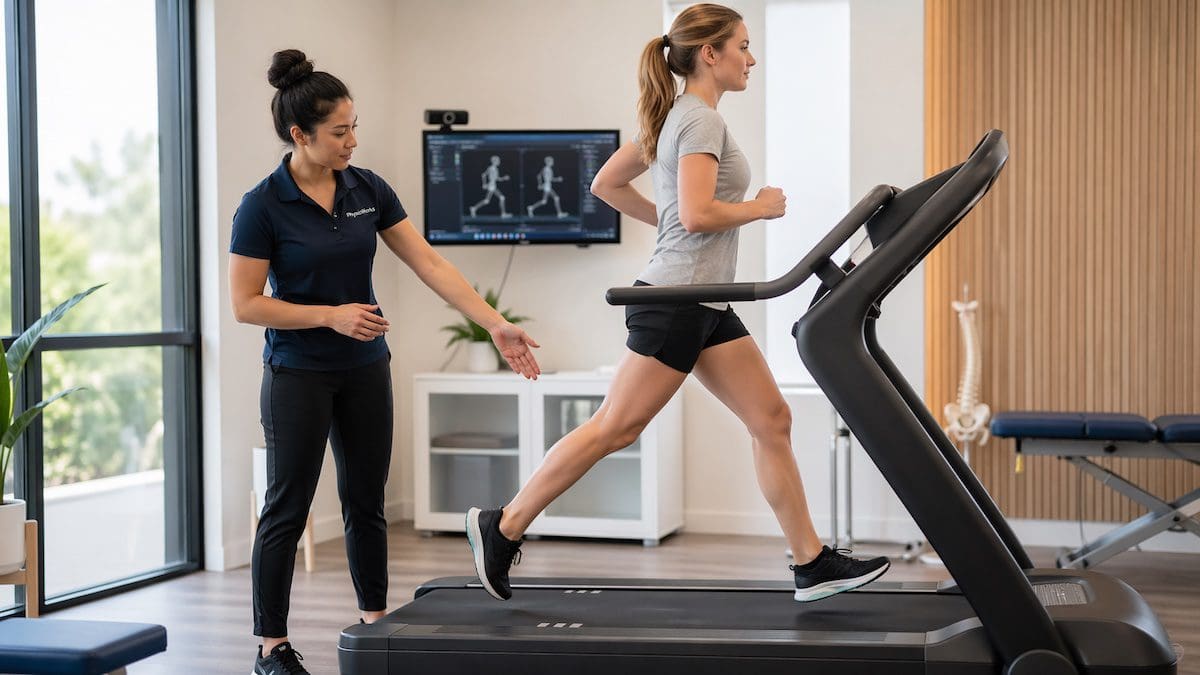
A physiotherapist assesses treadmill running mechanics to identify overstriding.
Running efficiency is your ability to use less energy at a given pace. Improving it may help you run faster, feel smoother, and reduce injury risk. Small changes to cadence, posture, and strength often make the biggest difference.
If your stride feels heavy, noisy, or tiring, improving running efficiency usually starts with practical adjustments rather than a dramatic technique overhaul. A running analysis or gait analysis assessment may help identify whether overstriding, cadence, posture, stiffness, strength, or fatigue is holding you back.
Quick signs your running efficiency may need work
- Your feet land too far in front of your body.
- Your stride feels noisy, heavy, or overly bouncy.
- You fade early even when your fitness should be enough.
- You keep getting niggles in the knees, calves, feet, or ankles.
- Your pace drops sharply as fatigue builds.
What is running efficiency?
Running efficiency describes how economically you move at a set pace. Efficient runners waste less energy through excessive braking, too much up-and-down motion, poor body position, or unstable lower-limb control, which may make it easier to run longer and more comfortably.
How can you improve running efficiency?
You can often improve running efficiency by shortening an overstride, making small cadence changes, improving posture, reducing wasted vertical bounce, and building stronger force transfer through the hips, knees, ankles, and feet. The goal is not to copy another runner. It is to find a smoother, more economical pattern that suits your body and training load.
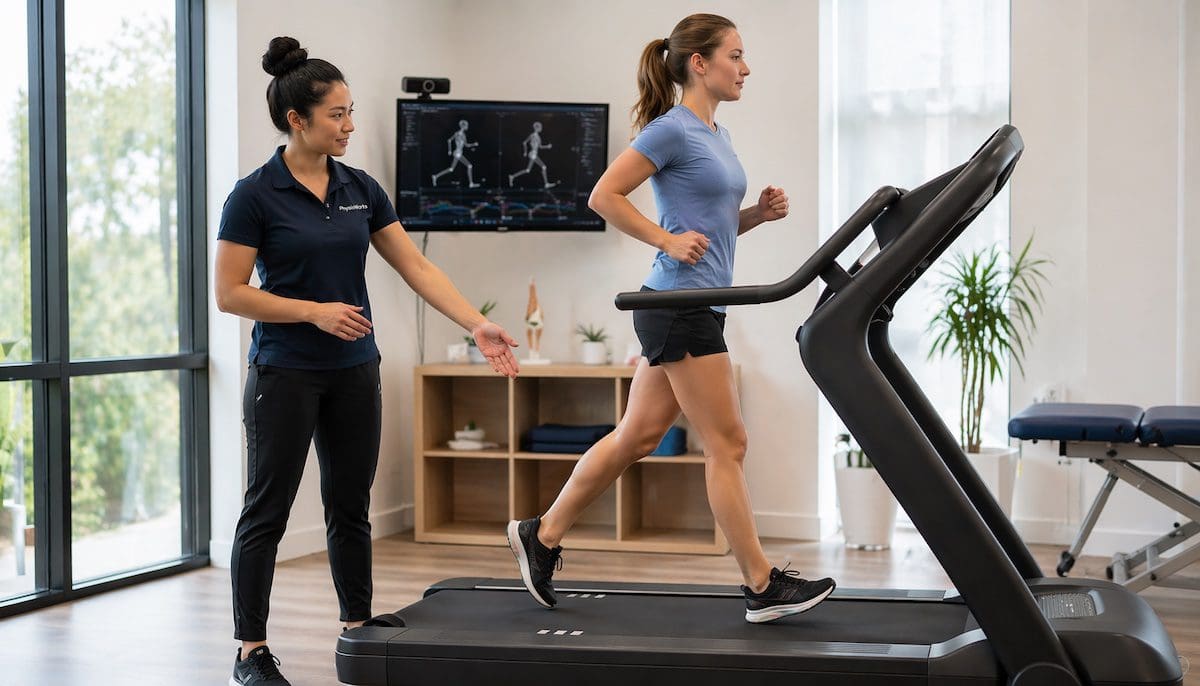
Shorter, lighter steps can help reduce overstriding.
Why does overstriding reduce running efficiency?
Overstriding usually means your foot lands too far in front of your centre of mass. That increases braking, often increases vertical motion, and can make your stride feel choppy rather than smooth. A shorter, quicker step often helps your body move forward with less wasted effort.
1. Increase cadence slightly if you overstride
One of the most common running errors is overstriding. This happens when your foot lands too far in front of your body. As a result, you create extra braking force, spend longer absorbing impact, and then have to work harder to move forward again.
For many runners, a small increase in cadence can help reduce overstriding. Instead of chasing a universal number such as 180 steps per minute, think about slightly quicker, lighter steps. That often helps bring your landing position closer underneath you and may reduce stress through areas such as the knees and hips. This can be especially relevant if you are managing runner’s knee, ankle pain, or heel pain.
2. Avoid a heavy heel-first landing pattern
The main issue is not whether your heel touches the ground. The bigger problem is landing too far in front of you with a stiff leg and obvious braking. Many runners do better when they aim for a softer landing with the foot closer to underneath the body.
Some runners land closer to flat-footed, while others contact more through the midfoot or forefoot. The best option depends on your body, speed, strength, and injury history. If you are dealing with recurring calf tightness, leg pain, or foot overload, changing foot strike too aggressively can create a new problem elsewhere. That is why technique changes should be gradual and monitored.
3. Lean forward from the whole body, not just your hips
A slight forward body lean can help you move forward more smoothly, but it should come from the whole body rather than bending sharply at the hips. When runners hinge too much at the waist, they often lose glute control, collapse through the trunk, and make their stride less economical.
A better cue is to stay tall through your trunk, keep your ribs and pelvis stacked, and let your body angle forward subtly from the ankles. This usually looks smoother and feels more balanced than forcing an exaggerated lean.
4. Reduce unnecessary vertical bounce
Running efficiency improves when more of your energy goes forward rather than upward. If you bounce too much, you spend energy lifting your body instead of moving ahead. That often shows up as a noisy stride, a heavy landing, or a feeling that you are working hard without moving efficiently.
You do not need to run flat or stiff. Instead, aim for smoother forward travel, quieter steps, and better control through the trunk and pelvis. In practice, this often improves when you slightly shorten an overstride, increase cadence modestly, and avoid pushing up too aggressively off the ground.
The best running-efficiency cue for most runners
Think quicker, lighter, quieter rather than trying to run perfectly. That cue is usually easier to apply than obsessing over foot strike, arm swing, or a fixed cadence target.
Why does your stride feel heavy or noisy?
A heavy or noisy stride often reflects wasted braking, poor force transfer, fatigue, or too much vertical bounce. It may also be linked with reduced lower-limb strength, limited ankle motion, trunk control issues, or recurring pain that changes the way you run.
5. Build strength and stiffness, not just better-looking form
Good running efficiency is not only about technique. It also depends on how well your body stores and releases force. Stronger calves, glutes, hamstrings, and trunk muscles can help you transfer force more effectively and reduce wasted motion.
Strength training may improve running economy, especially when it is progressive and matched to your training level. For many runners, the biggest gains come from pairing sensible technique changes with better lower-limb strength, single-leg control, and elastic stiffness rather than relying on form cues alone. This is one reason a physiotherapist may combine sports physiotherapy, strength work, and movement retraining.
A physiotherapist may also assess how well you transfer force through each stride and identify whether strength, stiffness, or coordination is limiting your running efficiency.
6. Manage fatigue and training load
Even good technique becomes less efficient when fatigue builds. If your stride falls apart late in a run, the problem may be less about your form and more about your load management, recovery, or strength endurance.
Improving running efficiency often means progressing volume and intensity gradually, recovering well, and avoiding sudden spikes in speed or distance. If your symptoms build as fatigue increases, a more detailed biomechanical analysis may help identify whether the key limiter is tissue capacity, mechanics, or training structure.
What else affects running efficiency?
Running efficiency is also influenced by mobility, footwear, terrain, and pain. Hip weakness, reduced ankle motion, poor pelvic control, trunk collapse, and recurrent pain can all make your stride less economical. Likewise, changing shoes or technique too quickly may shift load from one area to another.
If you keep getting the same niggles, it is worth looking beyond technique alone. A physiotherapist may assess whether the main issue is stride pattern, strength, flexibility, load management, or a specific injury driver.
What usually improves running efficiency most?
Most runners improve with a combination of small cadence changes, better load management, stronger lower-limb control, and clearer feedback on how they move. Large technique overhauls are usually less helpful than a few targeted changes done well.
When should you get your running checked?
You should consider an assessment if running feels inefficient, painful, or inconsistent despite regular training. Early review can be especially helpful if you are developing repeated knee, ankle, calf, or heel symptoms, or if your pace and comfort have dropped without an obvious reason. A sports physiotherapy assessment may help guide your next step.
If you would like a broader public-health overview of healthy physical activity and exercise, Healthdirect provides useful guidance on exercise and physical activity.
Related running and lower-limb articles
- Running Injuries – common injury patterns, warning signs, and prevention ideas for runners.
- Running Analysis – how a physiotherapist assesses your stride, loading, and technique.
- Gait Analysis – broader walking and running movement assessment options.
- Runner’s Knee – a common overuse problem linked with poor running mechanics.
- Heel Pain – common causes of heel pain affecting runners.
- Ankle Pain – ankle problems that may affect stride confidence and efficiency.
Smoother running form can build confidence and reduce wasted effort.
What to do next
If you want to improve your running efficiency, start with small changes rather than a full technique overhaul. Slight cadence adjustments, softer landing, better posture, lower vertical bounce, and stronger lower-limb control usually work better than trying to force a perfect style.
If pain, recurring niggles, or a drop in performance is affecting your training, a physiotherapist may assess your running mechanics, strength, flexibility, and workload to guide the next step.
Choose your clinic and appointment pathway
Select a PhysioWorks clinic to continue to live booking, an appointment request or reception assistance.


References
- Anderson LM, Bonanno DR, Hart HF, et al. What is the effect of changing running step rate on injury, performance and biomechanics? A systematic review and meta-analysis. Sports Med Open. 2022;8(1):122.
- Lenhart RL, Thelen DG, Wille CM, Chumanov ES, Heiderscheit BC. Increasing running step rate reduces patellofemoral joint forces. Med Sci Sports Exerc. 2014;46(3):557-564.
- Bonacci J, Hall M, Saunders N, Vicenzino B, Spratford W, Collins P. The influence of cadence and shoes on patellofemoral joint forces in barefoot and shod runners. Med Sci Sports Exerc. 2018;50(1):75-82.
- Van Hooren B, Goudsmit JF, de Ruiter CJ, et al. The relationship between running biomechanics and running economy: a systematic review and meta-analysis of observational studies. Sports Med. 2024.
- Carson NM, Aslan DH, Ortega JD. The effect of forward postural lean on running economy, kinematics, and muscle activation. PLoS One. 2024;19(5):e0302249.
- Llanos-Lagos C, Ramírez-Campillo R, García-Pinillos F, et al. Is there any relationship between strength training and running economy in trained distance runners? A systematic review with meta-analysis. Sports Med. 2023;53(8):1663-1679.

