
Delayed Onset Muscle Soreness (DOMS)
Delayed Onset Muscle Soreness (DOMS)


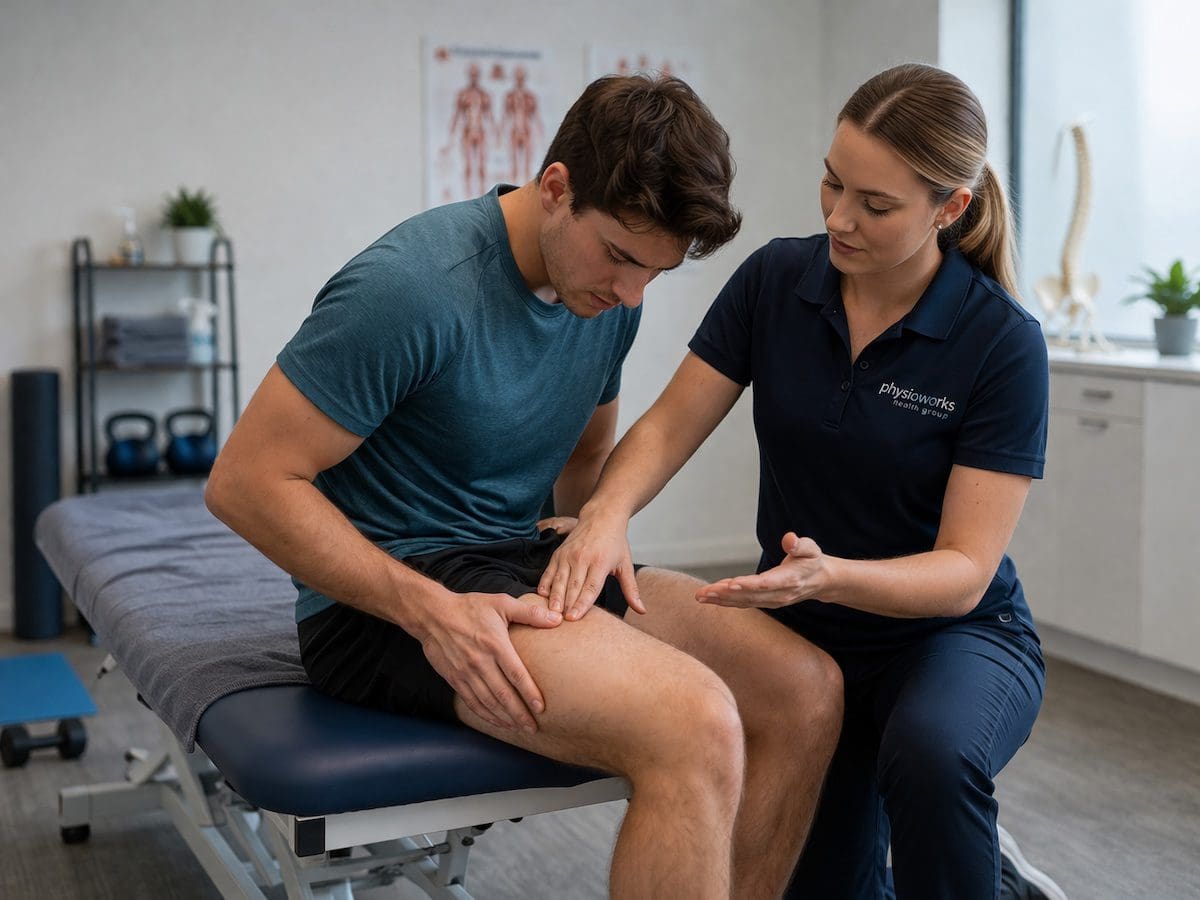
Assessment can help distinguish normal post-exercise soreness from a muscle injury.
Delayed onset muscle soreness (DOMS) is the aching and stiffness that can develop after unfamiliar, harder or higher-volume exercise. It often begins 12 to 24 hours after training, feels strongest around 24 to 72 hours and then settles over several days.
DOMS is usually a normal response to a new training load. However, sharper pain, bruising, marked weakness or symptoms that keep worsening may point to a muscle strain or another problem rather than ordinary post-exercise soreness.
DOMS at a Glance
Typical onset
DOMS commonly develops 12 to 24 hours after unfamiliar or harder exercise.
Typical peak
Muscle soreness often feels strongest around 24 to 72 hours after the session.
Common trigger
New exercises, heavier loads, downhill activity and repeated lowering movements are common triggers.
Usual feeling
DOMS usually causes a dull, widespread ache rather than sharp pain in one small area.
First step
Keep moving comfortably and reduce another heavy session for the same sore muscles.
Get checked
Seek assessment when pain is sharp, severe, localised, associated with bruising or worsening rather than improving.
What Is Delayed Onset Muscle Soreness?
Delayed onset muscle soreness is a short-term response to exercise that places more demand on a muscle than it is used to. It commonly follows eccentric exercise, where a muscle produces force while lengthening.
Examples include lowering a weight, walking or running downhill, descending stairs, completing lunges or squats, starting plyometric exercises or returning to training after a break.
DOMS can make walking, using stairs, sitting down, standing from a chair or completing another training session uncomfortable. Even so, it normally improves as the muscle adapts and recovers.
What Causes DOMS?
DOMS develops after unfamiliar or increased loading creates temporary stress within muscle fibres and nearby connective tissue. The body then produces a delayed response involving tenderness, stiffness and increased sensitivity.
DOMS is not caused by lactic acid remaining in the muscle. Lactate levels return towards normal well before delayed soreness reaches its peak.
When Is DOMS More Likely?
DOMS becomes more likely when training changes faster than your body can adapt. A new movement can cause soreness even when the total session does not feel especially difficult.
| Training change | Why it may trigger DOMS |
|---|---|
| New gym exercise | The muscle meets an unfamiliar movement or loading pattern. |
| Heavy lowering work | Eccentric loading places a high demand on working muscle fibres. |
| Downhill running | The quadriceps work while lengthening to control the descent. |
| Sudden volume increase | The total workload rises beyond your current training tolerance. |
| Return after a break | Previous training tolerance may have reduced during time away. |
What Does DOMS Feel Like?
DOMS usually causes a dull, widespread ache through the muscles used during the session. It may feel worse after rest or the next morning and then ease slightly as you move and warm up.
- Dull or aching muscle soreness
- Stiffness after rest
- Tenderness when pressing the muscle
- Temporary heaviness or reduced strength
- Discomfort during stretching or loaded movement
- Soreness on both sides when both sides completed similar work
- Symptoms that ease slightly with comfortable movement
DOMS vs Muscle Strain: What Is the Difference?
DOMS develops after exercise and is usually spread through the muscle. A muscle strain commonly causes more sudden and localised pain during a sprint, lift, stretch or change of direction.
| Feature | DOMS | Muscle strain |
|---|---|---|
| Onset | Usually begins 12 to 24 hours after exercise. | Often begins suddenly during activity. |
| Pain | Dull, aching and spread through the exercised muscle. | Sharper and more localised to one area. |
| Bruising | Uncommon. | May occur with a larger muscle tear. |
| Function | Movement feels stiff or sore but remains possible. | Strength, walking, running or normal movement may be clearly limited. |
| Recovery | Usually improves over several days. Stronger soreness may take around a week to settle. | May require several weeks or longer, depending on severity. |
If your pain began suddenly during exercise, read our guide to muscle strain symptoms and recovery.
Can You Exercise With DOMS?
Light to moderate activity is usually reasonable when DOMS is mild and your movement remains controlled. Gentle activity may reduce stiffness and help you judge whether the muscle is improving.
Avoid repeating the same heavy session while soreness is strong. Reduce or stop the activity if pain becomes sharp, changes your technique or becomes worse later that day.
Which Exercises May Help When You Have DOMS?
Choose movement that feels comfortable and does not add another large training stress. The purpose is to maintain movement rather than force the soreness away.
- Walking at an easy pace
- Light cycling
- Pool walking or comfortable swimming
- Gentle mobility exercises
- Low-load resistance exercise
- Easy warm-up sets before gradually returning to normal training
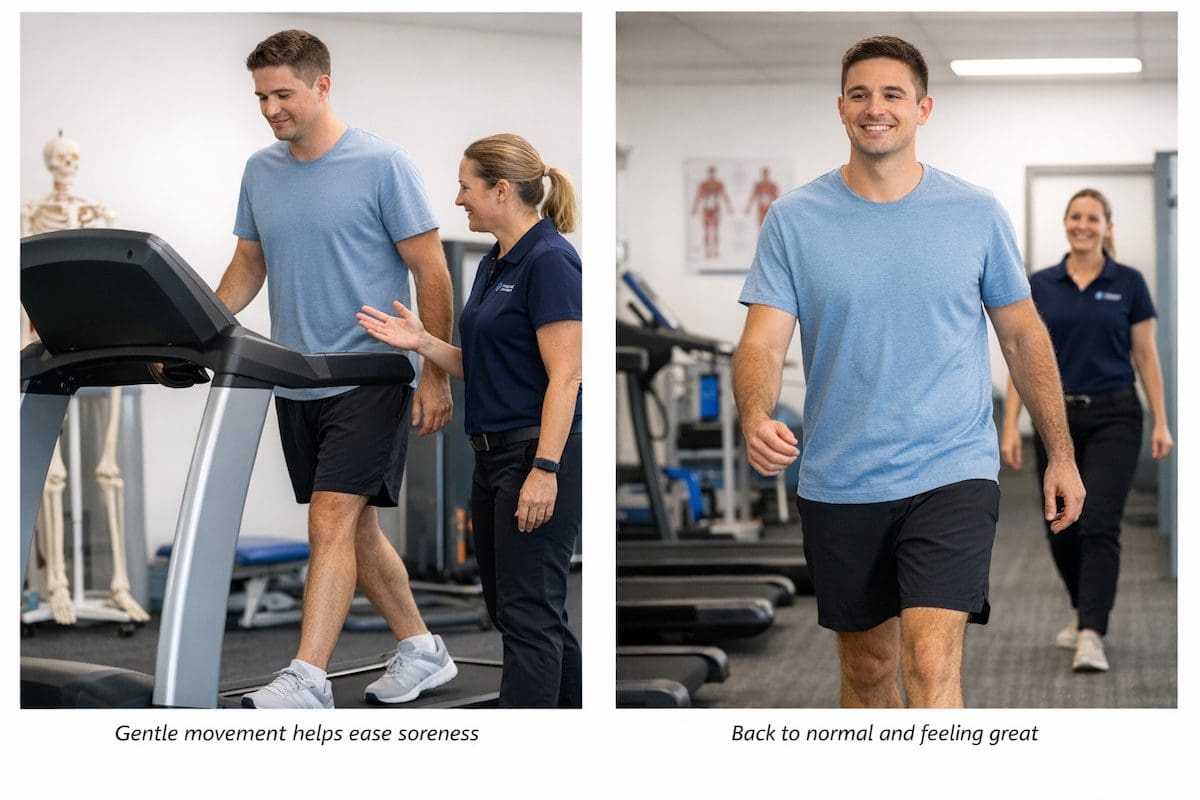
Gentle movement may help maintain mobility and reduce stiffness while sore muscles recover.
What Helps DOMS Recovery?
Most DOMS settles with time, sensible load changes and comfortable movement. No single treatment removes DOMS immediately, and recovery responses differ between people.
- Active recovery: easy walking, cycling or mobility work may improve comfort.
- Load reduction: temporarily reduce resistance, speed, range, sets or repetitions.
- Massage: may help reduce soreness or muscle tension for some people.
- Compression: some athletes find compression garments comfortable during recovery.
- Foam rolling: gentle use may provide short-term relief for some people.
- Sleep and nutrition: support normal recovery and adaptation between training sessions.
Our guide to muscle recovery after exercise explains these options in more detail. When there is no acute injury, recovery massage may also suit training-related soreness or muscle tension.
Should You Stretch DOMS?
Gentle stretching can feel comfortable, but strong stretching does not appear necessary for DOMS recovery. Avoid forcing a sore muscle into a painful range. Comfortable movement and gradual return to loading are usually more useful than trying to stretch the soreness away.
How Should You Adjust Training With DOMS?
Training through mild soreness may be reasonable when technique, range and control remain normal. Strong soreness can reduce strength and alter movement, so adjust the session when it affects your normal form.
When Is Muscle Soreness More Serious?
Not every sore muscle is DOMS. Sudden or severe symptoms can indicate a strain, tendon problem, joint injury or another medical condition.
These symptoms are not typical DOMS and can occur with rhabdomyolysis, a serious breakdown of muscle tissue.
Arrange a physiotherapy or medical assessment when pain began suddenly, remains sharply localised, causes bruising, prevents normal use of the limb or keeps worsening instead of improving.
Can You Prevent DOMS?
You cannot prevent every episode of DOMS, particularly when learning a new activity. However, gradual progression can reduce the chance of severe soreness.
- Increase training load in small steps.
- Begin new exercises with fewer sets and lighter resistance.
- Build downhill running, jumping and heavy lowering exercises gradually.
- Use lighter warm-up sets before heavier strength work.
- Avoid testing your hardest session on the first day after a long break.
- Plan easier sessions after hard or unfamiliar training.
Gradual loading also helps manage problems linked with tendinopathy, including Achilles tendinopathy.
How Can Physiotherapy Help?
Physiotherapy may help when soreness is unusually strong, recovery is slow or you are unsure whether the problem is DOMS or an injury.
A physiotherapist can ask how the symptoms began, examine the painful area, check movement and strength and help you plan a graded return to training. Management may include load advice, exercise modification, mobility work, strength progression and return-to-sport planning.
When the presentation is not simple DOMS, a physiotherapy assessment can help identify the likely source of the symptoms and guide the next step.
Frequently Asked Questions About DOMS
How long does DOMS last?
DOMS usually improves within 2 to 5 days. Stronger soreness may take up to a week to settle, especially after heavy eccentric exercise or a sudden return to training.
Is DOMS a good sign?
DOMS can occur after a new training stimulus, but it is not required for progress. You can improve strength and fitness without becoming sore after every session.
Can you train with DOMS?
You can often train lightly when DOMS is mild, movement remains controlled and symptoms ease as you warm up. Reduce the session if pain alters your technique, becomes sharp or feels worse afterwards.
Should you stretch sore muscles with DOMS?
Gentle stretching may feel comfortable, but forceful stretching is not needed. Keep the range comfortable and combine it with light movement and sensible load management.
Is DOMS the same as a muscle strain?
No. DOMS normally begins later and feels dull and widespread. A muscle strain often causes sudden, sharper pain during activity and may involve bruising, weakness or a longer recovery.
When should you get DOMS checked?
Arrange an assessment if pain is sharp, severe, localised, linked with bruising or not improving after several days. Seek urgent medical care for dark urine, marked swelling, extreme weakness, fever or feeling very unwell.
What to Do Next
If your symptoms fit normal DOMS, keep moving gently, reduce heavy repeat loading and return to normal training in stages. Do not use soreness as the only measure of whether a workout was effective.
If the pain is sharp, unusually severe, keeps returning or does not settle as expected, arrange a physiotherapy assessment. An assessment can help distinguish normal muscle soreness from a strain, tendon overload or another soft-tissue problem.
Choose your clinic and appointment pathway
Select a PhysioWorks clinic to continue to live booking, an appointment request or reception assistance.


References
- Wiecha S, Cieśliński I, Wiśniowski P, et al. Physical therapies for delayed-onset muscle soreness: an umbrella and mapping systematic review with meta-meta-analysis. Sports Med. 2025;55(5):1183–1212. doi:10.1007/s40279-025-02187-5.
- Di Lorenzo L, Forte AM, Agosti V, et al. Advances in non-pharmacological strategies for delayed onset muscle soreness (DOMS): a scoping review. J Funct Morphol Kinesiol. 2025;10(4):452. doi:10.3390/jfmk10040452.
- Wei M, Liu X, Wang S. The impact of various post-exercise interventions on the relief of delayed-onset muscle soreness: a randomized controlled trial. Front Physiol. 2025;16:1622377. doi:10.3389/fphys.2025.1622377.
- Afonso J, Clemente FM, Nakamura FY, et al. The effectiveness of post-exercise stretching in short-term and delayed recovery of strength, range of motion and delayed onset muscle soreness: a systematic review and meta-analysis of randomized controlled trials. Front Physiol. 2021;12:677581. doi:10.3389/fphys.2021.677581.
- Cheung K, Hume PA, Maxwell L. Delayed onset muscle soreness: treatment strategies and performance factors. Sports Med. 2003;33(2):145–164. doi:10.2165/00007256-200333020-00005.
- Healthdirect Australia. Rhabdomyolysis. Reviewed 2025. Accessed 5 August 2026.
