
Tendon Healing
Tendon Healing Physiotherapy Guide


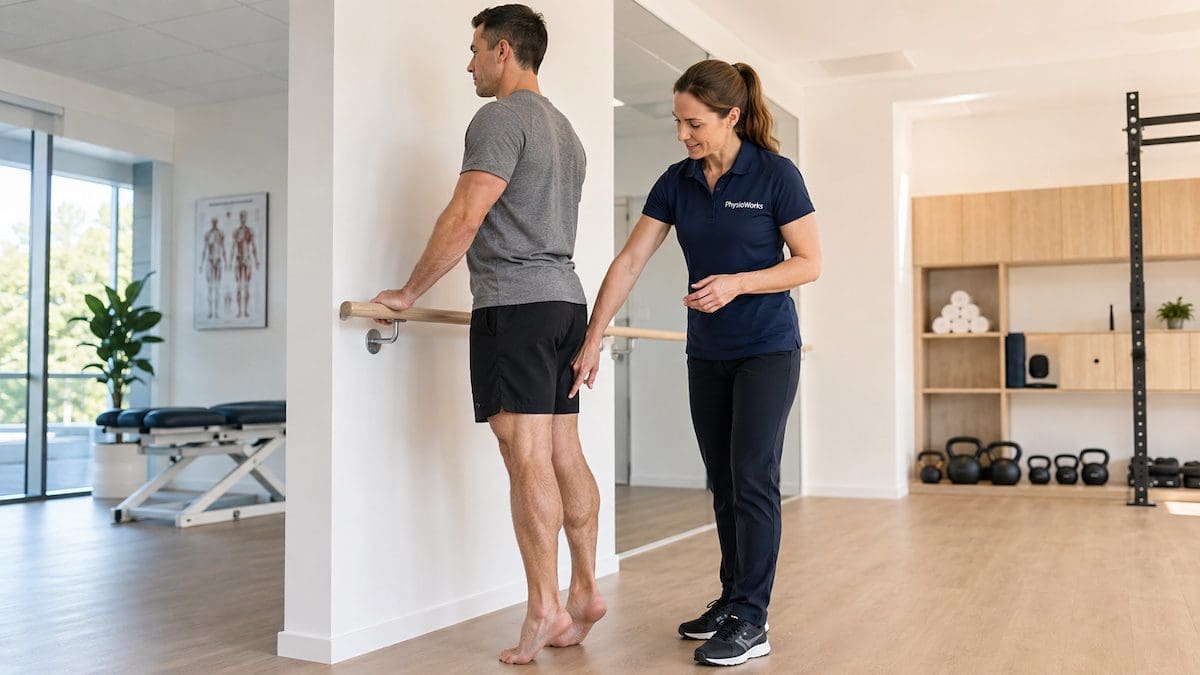
Guided loading helps rebuild tendon capacity.
Tendon healing usually improves with the right mix of movement, strengthening, and load management. Complete rest may calm symptoms briefly, but most tendon problems need a gradual plan that rebuilds strength, confidence, and tissue capacity over time.
At PhysioWorks, physiotherapy may help people recover from tendinopathy, reduce tendon pain, and return to work, exercise, and sport with a clearer plan. Your physiotherapist considers your pain pattern, strength, movement quality, training load, recovery habits, and goals rather than relying on a scan alone.
Tendon Healing Quick Guide
- Rest alone rarely solves persistent tendon pain.
- Load management helps settle flare-ups while keeping you active.
- Strengthening usually needs gradual progression over weeks to months.
- Scans do not always match pain levels or function.
- Sudden weakness, a pop, or major loss of function needs prompt review.
What Is Tendon Healing?
Tendon healing is the process of settling pain, restoring the tendon’s ability to tolerate load, and rebuilding strength for normal activity. In practical terms, this usually means reducing aggravating spikes, keeping useful movement going, and progressing exercise in planned stages.
Tendons connect muscle to bone and transfer force during walking, running, jumping, lifting, gripping, and sport. When the load on a tendon exceeds its current capacity, pain may develop. This can happen after a sudden training increase, repetitive work, a return after time off, or a change in footwear, surface, exercise, or technique.
Do Tendons Ever Fully Heal?
Many people return to normal work, walking, gym training, and sport after tendon pain. However, tendon recovery is not always the same as making a scan look perfect. A tendon may still look thickened or changed on imaging while functioning well and feeling comfortable.
This is why physiotherapists focus on your symptoms, strength, activity tolerance, and function. Imaging may help in some cases, but your day-to-day progress often gives a clearer guide to recovery than a scan result alone.
What Affects Tendon Healing?
Tendon healing depends on several factors. These include your age, how long symptoms have been present, recent spikes in training or workload, sleep quality, general health, footwear, movement control, and how quickly you try to return to higher-load activity.
Common tendon problems include Achilles tendinopathy, patellar tendinopathy, gluteal tendinopathy, proximal hamstring tendinopathy, and shoulder tendon problems such as rotator cuff tendinopathy. Each tendon responds differently depending on the body region, the aggravating loads, and the person’s goals.
Tendon Load Decision Guide
If pain is mild and settles quickly: you may be able to keep moving with reduced load.
If pain increases during activity and stays worse afterwards: the tendon may need a lower starting load.
If you notice sudden weakness, a pop, or major swelling: seek prompt assessment to check for a more significant tendon injury.
Why Doesn’t Imaging Always Match Tendon Pain?
Imaging can help, but it has limits. Ultrasound, X-ray, or MRI may show tendon thickening, partial tearing, or degenerative change, yet those findings do not always explain pain levels. Some people have visible tendon changes and no pain. Others have high pain with only minor imaging changes.
Your physiotherapist may use scans to add context, rule out more serious problems, and help separate tendon overload from a larger tear or another source of symptoms. For public health information, Healthdirect provides a useful overview of tendinopathy symptoms, treatment, and when to seek care.
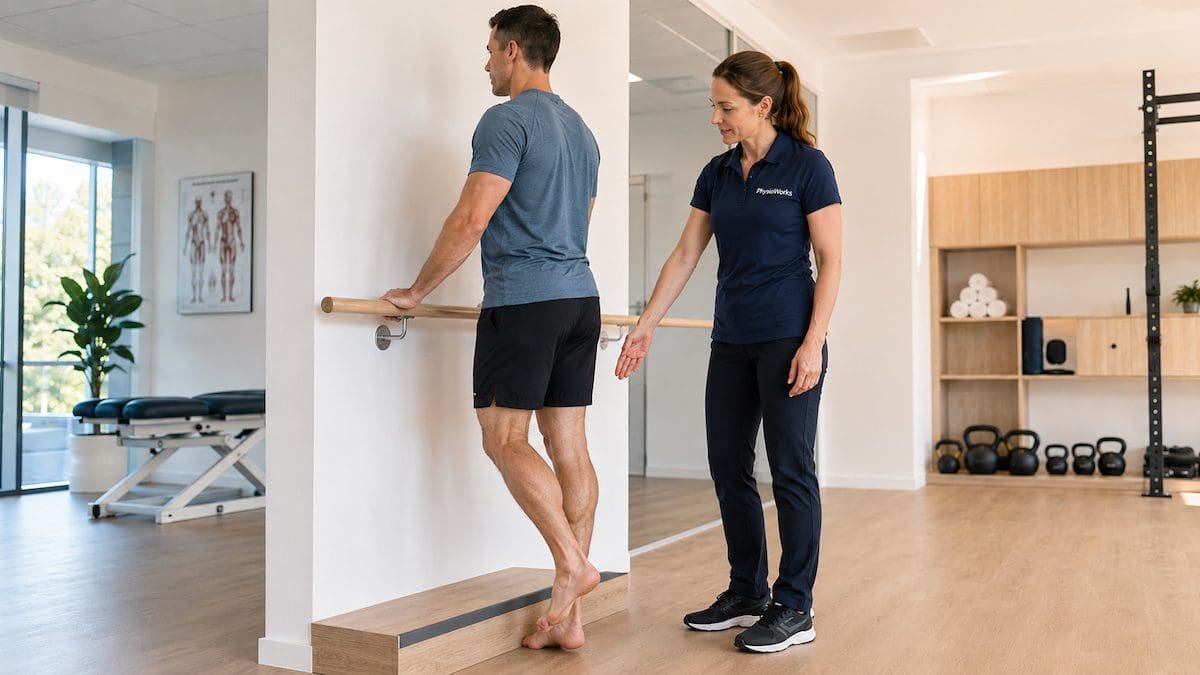
Exercise dosage should match tendon tolerance.
How Does Physiotherapy Help Tendon Healing?
Physiotherapy helps tendon healing by matching exercise load to your current tolerance. Early care may focus on settling a flare, reducing painful spikes, and using controlled strengthening. Later stages usually progress towards heavier loading, energy-storage tasks, and return-to-sport or work-specific drills where needed.
Your physiotherapist may also assess nearby factors that increase tendon stress. These can include calf weakness, hip weakness, balance deficits, stiff joints, poor landing mechanics, or reduced movement control. For lower-limb tendon issues, carefully progressed balance training and control work may help improve confidence and reduce recurrence risk.
Tendon Healing Stages
| Stage | Main Goal | Common Focus |
|---|---|---|
| Irritable flare | Settle pain and reduce overload | Activity modification, controlled movement, suitable starting exercises |
| Strength rebuild | Improve tendon and muscle capacity | Progressive resistance, technique changes, gradual workload increases |
| Return to activity | Prepare for work, exercise, or sport demands | Higher-load tasks, speed, jumping, running, lifting, or sport drills where relevant |
How to Judge Tendon Progress
A useful tendon plan should make activity feel more predictable over time. Look for less pain after loading, better next-day comfort, improved strength, and greater confidence with your usual work, training, or sport demands.
- Pain settles faster after activity.
- Morning stiffness becomes shorter or less intense.
- You can increase load without a strong flare the next day.
- Your strength, balance, or running tolerance improves gradually.
Should You Rest a Tendon Completely?
Complete rest is rarely the best long-term answer for persistent tendon pain. A short reduction in aggravating load can calm symptoms, but extended unloading may leave the tendon less prepared for daily activity, exercise, or sport.
Most people do better with load modification. That means reducing the activities that clearly flare symptoms, then rebuilding gradually with a plan that the tendon can tolerate. If this idea sounds familiar, read Why Rest Isn’t Best When It Comes To Tendons and our guide to what tendinopathy is and how it is treated.
What If You Have a Partial or Full Tendon Tear?
A partial or full tendon tear needs a more individual decision. Some tears respond well to structured rehabilitation, while others need surgical review. This is more likely after a sudden traumatic injury, marked weakness, major loss of function, or a strong need to return to high-demand sport.
Shoulder tendon tears, for example, may need surgeon involvement and staged rehabilitation. If surgery is required, post-operative shoulder physiotherapy can help guide the recovery process safely.
How Long Does Tendon Healing Take?
Tendon healing timeframes vary. A milder reactive tendon flare may settle over weeks, while longer-standing tendon pain often needs a longer strengthening block. Progress is usually measured by improved load tolerance, less pain during and after activity, and better function over time.
For many tendon problems, recovery is not a straight line. Symptoms may fluctuate when load changes. A good plan helps you know when to progress, when to hold steady, and when to reduce load briefly before building again.
Common Tendon Problems We Help
Different tendons need different loading strategies. These related pages may help you find more specific guidance:
- Tendinopathy – tendon overload, symptoms, and physiotherapy options.
- Achilles Tendinopathy – tendon pain at the back of the ankle.
- Patellar Tendinopathy – pain around the kneecap with jumping or running loads.
- Gluteal Tendinopathy – outer hip tendon pain with walking, stairs, or side-lying.
- Proximal Hamstring Tendinopathy – upper hamstring tendon pain, often with sitting or running.
- Rotator Cuff Tendinopathy – shoulder tendon pain with lifting or overhead movement.
- Wrist Tendinopathy – wrist tendon pain linked to gripping, loading, or repetition.
- Soft Tissue Injury Healing – broader healing advice for muscles, ligaments, and tendons.
Tendon Healing FAQs
Can you exercise with tendon pain?
Often yes, but the dose matters. A physiotherapist may modify your exercise load so you keep moving without repeatedly flaring the tendon. The aim is to stay active while gradually rebuilding tissue capacity.
Does complete rest help tendons heal faster?
Usually not for persistent tendon pain. A short reduction in painful activities may help settle symptoms, but tendons usually need gradual reloading to regain strength and tolerance.
When do you need a scan for tendon pain?
A scan may help when symptoms are severe, recovery stalls, a rupture is suspected, or the result is likely to change treatment decisions. Imaging is useful support information, but it should not replace a clinical assessment.
What is the fastest way to help tendon healing?
The safest path is usually not the fastest-looking option. Tendons tend to respond better to a clear loading plan, sensible activity modification, adequate recovery, and progressive strengthening. Repeated pain testing or aggressive stretching may delay progress in some people.
When should you seek urgent review?
Seek prompt assessment if you felt a sudden pop, developed obvious weakness, cannot push off or lift normally, have rapid swelling, or suspect a complete tear. These features may suggest a more significant tendon injury.
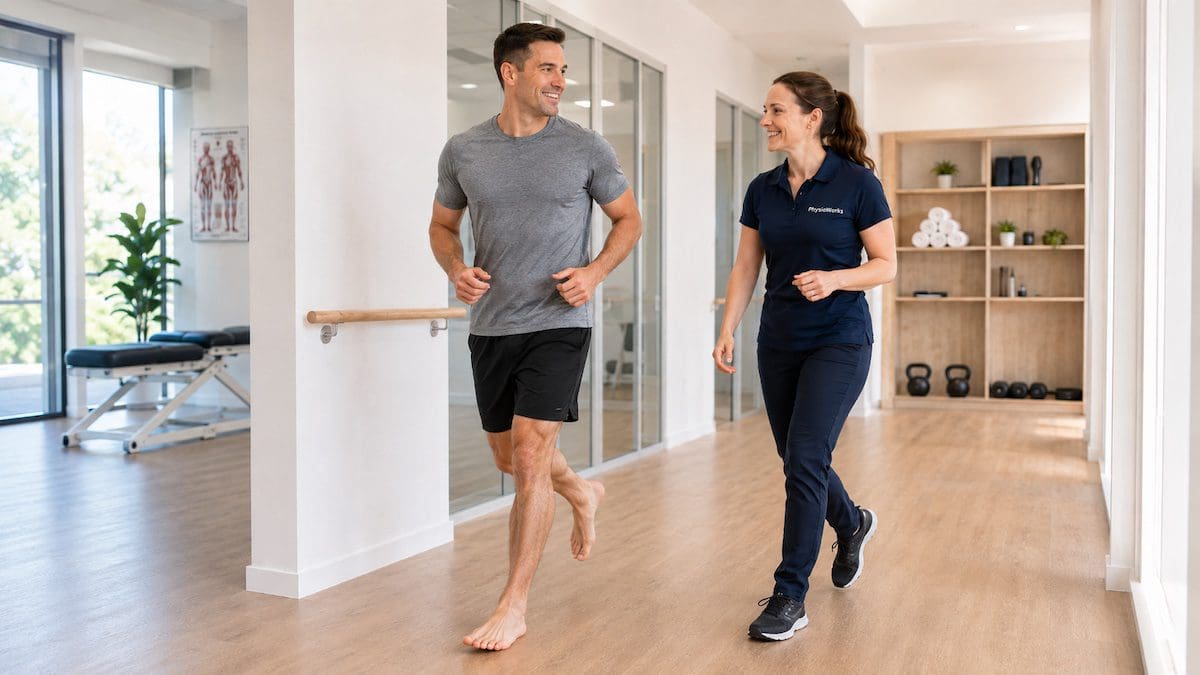
Progressive rehab can support confident return to running.
What to Do Next
If tendon pain is stopping you from training, working, or moving comfortably, start by reducing the activities that clearly flare it. Avoid testing the tendon aggressively day after day, especially if pain keeps building afterwards.
A physiotherapist can assess whether your symptoms fit tendon overload, a partial tear, or another soft tissue problem. From there, they can guide a graded plan that matches your symptoms, load tolerance, and goals.
Book your appointment – 24/7
Choose your preferred PhysioWorks clinic and book online.
Follow PhysioWorks
Get free physiotherapy tips, exercise videos, recovery advice, and blog updates.
 |  |  | B |  |  |
References
- Malliaras P, Barton CJ, Reeves ND, Langberg H. Achilles and patellar tendinopathy loading programmes: a systematic review comparing clinical outcomes and identifying potential mechanisms for effectiveness. Sports Med. 2013;43(4):267-286. doi:10.1007/s40279-013-0019-z.
- Cooper K, Alexander L, Brandie D, et al. Exercise therapy for tendinopathy: a mixed-methods evidence synthesis exploring feasibility, acceptability and effectiveness. Health Technol Assess. 2023;27(24). doi:10.3310/TFWS2748.
- Chimenti RL, Cychosz CC, Hall MM, et al. Midportion Achilles tendinopathy revision 2024: clinical practice guideline. J Orthop Sports Phys Ther. 2024;54(12):CPG1-CPG32. doi:10.2519/jospt.2024.0302.
- Silbernagel KG, Hanlon S, Sprague A. Current clinical concepts: conservative management of Achilles tendinopathy. J Athl Train. 2020;55(5):438-447. doi:10.4085/1062-6050-356-19.
- Cook JL, Purdam CR. Is tendon pathology a continuum? A pathology model to explain the clinical presentation of load-induced tendinopathy. Br J Sports Med. 2009;43(6):409-416. doi:10.1136/bjsm.2008.051193.