

How do you tape an ankle for sport?
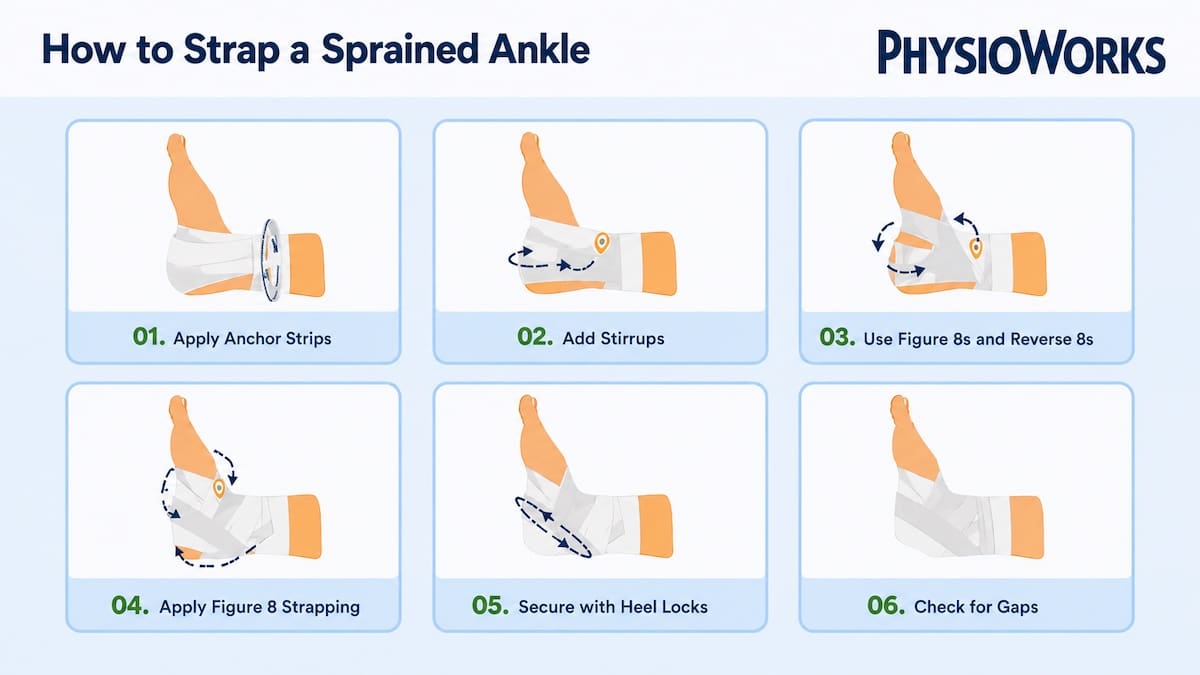
How to tape an ankle for sport means using rigid strapping tape to help limit excessive ankle rolling while still allowing useful movement. Athletes often use ankle taping for running, jumping, landing and change-of-direction sport.
Ankle taping may improve confidence after a previous sprain. However, it should not replace rehab. Strength, balance, footwear and staged training progressions still matter. For the full method, start with our ankle strapping guide. If your ankle has been injured, also review our sprained ankle recovery guide and ankle sprain prevention tips.
Quick Answer: Best Ankle Taping Setup for Sport
Most sports ankle taping uses rigid strapping tape with anchors, stirrups, heel locks and figure-6 or figure-8 patterns. This setup aims to reduce unwanted inversion. Inversion is the common “rolling outwards” ankle movement in many lateral ankle sprains.
- Best tape: rigid sports tape, often 38 mm for most ankles.
- Main goal: reduce excessive rolling while allowing sport movement.
- Best use: short-term support during training or return to sport.
- Not enough alone: combine taping with strength and balance rehab.
How tight should ankle tape feel?
Ankle tape should feel firm and supportive. It should not feel painful or restrictive. Your toes should stay warm, pink and comfortable. Remove or loosen the tape if you notice numbness, pins and needles, cold toes, colour change or increasing pain.
Before You Tape: Safety Checks
- Check circulation: toes should stay warm and pink during warm-up.
- Watch swelling: a swollen ankle can make tape feel tighter as activity continues.
- Protect your skin: use underwrap if your skin reacts to adhesive or if you tape often.
- Respect pain: do not use tape to push through a significant ankle injury.
- Check the injury type: pain high above the ankle joint may suggest a high ankle sprain.
Why Do Athletes Use Ankle Taping?
Ankle taping is common in football, netball, basketball, hockey, tennis and court sports. These sports often involve landing, pivoting and rapid direction changes. Rigid tape may help reduce unwanted ankle movement and give the athlete a more secure feeling.
Research suggests ankle supports can affect movement in useful and limiting ways. Taping may restrict ankle range of motion. Its effect can vary by sport, task, tape method, sweat and time worn. Therefore, ankle taping should match the person, injury history, footwear and sport demands.
Which Tape Should You Use?
Rigid strapping tape is the usual choice for sports ankle taping. It provides firmer mechanical support than elastic or kinesiology tape. A 38 mm roll suits most ankles. A 50 mm roll may suit larger ankles or higher coverage needs. A 25 mm roll is usually too narrow for standard ankle strapping.
If you are comparing tape types, read our guide to kinesiology tape versus rigid tape. You can also view our general supportive taping and strapping information.
Common Sports Ankle Taping Patterns
Most ankle strapping methods combine several tape patterns. Your physiotherapist may adjust the setup based on ankle shape, sport, skin tolerance, footwear and injury history.
- Anchors: tape around the lower shin and midfoot to hold the rest of the strapping.
- Stirrups: vertical strips from the inside lower leg, under the heel and up the outside lower leg.
- Heel locks: angled strips around the heel to help control rearfoot movement.
- Figure-6: a crossing pattern that adds lateral ankle support.
- Figure-8: a wrap pattern around the ankle and foot that supports sport movement.
- Basket weave: layered support for higher-risk ankles or more demanding sport.
Taping Checklist Before You Play
- Can you walk and jog without a limp?
- Can you balance on the taped ankle?
- Can you change direction without sharp pain?
- Do your toes still feel normal after warm-up?
- Does the tape fit inside your shoe without rubbing?
Is Ankle Taping Better Than an Ankle Brace?
Ankle taping and ankle braces can both support sport. Taping often feels more customised because it is shaped to the person. A brace is quicker to apply and easier to repeat in the same way each session.
Tape can loosen with sweat and time. A brace can feel bulkier in some shoes. The better option depends on your sport, comfort, cost, footwear, ankle shape and whether you have a history of repeat ankle sprains or chronic ankle instability.
When Should You Avoid Taping and Get Assessed?
Do not rely on ankle tape if the injury is new, painful, swollen or unstable. A physiotherapist can assess the likely injury type and guide what level of support is safe.
- You cannot walk normally after an ankle injury.
- Swelling or bruising appears quickly.
- Pain sits high above the ankle joint.
- The ankle keeps giving way.
- You feel sharp pain during warm-up.
- You need tape every session but have not rebuilt strength or balance.
What Else Reduces Ankle Sprain Risk?
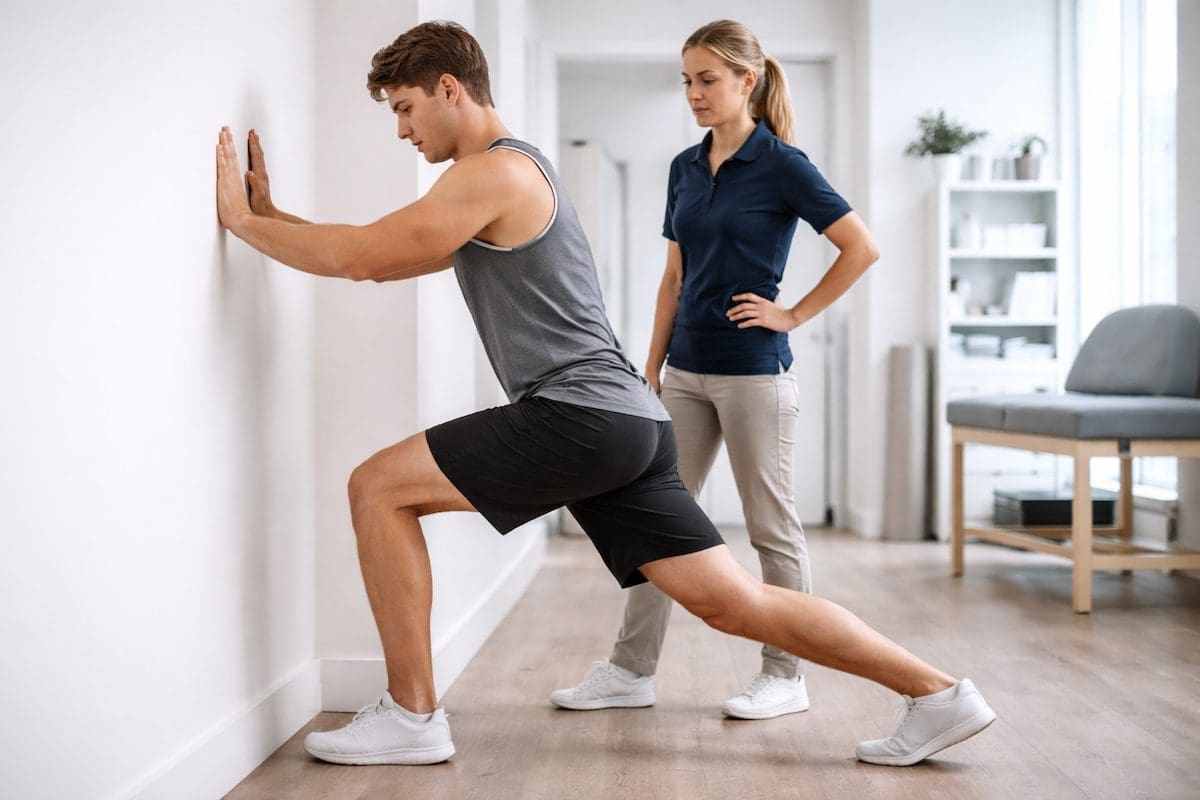
Ankle taping works best as part of a broader plan. Many athletes need calf strength, ankle control, hip strength, balance training, landing practice, footwear advice and a gradual return to sport. For a broader plan, read our ankle pain physiotherapy guide and sports physiotherapy information.
What to Do Next
If you are taping for a one-off game, use a safe method and check circulation. If you need ankle tape most weeks, find out why. Repeat taping may be a sign that the ankle still needs strength, balance, movement control or return-to-sport progression.
PhysioWorks can assess your ankle, discuss whether taping or bracing suits your sport, and guide a plan that also rebuilds long-term ankle control. You can also order rigid strapping tape if you already know the correct tape type and size.
Choose your clinic and appointment pathway
Select a PhysioWorks clinic to continue to live booking, an appointment request or reception assistance.
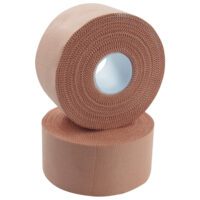
Strapping & Taping Products
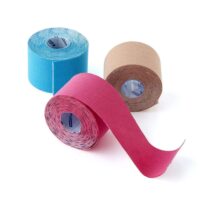
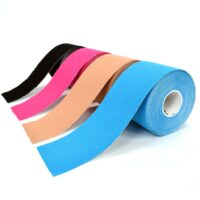
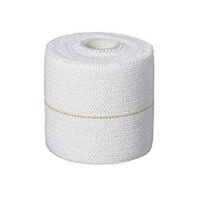
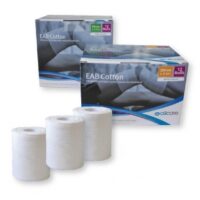
These strapping and taping products are commonly used by our physiotherapists to support and prevent injuries.


Related Information
- Ankle strapping guide
- Sprained ankle recovery guide
- Ankle sprain prevention tips
- High ankle sprain
- Chronic ankle instability
- Supportive taping and strapping
- Kinesiology tape vs rigid tape
- Sports physiotherapy
References
- Romero-Morales C, Matilde-Cruz A, García-Arrabe M, et al. Assessing the effect of prophylactic ankle taping on ankle and knee biomechanics during landing tasks in healthy individuals: a cross-sectional observational study. Sao Paulo Med J. 2023;142(2):e2022548. doi:10.1590/1516-3180.2022.0548
- Megalaa T, Beckenkamp PR, Fong Yan A, Hiller CE. What are the clinical recommendations for the use of ankle braces? A scoping review. JSAMS Plus. 2024;3:100058. doi:10.1016/j.jsampl.2024.100058
- Wang C, Hou S, Zhang X, et al. Six-week effects of ankle bracing and taping on specific performance in tennis collegiate players: a randomized controlled trial. BMC Sports Sci Med Rehabil. 2026;18:129. doi:10.1186/s13102-026-01571-6
FAQs About Ankle Taping for Sport
How do you tape an ankle for sport?
Most sports ankle taping uses rigid strapping tape with anchors, stirrups, heel locks and figure-6 or figure-8 patterns. The aim is to reduce excessive ankle rolling while still allowing running, jumping, landing and change-of-direction movement.
What tape is best for ankle strapping?
Rigid strapping tape is usually best for ankle strapping in sport. Many athletes use 38 mm rigid tape. Larger ankles may suit 50 mm tape. Kinesiology tape is more flexible, so it does not provide the same firm movement restriction.
How tight should ankle tape be?
Ankle tape should feel firm but not painful. Your toes should stay warm and pink. Remove or loosen the tape if you feel numbness, pins and needles, cold toes, colour change or increasing pain during activity.
Can you tape a swollen ankle?
You can tape some swollen ankles, but swelling can make tape feel too tight as activity continues. If swelling is significant, painful or linked to a recent injury, get assessed before returning to sport.
Is taping better than an ankle brace?
Taping and ankle braces can both support sport. Taping may feel more customised, while braces are quicker and more consistent. The better choice depends on your sport, footwear, comfort, injury history and whether the tape loosens during play.
Should I keep taping my ankle every game?
Regular ankle taping may be useful during return to sport, but it should not replace rehab. If you need tape every game, consider a physiotherapy assessment to check strength, balance, stability, and landing or cutting control.
