
Assessing joint control after a ligament injury.
Common Ligament Injuries


Common ligament injuries affect the strong bands of tissue that connect one bone to another at a joint. They often happen after a twist, fall, collision, awkward landing or sudden change of direction.
The ankle, knee, shoulder, wrist, hand and spine are common injury sites. Symptoms may include pain, swelling, bruising, reduced movement or a feeling that the joint may buckle or give way. For a broader overview, see our ligament tear guide.
Quick answer: A ligament sprain can range from a mild overstretch to a complete tear.
Many ligament injuries improve with suitable protection and rehabilitation. However, prompt assessment is important when the joint looks deformed, will not support weight, swells rapidly or repeatedly gives way.
What Are Common Ligament Injuries?
Common ligament injuries are sprains or tears affecting the ligaments around a joint. The severity can vary considerably. A mild injury may cause local pain and swelling, while a more significant tear may affect joint stability and normal function.
Common Signs and Symptoms
- pain after twisting, landing, impact or overloading a joint
- swelling or bruising around the injured area
- difficulty walking, gripping, lifting, reaching or changing direction
- reduced joint movement or stiffness
- weakness or reduced confidence using the joint
- a feeling that the joint may buckle, shift or give way
What Are the Grades of Ligament Injury?
Clinicians often describe ligament injuries by grade. The grade indicates the degree of tissue damage. However, symptoms and recovery needs also depend on the ligament involved and the demands placed on the joint.
| Grade | What It Means | Possible Features |
|---|---|---|
| Grade 1 | Mild stretching or small fibre damage | Local pain, mild swelling and little or no instability |
| Grade 2 | Partial ligament tear | Moderate pain, swelling, movement loss and possible looseness |
| Grade 3 | Complete ligament tear | Marked swelling, loss of function and joint instability |
Where Do Common Ligament Injuries Happen?
Ankle Ligament Injuries
Ankle ligament injuries often follow a sudden roll, twist or awkward landing. The most common pattern involves the ligaments on the outside of the ankle. However, the syndesmosis between the lower leg bones can also be injured.
Knee Ligament Injuries
Knee ligament injuries are common in sport and may affect walking, running, pivoting and changes of direction. The four main knee ligaments are the anterior cruciate ligament, posterior cruciate ligament, medial collateral ligament and lateral collateral ligament.
Shoulder Ligament Injuries
Shoulder ligament injuries commonly follow a fall onto the shoulder, an outstretched hand or a forceful collision. They may affect lifting, reaching, sleeping and participation in contact sport.
Wrist and Hand Ligament Injuries
Wrist, thumb and finger sprains can occur during falls, ball sports and workplace accidents. These injuries may interfere with gripping, pinching, writing, lifting and other everyday hand tasks.
Neck and Back Ligament Injuries
Spinal ligament sprains may follow sudden acceleration, awkward lifting, a fall, a collision or other trauma. Neck sprains and whiplash may occur when the head and neck move rapidly beyond their usual range.
What Causes Ligament Injuries?
Most ligament injuries happen when a joint is pushed beyond its normal range or subjected to a force it cannot control. This may occur during:
- twisting or pivoting movements
- sudden acceleration or deceleration
- awkward landings
- slips or falls
- direct collisions
- rapid changes in training load
- repeated joint stress
Previous injury, fatigue, reduced strength, limited balance and poor movement control may also increase the likelihood of another sprain.
How Are Ligament Injuries Assessed?
A physiotherapist or doctor will usually ask how the injury happened and examine the location of pain, swelling, bruising, movement loss and joint stability.
The assessment may also include walking, balance, strength or sport-specific movement tests. An X-ray may be required when a fracture or dislocation is suspected. Ultrasound or MRI may sometimes help assess a significant tear or associated joint injury.
Seek Prompt Medical Assessment If:
- the joint looks deformed or out of position
- you cannot bear weight or use the injured area
- pain or swelling is severe or rapidly increasing
- you notice numbness, unusual coldness or colour change
- the joint repeatedly buckles, shifts or gives way
How Are Common Ligament Injuries Treated?
Treatment depends on which ligament is injured, the severity of the damage, associated injuries and the activities you need to resume.
Early Management
Early care commonly focuses on protecting the joint, controlling pain and swelling and maintaining safe movement. Bracing, taping, crutches or other support may be recommended for some injuries.
Rehabilitation
Rehabilitation usually progresses through several stages. These may include:
- restoring comfortable joint movement
- rebuilding muscle strength
- improving balance and joint-position awareness
- developing control during functional movement
- reintroducing running, jumping or change-of-direction tasks where required
- preparing for a graded return to work, exercise or sport

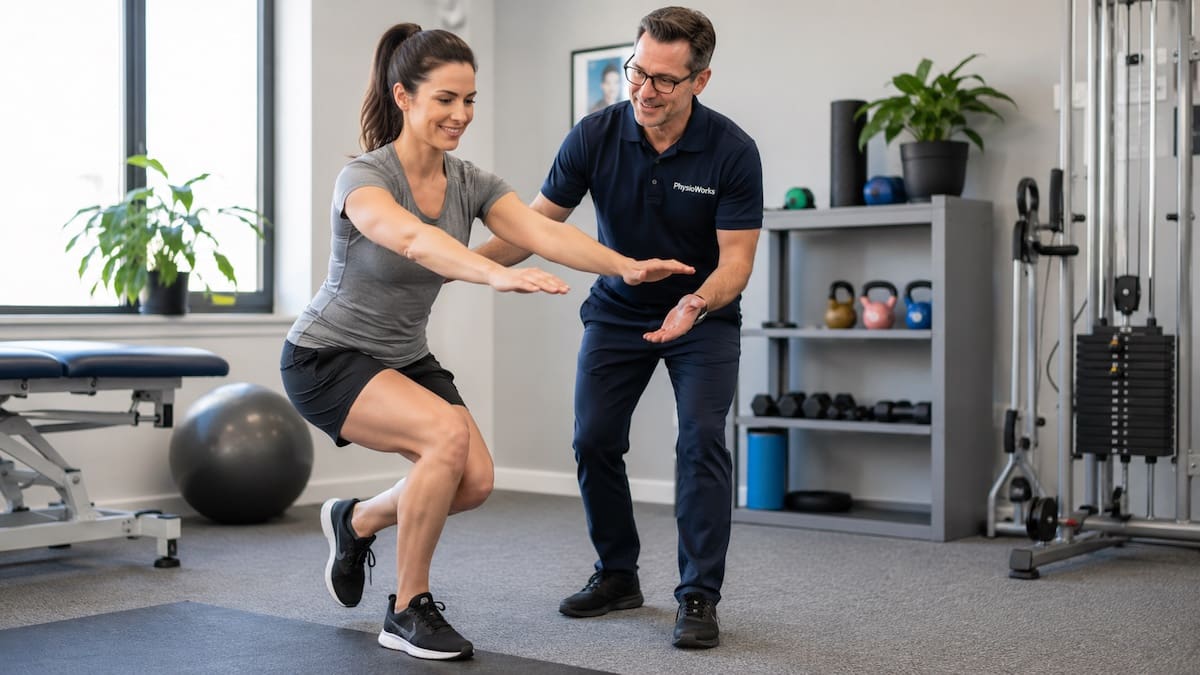
Rebuilding strength and joint control through guided movement.
Many people improve with guided physiotherapy. Some complete tears, recurrent instability problems or combined injuries may also require medical or surgical review.
How Long Does a Ligament Injury Take to Heal?
Recovery varies according to the ligament, injury grade, joint stability, age, general health and activity goals. A mild sprain may settle within several weeks. More significant injuries may take several months of rehabilitation.
Symptoms alone do not always show whether a joint is ready for sport. Strength, balance, movement control and confidence should also be considered before returning to high-load or change-of-direction activity.
Can Ligament Injuries Be Prevented?
Not every ligament injury can be prevented. However, appropriate preparation may reduce avoidable risk. Useful strategies can include:
- building strength around vulnerable joints
- improving balance, landing and change-of-direction control
- progressing training loads gradually
- allowing suitable recovery between demanding sessions
- using appropriate footwear and equipment
- completing rehabilitation after an earlier injury
- using taping or bracing when clinically appropriate
Related Ligament Injury Guides
Ligament Tear Guide
Understand ligament symptoms, severity and general treatment options.
Ankle Strapping
Review common ankle-support and strapping considerations.
Sub-Acute Soft Tissue Injury
See how rehabilitation may progress after the early injury stage.
FAQs About Common Ligament Injuries
What Is the Difference Between a Ligament Sprain and a Ligament Tear?
A ligament sprain is the general term for an injury to a ligament. It may describe a mild overstretch, a partial tear or a complete tear. In everyday language, people often use the terms sprain and tear interchangeably.
Do Ligament Injuries Heal Without Surgery?
Many ligament injuries improve without surgery, particularly mild and moderate sprains. Surgery may be considered when there is major instability, a complete tear affecting a high-demand joint, repeated dislocation or poor progress despite suitable rehabilitation.
How Long Do Ligament Injuries Take to Recover?
Recovery time depends on the body part, injury severity and activity goals. Mild sprains may improve within several weeks. More significant ligament injuries can take several months. Returning to sport usually requires more preparation than returning to normal daily activity.
Should I Exercise After a Ligament Injury?
Exercise is often an important part of recovery, but the type and intensity should match the stage of healing. Early exercises may focus on gentle movement and supported loading. Later rehabilitation builds strength, balance, control and confidence.
Can a Ligament Injury Cause Long-Term Instability?
Yes. Some people develop repeated ankle sprains, knee instability, recurrent shoulder dislocation or ongoing weakness when a ligament does not recover well or rehabilitation remains incomplete.
Can You Walk on a Torn Ligament?
Some people can still walk after a ligament injury, including certain significant tears. The ability to walk does not confirm that the injury is minor. Assessment is recommended when walking is painful, limited or associated with instability.
What to Do Next
Consider an assessment if pain, swelling or instability is limiting normal activity.
A physiotherapist may help identify the likely injured structure, assess joint stability and guide protection, exercise progression and return-to-activity planning.
Choose your clinic and appointment pathway
Select a PhysioWorks clinic to continue to live booking, an appointment request or reception assistance.


References
- Martin RL, Davenport TE, Fraser JJ, et al. Ankle stability and movement coordination impairments: lateral ankle ligament sprains revision 2021 clinical practice guidelines. J Orthop Sports Phys Ther. 2021;51(4):CPG1-CPG80. doi:10.2519/jospt.2021.0302
- Jadidi S, Lee AD, Pierko EJ, Choi H, Jones NS. Non-operative management of acute knee injuries. Curr Rev Musculoskelet Med. 2024;17(1):1-13. doi:10.1007/s12178-023-09875-7
- Waldron K, Brown M, Feldman M. Anterior cruciate ligament rehabilitation and return to sport: how fast is too fast?. Arthrosc Sports Med Rehabil. 2022;4(1):e175-e179.
